

发电技术 ›› 2026, Vol. 47 ›› Issue (2): 237-247.DOI: 10.12096/j.2096-4528.pgt.260201
• 发电及环境保护 •
朱法华1,2, 徐静馨1,2, 沈凡卉1, 张西1, 李辉1, 田文鑫1, 赵秀勇1, 柏源1
收稿日期:2025-08-12
修回日期:2025-10-22
出版日期:2026-04-30
发布日期:2026-04-21
作者简介:基金资助:Fahua ZHU1,2, Jingxin XU1,2, Fanhui SHEN1, Xi ZHANG1, Hui LI1, Wenxin TIAN1, Xiuyong ZHAO1, Yuan BAI1
Received:2025-08-12
Revised:2025-10-22
Published:2026-04-30
Online:2026-04-21
Supported by:摘要:
目的 中国火电行业CO2排放占比超过40%,其低碳转型是实现碳中和目标的关键。为此,分析了当前中国火电低碳发展现状,并据此提出针对性的降碳治理路径。 方法 聚焦火电行业低碳发展实际情况,通过分析装机容量、发电量占比、机组结构、碳排放强度等核心指标,结合技术应用与产业布局现状,提出降碳治理路径,包括加快推动高能耗、低水平的燃煤小机组有序退出,调整燃煤小机组结构提效节能,驱动煤电产业低碳转型全面升级;构建基于生物质能及绿基燃料(绿氨/绿氢)混烧的源头降碳路径,完善燃煤入炉质量闭环管控链条,推行低碳高效煤电机组替代;加快部署碳捕集、利用与封存(carbon capture,utilization and storage,CCUS)等研发应用,实现CO2大规模移除和转化。 结论 中国火电装机及发电量占比正快速下降,机组结构持续优化,单位火电碳排放强度不断降低,但气电在火电中占比较低且提升缓慢。提出的治理路径可有效推动火电行业低碳转型,为提升能源结构优化与碳中和目标实现提供理论支撑与实践参考,同时也亟待突破绿氢/绿氨在储运、经济性等方面的技术瓶颈,克服CCUS在成本、效率和规模化应用中的障碍,并需结合区域资源禀赋差异,统筹推动全国能源结构的整体优化。
中图分类号:
朱法华, 徐静馨, 沈凡卉, 张西, 李辉, 田文鑫, 赵秀勇, 柏源. 中国火电低碳发展现状及展望[J]. 发电技术, 2026, 47(2): 237-247.
Fahua ZHU, Jingxin XU, Fanhui SHEN, Xi ZHANG, Hui LI, Wenxin TIAN, Xiuyong ZHAO, Yuan BAI. Current Situation and Prospects of the Low-Carbon Development of Thermal Power in China[J]. Power Generation Technology, 2026, 47(2): 237-247.
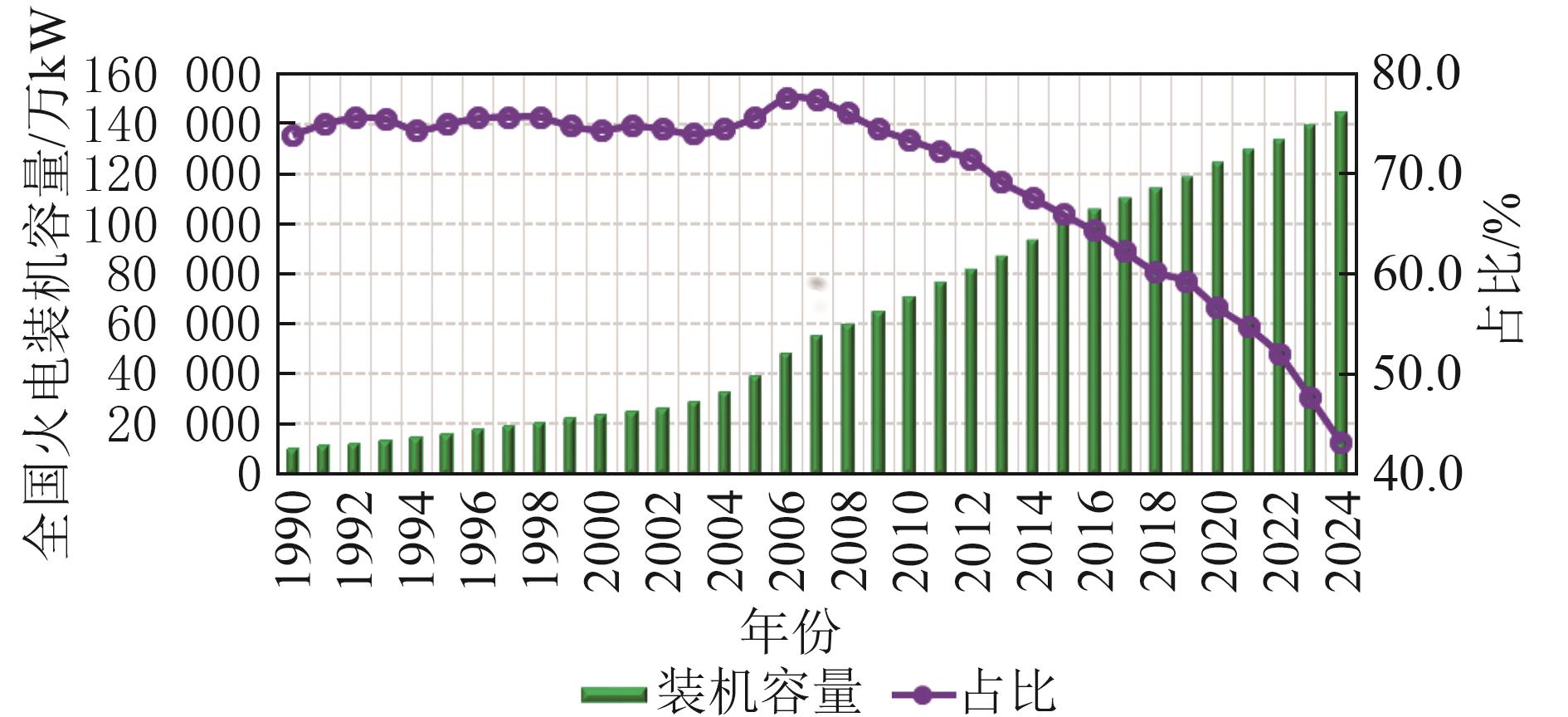
图1 1990—2023年全国火电装机总容量及占比变化
Fig. 1 Variations in total installed capacity and proportion of thermal power in China (1990-2023)
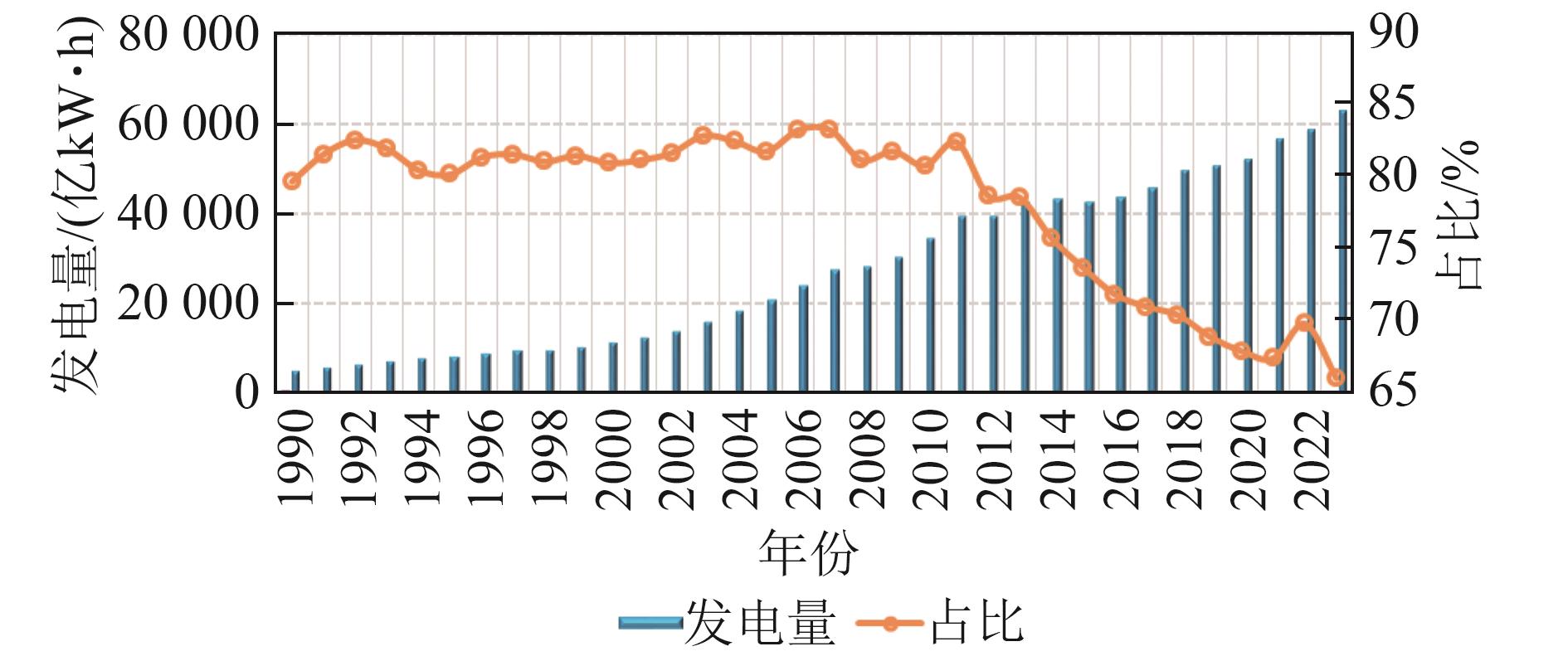
图2 1990—2023年全国火电发电量及占比变化
Fig. 2 Variations in power generation and proportion of thermal power in China (1990-2023)
| 机组种类 | 蒸汽初参数 | 设计热效率/% | 设计发电煤耗/[g/(kW⋅h)] | 设计厂用电率/% | 设计供电煤耗/[g/(kW⋅h)] | |
|---|---|---|---|---|---|---|
| 温度/℃ | 压力/MPa | |||||
| 亚临界30万kW | 538 | 16.67 | 41.3 | 298 | 6.7 | 319.9 |
| 亚临界60万kW | 538 | 16.67 | 41.6 | 296 | 6.2~6.5 | 315.6~316.6 |
| 超临界60万kW | 566 | 24.2 | 43.6 | 282 | 6.2~6.5 | 300.6~301.6 |
| 超超临界60万kW | 600 | 25.0 | 45.4 | 271 | 6.0~6.2 | 288.3~288.9 |
| 超超临界100万kW | 600 | 27.0 | 45.7 | 269 | 5.0~5.5 | 283.2~284.7 |
表1 30万kW及以上煤电机组设计热效率及供电煤耗
Tab. 1 Design thermal efficiency and coal consumption for power supply of coal-fired power units with capacity of 300 000 kW and above
| 机组种类 | 蒸汽初参数 | 设计热效率/% | 设计发电煤耗/[g/(kW⋅h)] | 设计厂用电率/% | 设计供电煤耗/[g/(kW⋅h)] | |
|---|---|---|---|---|---|---|
| 温度/℃ | 压力/MPa | |||||
| 亚临界30万kW | 538 | 16.67 | 41.3 | 298 | 6.7 | 319.9 |
| 亚临界60万kW | 538 | 16.67 | 41.6 | 296 | 6.2~6.5 | 315.6~316.6 |
| 超临界60万kW | 566 | 24.2 | 43.6 | 282 | 6.2~6.5 | 300.6~301.6 |
| 超超临界60万kW | 600 | 25.0 | 45.4 | 271 | 6.0~6.2 | 288.3~288.9 |
| 超超临界100万kW | 600 | 27.0 | 45.7 | 269 | 5.0~5.5 | 283.2~284.7 |
| 机组容量 | 2012年 | 2021年 | ||
|---|---|---|---|---|
装机容量/ 亿kW | 占比/% | 装机容量/亿kW | 占比/% | |
| >1 000 MW机组 | 3.224 1 | 40.15 | 0.57 | 4.99 |
| 600~1 000 MW(含) | 3.94 | 34.44 | ||
| 300~600 MW(含) | 2.844 1 | 35.42 | 4.44 | 38.81 |
| 100~300 MW(含) | 1.147 3 | 14.29 | 1.72 | 15.03 |
| ≤100 MW | 0.814 6 | 10.14 | 0.77 | 6.73 |
表2 中国煤电装机规模分布情况
Tab. 2 Distribution of installed capacity of coal-fired power in China
| 机组容量 | 2012年 | 2021年 | ||
|---|---|---|---|---|
装机容量/ 亿kW | 占比/% | 装机容量/亿kW | 占比/% | |
| >1 000 MW机组 | 3.224 1 | 40.15 | 0.57 | 4.99 |
| 600~1 000 MW(含) | 3.94 | 34.44 | ||
| 300~600 MW(含) | 2.844 1 | 35.42 | 4.44 | 38.81 |
| 100~300 MW(含) | 1.147 3 | 14.29 | 1.72 | 15.03 |
| ≤100 MW | 0.814 6 | 10.14 | 0.77 | 6.73 |
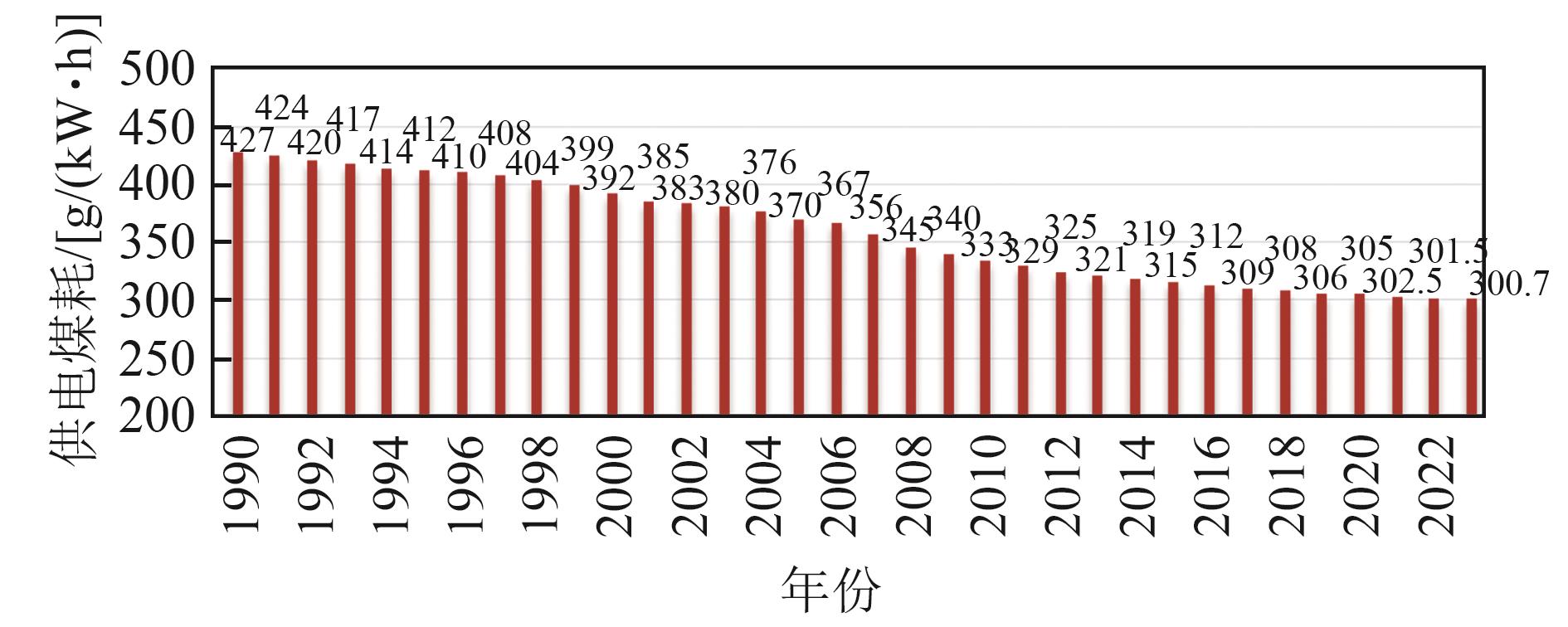
图3 1990—2023年全国火电供电标准煤耗变化
Fig. 3 Variations in standard coal consumption for power supply of thermal power in China (1990-2023)
| 项目 | 美国 | 德国 | 英国 | 日本 | 中国 |
|---|---|---|---|---|---|
| 2005年化石能源发电量占比 | 73.3 | 64.8 | 76.8 | 63.8 | 81.8 |
| 2023年化石能源发电量占比 | 59.9 | 41.0 | 36.3 | 65.0 | 64.1 |
| 2023年油电发电量占比 | 0.4 | 1.0 | 0.8 | 3.3 | 0.1 |
| 2023年气电发电量占比 | 43.1 | 15.1 | 34.3 | 31.7 | 3.2 |
| 2023年煤电发电量占比 | 16.4 | 24.9 | 1.2 | 30.0 | 60.8 |
表3 不同国家化石能源发电量占比 (%)
Tab. 3 Proportion of fossil energy power generation in different countries
| 项目 | 美国 | 德国 | 英国 | 日本 | 中国 |
|---|---|---|---|---|---|
| 2005年化石能源发电量占比 | 73.3 | 64.8 | 76.8 | 63.8 | 81.8 |
| 2023年化石能源发电量占比 | 59.9 | 41.0 | 36.3 | 65.0 | 64.1 |
| 2023年油电发电量占比 | 0.4 | 1.0 | 0.8 | 3.3 | 0.1 |
| 2023年气电发电量占比 | 43.1 | 15.1 | 34.3 | 31.7 | 3.2 |
| 2023年煤电发电量占比 | 16.4 | 24.9 | 1.2 | 30.0 | 60.8 |
| 项目 | 2021年 | 2025年预测 | 2030年预测 |
|---|---|---|---|
| 平均供电煤耗/[g/(kW∙h)] | 301.5 | 298.9 | 293.9 |
| 标煤耗减少量/亿t | — | 0.13 | 0.35 |
| CO2减排量/亿t | — | 0.35 | 0.95 |
表4 节能提效措施碳减排分析
Tab. 4 Analysis of carbon emission reduction of energy-saving and efficiency-improving measures
| 项目 | 2021年 | 2025年预测 | 2030年预测 |
|---|---|---|---|
| 平均供电煤耗/[g/(kW∙h)] | 301.5 | 298.9 | 293.9 |
| 标煤耗减少量/亿t | — | 0.13 | 0.35 |
| CO2减排量/亿t | — | 0.35 | 0.95 |
| 项目 | 能源化利用率 | |
|---|---|---|
| 低 | 中 | |
| 掺混比例 | 10% | 20% |
| CO2减排量/亿t | 0.76~1.44 | 1.84~4.11 |
| 目标达成年份 | 2025 | 2030 |
表5 生物质耦合发电碳减排分析
Tab. 5 Analysis of carbon emission reduction in biomass co-firing power generation
| 项目 | 能源化利用率 | |
|---|---|---|
| 低 | 中 | |
| 掺混比例 | 10% | 20% |
| CO2减排量/亿t | 0.76~1.44 | 1.84~4.11 |
| 目标达成年份 | 2025 | 2030 |
| 项目 | 2025年 | 2030年 | 2060年 |
|---|---|---|---|
| 绿氢产量/万t | 10~20 | 300~500 | 9 100 |
| 绿氨/万t* | 18~36 | 545~907 | 16 500 |
| 绿氨/万t** | 56~112 | 1 701~2 835 | 51 600 |
表6 2025—2060年绿氢产量预测
Tab. 6 Projection of green hydrogen production (2025-2060)
| 项目 | 2025年 | 2030年 | 2060年 |
|---|---|---|---|
| 绿氢产量/万t | 10~20 | 300~500 | 9 100 |
| 绿氨/万t* | 18~36 | 545~907 | 16 500 |
| 绿氨/万t** | 56~112 | 1 701~2 835 | 51 600 |
| [1] | 朱法华,王玉山,徐振,等 .中国电力行业碳达峰、碳中和的发展路径研究[J].电力科技与环保,2021,37(3):9-16. |
| ZHU F H, WANG Y S, XU Z,et al .Research on the development path of carbon peak and carbon neutrality in China’s Power Industry[J].Electric Power Technology and Environmental Protection,2021,37(3):9-16. | |
| [2] | 周原冰,张士宁,侯方心,等 .电力行业碳达峰及促进全社会碳减排影响分析[J].中国电力,2024,57(9):1-9. |
| ZHOU Y B, ZHANG S N, HOU F X,et al .Analysis of carbon peaking in power sector and its impact on promoting whole-society carbon emissions reduction[J].Electric Power,2024,57(9):1-9. | |
| [3] | 徐静馨,朱法华,王圣,等 .煤电清洁高效发展政策与实践[J].中国环保产业,2023(2):34-38. |
| XU J X, ZHU F H, WANG S,et al .Policies and practices on clean and efficient development of coal power industry[J].China Environmental Protection Industry,2023(2):34-38. | |
| [4] | 国家发展改革委 .关于燃煤电站项目规划和建设有关要求的通知(发改能源[2004]864号)[EB/OL].(2004-05-16)[2025-07-25].. |
| National Development and Reform Commission .Notice on relevant requirements for the planning and construction of coal-fired power station projects (Development and Reform Energy [2004]No. 864)[EB/OL].(2004-05-16)[2025-07-25].. | |
| [5] | 发展改革委,环境保护部,国家能源局 .关于印发《煤电节能减排升级与改造行动计划(2014—2020年)》的通知(发改能源[2014]2093号)[EB/OL].(2014-09-12)[2025-07-25].. |
| National Development and Reform Commission,Ministry of Environmental Protection,National Energy administration .Notice on issuing the “Action Plan for Upgrading and Transformation of Coal Energy Conservation and Emission Reduction (2014-2020)”(Development and Gai Energy [2014] No. 2093).. | |
| [6] | 国家发展和改革委员会 .关于发布《煤炭清洁高效利用重点领域标杆水平和基准水平(2022年版)》的通知(发改运行〔2022〕559号)[EB/OL].(2022-04-09)[2025-07-25].. |
| National Development and Reform Commission .Notice on Issuing the “Benchmarking Levels and Benchmark Levels in Key Areas of Clean and Efficient Coal Utilization (2022 Edition)”(Fa Gai Operation [2022]No. 559)[EB/OL].(2022-04-09)[2025-07-25].. | |
| [7] | 国家发展改革委,国家能源局 .关于开展全国煤电机组改造升级的通知(发改运行[2021]1519号)[EB/OL].(2021-10-29)[2025-07-25].. |
| National Development and Reform Commission,National Energy administration .Notice on Carrying out the Transformation and Upgrading of Coal Power Units nationwide (Development and Reform Operation [2021]No.1519).(2021-10-29)[2025-07-25].. | |
| [8] | 中华人民共和国中央人民政府 .国务院批转发展改革委、能源办关于加快关停小火电机组若干意见的通知(国发[2007]2号)[EB/OL].(2008-03-28)[2025-07-25].. |
| Central People’s Government of People’s Republic of China .Notice of the state council on transmitting certain opinions of the development and reform commission and the energy office on accelerating the shutdown of small thermal power units Guo Fa [2007]No. 2[EB/OL].(2008-03-28)[2025-07-25].. | |
| [9] | 王放放,杨鹏威,赵光金,等 .新型电力系统下火电机组灵活性运行技术发展及挑战[J].发电技术,2024,45(2):189-198. doi:10.12096/j.2096-4528.pgt.23079 |
| WANG F F, YANG P W, ZHAO G J,et al .Development and challenge of flexible operation technology of thermal power units under new power system[J].Power Generation Technology,2024,45(2):189-198. doi:10.12096/j.2096-4528.pgt.23079 | |
| [10] | 邬凯浪,单兰晴,薄利明,等 .考虑电力系统灵活爬坡需求的火电厂碳捕集改造方案优化方法[J].电力建设,2025,46(9):27-41. |
| WU K L, SHAN L Q, BO L M,et al .Optimization methodology for carbon capture reformation schemes in thermal power plants considering the power flexible ramping demand[J].Electric Power Construction,2025,46(9):27-41. | |
| [11] | 李家桐,谢宁,王承民,等 .基于CHP机组碳排放分析的综合能源系统低碳调度优化方法[J].智慧电力,2024,52(6):31-37,83. |
| LI J T, XIE N, WANG C M,et al .Low-carbon dispatch optimization method for integrated energy system based on carbon emission analysis of CHP units[J].Smart Power,2024,52(6):31-37,83. | |
| [12] | 朱法华,徐静馨,王圣,等 .中国燃煤电厂大气污染物治理历程及展望[J].电力科技与环保,2023,39(5):371-384. |
| ZHU F H, XU J X, WANG S,et al .Processes and prospects of air pollutant control in coal-fired power plants in China[J].Electric Power Technology and Environmental Protection,2023,39(5):371-384. | |
| [13] | 国家能源局 .煤电核准量增加推动产能升级[EB/OL].(2023-04-17)[2025-07-28].. |
| National Energy administration .Increase in coal power approvals promotes production capacity upgrading[EB/OL].(2023-04-17)[2025-07-28]... | |
| [14] | 刘志强,李建锋,潘荔,等 .中国煤电机组改造升级效果分析与展望[J].中国电力,2024,57(7):1-11. doi:10.11930/j.issn.1004-9649.202402031 |
| LIU Z Q, LI J F, PAN L,et al .Analysis and prospect of transformation and upgrading effects of coal-fired power units in China[J].Electric Power,2024,57(7):1-11. doi:10.11930/j.issn.1004-9649.202402031 | |
| [15] | 刘宇,任品桥,郑焱,等 .水力发电生命周期评价及碳足迹区域化分析[J].北京工业大学学报,2024,50(3):282-289. doi:10.11936/bjutxb2022080001 |
| LIU Y, REN P Q, ZHENG Y,et al .Life cycle assessment and regionalized carbon footprint analysis of hydropower generation[J].Journal of Beijing University of Technology,2024,50(3):282-289. doi:10.11936/bjutxb2022080001 | |
| [16] | 钱兴坤,王新哲,王海博 .美国天然气发电快速发展的原因与启示[J].国际石油经济,2015,23(10):18-24. doi:10.3969/j.issn.1004-7298.2015.10.004 |
| QIAN X K, WANG X Z, WANG H B .The rapid development of natural gas-fired power generation in the US[J].International Petroleum Economics,2015,23(10):18-24. doi:10.3969/j.issn.1004-7298.2015.10.004 | |
| [17] | BP .Statistical review of world energy 2023[R].London,2023. |
| [18] | 葛然 .合理规划煤电升级改造 助力构建新型电力系统[J].中国电力企业管理,2022(4):74-75. |
| GE R .Reasonable planning of coal-fired power upgrading and reconstruction to help build a new power system[J].China Power Enterprise Management,2022(4):74-75. | |
| [19] | 葛然 .以“三改”拓展煤电企业综合能源服务[J].中国电力企业管理,2022(16):34-36. |
| GE R .Expanding comprehensive energy services of coal-fired power enterprises with “three reforms”[J].China Power Enterprise Management,2022(16):34-36. | |
| [20] | 林富生,谢锡善,赵双群,等 .我国700 ℃超超临界锅炉过热器管用高温合金选材探讨[J].动力工程学报,2011,31(12):960-968. |
| LIN F S, XIE X S, ZHAO S Q,et al .Selection of superalloys for superheater tubes of domestic 700 ℃ A-USC boilers[J].Journal of Chinese Society of Power Engineering,2011,31(12):960-968. | |
| [21] | 莫春鸿,刘宇钢,王冬平,等 .更高参数二次再热超超临界锅炉关键技术探讨[J].中国电力,2018,51(9):73-77. doi:10.11930/j.issn.1004-9649.201804047 |
| MO C H, LIU Y G, WANG D P,et al .Discussion on critical technologies of double-reheat ultra-supercritical boiler with higher steam parameters[J].Electric Power,2018,51(9):73-77. doi:10.11930/j.issn.1004-9649.201804047 | |
| [22] | 毛健雄 .燃煤耦合生物质发电[J].分布式能源,2017,2(5):47-54. doi:10.16513/j.cnki.10-1427/tk.2017.05.008 |
| MAO J X .Co-firing biomass with coal for power generation[J].Distributed Energy,2017,2(5):47-54. doi:10.16513/j.cnki.10-1427/tk.2017.05.008 | |
| [23] | Ammonia Energy News .Chugoku electric completes successful trial,seeks patent for ammonia co-firing technology[EB/OL].(2023-03-17)[2025-0-28].https:/ . |
| [24] | NAGATANI G .Development of co-firing method of pulverized coal and ammonia to reduce greenhouse gas emissions[J].IHI Engineering Review,2020,53(1):1-10. |
| [25] | 赖诗妮,江丽霞,李军,等 .含碳掺氨燃料的研究进展[J].化工进展,2023,42(9):4603-4615. doi:10.16085/j.issn.1000-6613.2022-2005 |
| LAI S N, JIANG L X, LI J,et al .Research progress of ammonia blended fossil fuel[J].Chemical Industry and Engineering Progress,2023,42(9):4603-4615. doi:10.16085/j.issn.1000-6613.2022-2005 | |
| [26] | 曹权,王洪建,吴荣,等 .氢能供热技术发展现状与分析[J].煤气与热力,2023,43(11):28-32. |
| CAO Q, WANG H J, WU R,et al .Development status and analysis of hydrogen energy heating technology[J].Gas & Heat,2023,43(11):28-32. | |
| [27] | 邹鹏,王晓娜,王光礼,等 .燃煤锅炉混氨燃烧技术研究进展[J].节能,2024,43(6):113-116. |
| ZOU P, WANG X N, WANG G L,et al .Research progress of mixed ammonia combustion technology for coal-fired boilers[J].Energy Conservation,2024,43(6):113-116. | |
| [28] | 刘小伟,周昊,吴玉新,等 .“绿氢/氨碳中性燃料燃烧机理与技术”专题特约主编寄语[J].热力发电,2025,54(8):3-6. |
| LIU X W, ZHOU H, WU Y X,et al .Message from the special editor of “combustion mechanism and technology of green hydrogen/ammonia carbon neutral fuel”[J].Thermal Power Generation,2025,54(8):3-6. | |
| [29] | 王凯卉,刘斌,折晓会,等 .氨氢混合燃烧在旋流燃烧器中的动力学特性与NO x 减排机理研究[J].发电技术,2025,46(1):171-179. |
| WANG K H, LIU B, ZHE X H,et al .Kinetic characterization and NO x reduction mechanism of mixed ammonia-hydrogen combustion in cyclone combustor[J].Power Generation Technology,2025,46(1):171-179. | |
| [30] | 汪飞,喻梦伊,陈良勇 .氢能产业技术经济性分析及展望[J].电力科技与环保,2024,40(5):445-454. doi:10.19944/j.eptep.1674-8069.2024.05.001 |
| WANG F, YU M Y, CHEN L Y .Technical and economic analysis and outlook of hydrogen energy industry[J].Electric Power Environmental Protection,2024,40(5):445-454. doi:10.19944/j.eptep.1674-8069.2024.05.001 | |
| [31] | 牛涛,张文振,刘欣,等 .燃煤锅炉氨煤混合燃烧工业尺度试验研究[J].洁净煤技术,2022,28(3):193-200. doi:10.13226/j.issn.1006-6772.CC22022401 |
| NIU T, ZHANG W Z, LIU X,et al .Industrial-scale experimental investigation of ammonia-coal cofiring in coal-fired boiler[J].Clean Coal Technology,2022,28(3):193-200. doi:10.13226/j.issn.1006-6772.CC22022401 | |
| [32] | 王震,张晓舟,周彦希 .碳中和目标下CCUS产业特征和趋势及支持政策分析[J].天然气与石油,2024,42(5):1-7. |
| WANG Z, ZHANG X Z, ZHOU Y X .Analysis on CCUS industry characteristics,trends and supporting policies under the carbon neutrality goal[J].Natural Gas and Oil,2024,42(5):1-7. | |
| [33] | 谢斌,卢大贵,吴彩斌 .碳捕集利用与封存技术研究进展[J].有色金属科学与工程,2023,14(6):871-878. doi:10.13264/j.cnki.ysjskx.2023.06.015 |
| XIE B, LU D G, WU C B .Research progress of carbon capture utilization and storage technology[J].Nonferrous Metals Science and Engineering,2023,14(6):871-878. doi:10.13264/j.cnki.ysjskx.2023.06.015 | |
| [34] | 叶云云,廖海燕,王鹏,等 .我国燃煤发电CCS/CCUS技术发展方向及发展路线图研究[J].中国工程科学,2018,20(3):80-89. doi:10.15302/J-SSCAE-2018.03.012 |
| YE Y Y, LIAO H Y, WANG P,et al .Research on technology directions and roadmap of CCS/CCUS for coal-fired power generation in China[J].Engineering Science,2018,20(3):80-89. doi:10.15302/J-SSCAE-2018.03.012 | |
| [35] | 张贤,杨晓亮,鲁玺 等 .中国二氧化碳碳捕集与封存(CCUS)年度报告(2023)[R].北京:中国21世纪议程管理中心,全球碳捕集与封存研究院,清华大学,2023. |
| ZHANG X, YANG X L, LU X,et al .China carbon dioxide capture and storage (CCUS) annual report (2023)[R].Beijing:China Agenda 21 Management Center,Global Carbon Capture and Storage Institute,Tsinghua University,2023. | |
| [36] | 韩学义 .电力行业二氧化碳捕集、利用与封存现状与展望[J].中国资源综合利用,2020,38(2):110-117. doi:10.3969/j.issn.1008-9500.2020.02.031 |
| HAN X Y .Current situation and prospect of carbon dioxide capture,utilization and storage in electric power industry[J].China Resources Comprehensive Utilization,2020,38(2):110-117. doi:10.3969/j.issn.1008-9500.2020.02.031 | |
| [37] | 彭雪婷,吕昊东,张贤. IPCC AR 6 报告解读:全球碳捕集利用与封存(CCUS)技术发展评估[J].气候变化研究进展,2022,18(5):580-590. doi:10.12006/j.issn.1673-1719.2022.140 |
| PENG X T, LYU H D, ZHANG X .Interpretation of IPCC AR6 report on carbon capture,utilization and storage (CCUS) technology development[J].Climate Change Research,2022,18(5):580-590. doi:10.12006/j.issn.1673-1719.2022.140 | |
| [38] | 朱法华,徐静馨 .双碳背景下中国与主要发达国家电力低碳转型比较[J].电力科技与环保,2024,40(6):561-571. |
| ZHU F H, XU J X .Comparison of low-carbon transformation in electricity between China and major developed countries under the background of carbon peaking and carbon neutrality[J].Electric Power Technology and Environmental Protection,2024,40(6):561-571. |
| [1] | 邵雁, 谢颖, 刘子豪, 方梦祥, 许晓明, 胡昔鸣, 夏阳, 陈伟, 朴永玉. 钢铁行业碳捕集与利用技术研究进展[J]. 发电技术, 2026, 47(1): 1-13. |
| [2] | 张萍, 邸宏亮, 胡龙, 薛延刚, 刘海涛. 基于分层自适应控制的混合储能参与二次调频控制策略[J]. 发电技术, 2026, 47(1): 99-110. |
| [3] | 李伟, 王英旭, 王师鹏. 考虑碳交易的火电机组参与电力市场容量分配优化模型研究[J]. 发电技术, 2025, 46(6): 1260-1268. |
| [4] | 路诗梦, 孙建林, 曾凡杰, 林小杰, 吴均湛, 马添翼, 钟崴, 谢立坤, 谢伟. 零碳地热能综合利用技术研究进展[J]. 发电技术, 2025, 46(5): 909-922. |
| [5] | 张帅柠, 高明明, 王勇权, 王唯铧, 于浩洋, 黄中. 循环流化床锅炉宽负荷一体化脱硫建模研究[J]. 发电技术, 2025, 46(4): 849-856. |
| [6] | 张鹏新, 高明明, 解沛然, 于浩洋, 张洪福, 黄中. 基于数据驱动的循环流化床机组深度调峰NO x 预测[J]. 发电技术, 2025, 46(3): 627-636. |
| [7] | 黄忠源, 金绪良, 孟凡钦, 殷爱鸣, 张丽, 陈绍云. 天然气电厂新型多元胺基CO2吸收剂试验与应用研究[J]. 发电技术, 2025, 46(2): 304-313. |
| [8] | 董建宁, 安吉振, 陈衡, 潘佩媛, 徐钢, 王修彦. 考虑天气影响的火电机组空冷系统性能预测方法[J]. 发电技术, 2024, 45(6): 1105-1113. |
| [9] | 赵长红, 张李琳, 邵云姝, 袁家海, 邓祎璐. 发电上市公司低碳信息披露与低碳转型效率研究[J]. 发电技术, 2024, 45(6): 1121-1134. |
| [10] | 解婷婷, 孙友源, 郭振, 宋明光. 火电机组碳排放连续监测技术研究与应用综述[J]. 发电技术, 2024, 45(5): 919-928. |
| [11] | 郑淇薇, 赵欣悦, 卢荻, 陈衡, 潘佩媛, 刘彤. 多类型小容量火电机组热电解耦潜力与经济性对比评估[J]. 发电技术, 2024, 45(5): 929-940. |
| [12] | 刘佳, 孙佰仲, 高梓维. 高水分褐煤流动性离散元数值模拟[J]. 发电技术, 2024, 45(5): 969-974. |
| [13] | 单思珂, 刘含笑, 刘美玲, 王帅, 崔盈. 我国火电行业碳足迹评估综述[J]. 发电技术, 2024, 45(4): 575-589. |
| [14] | 夏忠林, 陈文通, 许书峤, 吴忠胜, 谢强, 马双忱, 马京香. 火电厂烟塔合一技术应用现状与现存问题分析[J]. 发电技术, 2024, 45(4): 590-599. |
| [15] | 刘旺, 陈连, 龚高阳, 李智华, 薛文华, 石金刚, 谢军, 李雷雷, 姚荣财, 王召鹏, 杨延西, 邓毅, 张晨辉. 基于数字孪生的空气预热器预测性维护模式研究[J]. 发电技术, 2024, 45(4): 622-632. |
| 阅读次数 | ||||||
|
全文 |
|
|||||
|
摘要 |
|
|||||
