

发电技术 ›› 2026, Vol. 47 ›› Issue (2): 266-273.DOI: 10.12096/j.2096-4528.pgt.260204
• 发电及环境保护 • 上一篇
甄箫斐1,2, 张沥1, 张永恒1
收稿日期:2025-03-06
修回日期:2025-05-25
出版日期:2026-04-30
发布日期:2026-04-21
作者简介:基金资助:Xiaofei ZHEN1,2, Li ZHANG1, Yongheng ZHANG1
Received:2025-03-06
Revised:2025-05-25
Published:2026-04-30
Online:2026-04-21
Supported by:摘要:
目的 为减少熔盐储能式塔式太阳能热发电系统的熔盐用量,需增大超临界CO2吸热温差,从而提高熔盐的吸、放热温差,因此针对超临界CO2吸热温差进行建模分析。 方法 通过在EBSILON中建立超临界CO2再压缩循环模型,并结合理论推导,分析主加热器吸热温差ΔT1和再热器吸热温差ΔT2。采用理论分析与仿真模拟相结合的方法,详细探讨了循环最高温度、循环最低温度、循环总压比、高压透平压比以及分流系数等参数对超临界CO2吸热温差的影响。 结果 提高循环最高温度,降低循环最低温度、循环总压比、高压透平压比以及分流系数可以增大主加热器吸热温差ΔT1;提高循环最高温度、循环总压比以及高压透平压比可增大再热器吸热温差ΔT2。当循环最高温度提高时,主加热器吸热温差ΔT1与再热器吸热温差ΔT2均提高,数据显示,当循环最高温度从400 ℃提高到700 ℃时,主加热器吸热温差从122.13 ℃提高到182.81 ℃,再热器吸热温差从54.47 ℃提高到67.23 ℃。 结论 通过调整循环参数,可以有效提高超临界CO2再压缩循环的吸热温差,从而优化系统性能。研究结果为进一步优化超临界CO2再压缩循环提供了理论依据。
中图分类号:
甄箫斐, 张沥, 张永恒. 超临界CO2再压缩循环吸热温差的热力学分析[J]. 发电技术, 2026, 47(2): 266-273.
Xiaofei ZHEN, Li ZHANG, Yongheng ZHANG. Thermodynamic Analysis of Heat Absorption Temperature Difference of Supercritical CO2 Recompression Cycle[J]. Power Generation Technology, 2026, 47(2): 266-273.
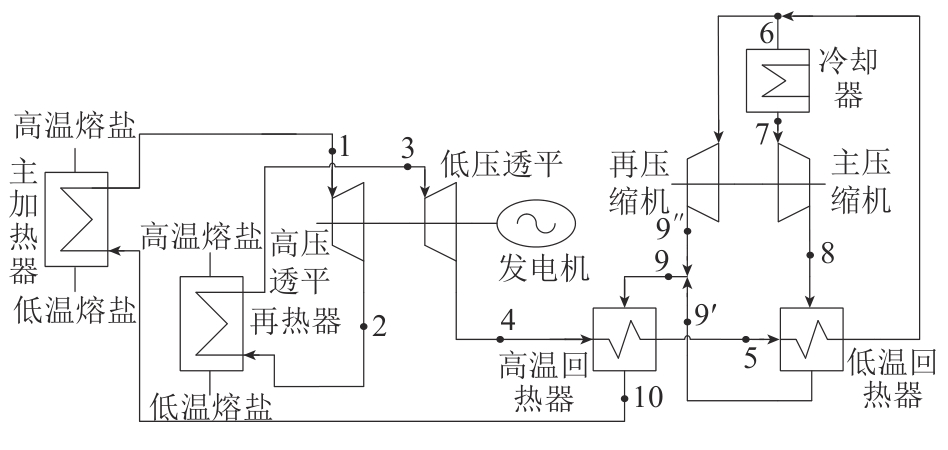
图1 超临界CO2再压缩循环结构图
Fig. 1 Structural diagram of supercritical CO2 recompression cycle
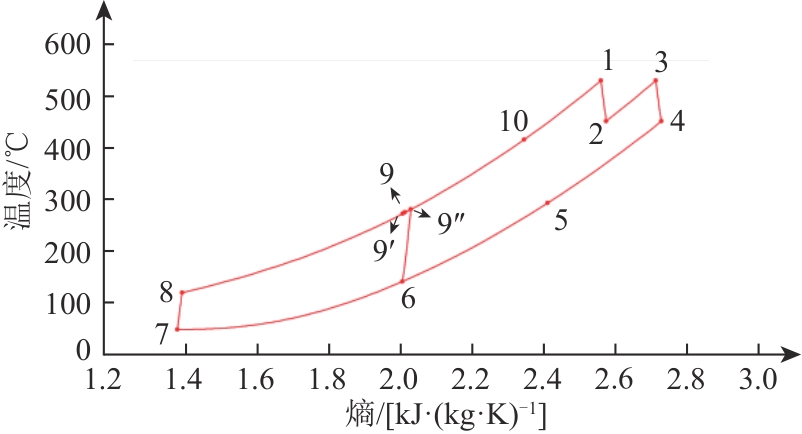
图2 超临界CO2再压缩循环温-熵图
Fig. 2 Temperature-entropy diagram of supercritical CO2 recompression cycle
| 参数 | 数值 | 参数 | 数值 |
|---|---|---|---|
| 主汽温度/℃ | 550 | 高压透平定熵效率/% | 90 |
| 再热温度/℃ | 550 | 低压透平定熵效率/% | 90 |
| 主汽压力/MPa | 30 | 再压缩机定熵效率/% | 85 |
| 循环增压比 | 3.90 | 主压缩机定熵效率/% | 85 |
| 再压缩机进口温度/℃ | 32 | 高温回热器效率/% | 86 |
| 分流系数/% | 33.1 | 低温回热器效率/% | 86 |
表1 动力循环基本设计参数
Tab. 1 Basic design parameters of power cycle
| 参数 | 数值 | 参数 | 数值 |
|---|---|---|---|
| 主汽温度/℃ | 550 | 高压透平定熵效率/% | 90 |
| 再热温度/℃ | 550 | 低压透平定熵效率/% | 90 |
| 主汽压力/MPa | 30 | 再压缩机定熵效率/% | 85 |
| 循环增压比 | 3.90 | 主压缩机定熵效率/% | 85 |
| 再压缩机进口温度/℃ | 32 | 高温回热器效率/% | 86 |
| 分流系数/% | 33.1 | 低温回热器效率/% | 86 |
| 参数 | 工况1 | 工况2 |
|---|---|---|
| 主汽/再热温度/℃ | 550 | 550 |
| 主压缩机进口温度/℃ | 32 | 32 |
| 主汽压力/MPa | 30 | 20 |
| 循环增压比 | 3.90 | 2.64 |
| 分流系数 | 0.331 | 0.312 |
| 文献[ | 44.83 | 41.92 |
| 模型循环效率/% | 44.16 | 42.57 |
| 循环效率相对误差/% | 1.49 | 1.53 |
表2 模型结果与文献[7]数据对比
Tab. 2 Comparison between model results and literature[7] data
| 参数 | 工况1 | 工况2 |
|---|---|---|
| 主汽/再热温度/℃ | 550 | 550 |
| 主压缩机进口温度/℃ | 32 | 32 |
| 主汽压力/MPa | 30 | 20 |
| 循环增压比 | 3.90 | 2.64 |
| 分流系数 | 0.331 | 0.312 |
| 文献[ | 44.83 | 41.92 |
| 模型循环效率/% | 44.16 | 42.57 |
| 循环效率相对误差/% | 1.49 | 1.53 |
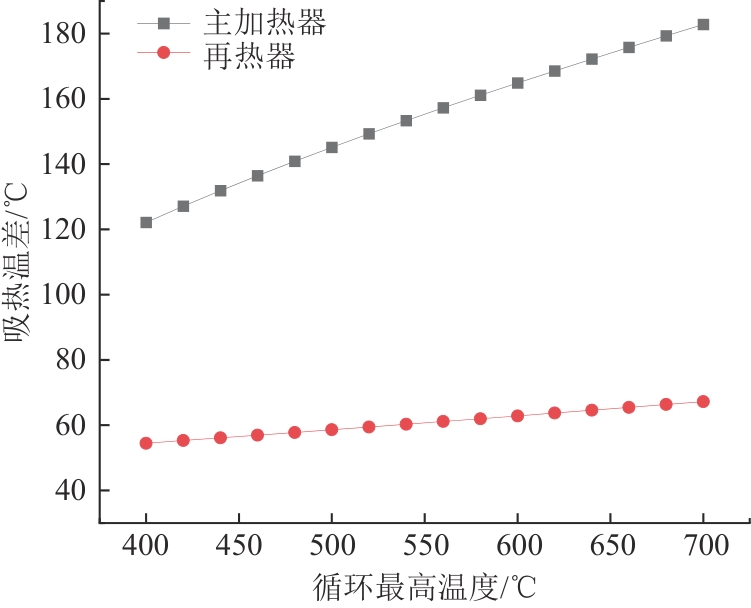
图3 循环最高温度对吸热温差的影响
Fig. 3 Effect of maximum cycle temperature on heat absorption temperature difference
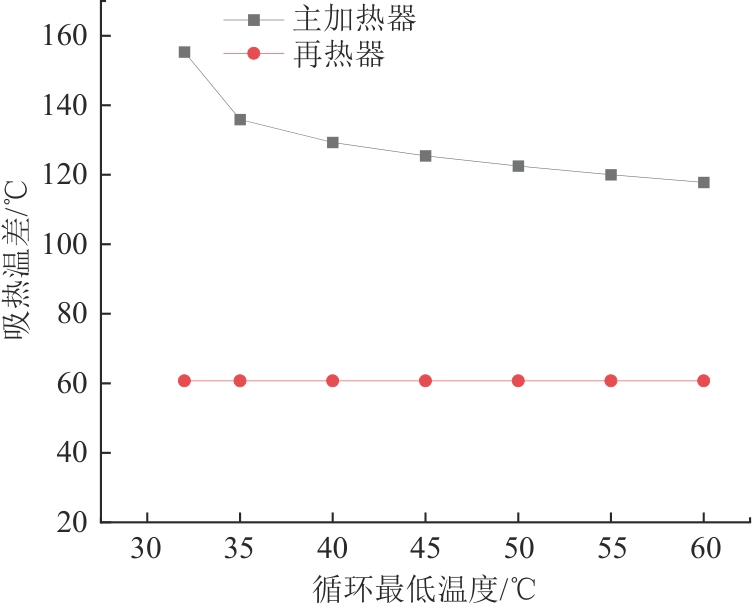
图4 循环最低温度对吸热温差的影响
Fig. 4 Effect of minimum cycle temperature on heat absorption temperature difference
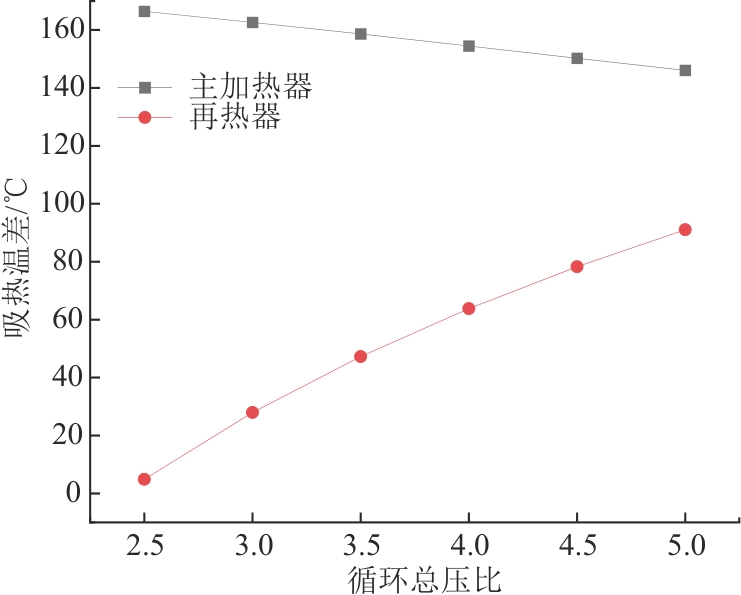
图5 循环总压比对吸热温差的影响
Fig. 5 Effect of total cycle pressure ratio on heat absorption temperature difference
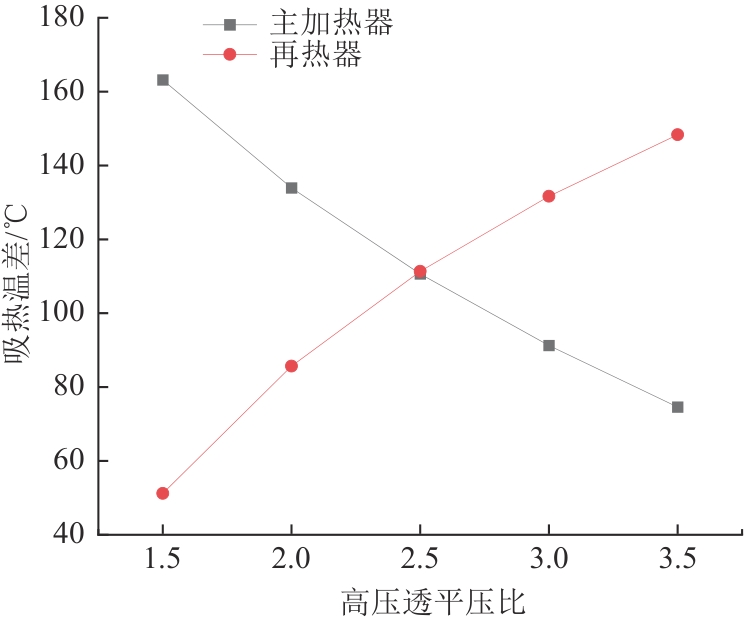
图6 高压透平压比对吸热温差的影响
Fig. 6 Effect of high-pressure turbine pressure ratio on heat absorption temperature difference
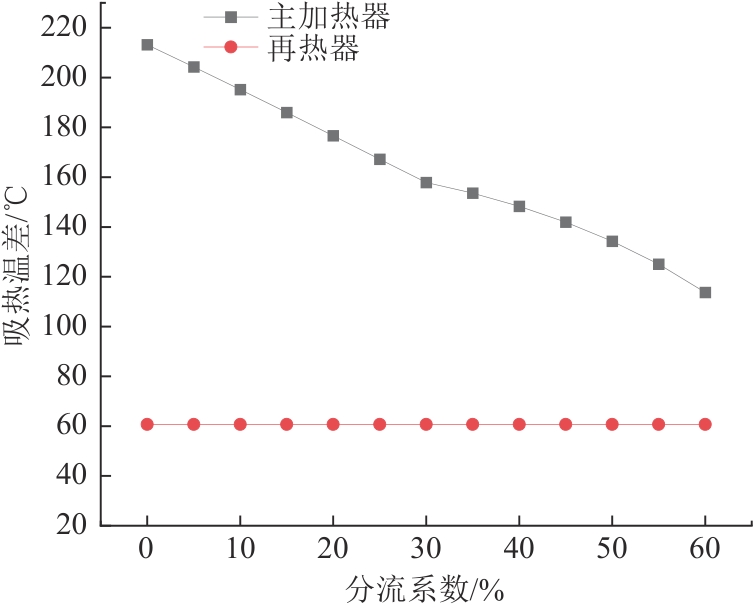
图7 分流系数对吸热温差影响
Fig. 7 Effect of shunt coefficient on heat absorption temperature difference
| [1] | SULZER G .Verfahren zur erzeugung von arbeit aus warme[J].Swiss Patent,1950,269599:15. |
| [2] | FEHER E G .The supercritical thermodynamic power cycle[J].Energy Conversion,1968,8(2):85-90. doi:10.1016/0013-7480(68)90105-8 |
| [3] | ANGELINO G .Carbon dioxide condensation cycles for power production[J].Journal of Engineering for Power,1968,90(3):287-295. doi:10.1115/1.3609190 |
| [4] | 陈璟,刘辉,朱萌,等 .125 MW超临界CO2燃煤发电机组烟气再循环对锅炉热力性能及经济性的影响分析[J].发电技术,2025,46(5):986-995. doi:10.12096/j.2096-4528.pgt.24034 |
| CHEN J, LIU H, ZHU M,et al .Analysis of influence of flue gas recirculation on thermodynamic performance and economic efficiency of 125 MW supercritical CO2 coal-fired power generation unit[J].Power Generation Technology,2025,46(5):986-995. doi:10.12096/j.2096-4528.pgt.24034 | |
| [5] | 尹秋钰,李德波,方立军,等 .1 000 MW超临界CO2锅炉热力计算与变工况特性研究[J].广东电力,2024,37(11):120-126. |
| YIN Q Y, LI D B, FANG L J,et al .Thermodynamic calculation and research on 1 000 MW supercritical CO2 boiler under variable conditions[J].Guangdong Electric Power,2024,37(11):120-126. | |
| [6] | TURCHI C S, MA Z W, NEISES T W,et al .Thermodynamic study of advanced supercritical carbon dioxide power cycles for high performance concentrating solar power systems[C]//Energy Sustainablity.American Society of Mechanical Engineers,2012,44816: 375-383. doi:10.1115/es2012-91179 |
| [7] | TURCHI CRAIG S, MA Z, NEISES TY W,et al .Thermodynamic study of advanced supercritical carbon dioxide power cycles for concentrating solar power systems[J].Journal of Solar Energy Engineering,2013,135(4):041007. doi:10.1115/1.4024030 |
| [8] | NEISES T, TURCHI C .A comparison of supercritical carbon dioxide power cycle configurations with an emphasis on CSP applications[J].Energy Procedia,2014,49:1187-1196. doi:10.1016/J.EGYPRO.2014.03.128 |
| [9] | SARKAR J, BHATTACHARYYA S .Optimization of recompression S-CO2 power cycle with reheating[J].Energy Conversion and Management,2009,50(8):1939-1945. doi:10.1016/j.enconman.2009.04.015 |
| [10] | MECHERI M, LE MOULLEC Y .Supercritical CO2 Brayton cycles for coal-fired power plants[J].Energy,2016,103:758-771. doi:10.1016/j.energy.2016.02.111 |
| [11] | AL-SULAIMAN F A, ATIF M .Performance comparison of different supercritical carbon dioxide Brayton cycles integrated with a solar power tower[J].Energy,2015,82:61-71. doi:10.1016/j.energy.2014.12.070 |
| [12] | MOHAMMADI Z, FALLAH M, SEYED MAHMOUDI S M .Advanced exergy analysis of recompression supercritical CO2 cycle[J].Energy,2019,178:631-643. doi:10.1016/j.energy.2019.04.134 |
| [13] | PADILLA R V, BENITO R G, STEIN W .An exergy analysis of recompression supercritical CO2 cycles with and without reheating[J].Energy Procedia,2015,69:1181-1191. doi:10.1016/j.egypro.2015.03.201 |
| [14] | SERRANO I P, LINARES J I, CANTIZANO A,et al .Enhanced arrangement for recuperators in supercritical CO2 Brayton power cycle for energy conversion in fusion reactors[J].Fusion Engineering and Design,2014,89(9/10):1909-1912. doi:10.1016/j.fusengdes.2014.03.083 |
| [15] | 廖吉香,刘兴业,郑群,等 .超临界CO2发电循环特性分析[J].热能动力工程,2016,31(5):40-46. doi:10.16146/j.cnki.rndlgc.2016.05.006 |
| LIAO J X, LIU X Y, ZHENG Q,et al .Characteristics analysis of supercritical CO2 power generation cycle[J].Journal of Engineering for Thermal Energy and Power,2016,31(5):40-46. doi:10.16146/j.cnki.rndlgc.2016.05.006 | |
| [16] | 谢蓉,于健尧 .基于Aspen的超临界CO2布雷顿循环性能研究[J].工程热物理学报,2021,42(10):2544-2552. |
| XIE R, YU J Y .Study on the performance of supercritical CO2 Brayton cycle based on Aspen[J].Journal of Engineering Thermophysics,2021,42(10):2544-2552. | |
| [17] | 梁铁波,唐鑫,钱奕然,等 .微型堆超临界CO2布雷顿循环系统构型及参数优化[J].原子能科学技术,2023,57(9):1706-1719. |
| LIANG T B, TANG X, QIAN Y R,et al .Configuration and parameter optimization of SCO2 Brayton cycle system in micro reactor[J].Atomic Energy Science and Technology,2023,57(9):1706-1719. | |
| [18] | 刘国浩 .超临界二氧化碳布雷顿循环热力分析与性能比较[D].南昌:南昌大学,2023. |
| LIU G H .Thermodynamic analysis and performance comparison of supercritical carbon dioxide Brayton cycle[D].Nanchang:Nanchang University,2023. | |
| [19] | DI MAIO D V, BOCCITTO A, CARUSO G .Supercritical carbon dioxide applications for energy conversion systems[J].Energy Procedia,2015,82:819-824. doi:10.1016/j.egypro.2015.11.818 |
| [20] | BATTISTI F G, CARDEMIL J M, SILVA A K DA .A multivariable optimization of a Brayton power cycle operating with CO2 as working fluid[J].Energy,2016,112:908-916. doi:10.1016/j.energy.2016.06.118 |
| [21] | KIM S, CHO Y, KIM M S,et al .Characteristics and optimization of supercritical CO2 recompression power cycle and the influence of pinch point temperature difference of recuperators[J].Energy,2018,147:1216-1226. doi:10.1016/j.energy.2017.12.161 |
| [22] | 张一帆,王生鹏,刘文娟,等 .超临界二氧化碳再压缩再热火力发电系统关键参数的研究[J].动力工程学报,2016,36(10):827-833. |
| ZHANG Y F, WANG S P, LIU W J,et al .Study on key parameters of a supercritical fossil-fired power system with CO2 recompression and reheat cycles[J].Journal of Chinese Society of Power Engineering,2016,36(10):827-833. | |
| [23] | 代浩,吕丽霞 .100 MW超临界二氧化碳布雷顿循环发电系统热力性能研究[J].电力科学与工程,2021,37(12):57-64. doi:10.3969/j.ISSN.1672-0792.2021.12.007 |
| DAI H, LÜ L X .Study on thermal performance of 100 MW supercritical carbon dioxide brayton cycle power generation systems[J].Electric Power Science and Engineering,2021,37(12):57-64. doi:10.3969/j.ISSN.1672-0792.2021.12.007 | |
| [24] | 王智,付静 .再压缩超临界二氧化碳闭式布雷顿循环系统㶲分析[J].华北电力大学学报,2018,15(4):86-92. |
| WANG Z, FU J .Exergy analyses of recompression supercritical carbon dioxide closed Brayton cycle system[J].Journal of North China Electric Power University,2018,15(4):86-92. | |
| [25] | 郭嘉琪,王坤,朱含慧,等 .超临界CO2及其混合工质布雷顿循环热力学分析[J].工程热物理学报,2017,38(4):695-702. |
| GUO J Q, WANG K, ZHU H H,et al .Thermodynamic analysis of brayton cycles using supercritical carbon dioxide and its mixture as working fluid[J].Journal of Engineering Thermophysics,2017,38(4):695-702. | |
| [26] | 孙铭泽,马宁,李浩然,等 .中低温超临界CO2及其混合工质布雷顿循环热力学分析[J].化工学报,2022,73(3):1379-1388. doi:10.11949/0438-1157.20211432 |
| SUN M Z, MA N, LI H R,et al .Thermodynamic analysis of Brayton cycle of medium and low temperature supercritical CO2 and its mixed working medium[J].CIESC Journal,2022,73(3):1379-1388. doi:10.11949/0438-1157.20211432 | |
| [27] | 王为术,黄志豪,赵世飞,等 .超临界二氧化碳600 MW燃煤发电系统热力学性能仿真研究[J].热力发电,2020,49(10):101-106. doi:10.19666/j.rlfd.202006159 |
| WANG W S, HUANG Z H, ZHAO S F,et al .Simulation research on thermodynamic performance of supercritical carbon dioxide 600 MW coal-fired power system[J].Thermal Power Generation,2020,49(10):101-106. doi:10.19666/j.rlfd.202006159 | |
| [28] | YU W, GONG Q, GAO D,et al .Thermodynamic analysis of supercritical carbon dioxide cycle for internal combustion engine waste heat recovery[J].Processes,2020,8(2):216. doi:10.3390/pr8020216 |
| [29] | WANG K, HE Y L, ZHU H H .Integration between supercritical CO2 Brayton cycles and molten salt solar power towers:a review and a comprehensive comparison of different cycle layouts[J].Applied Energy,2017,195:819-836. doi:10.1016/j.apenergy.2017.03.099 |
| [30] | 何雅玲 .太阳能光热发电原理、技术及数值分析[M].北京:科学出版社,2023. |
| HE Y L .Principles,technologies and numerical methods of solar thermal power[M].Beijing:Science Press,2023. |
| [1] | 刘松洋, 白云鹏, 陈志董, 丁亮, 孙超杰, 孔艳强. 基于熔盐储热的核电机组调峰特性研究[J]. 发电技术, 2025, 46(6): 1200-1211. |
| [2] | 邹博, 任建地, 许道明, 邓立生, 廖力达, 肖俊兵. 氯化物熔盐储热技术应用于新能源发电的研究进展[J]. 发电技术, 2025, 46(5): 872-884. |
| [3] | 曾宪民, 李柏云, 沈向阳, 陈嘉澍, 丁力行. 半周受热下太阳能吸热器横纹管的热应力分析[J]. 发电技术, 2025, 46(1): 190-199. |
| [4] | 邱立翔, 黄超, 魏高升, 崔柳, 杜小泽. 颗粒团聚对太阳盐纳米流体导热性能的影响特性研究[J]. 发电技术, 2024, 45(5): 878-887. |
| [5] | 董军, 汤建方, 臧春城, 徐立, 王志峰. 抛物面槽式太阳能集热器球形接头测试系统的研制与应用[J]. 发电技术, 2024, 45(2): 291-298. |
| [6] | 徐立, 孙飞虎, 李钧, 张强强. 抛物面槽式太阳能集热器热损失因素研究[J]. 发电技术, 2023, 44(2): 229-234. |
| [7] | 徐运飞, 吴水木, 李英杰. 面向太阳能热发电的CaO-CO2热化学储热技术研究进展[J]. 发电技术, 2022, 43(5): 740-747. |
| [8] | 李泽航, 周浩, 李浩秒, 王康丽, 蒋凯. 面向电力系统的液态金属电池储能技术[J]. 发电技术, 2022, 43(5): 760-774. |
| [9] | 徐立, 孙飞虎, 李志, 张强强. 一种太阳能集热器流体平均温度计算方法[J]. 发电技术, 2022, 43(3): 405-412. |
| [10] | 廖志荣, 李朋达, 田紫芊, 徐超, 魏高升. 非均匀翅片对级联相变储热系统热性能强化的研究[J]. 发电技术, 2022, 43(1): 83-91. |
| [11] | 杜春旭, 马彦成, 王彦泉, 谢济豪, 刘金恺, 鹿院卫. 基于监视与控制通用系统和可编程逻辑控制器的熔盐电加热控制系统开发[J]. 发电技术, 2021, 42(6): 727-733. |
| [12] | 丁路, 肖欣悦, 奚正稳, 华文瀚. 塔式太阳能吸热器不同方位高空风速模拟计算及影响分析[J]. 发电技术, 2021, 42(6): 707-714. |
| [13] | 孙浩, 高博, 刘建兴. 塔式太阳能电站定日镜场布局研究[J]. 发电技术, 2021, 42(6): 690-698. |
| [14] | 刘兰华, 狄林文, 董兴万, 王瑞林. 抛物槽式聚光太阳能集热回路动态特性研究[J]. 发电技术, 2021, 42(6): 673-681. |
| [15] | 徐立, 孙飞虎, 李钧, 张强强. 流量对抛物面槽式太阳能集热器传热特性影响的实验分析[J]. 发电技术, 2021, 42(6): 665-672. |
| 阅读次数 | ||||||
|
全文 |
|
|||||
|
摘要 |
|
|||||
