

发电技术 ›› 2026, Vol. 47 ›› Issue (2): 257-265.DOI: 10.12096/j.2096-4528.pgt.260203
• 发电及环境保护 • 上一篇
邓素华1, 何宗源1, 丘建晖2, 杨用龙3, 江建平3, 刘博3, 张杨3, 郭栋3
收稿日期:2025-02-17
修回日期:2025-05-16
出版日期:2026-04-30
发布日期:2026-04-21
作者简介:基金资助:Suhua DENG1, Zongyuan HE1, Jianhui QIU2, Yonglong YANG3, Jianping JIANG3, Bo LIU3, Yang ZHANG3, Dong GUO3
Received:2025-02-17
Revised:2025-05-16
Published:2026-04-30
Online:2026-04-21
Supported by:摘要:
目的 为精准核算燃煤电厂碳排放量,结合燃煤电厂实际生产工况,开展“摇篮到大门”全生命周期精细化碳排放核算研究,分析各环节碳排放占比及其敏感性特征。 方法 以典型电厂4台600 MW超临界燃煤发电机组为例,基于生命周期评价方法,详细核算了原料获取、原辅料运输、电力生产、废物处理环节的精细化碳排放量。 结果 原料获取和运输等上游环节的碳排放量占总排放量的9.4%,其中煤炭开采环节的碳排放量最大,占总排放量的5.77%。若煤炭开采环节能耗下降5%和10%,可使各机组生命周期的单位供电碳排放量分别降低0.289%和0.577%。在不同情景下,采用碳捕集技术可使电厂碳排放量降低78.8%~82.3%。 结论 煤炭燃烧作为电力生产全过程碳排放的主要环节,通过改变燃烧方式、提高锅炉效率、降低损失等手段可实现单位发电/供电煤耗的降低。采用碳捕集技术可有效降低电厂综合碳排放,尽管碳捕集过程会增加一定能耗,但其碳捕集效率较高,采用高效、低能耗的碳捕集技术是减少电厂碳排放的关键手段。
中图分类号:
邓素华, 何宗源, 丘建晖, 杨用龙, 江建平, 刘博, 张杨, 郭栋. 基于生命周期评价的燃煤电厂碳排放敏感性分析[J]. 发电技术, 2026, 47(2): 257-265.
Suhua DENG, Zongyuan HE, Jianhui QIU, Yonglong YANG, Jianping JIANG, Bo LIU, Yang ZHANG, Dong GUO. Carbon Emission Sensitivity Analysis of Coal-Fired Power Plants Based on Life Cycle Assessment[J]. Power Generation Technology, 2026, 47(2): 257-265.
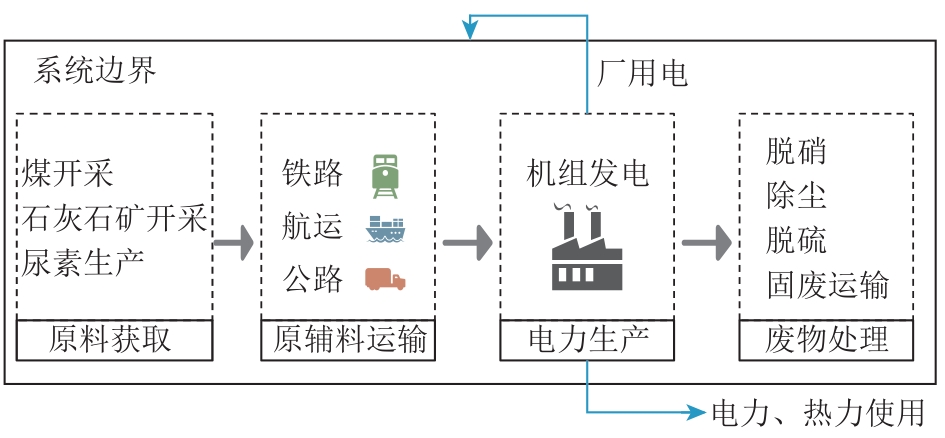
图1 系统边界
Fig. 1 System boundaries
| 参数 | 机组 | |||
|---|---|---|---|---|
| 1# | 2# | 3# | 4# | |
| 年耗煤量/万t | 164.20 | 163.86 | 155.33 | 128.40 |
| 年发电量/(亿kW⋅h) | 33.99 | 32.71 | 31.46 | 25.59 |
| 年供电量/(亿kW⋅h) | 32.46 | 31.06 | 29.86 | 24.28 |
| 年供热量/GJ | 631 494 | 383 791 | 798 802 | 776 411 |
| 平均厂用电率/% | 5.02 | 5.03 | 4.89 | 4.58 |
| 平均低位发热量/(MJ/kg) | 17.31 | 17.31 | 17.31 | 17.31 |
| 平均收到基碳质量分数/% | 46.45 | 46.45 | 46.45 | 46.45 |
| 平均收到基硫质量分数/% | 0.58 | 0.58 | 0.58 | 0.58 |
| 平均收到基灰分质量分数/% | 14.40 | 14.40 | 14.40 | 14.40 |
| 平均收到基氮质量分数/% | 0.70 | 0.70 | 0.70 | 0.70 |
| 燃煤铁路运输距离/km | 815 | 815 | 815 | 815 |
| 燃煤海路运输距离/km | 1 852 | 1 852 | 1 852 | 1 852 |
| 石灰石矿运输距离/km | 400 | 400 | 400 | 400 |
| 尿素运输距离/km | 133 | 133 | 133 | 133 |
| 固废运输距离/km | 4.2 | 4.2 | 4.2 | 4.2 |
| 平均飞灰含碳质量分数/% | 0.77 | 0.88 | 0.61 | 0.72 |
| 平均底渣含碳质量分数/% | 2.38 | 2.21 | 1.95 | 2.97 |
| 石灰石单耗/t | 1 365.57 | 3 320.65 | 3 022.57 | 3 151.15 |
| 年尿素耗量/t | 1 418 | 1 370 | 1 342 | 1 099 |
| 平均脱硝效率/% | 85 | 85 | 85 | 85 |
| 平均脱硫效率/% | 99.84 | 99.84 | 99.84 | 99.84 |
| 平均除尘效率/% | 90 | 90 | 90 | 90 |
表1 电厂全生命周期的碳排放活动水平
Tab. 1 Carbon emission activity levels throughout the full life cycle of power plants
| 参数 | 机组 | |||
|---|---|---|---|---|
| 1# | 2# | 3# | 4# | |
| 年耗煤量/万t | 164.20 | 163.86 | 155.33 | 128.40 |
| 年发电量/(亿kW⋅h) | 33.99 | 32.71 | 31.46 | 25.59 |
| 年供电量/(亿kW⋅h) | 32.46 | 31.06 | 29.86 | 24.28 |
| 年供热量/GJ | 631 494 | 383 791 | 798 802 | 776 411 |
| 平均厂用电率/% | 5.02 | 5.03 | 4.89 | 4.58 |
| 平均低位发热量/(MJ/kg) | 17.31 | 17.31 | 17.31 | 17.31 |
| 平均收到基碳质量分数/% | 46.45 | 46.45 | 46.45 | 46.45 |
| 平均收到基硫质量分数/% | 0.58 | 0.58 | 0.58 | 0.58 |
| 平均收到基灰分质量分数/% | 14.40 | 14.40 | 14.40 | 14.40 |
| 平均收到基氮质量分数/% | 0.70 | 0.70 | 0.70 | 0.70 |
| 燃煤铁路运输距离/km | 815 | 815 | 815 | 815 |
| 燃煤海路运输距离/km | 1 852 | 1 852 | 1 852 | 1 852 |
| 石灰石矿运输距离/km | 400 | 400 | 400 | 400 |
| 尿素运输距离/km | 133 | 133 | 133 | 133 |
| 固废运输距离/km | 4.2 | 4.2 | 4.2 | 4.2 |
| 平均飞灰含碳质量分数/% | 0.77 | 0.88 | 0.61 | 0.72 |
| 平均底渣含碳质量分数/% | 2.38 | 2.21 | 1.95 | 2.97 |
| 石灰石单耗/t | 1 365.57 | 3 320.65 | 3 022.57 | 3 151.15 |
| 年尿素耗量/t | 1 418 | 1 370 | 1 342 | 1 099 |
| 平均脱硝效率/% | 85 | 85 | 85 | 85 |
| 平均脱硫效率/% | 99.84 | 99.84 | 99.84 | 99.84 |
| 平均除尘效率/% | 90 | 90 | 90 | 90 |
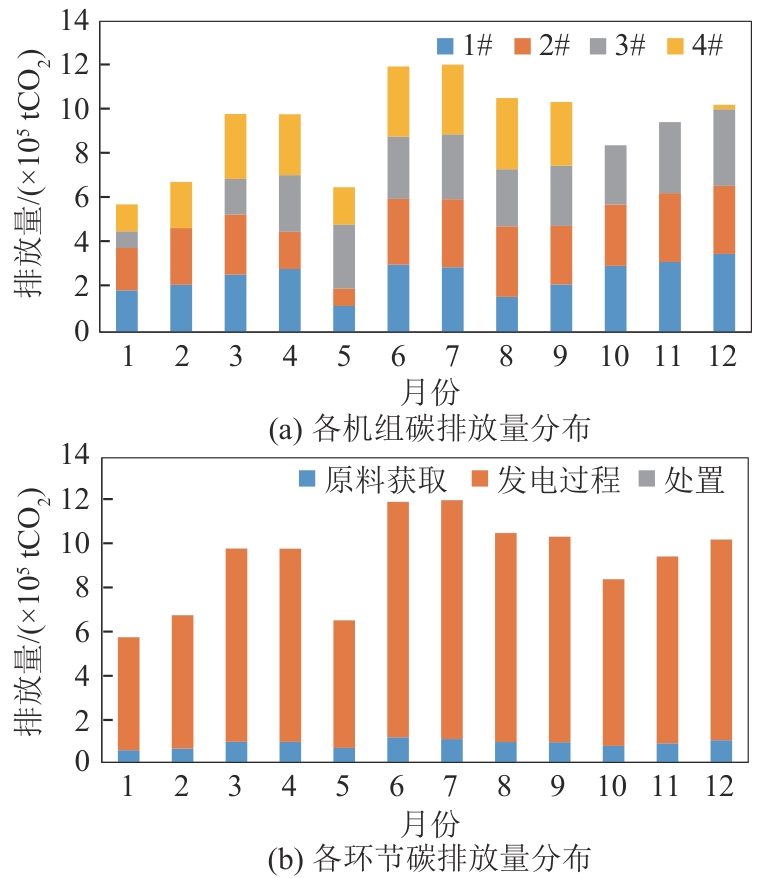
图2 碳排放量分布
Fig. 2 Carbon emission distribution
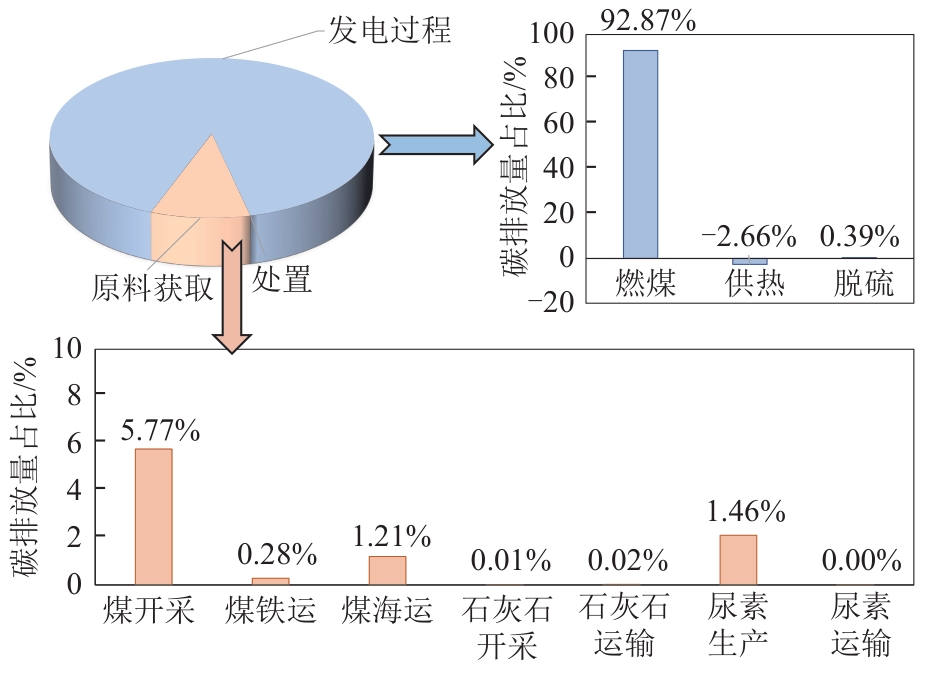
图3 各子环节碳排放量分布
Fig. 3 Carbon emission distribution of each sub-link
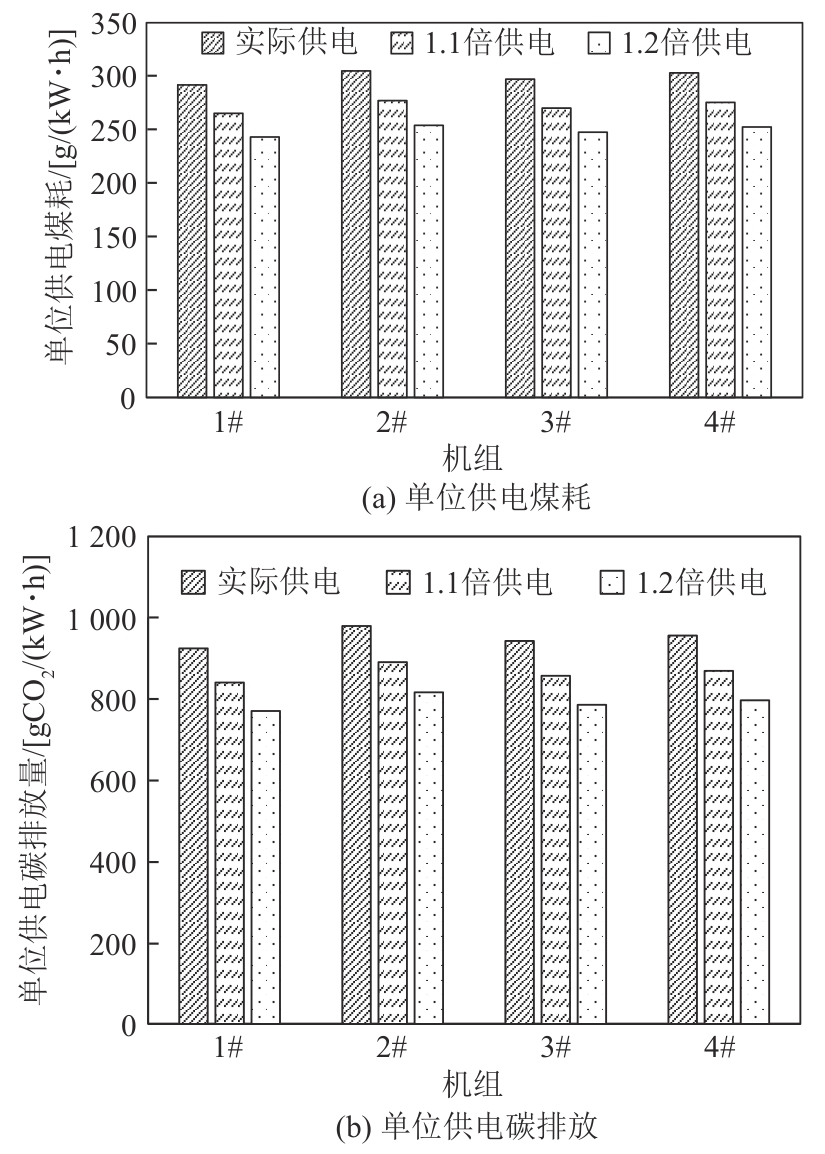
图4 不同供电效率的煤耗和碳排放量分析
Fig. 4 Coal consumption and carbon emission analysis of different power supply efficiency
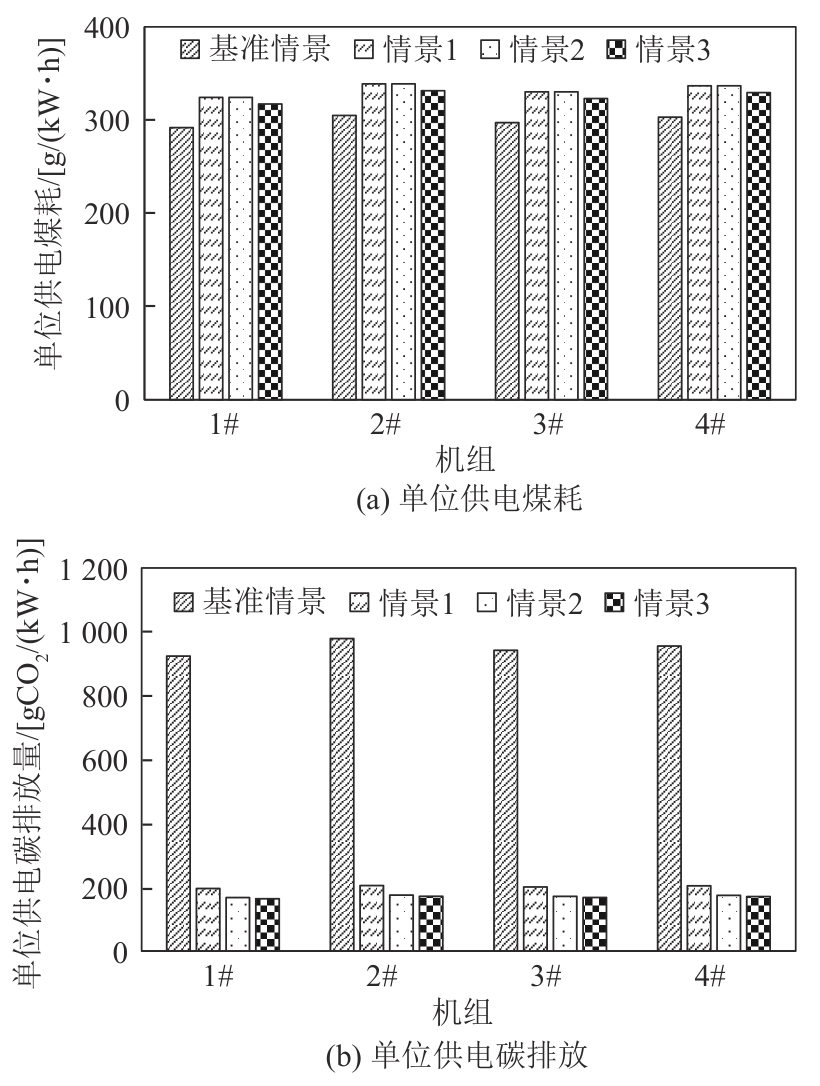
图5 不同碳捕集效率情景下煤耗和碳排放量分析
Fig. 5 Analysis of coal consumption and carbon emissions under different carbon capture efficiency scenarios
| 参数 | 情景1 | 情景2 | 情景3 | |
|---|---|---|---|---|
| 单位供电煤耗率/% | 11.1 | 11.1 | 8.7 | |
| 碳减排率/% | 1#机组 | 78.8 | 81.9 | 82.3 |
| 2#机组 | 79.1 | 82.1 | 82.5 | |
| 3#机组 | 78.7 | 81.8 | 82.2 | |
| 4#机组 | 78.6 | 81.8 | 82.1 | |
| 平均值 | 78.8 | 81.9 | 82.3 | |
表2 不同情景下煤耗与碳减排分析
Tab. 2 Analysis of coal consumption and carbon emission reduction under different scenarios
| 参数 | 情景1 | 情景2 | 情景3 | |
|---|---|---|---|---|
| 单位供电煤耗率/% | 11.1 | 11.1 | 8.7 | |
| 碳减排率/% | 1#机组 | 78.8 | 81.9 | 82.3 |
| 2#机组 | 79.1 | 82.1 | 82.5 | |
| 3#机组 | 78.7 | 81.8 | 82.2 | |
| 4#机组 | 78.6 | 81.8 | 82.1 | |
| 平均值 | 78.8 | 81.9 | 82.3 | |
| [1] | 马楠,刘国伟,吴杰康,等 .面向碳排放的“源-储”容量配置协同优化模型[J].南方电网技术,2025,19(10):76-85. doi:10.13648/j.cnki.issn1674-0629.2025.10.008 |
| MA N, LIU G W, WU J K,et al .Collaborative optimization model for carbon emission oriented “source-storage” capacity allocation[J].Southern Power System Technology,2025,19(10):76-85. doi:10.13648/j.cnki.issn1674-0629.2025.10.008 | |
| [2] | IEA .CO2 Emissions in 2023[EB/OL].(2024-03-01)[2025-02-01].. |
| [3] | 赵俊华,白焰,王智冬 .电碳耦合视角下新型电力系统低碳运行调度的关键问题及展望[J].电力建设,2025,46(7):133-149. |
| ZHAO J H, BAI Y, WANG Z D .Key issues and prospects for low-carbon operation and scheduling of the new power system from an electricity-carbon coupling perspective[J].Electric Power Construction,2025,46(7):133-149. | |
| [4] | 张全斌,周琼芳 .基于“双碳”目标的中国火力发电技术发展路径研究[J].发电技术,2023,44(2):143-154. doi:10.12096/j.2096-4528.pgt.22092 |
| ZHANG Q B, ZHOU Q F .Research on the development path of China’s thermal power generation technology based on the goal of “carbon peak and carbon neutralization”[J].Power Generation Technology,2023,44(2):143-154. doi:10.12096/j.2096-4528.pgt.22092 | |
| [5] | 刘天蔚,边晓燕,吴珊,等 .电力系统碳排放核算综述与展望[J].电力系统保护与控制,2024,52(4):176-187. |
| LIU T W, BIAN X Y, WU S,et al .Overview and prospect of carbon emission accounting in electric power systems[J].Power System Protection and Control,2024,52(4):176-187. | |
| [6] | 单思珂,刘含笑,刘美玲,等 .我国火电行业碳足迹评估综述[J].发电技术,2024,45(4):575-589. doi:10.12096/j.2096-4528.pgt.23088 |
| SHAN S K, LIU H X, LIU M L,et al .Review of carbon footprint for thermal power industry in China[J].Power Generation Technology,2024,45(4):575-589. doi:10.12096/j.2096-4528.pgt.23088 | |
| [7] | 陈政,何耿生,尚楠 .面向碳达峰碳中和的电网碳排放因子改进计算方法[J].南方电网技术,2024,18(1):153-162. doi:10.13648/j.cnki.issn1674-0629.2024.01.016 |
| CHEN Z, HE G S, SHANG N .Improved calculation method of power grid carbon emission factor for carbon peak and carbon neutrality goals[J].Southern Power System Technology,2024,18(1):153-162. doi:10.13648/j.cnki.issn1674-0629.2024.01.016 | |
| [8] | XIAO M, LI X, ZHANG H,et al .Environmental impact assessment and remediation decision-making of a contaminated megasite:combining LCA and IO-LCA[J].Journal of Cleaner Production,2024,462:142586. doi:10.1016/j.jclepro.2024.142586 |
| [9] | 刘含笑,单思珂,魏书洲,等 .基于生命周期法的煤电碳足迹评估[J].中国电力,2024,57(7):227-237. doi:10.11930/j.issn.1004-9649.202404039 |
| LIU H X, SHAN S K, WEI S Z,et al .Life-cycle carbon footprint assessment of coal-fired power generation[J].Electric Power,2024,57(7):227-237. doi:10.11930/j.issn.1004-9649.202404039 | |
| [10] | 李可昀,张宁,赵乐,等 .输变电工程关键电力设备与材料碳排放核算方法[J].中国电力,2025,58(4):193-204. doi:10.11930/j.issn.1004-9649.202411030 |
| LI K Y, ZHANG N, ZHAO L,et al .Carbon emission accounting methods for key electric equipment and materials in power transmission and transformation projects[J].Electric Power,2025,58(4):193-204. doi:10.11930/j.issn.1004-9649.202411030 | |
| [11] | 吴文睿,于洋,张迎迎,等 .考虑生命周期碳排放与绿证-碳联合交易的能源综合服务站低碳经济调度[J].电网与清洁能源,2025,41(4):58-67. |
| WU W R, YU Y, ZHANG Y Y,et al .Low-carbon economic dispatch of the integrated energy service station considering life cycle carbon emission and green certificate-carbon joint trading[J].Power System and Clean Energy,2025,41(4):58-67. | |
| [12] | 胡彦勇,张瑞,郄晓彤,等 .全生命周期下中国煤炭资源能源碳排放效率评[J].中国环境科学,2022,42(6):2942-2954. doi:10.3969/j.issn.1000-6923.2022.06.050 |
| HU Y Y, ZHANG R, QIE X T,et al .Evaluation of China’s coal resource and energy carbon emission efficiency in the whole life cycle[J].China Environmental Science,2022,42(6):2942-2954. doi:10.3969/j.issn.1000-6923.2022.06.050 | |
| [13] | 夏德建,任玉珑,史乐峰 .中国煤电能源链的生命周期碳排放系数计量[J].统计研究,2010,27(8):82-89. doi:10.3969/j.issn.1002-4565.2010.08.012 |
| XIA D J, REN Y L, SHI L F .Measurement of life-cycle carbon equivalent emissions of coal-energy chain[J].Statistical Research,2010,27(8):82-89. doi:10.3969/j.issn.1002-4565.2010.08.012 | |
| [14] | 国家发展改革委 .中国煤炭生产企业温室气体排放核算方法与报告指南[EB/OL].(2015-06-05)[2025-02-01].. |
| National Development and Reform Commission .Guidelines for accounting methods and reporting of greenhouse gas emissions from coal production enterprises in China[EB/OL].(2015-06-05)[2025-02-01].. | |
| [15] | 杨楠,李艳霞,赵盟,等 .水泥熟料生产企业CO2直接排放核算模型的建立[J].气候变化研究进展,2021,17(1):79-87. doi:10.12006/j.issn.1673-1719.2019.281 |
| YANG N, LI Y X, ZHAO M,et al .Establishment of a CO2 direct emission accounting model for cement clinker manufacturers[J].Climate Change Research,2021,17(1):79-87. doi:10.12006/j.issn.1673-1719.2019.281 | |
| [16] | 肖志雄,李伟 .基于生命周期评价方法的石灰石矿山碳排放核算模型研究[J].采矿技术,2023,23(6):195-200. |
| XIAO Z X, LI W .Study on carbon emission accounting model of limestone mine based on life cycle assessment method[J].Mining Technology,2023,23(6):195-200. | |
| [17] | 陈舜,逯非,王效科 .中国氮磷钾肥制造温室气体排放系数的估算[J].生态学报,2015,35(19):6371-6383. doi:10.5846/stxb201402210304 |
| CHEN S, LU F, WANG X K .Estimation of greenhouse gases emission factors for China’s nitrogen,phosphate,and potash fertilizers[J].Acta Ecologica Sinica,2015,35(19):6371-6383. doi:10.5846/stxb201402210304 | |
| [18] | 田庆峰,顾英春,陈牧 .SCR脱硝装置氨消耗量的计算方法探讨[J].电力勘测设计,2010(3):42-47. doi:10.3969/j.issn.1671-9913.2010.03.011 |
| TIAN Q F, GU Y C, CHEN M .Calculation method of ammonia consumption quantity in SCR denitration device[J].Electric Power Survey & Design,2010(3):42-47. doi:10.3969/j.issn.1671-9913.2010.03.011 | |
| [19] | CAI B, LIANG S, ZHOU J,et al .China high resolution emission database (CHRED) with point emission sources,gridded emission data,and supplementary socioeconomic data[J].Resources,Conservation and Recycling,2018,129:232-239. doi:10.1016/j.resconrec.2017.10.036 |
| [20] | 吕晨,张哲,陈徐梅,等 .中国分省道路交通二氧化碳排放因子[J].中国环境科学,2021,41(7):3122-3130. doi:10.3969/j.issn.1000-6923.2021.07.014 |
| LÜ C, ZHANG Z, CHEN X M,et al .Study on CO2 emission factors of road transport in Chinese provinces[J].China Environmental Science,2021,41(7):3122-3130. doi:10.3969/j.issn.1000-6923.2021.07.014 | |
| [21] | 康勤 .考虑碳排放及能耗费用的邯黄铁路货物列车运输组织方案优化[D].石家庄:石家庄铁道大学,2023. |
| KANG Q .Optimization of freight train transportation organization scheme of Han-Huang railway considering carbon emission and energy consumption cost[D].Shijiazhuang:Shijiazhuang Tiedao University,2023. | |
| [22] | 龙芸 .燃煤电厂CO2排放计算模型与方法研究[D].重庆:重庆大学,2016. |
| LONG Y .Study on calculation model and method of CO2 emission from coal-fired power plants[D].Chongqing:Chongqing University,2016. | |
| [23] | 熊子文,王浩,李文瑞,等 .燃煤电厂运行全过程的碳排放全生命周期评价与预测[J/OL].洁净煤技术.(2024-07-11)[2025-02-01].. |
| XIONG Z W, WANG H, LI W R,et al .Life cycle assessment and prediction of carbon emissions based on machine learning in whole operation process of coal-fired power plants[J/OL].Clean Coal Technology. (2024-07-11)[2025-02-01].. | |
| [24] | 李源,马仑,方庆艳 .660 MW燃煤机组掺烧生物质能耗及碳排放特性研究[J].热能动力工程,2024,39(6):123-130. doi:10.16146/j.cnki.rndlge.2024.06.015 |
| LI Y, MA L, FANG Q Y .Research on energy consumption and carbon emission characteristics of biomass co-firing in a 660 MW coal-fired power unit[J].Journal of Engineering for Thermal Energy and Power,2024,39(6):123-130. doi:10.16146/j.cnki.rndlge.2024.06.015 | |
| [25] | 金伟,李贵弘,阮虹嘉,等 .碳中和目标下二氧化碳捕集路径及技术研究进展[J].昆明理工大学学报(自然科学版),2024,49(3):265-274. |
| JIN W, LI G H, RUAN H J,et al .Research progress on carbon dioxide capture pathways and technologies under carbon neutrality targets[J].Journal of Kunming University of Science and Technology (Natural Science),2024,49(3):265-274. | |
| [26] | 熊梓垚,付瑞岩,熊永钧,等 .微胶囊型二氧化碳捕集技术的研究进展[J].石油石化物资采购,2024(7):88-90. |
| XIONG Z Y, FU R Y, XIONG Y J,et al .Research progress of microencapsulated carbon dioxide capture technology[J].Petroleum & Petrochemical Material Procurement,2024(7):88-90. | |
| [27] | 肖江,宋世杰,刘兰兰,等 .二氧化碳捕集及封存技术探索研究:以陕煤集团榆林化学公司为例[J].煤炭科学技术,2024,52(5):316-323. doi:10.12438/cst.2023-0808 |
| XIAO J, SONG S J, LIU L L,et al .Research on carbon dioxide capture and storage technology:a case study of Shaanxi Coal Group Yulin Chemical Co.,Ltd.[J].Coal Science and Technology,2024,52(5):316-323. doi:10.12438/cst.2023-0808 | |
| [28] | AROONWILAS A, VEAWAB A .Integration of CO2 capture unit using single- and blended-amines into supercritical coal-fired power plants:implications for emission and energy management[J].International Journal of Greenhouse Gas Control,2007,1(2):143-150. doi:10.1016/s1750-5836(07)00011-4 |
| [29] | 黄斌,许世森,郜时旺,等 .华能北京热电厂CO2捕集工业试验研究[J].中国电机工程学报,2009,29(17):14-20. doi:10.3321/j.issn:0258-8013.2009.17.003 |
| HUANG B, XU S S, GAO S W,et al .Industrial test of CO2 capture in Huaneng Beijing coal-fired power station[J].Proceedings of the CSEE,2009,29(17):14-20. doi:10.3321/j.issn:0258-8013.2009.17.003 | |
| [30] | DAVISON J .Performance and costs of power plants with capture and storage of CO2 [J].Energy,2007,32(7):1163-1176. doi:10.1016/j.energy.2006.07.039 |
| [31] | HOFFMANN J W, HACKETT G A, LEWIS E G,et al .Derate mitigation options for pulverized coal power plant carbon capture retrofits[J].Energy Procedia,2017,114:6465-6477. doi:10.1016/j.egypro.2017.03.1783 |
| [32] | MÜLLER L J, KÄTELHÖN A, BACHMANN M,et al .A guideline for life cycle assessment of carbon capture and utilization[J].Frontiers in Energy Research,2020,8:15. doi:10.3389/fenrg.2020.00015 |
| [33] | VON DER ASSEN N, VOLL P, PETERS M,et al .Life cycle assessment of CO2 capture and utilization:a tutorial review[J].Chemical Society Reviews,2014,43(23):7982-7994. doi:10.1039/c3cs60373c |
| [1] | 周祎力, 戴小云, 周锡元, 陈国年. 燃煤电厂电煤能价比指标及其应用[J]. 发电技术, 2026, 47(1): 168-175. |
| [2] | 乔世超, 陈衡, 李博, 潘佩媛, 徐钢. 基于K-Means聚类与Ridge回归算法的煤炭发热量预测研究[J]. 发电技术, 2025, 46(1): 135-144. |
| [3] | 李凯, 章平衡, 孟志浩, 曹允宁, 徐尧, 刘莉, 李廉明. SCR外置烟道飞灰沉积特性与流场优化数值仿真[J]. 发电技术, 2025, 46(1): 145-153. |
| [4] | 袁鑫, 刘骏, 陈衡, 潘佩媛, 徐钢, 王修彦. 碳捕集技术应用对燃煤机组调峰能力的影响[J]. 发电技术, 2024, 45(3): 373-381. |
| [5] | 张宏伟, 张永生, 汪涛, 王家伟. 电厂燃煤飞灰固化脱硫污泥重金属铅特性研究[J]. 发电技术, 2024, 45(3): 527-534. |
| [6] | 汪丽, 张欢, 叶舣, 赵兴雷. N-氨乙基哌嗪与甘氨酸钠CO2吸收剂配方研究[J]. 发电技术, 2023, 44(5): 674-684. |
| [7] | 刘含笑. 双碳背景下电除尘器的节能减碳分析[J]. 发电技术, 2023, 44(5): 738-744. |
| [8] | 罗志刚, 何成兵, 孟浩然, 刘国栋, 沈鹏, 张军, 张浩亮. 燃煤电厂SCR脱硝系统精准控氨优化方法研究[J]. 发电技术, 2023, 44(4): 525-533. |
| [9] | 高志刚, 陈福春, 王家伟, 汪涛, 张永生. 600 MW褐煤机组烟气汞排放及灰特性研究[J]. 发电技术, 2023, 44(4): 543-549. |
| [10] | 尹桃柱, 张永生, 汪涛, 王家伟. 硫掺杂多孔碳材料的制备及其对脱硫废水中重金属的电吸附性能研究[J]. 发电技术, 2023, 44(3): 382-391. |
| [11] | 吉攀. 燃煤电厂烟气中氨脱除及分布机理研究[J]. 发电技术, 2023, 44(3): 392-398. |
| [12] | 刘含笑, 郭高飞. 袋式除尘器脱Hg特性研究[J]. 发电技术, 2023, 44(2): 193-200. |
| [13] | 刘含笑, 郭高飞, 陈招妹. 超低排放机组湿式电除尘器多污染物减排及能效测试研究[J]. 发电技术, 2023, 44(1): 94-99. |
| [14] | 朱京冀, 徐义书, 徐静颖, 王华坤, 刘小伟, 于敦喜, 马晶晶, 徐明厚. 掺烧氨燃料对煤挥发分火焰特性及颗粒物生成的影响[J]. 发电技术, 2022, 43(6): 908-917. |
| [15] | 李小端, 赵兴雷, 叶舣, 王保登, 熊日华. 基于电渗析技术的CO2吸收剂再生过程研究[J]. 发电技术, 2022, 43(4): 593-599. |
| 阅读次数 | ||||||
|
全文 |
|
|||||
|
摘要 |
|
|||||
