

发电技术 ›› 2026, Vol. 47 ›› Issue (2): 285-294.DOI: 10.12096/j.2096-4528.pgt.260206
• 发电及环境保护 • 上一篇
陈智海1,2, 谭鹏1,2, 吴凡1,2, 谢树涛2, 张成2, 方庆艳2, 陈刚2
收稿日期:2025-05-26
修回日期:2025-07-30
出版日期:2026-04-30
发布日期:2026-04-21
作者简介:基金资助:ZhiHai CHEN1,2, Peng TAN1,2, Fang WU1,2, ShuTao XIE2, Cheng ZHANG2, QingYang FANG2, Gang CHEN2
Received:2025-05-26
Revised:2025-07-30
Published:2026-04-30
Online:2026-04-21
Supported by:摘要:
目的 深度调峰下,水冷壁超温爆管是锅炉安全运行面临的关键问题之一,为此,提出了一种锅-炉耦合仿真方法。 方法 通过燃烧数值模拟获得各工况下水冷壁壁面热流分布,然后基于Modelica建立工质侧计算模型,以便于对某660 MW超超临界锅炉水冷壁流量分配及工质出口温度分布进行研究。 结果 水冷壁出口工质关键参数误差均在3%以内,验证了模型的可靠性。螺旋水冷壁流量分配在负荷较高时表现负流量特性,在超低负荷时表现正流量特性。垂直水冷壁始终呈负流量特性,在100%汽轮机热耗率验收(turbine heat acceptance,THA)工况下,垂直水冷壁出口工质的最大温差为37.60 ℃,在40%THA和30%THA工况下,最大温差分别增至138.33 ℃和141.27 ℃。(超)低负荷垂直水冷壁前后墙出口工质温度高且温差大,左右侧墙出口工质温度低且温差小。 结论 研究成果可为锅炉深度调峰下的安全运行提供参考。
中图分类号:
陈智海, 谭鹏, 吴凡, 谢树涛, 张成, 方庆艳, 陈刚. 基于锅-炉耦合的超超临界锅炉水冷壁流量分配及工质出口温度分布研究[J]. 发电技术, 2026, 47(2): 285-294.
ZhiHai CHEN, Peng TAN, Fang WU, ShuTao XIE, Cheng ZHANG, QingYang FANG, Gang CHEN. Study of Water Wall Flow Distribution and Mass Outlet Temperature Distribution in Ultra-Supercritical Boiler Based on Pot-Furnace Coupling[J]. Power Generation Technology, 2026, 47(2): 285-294.
| 参数 | 数值 |
|---|---|
| 炉膛宽度/mm | 22 162.4 |
| 炉膛深度/mm | 15 456.8 |
| 炉膛容积/m3 | 19 722.0 |
| 炉膛断面积/m2 | 342.6 |
| 顶棚拐点标高/mm | 72 500.0 |
| 相邻燃烧器中心线之间的水平距离/mm | 3 048.0 |
| 顶层燃烧器至屏底的距离/mm | 26 353.5 |
| 底层燃烧器至冷灰斗折角的距离/mm | 2 397.7 |
| 燃尽风至燃烧器的距离/mm | 5 980.8 |
| 水冷壁下集箱标高/mm | 7 500.0 |
表1 锅炉基本尺寸
Tab. 1 Basic boiler dimensions
| 参数 | 数值 |
|---|---|
| 炉膛宽度/mm | 22 162.4 |
| 炉膛深度/mm | 15 456.8 |
| 炉膛容积/m3 | 19 722.0 |
| 炉膛断面积/m2 | 342.6 |
| 顶棚拐点标高/mm | 72 500.0 |
| 相邻燃烧器中心线之间的水平距离/mm | 3 048.0 |
| 顶层燃烧器至屏底的距离/mm | 26 353.5 |
| 底层燃烧器至冷灰斗折角的距离/mm | 2 397.7 |
| 燃尽风至燃烧器的距离/mm | 5 980.8 |
| 水冷壁下集箱标高/mm | 7 500.0 |
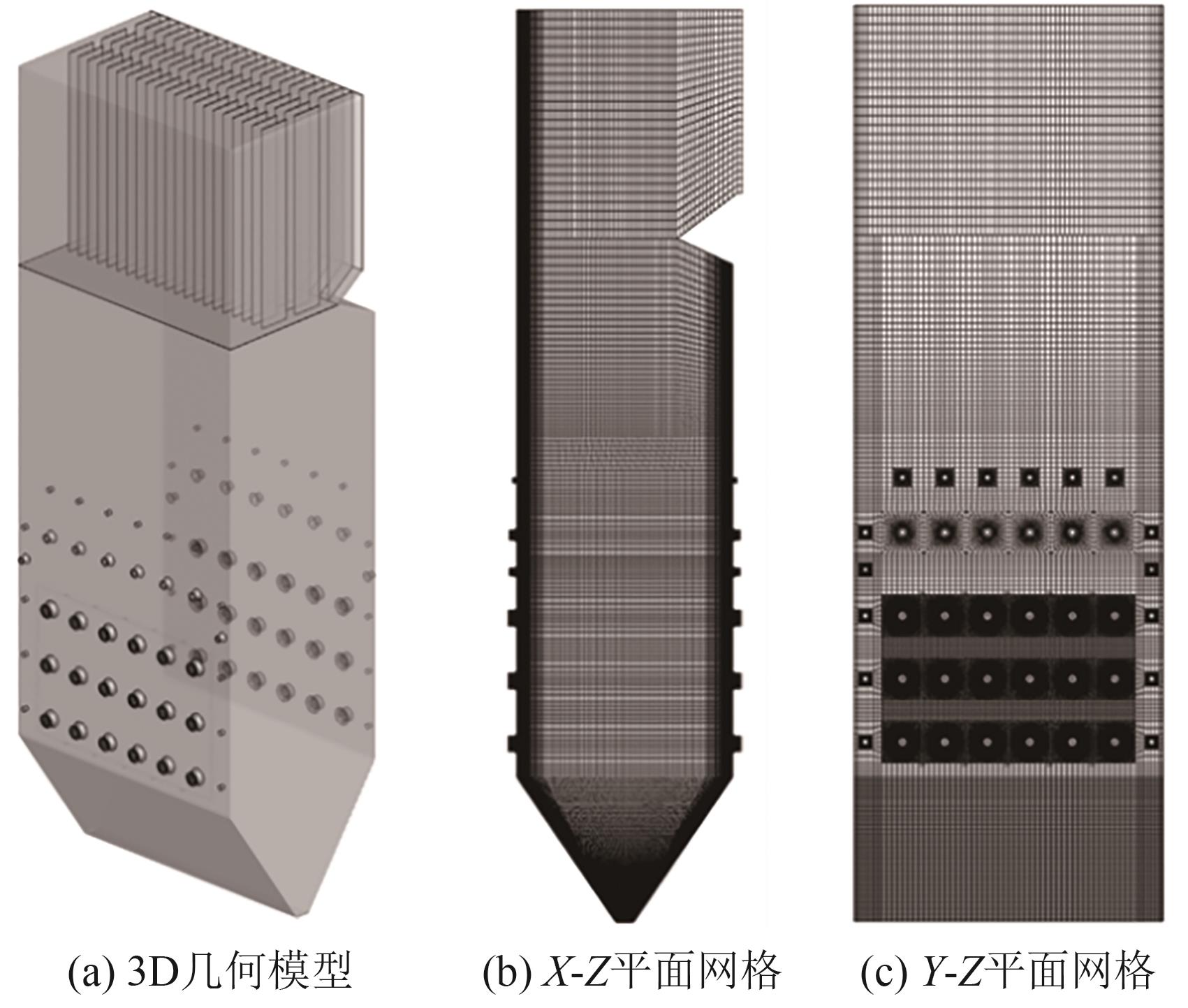
图1 全炉膛结构与网格示意图
Fig. 1 Schematic diagram of the overall furnace structure and mesh
| 模型类型 | 主要子模型 |
|---|---|
| 湍流流动模型 | Realizable k-ε模型[ |
| 颗粒运动模型 | P1模型[ |
| 煤粉挥发分模型 | 单速率方程反应模型[ |
| 焦炭燃烧模型 | 动力-扩散模型[ |
| 气相燃烧模型 | PDF模型[ |
表2 炉内燃烧过程建模采用的主要子模型
Tab. 2 Main sub-models used for combustion modelling in the furnace
| 模型类型 | 主要子模型 |
|---|---|
| 湍流流动模型 | Realizable k-ε模型[ |
| 颗粒运动模型 | P1模型[ |
| 煤粉挥发分模型 | 单速率方程反应模型[ |
| 焦炭燃烧模型 | 动力-扩散模型[ |
| 气相燃烧模型 | PDF模型[ |
| 参数 | 数值 | |
|---|---|---|
| 工业分析 | 收到基水分质量分数/% | 12.7 |
| 收到基灰分质量分数/% | 12.54 | |
| 收到基挥发分质量分数/% | 20.43 | |
| 收到基固定碳质量分数/% | 54.33 | |
| 元素分析 | 收到基碳元素质量分数/% | 80.94 |
| 收到基氢元素质量分数/% | 4.84 | |
| 收到基氧元素质量分数/% | 12.47 | |
| 收到基氮元素质量分数/% | 0.94 | |
| 收到基硫元素质量分数/% | 0.82 | |
| 低位发热量Qnet,ar/(MJ/kg) | 22.8 | |
表3 煤质分析
Tab. 3 Coal quality analysis
| 参数 | 数值 | |
|---|---|---|
| 工业分析 | 收到基水分质量分数/% | 12.7 |
| 收到基灰分质量分数/% | 12.54 | |
| 收到基挥发分质量分数/% | 20.43 | |
| 收到基固定碳质量分数/% | 54.33 | |
| 元素分析 | 收到基碳元素质量分数/% | 80.94 |
| 收到基氢元素质量分数/% | 4.84 | |
| 收到基氧元素质量分数/% | 12.47 | |
| 收到基氮元素质量分数/% | 0.94 | |
| 收到基硫元素质量分数/% | 0.82 | |
| 低位发热量Qnet,ar/(MJ/kg) | 22.8 | |
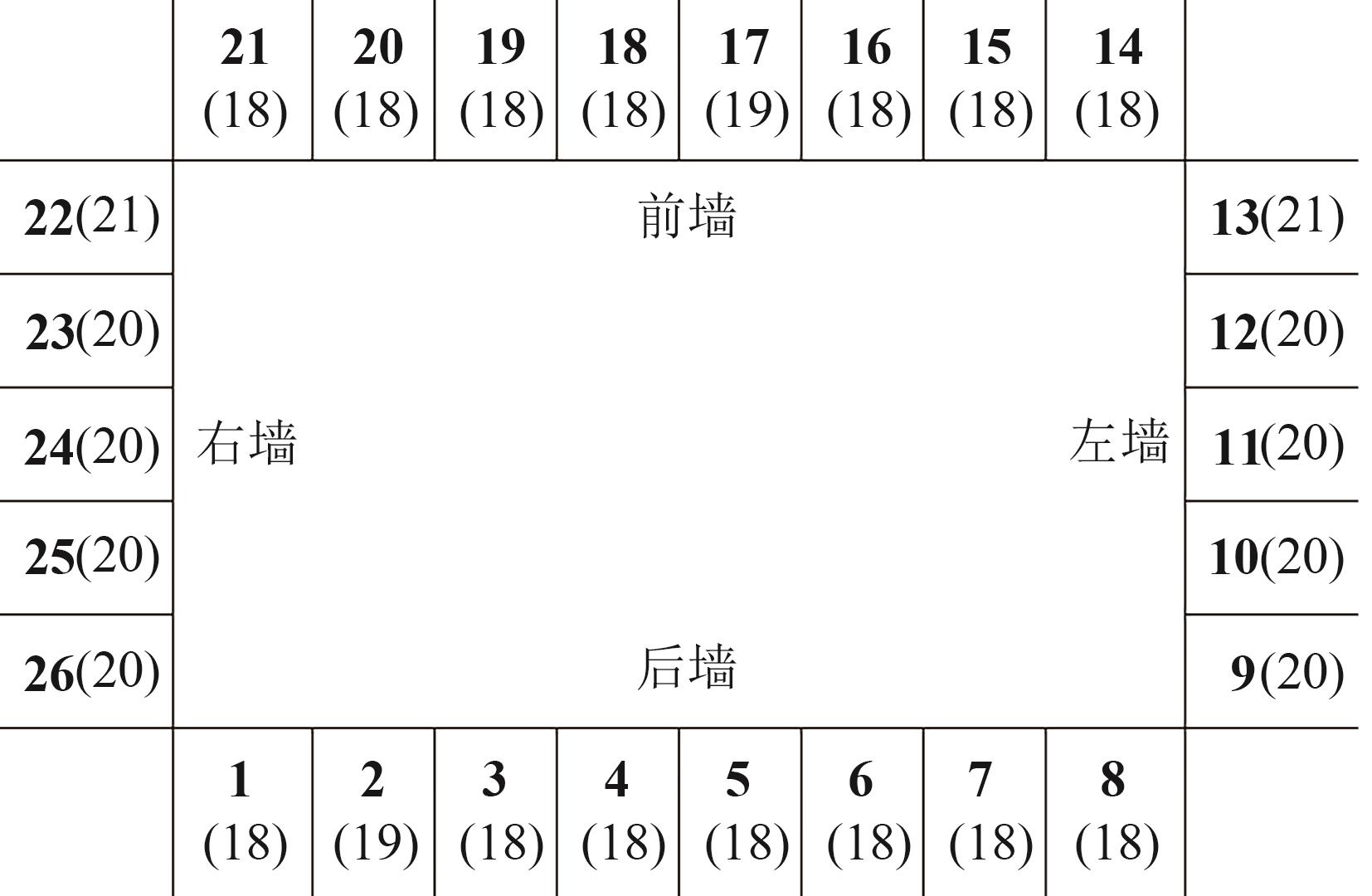
图2 下炉膛螺旋水冷壁划分示意图加粗的数字表示各回路的编号;括号内的数字为该回路内管子的数量。
Fig. 2 Schematic diagram of spiral water-cooled wall division in the lower furnace
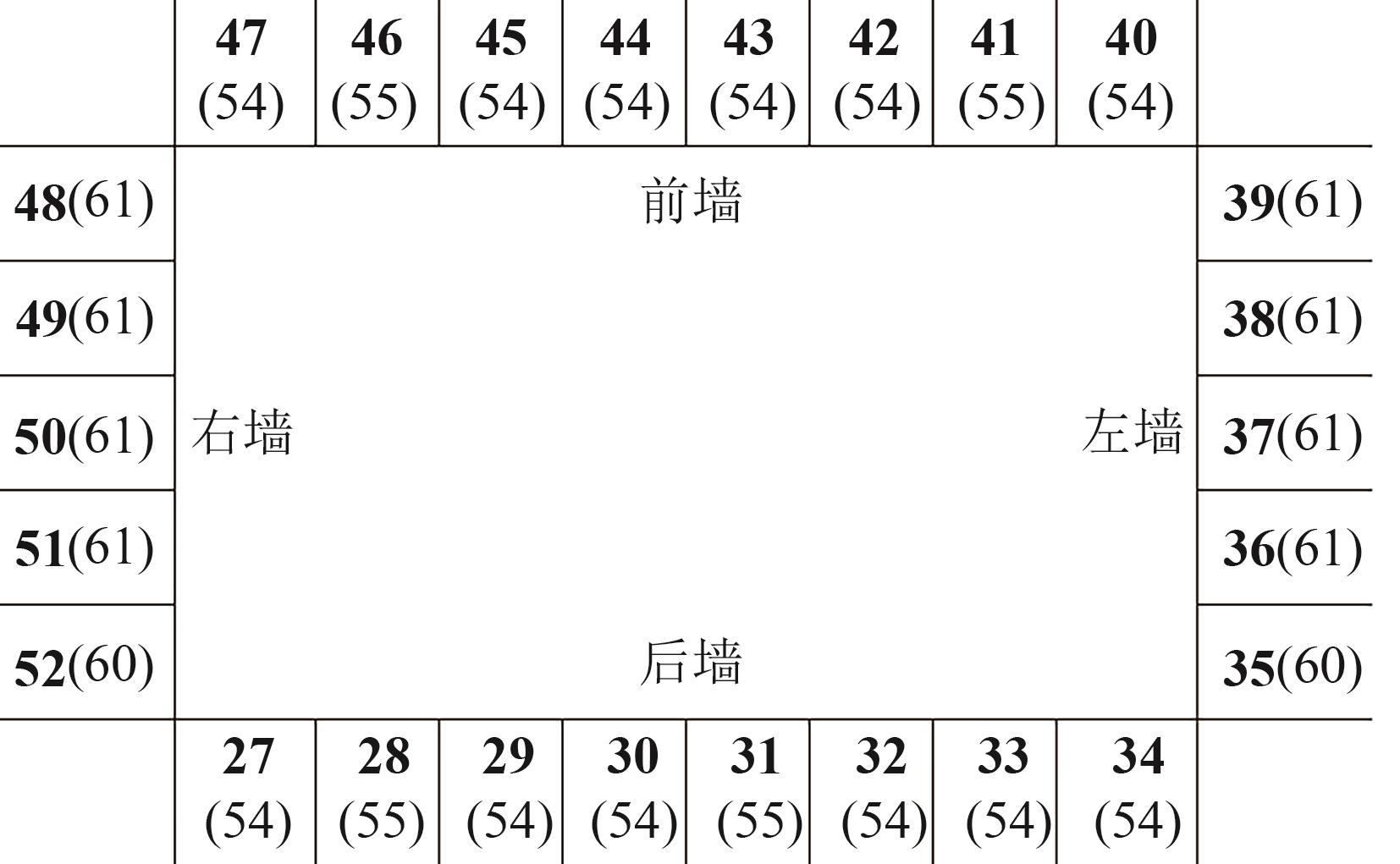
图3 上炉膛垂直水冷壁划分示意图加粗的数字表示各回路的编号;括号内的数字为该回路内管子的数量。
Fig. 3 Schematic diagram of vertical water-cooled wall division in the upper furnace
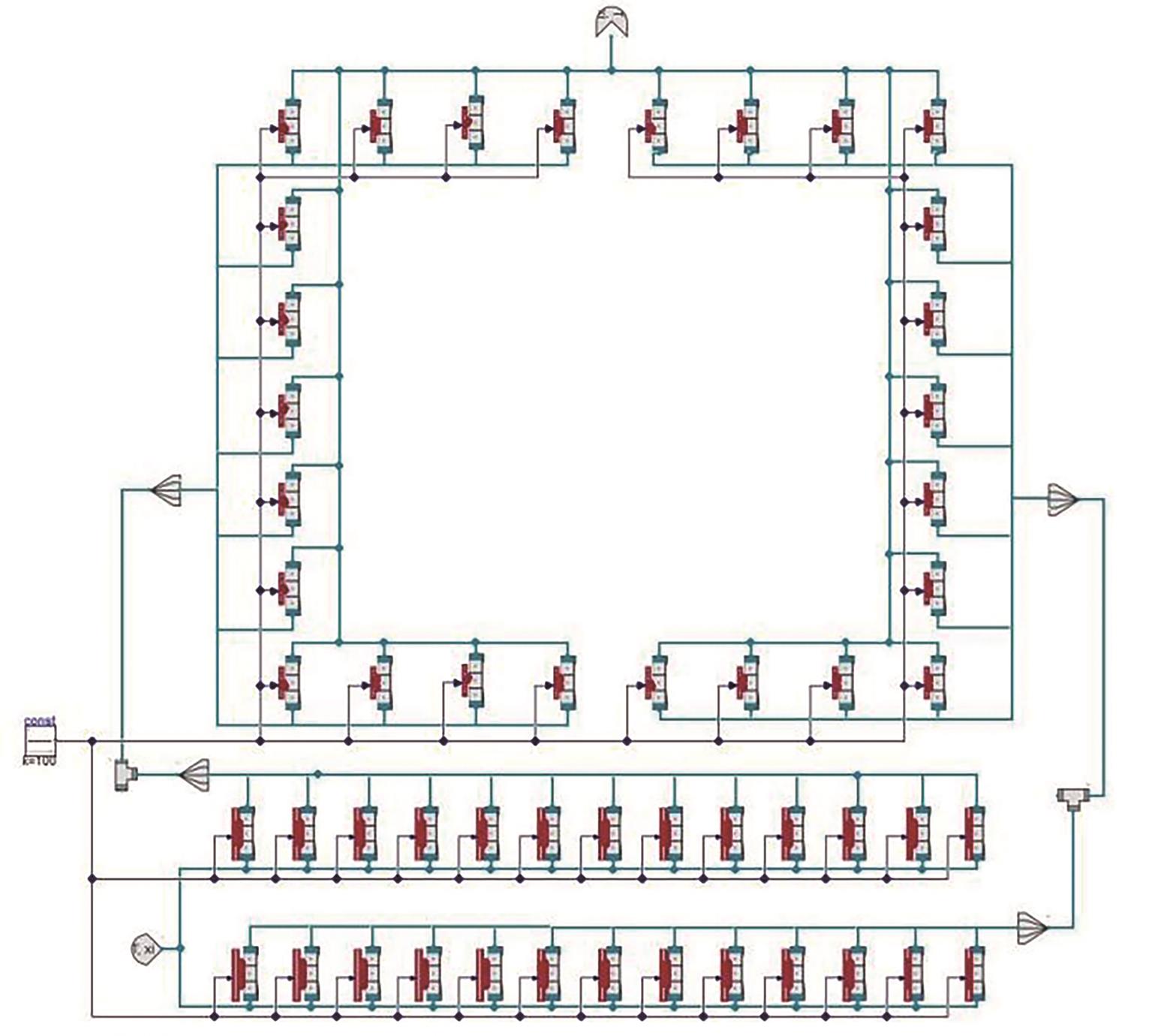
图4 工质侧模型
Fig. 4 Working fluid side model
| 负荷 | 参数 | 设计值/实测值 | 计算值 | 相对误差/% |
|---|---|---|---|---|
| 100%THA | 流量 | 498.17 kg/s | 504.80 kg/s | 1.33 |
| 出口温度 | 421.00 ℃ | 422.70 ℃ | 0.40 | |
| 出口压力 | 29.13 MPa | 28.73 MPa | -1.37 | |
| 40%THA | 流量 | 198.61 kg/s | 193.94 kg/s | -2.35 |
| 出口温度 | 340.00 ℃ | 332.69 ℃ | -2.15 | |
| 出口压力 | 11.77 MPa | 11.53 MPa | -2.04 | |
| 30%THA | 流量 | 160.96 kg/s | 162.89 kg/s | 1.20 |
| 出口温度 | 362.09 ℃ | 367.61 ℃ | 1.52 | |
| 出口压力 | 10.85 MPa | 10.82 MPa | -2.77 |
表4 各负荷水冷壁出口主要参数对比
Tab. 4 Comparison of main parameters of water wall outlet for each load
| 负荷 | 参数 | 设计值/实测值 | 计算值 | 相对误差/% |
|---|---|---|---|---|
| 100%THA | 流量 | 498.17 kg/s | 504.80 kg/s | 1.33 |
| 出口温度 | 421.00 ℃ | 422.70 ℃ | 0.40 | |
| 出口压力 | 29.13 MPa | 28.73 MPa | -1.37 | |
| 40%THA | 流量 | 198.61 kg/s | 193.94 kg/s | -2.35 |
| 出口温度 | 340.00 ℃ | 332.69 ℃ | -2.15 | |
| 出口压力 | 11.77 MPa | 11.53 MPa | -2.04 | |
| 30%THA | 流量 | 160.96 kg/s | 162.89 kg/s | 1.20 |
| 出口温度 | 362.09 ℃ | 367.61 ℃ | 1.52 | |
| 出口压力 | 10.85 MPa | 10.82 MPa | -2.77 |
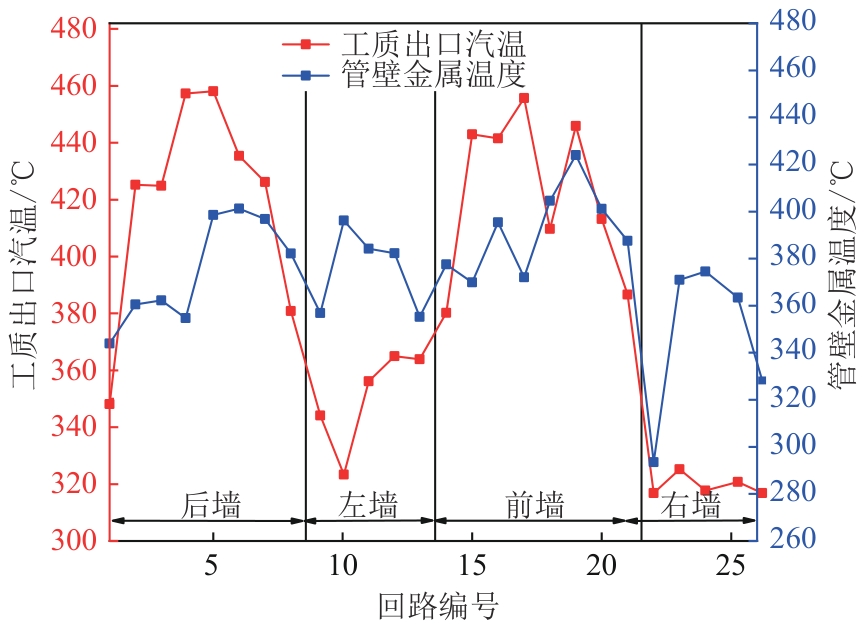
图5 30%THA下的壁温测量值和汽温计算值
Fig. 5 Wall temperature measurements and calculated steam temperatures at 30% THA
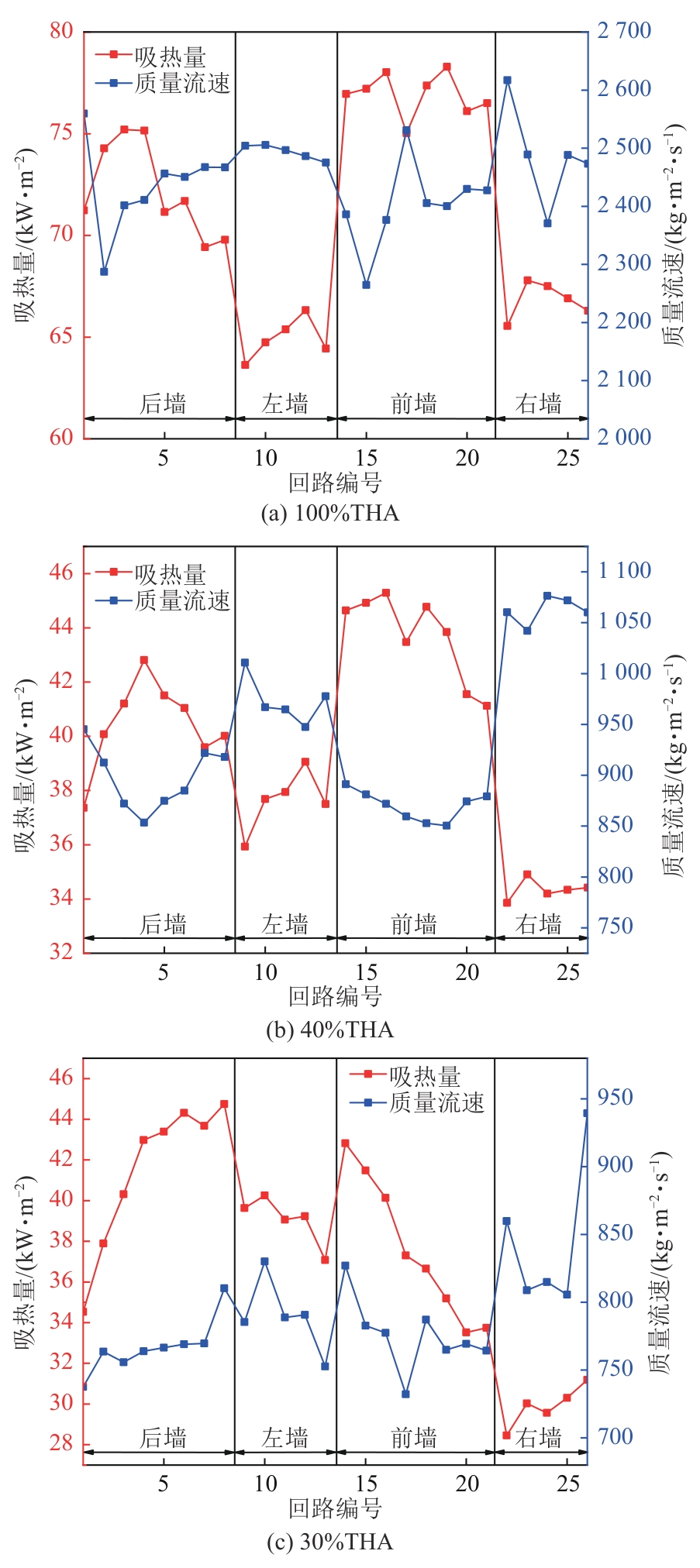
图6 螺旋水冷壁各回路吸热量及质量流速分布
Fig. 6 Distribution of heat load and mass flow rate in each circuit of the spiral water wall
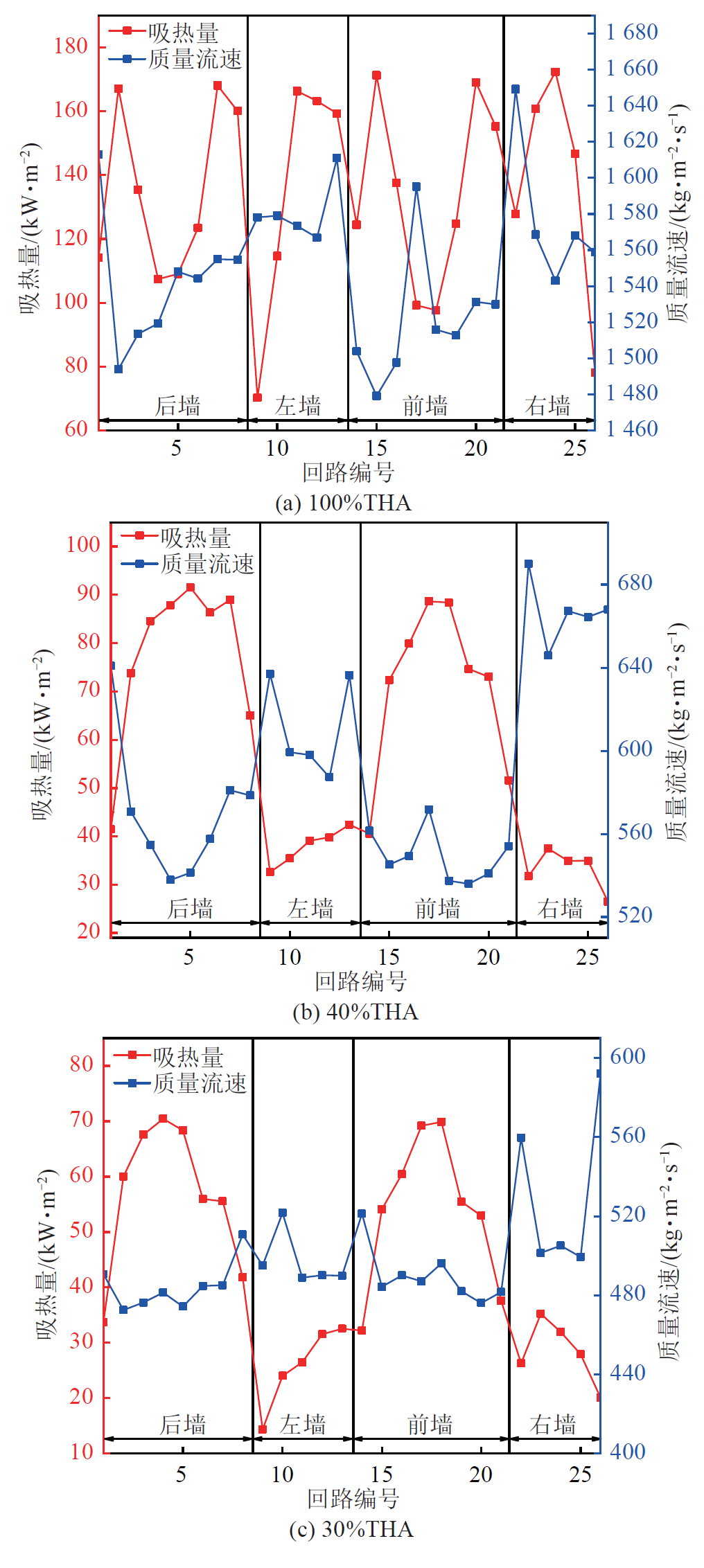
图7 垂直水冷壁各回路吸热量及质量流速分布
Fig. 7 Distribution of heat absorption and mass flow rate in each circuit of the vertical water wall
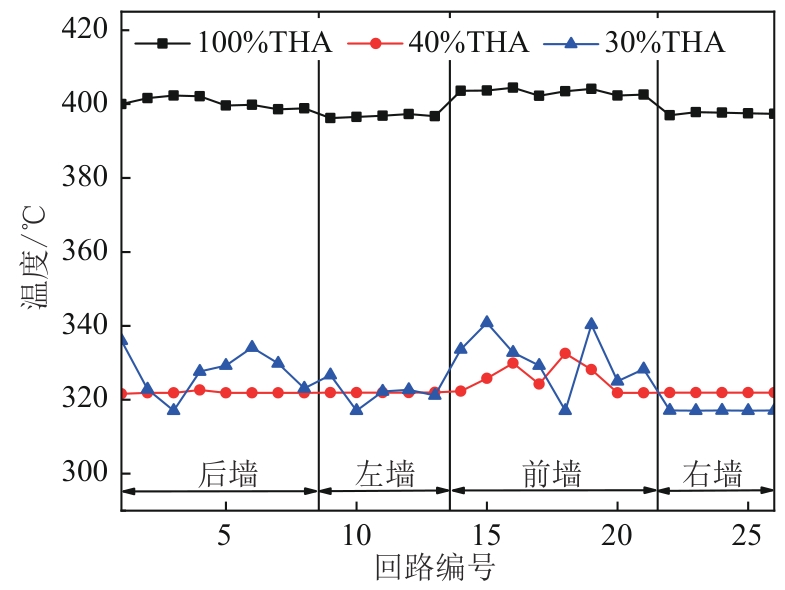
图8 螺旋水冷壁出口工质温度分布
Fig. 8 Spiral water wall outlet mass temperature distribution
| 负荷 | 最低温度 | 最高温度 | 最大温差 |
|---|---|---|---|
| 100%THA | 396.19 | 404.45 | 8.24 |
| 40%THA | 321.63 | 332.02 | 10.39 |
| 30%THA | 317.04 | 348.14 | 31.10 |
表5 螺旋水冷壁出口工质温度比较 (℃)
Tab. 5 Spiral water wall outlet mass temperature comparison
| 负荷 | 最低温度 | 最高温度 | 最大温差 |
|---|---|---|---|
| 100%THA | 396.19 | 404.45 | 8.24 |
| 40%THA | 321.63 | 332.02 | 10.39 |
| 30%THA | 317.04 | 348.14 | 31.10 |
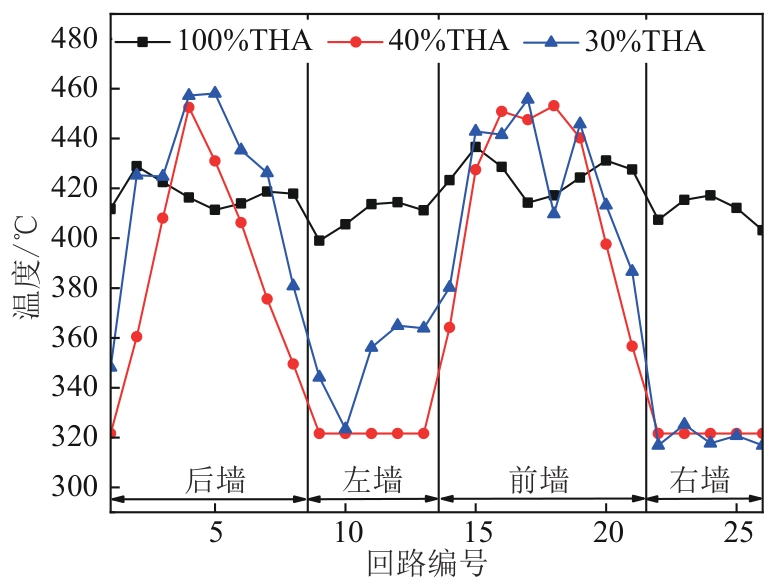
图9 垂直水冷壁出口工质温度分布
Fig. 9 Vertical water wall outlet mass temperature distribution
| 负荷 | 最低温度 | 最高温度 | 最大温差 |
|---|---|---|---|
| 100%THA | 398.96 | 436.56 | 37.60 |
| 40%THA | 321.63 | 459.96 | 138.33 |
| 30%THA | 316.81 | 458.09 | 141.27 |
表6 垂直水冷壁出口工质温度比较 (℃)
Tab. 6 Vertical water wall outlet mass temperature comparison
| 负荷 | 最低温度 | 最高温度 | 最大温差 |
|---|---|---|---|
| 100%THA | 398.96 | 436.56 | 37.60 |
| 40%THA | 321.63 | 459.96 | 138.33 |
| 30%THA | 316.81 | 458.09 | 141.27 |
| [1] | 许洪华,邵桂萍,鄂春良,等 .我国未来能源系统及能源转型现实路径研究[J].发电技术,2023,44(4):484-491. doi:10.12096/j.2096-4528.pgt.23002 |
| XU H H, SHAO G P, E C L,et al .Research on China’s future energy system and the realistic path of energy transformation[J].Power Generation Technology,2023,44(4):484-491. doi:10.12096/j.2096-4528.pgt.23002 | |
| [2] | 任卓亚,郭宁,解佗,等 .我国清洁能源发展规律分析及其与经济系统的协调发展评价[J].电网与清洁能源,2024,40(12):128-134. |
| REN Z Y, GUO N, XIE T,et al .A study on the development patterns of clean energy in China and evaluation of its coordinated development with the economic system[J].Power System and Clean Energy,2024,40(12):128-134. | |
| [3] | 郭婷婷,曹蕃 .低碳能源系统发展趋势与应用实践[J].分布式能源,2025,10(1):1-13. doi:10.16513/j.2096-2185.DE.(2025)010-01-0001-13 |
| GUO T T, CAO F .Development trend and application of low-carbon energy system[J].Distributed Energy,2025,10(1):1-13. doi:10.16513/j.2096-2185.DE.(2025)010-01-0001-13 | |
| [4] | 周太东,王泺,施训鹏 .能源清洁转型与全球发展路径[J].全球能源互联网,2024,7(6):627-628. |
| ZHOU T D, WANG L, SHI X P .Clean energy transition and international development path[J].Journal of Global Energy Interconnection,2024,7(6):627-628. | |
| [5] | 国家发展改革委,国家能源局 .“十四五”现代能源体系规划[EB/OL].(2022-01-29)[2024-06-25].. |
| National Development and Reform Commission,National Energy Administration .The 14th Five-Year Plan for the modern energy system[EB/OL].(2022-01-29)[2024-06-25].. | |
| [6] | 中国电力企业联合会 .2023—2024年度全国电力供需形势分析预测报告[EB/OL].(2024-01-30)[2024-06-25].. doi:10.3969/j.issn.1009-5578.2017.02.003 |
| China Electricity Council .Analysis and forecast report on national power supply and demand situation for 2023-2024[EB/OL].(2024-01-30)[2024-06-25].. doi:10.3969/j.issn.1009-5578.2017.02.003 | |
| [7] | MODLIŃSKI N, SZCZEPANEK K, NABAGŁO D,et al .Mathematical procedure for predicting tube metal temperature in the second stage reheater of the operating flexibly steam boiler[J].Applied Thermal Engineering,2019,146:854-865. doi:10.1016/j.applthermaleng.2018.10.063 |
| [8] | 黄越辉,卢慧,李建华,等 .新能源极端出力特性及典型电力电量平衡场景研究[J].电网与清洁能源,2024,40(2):1-9. |
| HUANG Y H, LU H, LI J H,et al .A study on the characteristics of renewable energy extreme output and typical power and energy balancing scenarios for new type power systems[J].Advances of Power System & Hydroelectric Engineering,2024,40(2):1-9. | |
| [9] | 谢菁,吕涛,方德斌 .低碳转型目标下的电力社会价值研究[J].全球能源互联网,2024,7(6):650-661. |
| XIE J,LYU T, FANG D B .The social value analysis of electric power considering the target of low-carbon transition[J].Journal of Global Energy Interconnection,2024,7(6):650-661. | |
| [10] | 闫群民,任效煜,宋潇,等 .考虑源荷不确定性的电力系统灵活调度策略[J].电力工程技术,2025,44(2):172-184. doi:10.12158/j.2096-3203.2025.02.016 |
| YAN Q M, REN X Y, SONG X,et al .Flexible scheduling strategy for power systems considering source-load uncertainty[J].Electric Power Engineering Technology,2025,44(2):172-184. doi:10.12158/j.2096-3203.2025.02.016 | |
| [11] | 刘新苗,刘俊磊,娄源媛,等 .基于时序模拟的风火打捆送出消纳规划优化方法[J].南方电网技术,2025,19(8):53-63. doi:10.13648/j.cnki.issn1674-0629.2025.08.006 |
| LIU X M, LIU J L, LOU Y Y,et al .Planning optimization method for transmission and consumption of wind-thermal bundled based on time series simulation[J].Southern Power System Technology,2025,19(8):53-63. doi:10.13648/j.cnki.issn1674-0629.2025.08.006 | |
| [12] | 刘志强,李建锋,潘荔,等 .中国煤电机组改造升级效果分析与展望[J].中国电力,2024,57(7):1-11. doi:10.11930/j.issn.1004-9649.202402031 |
| LIU Z Q, LI J F, PAN L,et al .Analysis and prospect of transformation and upgrading effects of coal-fired power units in China[J].Electric Power,2024,57(7):1-11. doi:10.11930/j.issn.1004-9649.202402031 | |
| [13] | 王志轩,张晶杰,董博,等 .“双碳”目标下燃煤电厂灵活性改造及政策建议[J].电力科技与环保,2024,40(3):213-220. doi:10.19944/j.eptep.1674-8069.2024.03.001 |
| WANG Z X, ZHANG J J, DONG B,et al .Research on technology and policy of flexibility renovation for coal-fired power plants under carbon peaking and carbon neutrality goal[J].Electric Power Technology and Environmental Protection,2024,40(3):213-220. doi:10.19944/j.eptep.1674-8069.2024.03.001 | |
| [14] | 严新荣,胡志勇,张鹏威,等 .煤电机组运行灵活性提升技术研究与应用[J].发电技术,2024,45(6):1074-1086. doi:10.12096/j.2096-4528.pgt.24170 |
| YAN X R, HU Z Y, ZHANG P W,et al .Research and application of operation flexibility improvement technology for coal-fired power unit[J].Power Generation Technology,2024,45(6):1074-1086. doi:10.12096/j.2096-4528.pgt.24170 | |
| [15] | YUE X, LIAO S, XU J,et al .Collaborative optimization of renewable energy power systems integrating electrolytic aluminum load regulation and thermal power deep peak shaving[J].Applied Energy,2024,373:123869. doi:10.1016/j.apenergy.2024.123869 |
| [16] | 倪晓滨,周克毅,徐青蓝 .30%BMCR工况下超临界锅炉水冷壁水动力安全性评估[J].发电设备,2021,35(3):149-156. doi:10.19806/j.cnki.fdsb.2021.03.001 |
| NI X B, ZHOU K Y, XU Q L .Hydrodynamic calculation and safety evaluation for the water wall in a supercritical boiler under 30% BMCR[J].Power Equipment,2021,35(3):149-156. doi:10.19806/j.cnki.fdsb.2021.03.001 | |
| [17] | 聂鑫,杨冬,吕宏彪,等 .某1 000 MW对冲燃烧超超临界锅炉水冷壁汽温偏差分析及设计运行对策[J].中国电机工程学报,2019,39(3):744-753. doi:10.13334/j.0258-8013.pcsee.180582 |
| NIE X, YANG D, LÜ H B,et al .Analysis on the steam temperature deviation of water wall and the countermeasures of design and operation for a 1 000 MW ultra supercritical boiler with opposed firing[J].Proceedings of the CSEE,2019,39(3):744-753. doi:10.13334/j.0258-8013.pcsee.180582 | |
| [18] | 邓启刚,吕卓,石友,等 .不带外置床的700 MW超超临界循环流化床锅炉失电后水冷壁安全计算分析[J].发电技术,2024,45(2):240-249. doi:10.12096/j.2096-4528.pgt.23134 |
| DENG Q G, LÜ Z, SHI Y,et al .Safety calculation and analysis of water wall for a 700 MW ultra-supercritical circulating fluidized bed boiler without external bed after power failure[J].Power Generation Technology,2024,45(2):240-249. doi:10.12096/j.2096-4528.pgt.23134 | |
| [19] | 王为术,郭会军,上官闪闪,等 .超临界锅炉螺旋水冷壁流量分配和壁温特性的研究[J].热能动力工程,2016,31(1):59-65. doi:10.16146/j.cnki.rndlgc.2016.01.010 |
| WANG W S, GUO H J, SHANGGUAN S S,et al .Study of the flow rate distribution and wall temperature characteristics of the spirally-coiled tube water wall in a supercritical boiler[J].Journal of Engineering for Thermal Energy and Power,2016,31(1):59-65. doi:10.16146/j.cnki.rndlgc.2016.01.010 | |
| [20] | MAGNUSSEN B F, HJERTAGER B H .On mathematical modeling of turbulent combustion with special emphasis on soot formation and combustion[J].Symposium (International) on Combustion,1977,16(1):719-729. doi:10.1016/S0082-0784(77)80366-4 |
| [21] | 董乐,辛亚飞,李娟,等 .660 MW超超临界循环流化床锅炉水动力及流动不稳定特性计算分析[J].中国电机工程学报,2020,40(5):1545-1554. doi:10.13334/j.0258-8013.pcsee.191718 |
| DONG L, XIN Y F, LI J,et al .Computational analysis on thermal-hydraulic characteristics and flow instability of a 660 MW ultra-supercritical circulating fluidized bed boiler[J].Proceedings of the CSEE,2020,40(5):1545-1554. doi:10.13334/j.0258-8013.pcsee.191718 | |
| [22] | 唐斌,顾君苹,张缦,等 .350 MW超临界循环流化床锅炉水冷壁流量分配及壁温计算[J].煤炭学报,2016,41(10):2560-2567. doi:10.13225/j.cnki.jccs.2016.8016 |
| TANG B, GU J P, ZHANG M,et al .Calculation on distribution of flow rate and temperature in water wall of 350 MW supercritical circulating fluidized bed boiler[J].Journal of China Coal Society,2016,41(10):2560-2567. doi:10.13225/j.cnki.jccs.2016.8016 | |
| [23] | 滕敏华,胡卿,万李,等 .1 000 MW宽负荷超超临界机组锅炉水动力特性计算及分析[J].热力发电,2019,48(4):60-67. doi:10.19666/j.rlfd.201809193 |
| TENG M H, HU Q, WAN L,et al .Calculation and analysis on hydrodynamic characteristics of an ultra-supercritical unit boiler with 1 000 MW broad regulation load[J].Thermal Power Generation,2019,48(4):60-67. doi:10.19666/j.rlfd.201809193 | |
| [24] | ZIMA W, NOWAK-OCŁOŃ M, OCŁOŃ P .Simulation of fluid heating in combustion chamber waterwalls of boilers for supercritical steam parameters[J].Energy,2015,92:117-127. doi:10.1016/j.energy.2015.02.111 |
| [25] | KHAUSTOV S A, ZAVORIN A S, BUVAKOV K V,et al .Computer simulation of the fire-tube boiler hydrodynamics[J].EPJ Web of Conferences,2015,82:01039. |
| [26] | ELGANDELWAR A M, JHA R S, LELE M M . Steady-state flow distribution analysis of natural circulation in water tube boiler[J].Computational Thermal Sciences,2020,12(3):275-288. doi:10.1615/computthermalscien.2020033963 |
| [27] | XUE W, LU Y, WANG Z,et al .Reconstructing near-water-wall temperature in coal-fired boilers using improved transfer learning and hidden layer configuration optimization[J].Energy,2024,294:130860. doi:10.1016/j.energy.2024.130860 |
| [28] | 姚杨,陈鑫科,马仑,等 .某1 000 MW双切圆锅炉燃烧侧和工质侧耦合建模及应用[J/OL].中国电机工程学报,1-14[2024-06-29]. . |
| YAO Y, CHEN X K, MA L,et al .Coupled modeling and application of combustion-side and mass-side coupling in a 1000 MW double-cut circular boiler[J/OL].Chinese Journal of Electrical Engineering,1-14[2024-06-29]. . | |
| [29] | 安吉华,马庆华,张一帆,等 .超超临界1 000 MW二次再热机组塔式锅炉水动力特性及壁温分布规律[J].热力发电,2018,47(12):134-140. |
| AN J H, MA Q H, ZHANG Y F,et al .Thermal hydrodynamic characteristics and wall temperature distribution of an ultra-supercritical 1 000 MW unit double-reheat tower type boiler[J].Thermal Power Generation,2018,47(12):134-140. | |
| [30] | 庞力平,袁虎,丘文生,等 .深度调峰锅炉水动力特性分析[J].化工进展,2023,42(4):1708-1718. doi:10.16085/j.issn.1000-6613.2022-1143 |
| PANG L P, YUAN H, QIU W S,et al .Hydrodynamic characteristics during peaking operation in utility boiler[J].Chemical Industry and Engineering Progress,2023,42(4):1708-1718. doi:10.16085/j.issn.1000-6613.2022-1143 | |
| [31] | 王超,王研凯,陈相如,等 .660 MW超临界直流锅炉水冷壁动态特性仿真研究[J].动力工程学报,2024,44(7):1001-1009. doi:10.19805/j.cnki.jcspe.2024.230297 |
| WANG C, WANG Y K, CHEN X R,et al .Simulation study on dynamic characteristics of water-cooled wall of a 660 MW supercritical once-through boiler[J].Journal of Chinese Society of Power Engineering,2024,44(7):1001-1009. doi:10.19805/j.cnki.jcspe.2024.230297 | |
| [32] | 方庆艳,周怀春,汪华剑,等 .W火焰锅炉结渣特性数值模拟[J].中国电机工程学报,2008,28(23):1-7. doi:10.3321/j.issn:1000-6761.2008.05.005 |
| FANG Q Y, ZHOU H C, WANG H J,et al .Numerical simulation of the ash deposition characteristics in a W-flame boiler furnace[J].Proceedings of the CSEE,2008,28(23):1-7. doi:10.3321/j.issn:1000-6761.2008.05.005 | |
| [33] | MAJUMDAR A K, SPALDING D B .Numerical computation of Taylor vortices[J].Journal of Fluid Mechanics,1977,81(2):295-304. doi:10.1017/S0022112077002043 |
| [34] | LAUNDER B E, SPALDING D B .Lectures in mathematical models of turbulence[M].London,New York:Academic Press,1972:8-11. |
| [35] | FANG Q, MUSA A A B, WEI Y,et al .Numerical simulation of multifuel combustion in a 200 MW tangentially fired utility boiler[J].Energy & Fuels,2012,26(1):313-323. doi:10.1021/ef201149p |
| [36] | BAUM M M, STREET P J .Predicting the combustion behaviour of coal particles[J].Combustion Science and Technology,1971,3(5):231-243. doi:10.1080/00102207108952290 |
| [37] | TAN P, MA L, FANG Q,et al .Application of different combustion models for simulating the co-combustion of sludge with coal in a 100 MW tangentially coal-fired utility boiler[J].Energy & Fuels,2016,30(3):1685-1692. doi:10.1021/acs.energyfuels.5b02236 |
| [1] | 陈禄, 王波, 王登亮, 陈伟雄, 刘继平. 燃煤发电机组瞬态变负荷过程性能优化研究[J]. 发电技术, 2026, 47(1): 157-167. |
| [2] | 李建军, 尚曼霞, 董海龙, 李冰铭, 黄中. 350 MW超临界循环流化床锅炉联合脱硝技术应用与优化研究[J]. 发电技术, 2025, 46(5): 1014-1021. |
| [3] | 罗晟, 王磊, 李杨, 孟庆明, 张贵彬, 赵元宾. 变流量配水对湿冷塔冷却特性的影响及其优化[J]. 发电技术, 2025, 46(5): 1041-1049. |
| [4] | 陈璟, 刘辉, 朱萌, 王灿, 陈磊, 周敬, 许凯, 江龙, 胡松, 向军. 125 MW超临界CO2燃煤发电机组烟气再循环对锅炉热力性能及经济性的影响分析[J]. 发电技术, 2025, 46(5): 986-995. |
| [5] | 张鹏新, 高明明, 解沛然, 于浩洋, 张洪福, 黄中. 基于数据驱动的循环流化床机组深度调峰NO x 预测[J]. 发电技术, 2025, 46(3): 627-636. |
| [6] | 张国林, 曾喆昭, 唐钰淇. 超临界机组燃水比系统的自耦PID控制方法[J]. 发电技术, 2025, 46(2): 344-352. |
| [7] | 严新荣, 胡志勇, 张鹏威, 郑成航, 向军, 唐郭安, 刘金亮, 郭剑雄, 黄一博, 于鹏峰, 高翔. 煤电机组运行灵活性提升技术研究与应用[J]. 发电技术, 2024, 45(6): 1074-1086. |
| [8] | 董建宁, 安吉振, 陈衡, 潘佩媛, 徐钢, 王修彦. 考虑天气影响的火电机组空冷系统性能预测方法[J]. 发电技术, 2024, 45(6): 1105-1113. |
| [9] | 郑淇薇, 赵欣悦, 卢荻, 陈衡, 潘佩媛, 刘彤. 多类型小容量火电机组热电解耦潜力与经济性对比评估[J]. 发电技术, 2024, 45(5): 929-940. |
| [10] | 丁湧. 1 000 MW超超临界燃煤锅炉深度调峰研究[J]. 发电技术, 2024, 45(3): 382-391. |
| [11] | 代华松, 浦绍旭, 柴国旭, 金李, 陈为平, 解明亮. 350 MW超临界流化床机组深度调峰研究与应用[J]. 发电技术, 2024, 45(3): 401-411. |
| [12] | 张思海, 李超然, 万广亮, 刘印学, 徐海楠, 黄中, 杨海瑞. 330 MW 循环流化床锅炉深度调峰技术[J]. 发电技术, 2024, 45(2): 199-206. |
| [13] | 郑淇薇, 王华霆, 陈衡, 潘佩媛, 徐钢. 深度调峰背景下火电机组热电解耦技术路径对比分析[J]. 发电技术, 2024, 45(2): 207-215. |
| [14] | 贾志军, 范伟, 任少君, 魏唐斌. 600 MW亚临界机组长时间深度调峰燃烧稳定性研究[J]. 发电技术, 2024, 45(2): 216-225. |
| [15] | 李展, 杨振勇, 刘磊, 陈振山, 季卫鸣, 洪烽. 火电机组深度调峰工况下炉侧蓄热系数对一次调频能力的影响分析[J]. 发电技术, 2024, 45(2): 226-232. |
| 阅读次数 | ||||||
|
全文 |
|
|||||
|
摘要 |
|
|||||
