

发电技术 ›› 2026, Vol. 47 ›› Issue (2): 274-284.DOI: 10.12096/j.2096-4528.pgt.260205
• 发电及环境保护 • 上一篇
童志庭1,2, 樊岳1,2, 刘新霞1,2, 张超1,2
收稿日期:2025-04-17
修回日期:2025-05-19
出版日期:2026-04-30
发布日期:2026-04-21
作者简介:基金资助:Zhiting TONG1,2, Yue FAN1,2, Xinxia LIU1,2, Chao ZHANG1,2
Received:2025-04-17
Revised:2025-05-19
Published:2026-04-30
Online:2026-04-21
Supported by:摘要:
目的 针对分布式能源中微型燃气轮机碳排放偏高的问题,研究了某10 kW微型燃气轮机燃烧室掺氨条件下的燃烧特性。 方法 通过计算流体力学数值模拟,耦合Okafor详细机理,分析了不同掺氨比、当量比对燃烧效率和NO、CO排放的影响。 结果 随着掺氨比从0增大至1.0,燃烧室出口流体速度从62.27 m/s增大至63.69 m/s,总压恢复系数从97.81%降低至97.18%;CO质量分数显著减少至接近0,但NO质量分数从1.16×10-4增至3.68×10-4,表明氨燃料虽然降低了CO排放,但增加了NO生成;燃烧效率也略有下降,从98.14%下降至97.64%。当量比对燃烧性能和排放有显著影响,低当量比时NO排放量较低,当量比达到1.0时NO排放达到峰值,富燃条件下NO排放减少,但燃烧效率也降低。 结论 甲烷/氨气的应用需在总压恢复系数、NO和CO排放、燃烧效率之间寻求平衡,并需要进一步优化设计,以实现高效、低排放的燃烧性能。
中图分类号:
童志庭, 樊岳, 刘新霞, 张超. 微型燃气轮机燃烧室掺氨燃烧性能分析[J]. 发电技术, 2026, 47(2): 274-284.
Zhiting TONG, Yue FAN, Xinxia LIU, Chao ZHANG. Performance Analysis of Ammonia-Doped Combustion in Micro Gas Turbine Combustion Chamber[J]. Power Generation Technology, 2026, 47(2): 274-284.
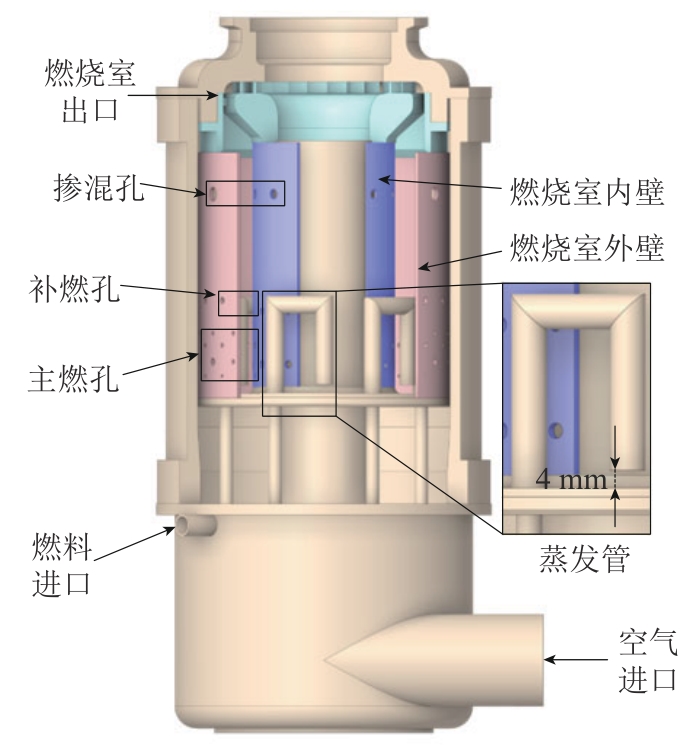
图1 微型燃气轮机三维模型
Fig. 1 3D model of micro gas turbine
| 参数 | 数值 |
|---|---|
| 蒸发管数量/个 | 6 |
| 蒸发管内直径/mm | 6.0 |
| 火焰筒内、外直径/mm | 61.0、117.0 |
| 火焰筒高度/mm | 137.0 |
| 主燃孔1、2直径/mm | 1.5、2.0 |
| 补燃孔1、2直径/mm | 2.0、3.0 |
| 掺混孔1、2直径/mm | 6.5、4.5 |
| 火焰筒壁厚/mm | 2.0 |
| 燃气轮机外壳内、外直径/mm | 48.0、144.0 |
| 燃气轮机外壳高度/mm | 325.0 |
| 燃气轮机外壳厚度/mm | 5.5 |
| 空气质量流量/(kg/s) | 0.11 |
| 空气温度/K | 430 |
| 燃料质量流量/(kg/s) | 0.001 837 |
| 燃料温度/K | 300 |
| 压力/kPa | 310 |
表1 微型燃气轮机主要参数
Tab. 1 Main parameters of micro gas turbine
| 参数 | 数值 |
|---|---|
| 蒸发管数量/个 | 6 |
| 蒸发管内直径/mm | 6.0 |
| 火焰筒内、外直径/mm | 61.0、117.0 |
| 火焰筒高度/mm | 137.0 |
| 主燃孔1、2直径/mm | 1.5、2.0 |
| 补燃孔1、2直径/mm | 2.0、3.0 |
| 掺混孔1、2直径/mm | 6.5、4.5 |
| 火焰筒壁厚/mm | 2.0 |
| 燃气轮机外壳内、外直径/mm | 48.0、144.0 |
| 燃气轮机外壳高度/mm | 325.0 |
| 燃气轮机外壳厚度/mm | 5.5 |
| 空气质量流量/(kg/s) | 0.11 |
| 空气温度/K | 430 |
| 燃料质量流量/(kg/s) | 0.001 837 |
| 燃料温度/K | 300 |
| 压力/kPa | 310 |
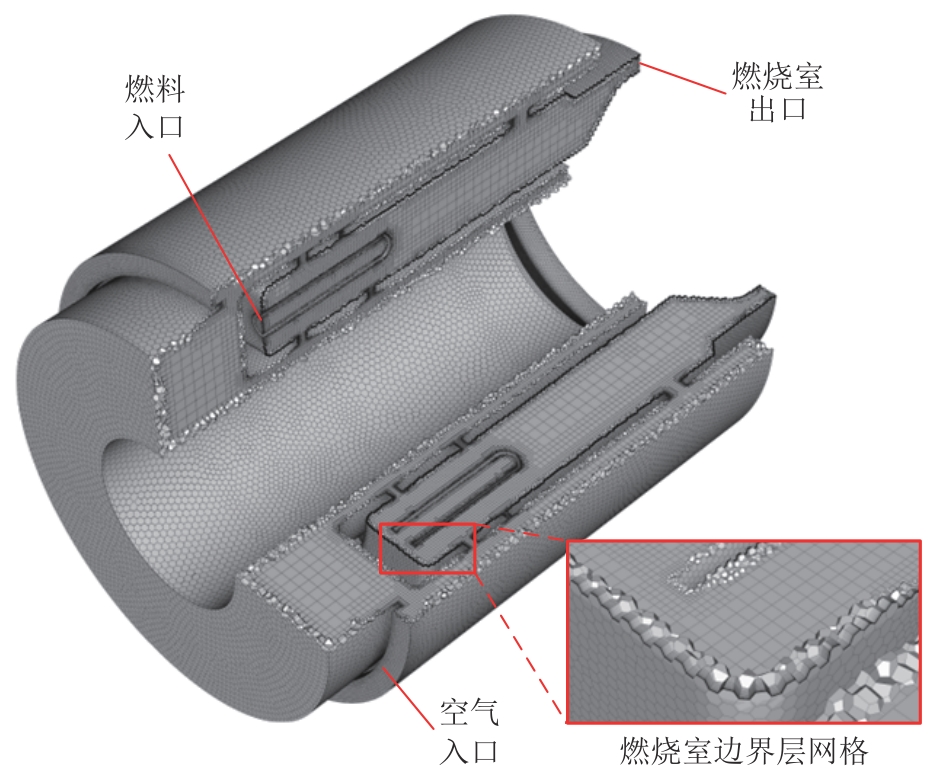
图2 燃烧室网格
Fig. 2 Mesh of combustion chamber
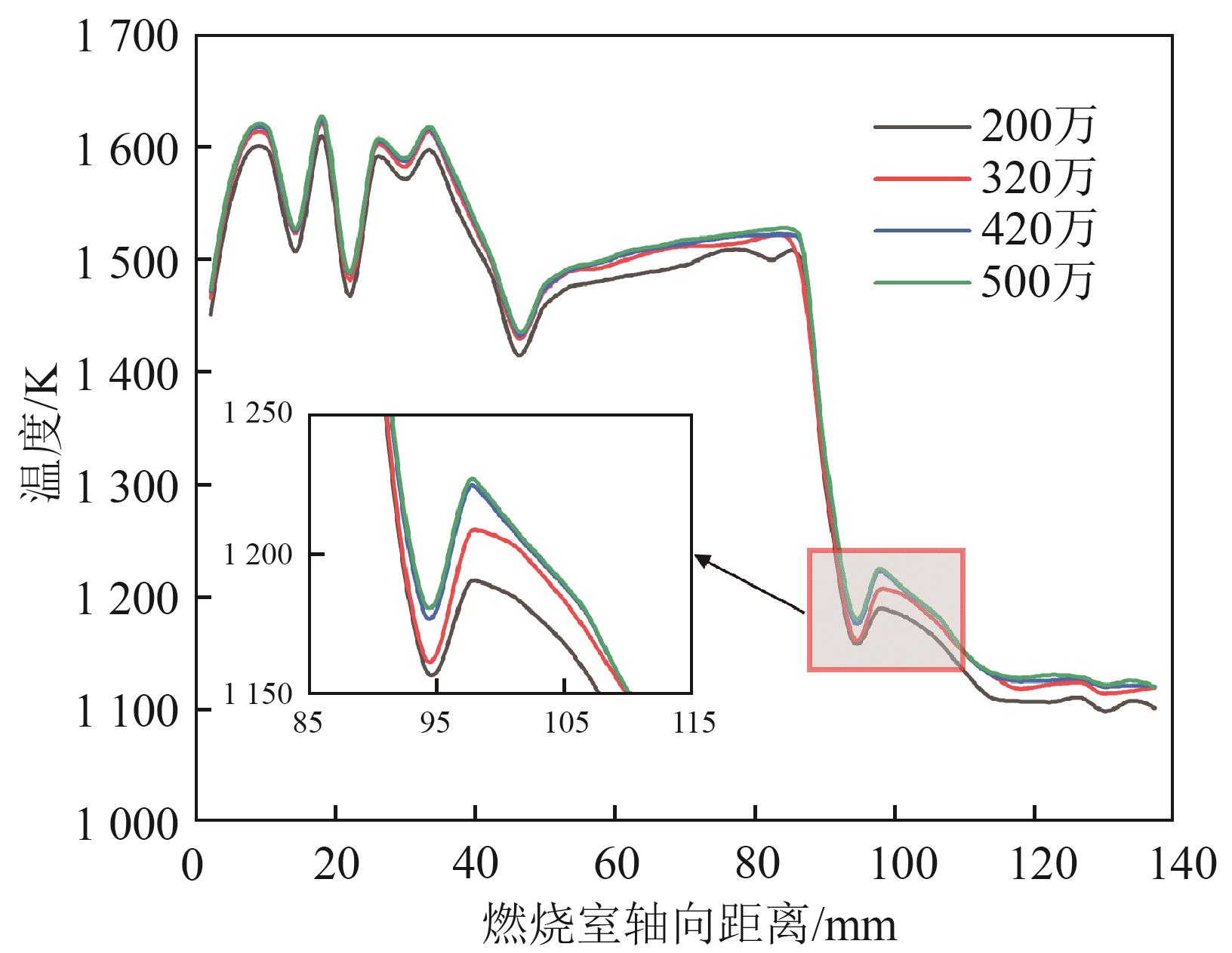
图3 网格无关性验证
Fig. 3 Mesh-independent verification
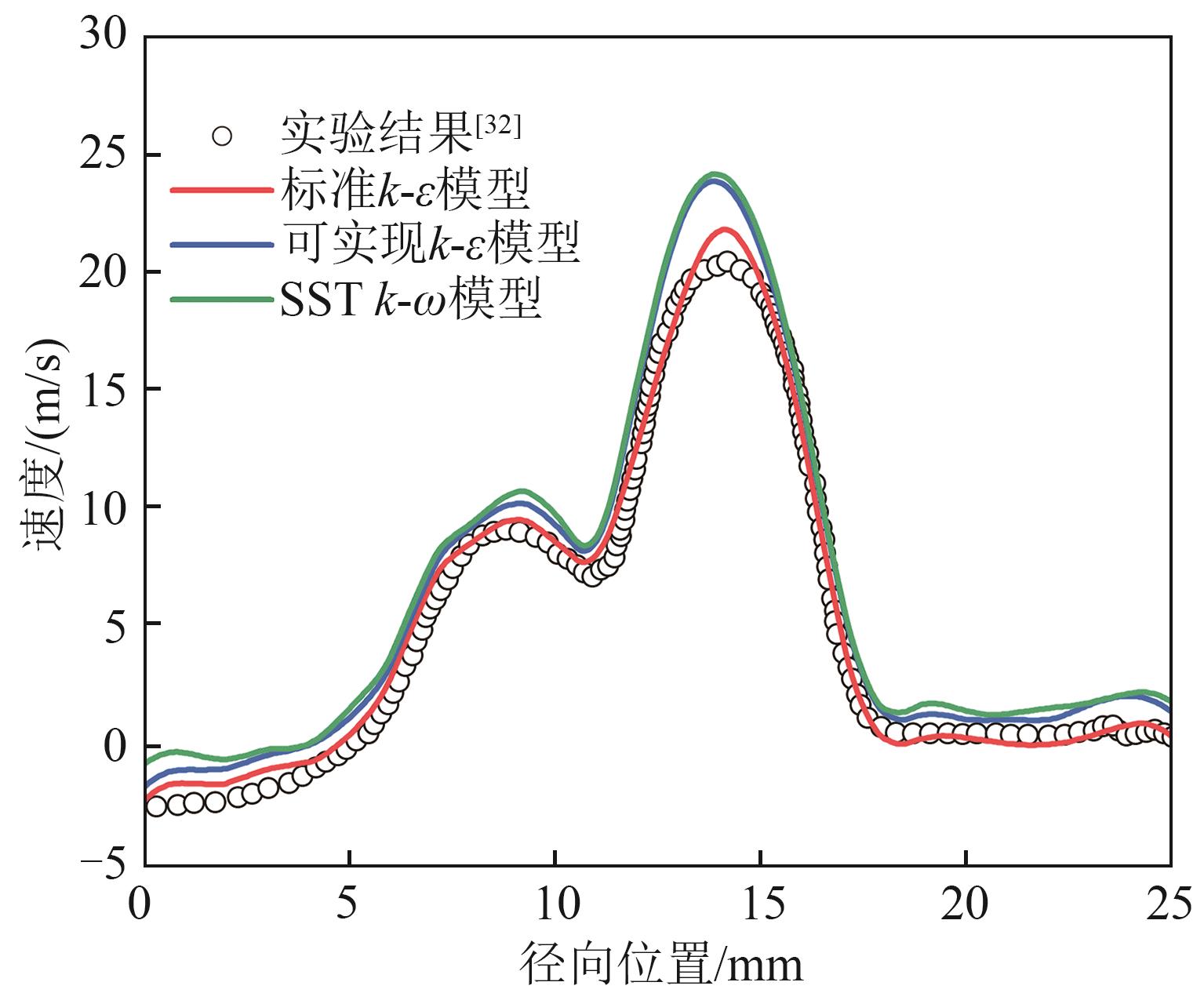
图4 实验与数值计算结果对比
Fig. 4 Comparison of experimental with numerical calculation results
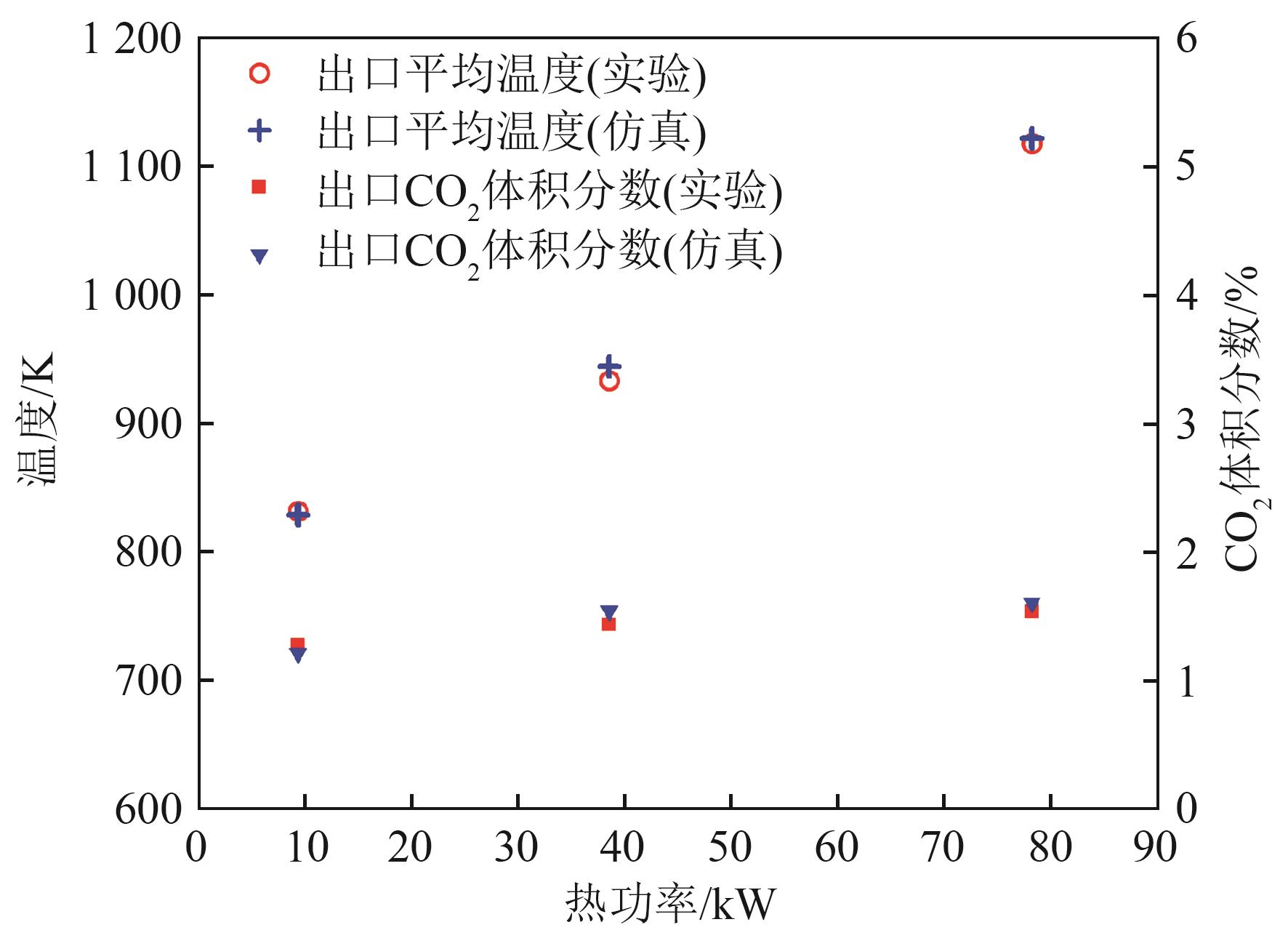
图5 燃烧室出口平均温度和CO2体积分数实验与数值计算结果对比
Fig. 5 Comparison of average temperature and CO2 volumetric fraction at combustion chamber outlet between experimental and numerical results
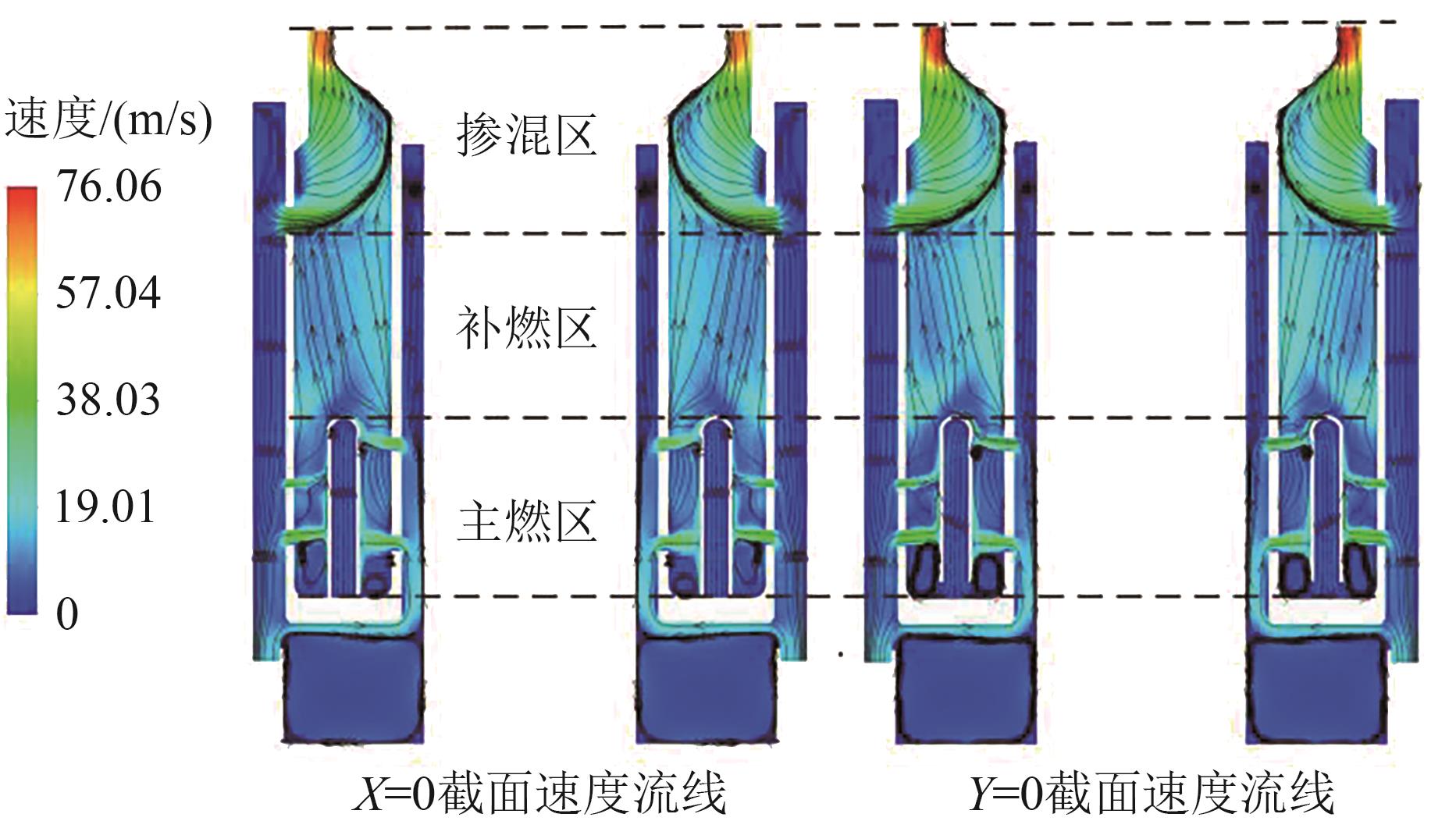
图6 不同截面速度流线
Fig. 6 Velocity streamline at different sections
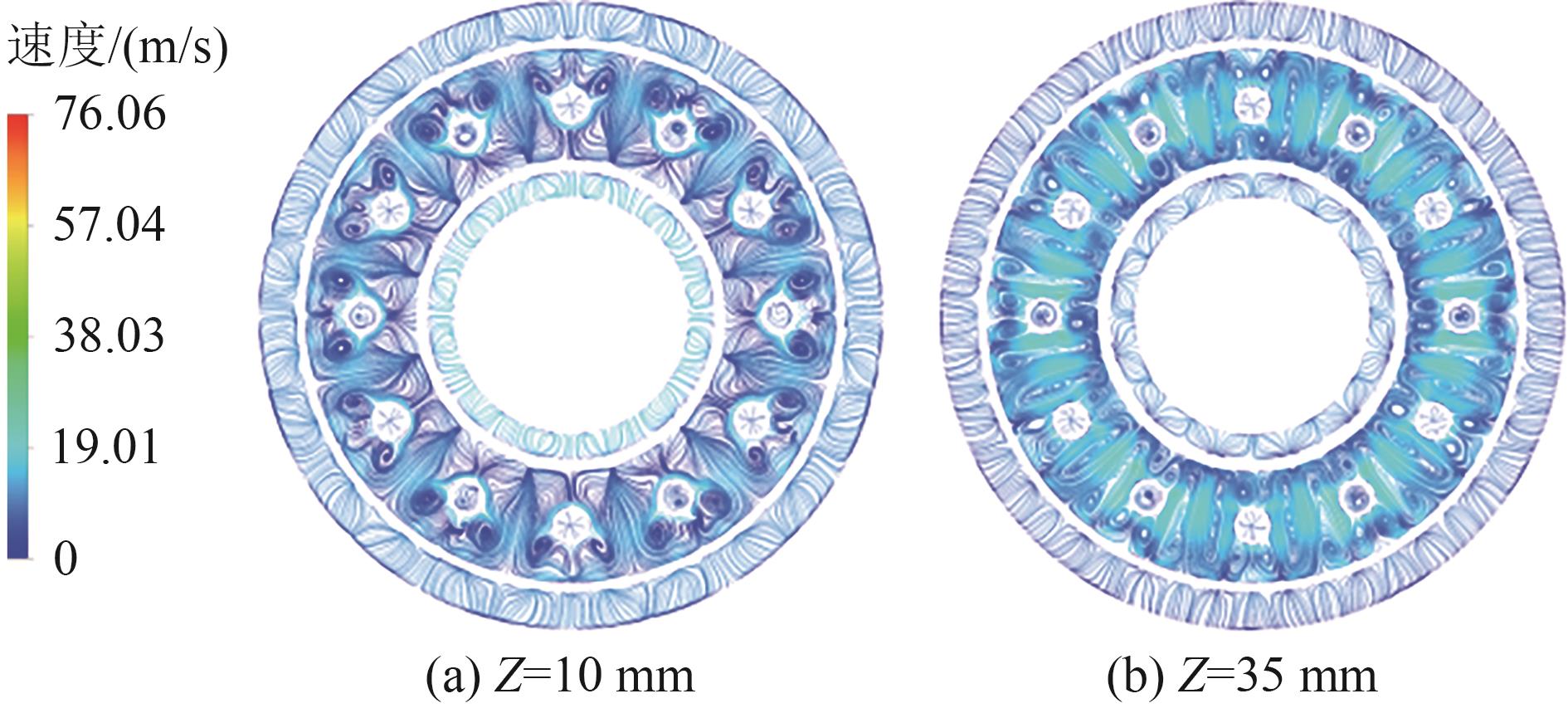
图7 主燃区截面速度流线
Fig. 7 Cross-sectional velocity streamline of primary combustion zone
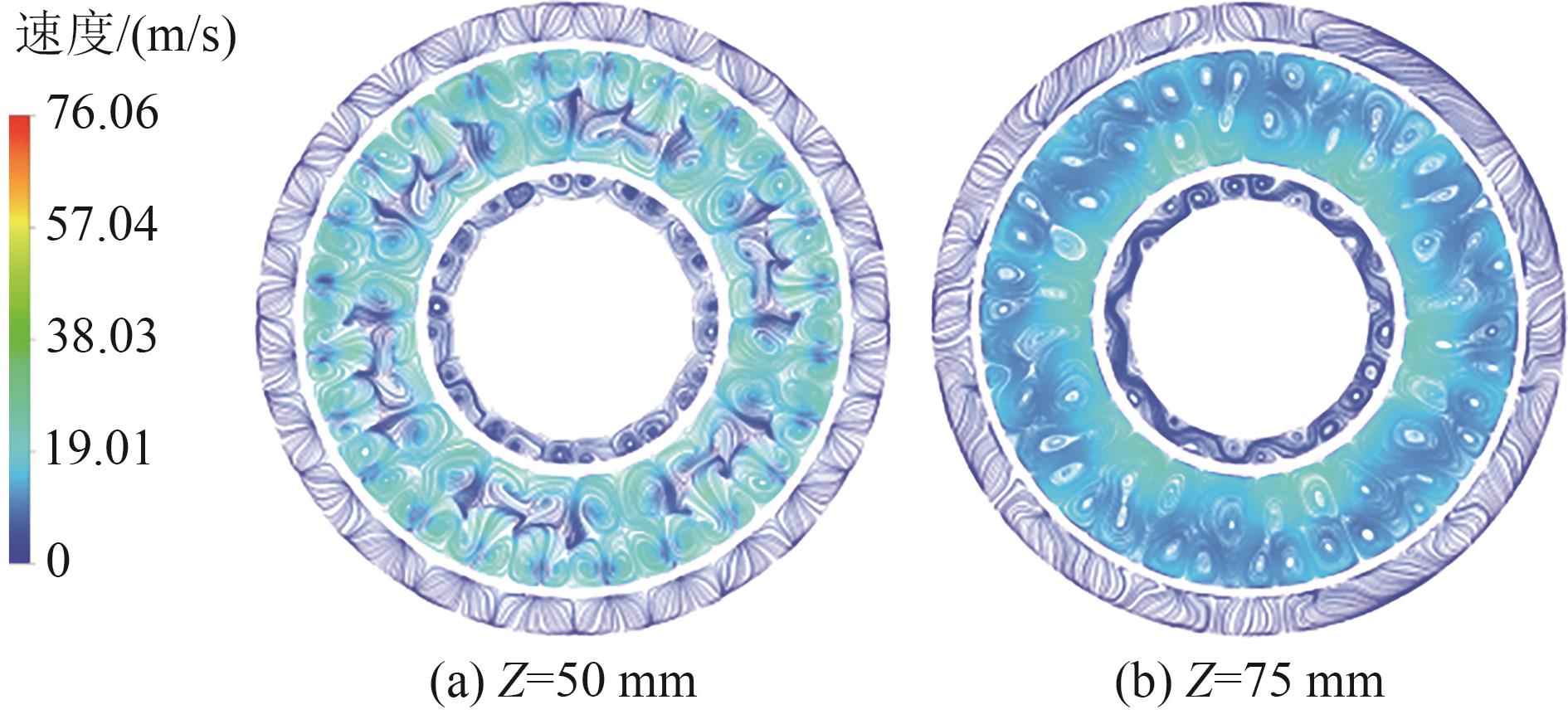
图8 补燃区截面速度流线
Fig. 8 Cross-sectional velocity streamline of supplementary combustion zone
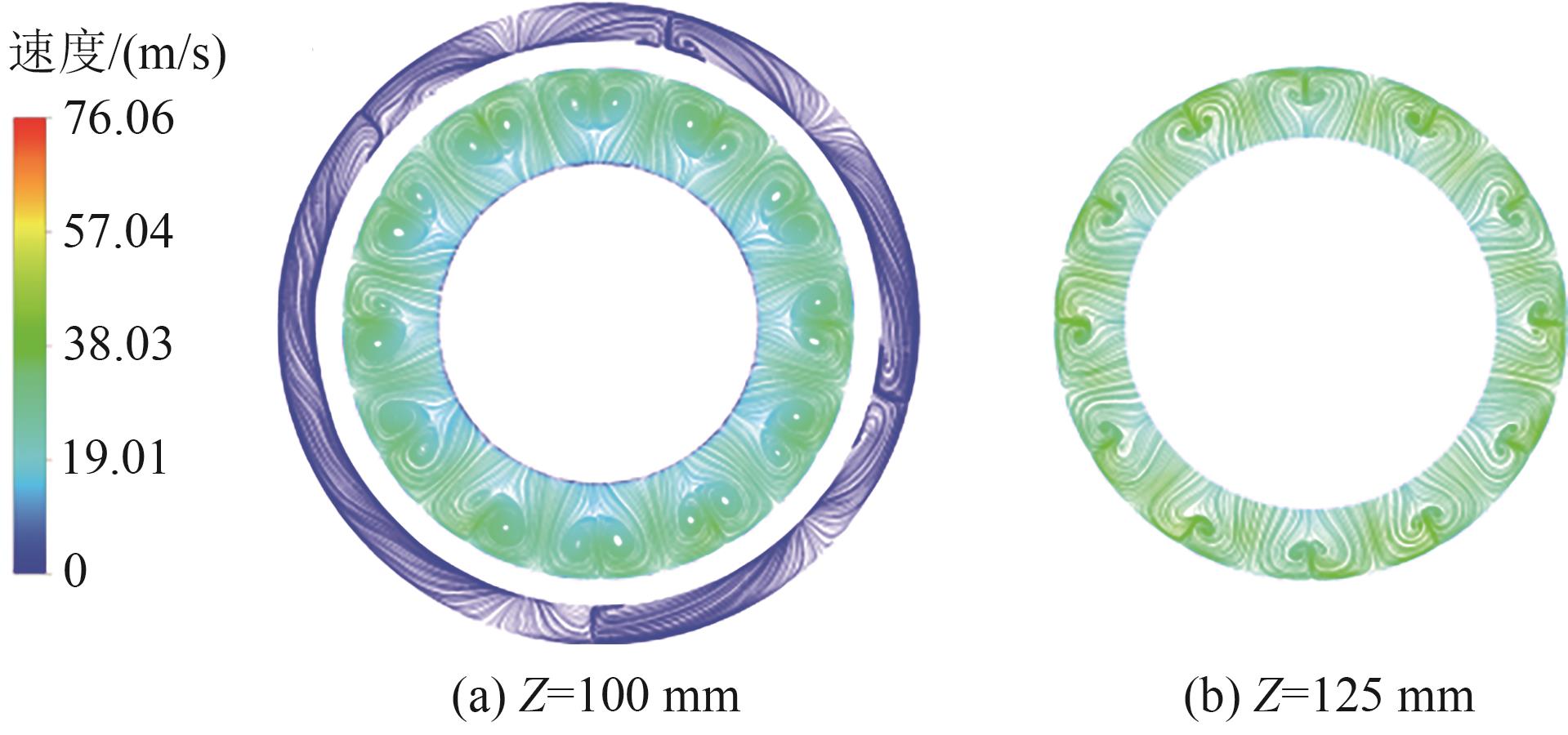
图9 掺混区截面速度流线
Fig. 9 Cross-sectional velocity streamline of mixing zone
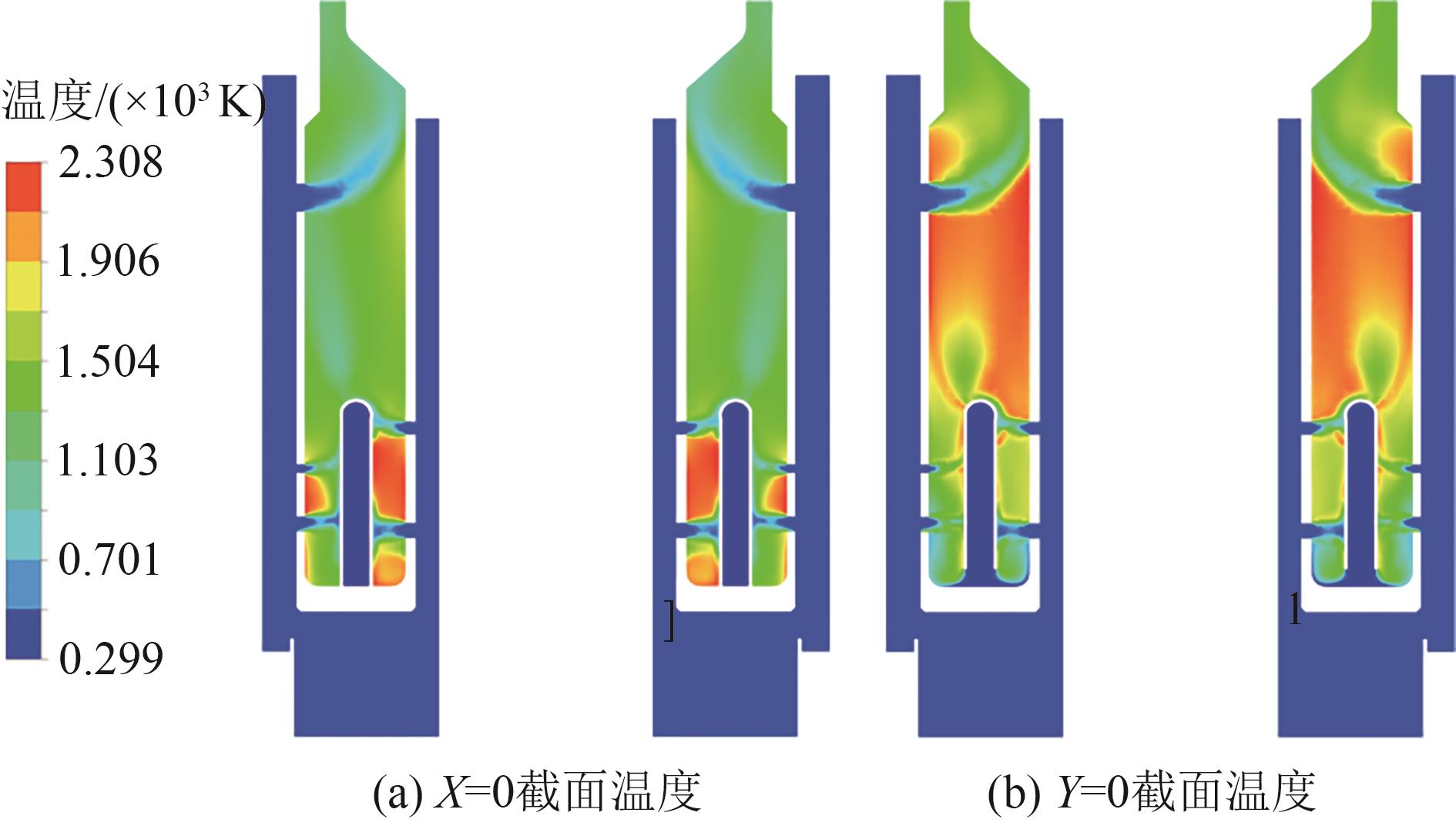
图10 燃烧室不同截面温度分布
Fig. 10 Temperature distribution in different sections of combustion chamber
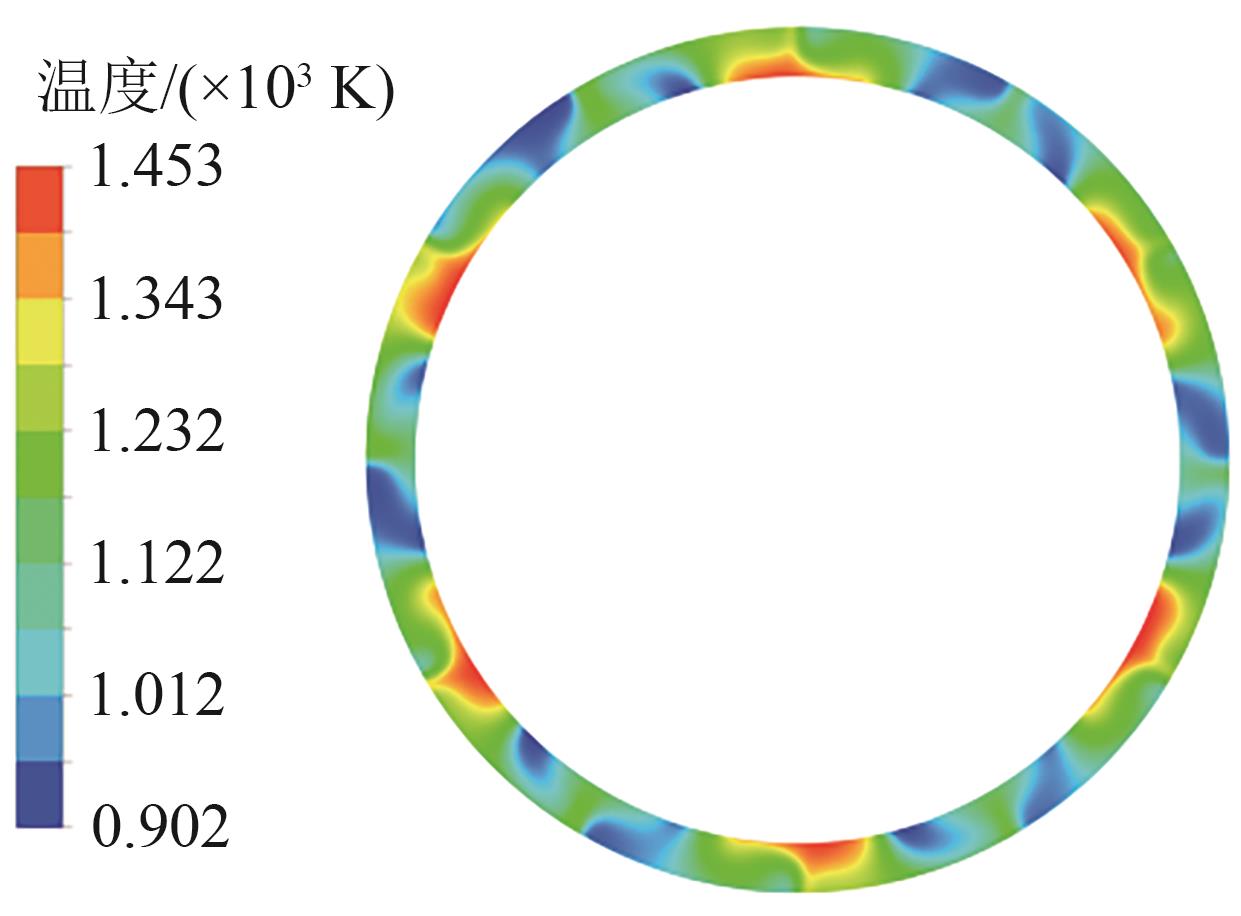
图11 燃烧室出口温度分布
Fig. 11 Temperature distribution at combustion chamber outlet
| 掺氨比 | 燃料质量流量/(kg/s) | 燃料低热值/(kJ/kg) |
|---|---|---|
| 0 | 0.001 837 | 50 028.0 |
| 0.1 | 0.001 960 | 46 885.6 |
| 0.2 | 0.002 101 | 43 743.2 |
| 0.3 | 0.002 264 | 40 600.8 |
| 0.4 | 0.002 453 | 37 458.4 |
| 0.5 | 0.002 678 | 34 316.0 |
| 0.6 | 0.002 948 | 31 173.6 |
| 0.7 | 0.003 279 | 28 031.2 |
| 0.8 | 0.003 692 | 24 888.8 |
| 0.9 | 0.004 226 | 21 746.4 |
| 1.0 | 0.004 940 | 18 604.0 |
表2 不同掺氨比下燃烧室燃料流量和低热值
Tab. 2 Fuel flow and lower heating value of combustion chamber with different ammonia blending ratios
| 掺氨比 | 燃料质量流量/(kg/s) | 燃料低热值/(kJ/kg) |
|---|---|---|
| 0 | 0.001 837 | 50 028.0 |
| 0.1 | 0.001 960 | 46 885.6 |
| 0.2 | 0.002 101 | 43 743.2 |
| 0.3 | 0.002 264 | 40 600.8 |
| 0.4 | 0.002 453 | 37 458.4 |
| 0.5 | 0.002 678 | 34 316.0 |
| 0.6 | 0.002 948 | 31 173.6 |
| 0.7 | 0.003 279 | 28 031.2 |
| 0.8 | 0.003 692 | 24 888.8 |
| 0.9 | 0.004 226 | 21 746.4 |
| 1.0 | 0.004 940 | 18 604.0 |
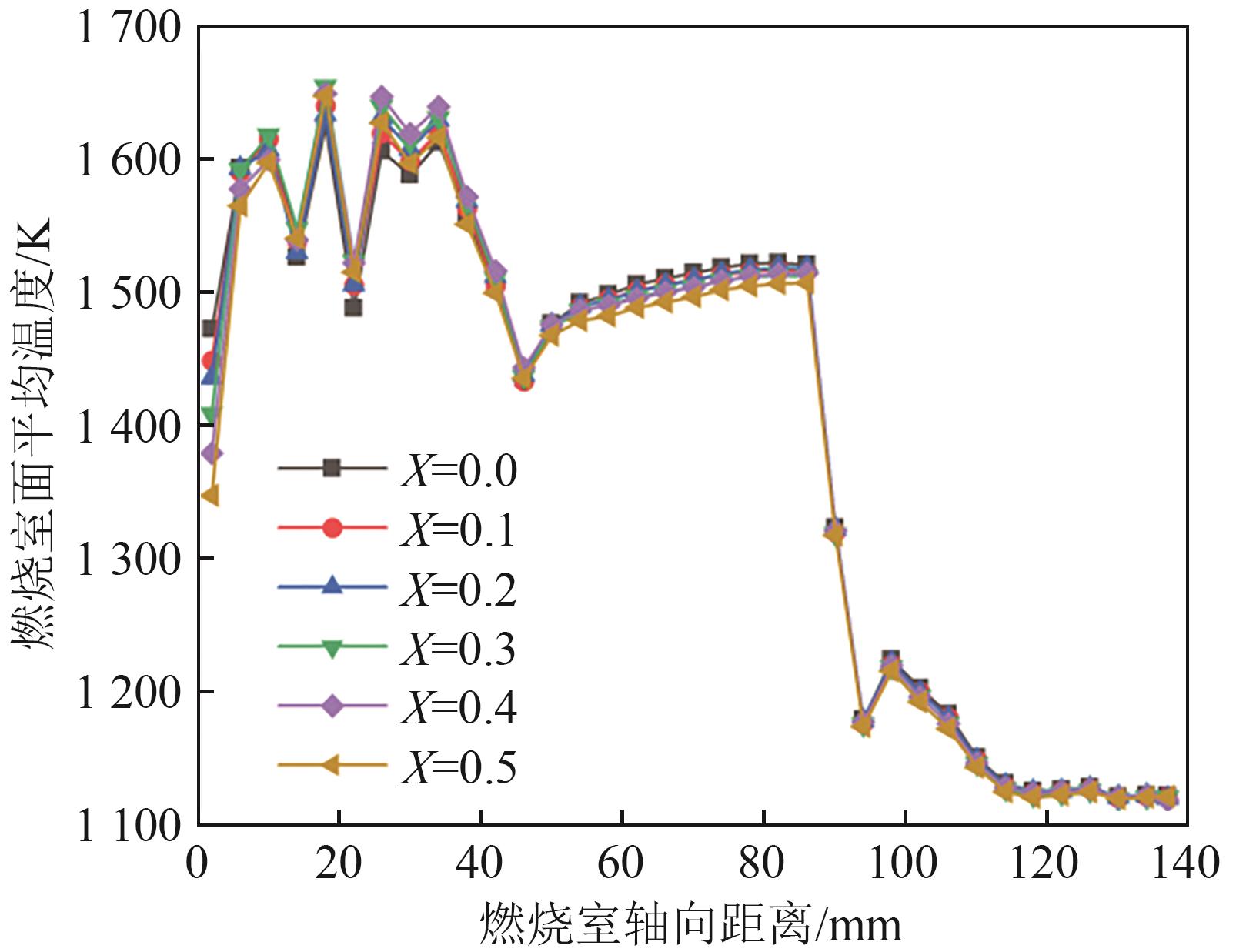
图12 不同掺氨比下燃烧室轴向平均温度
Fig. 12 Axially averaged temperature of combustion chamber with different ammonia blending ratios
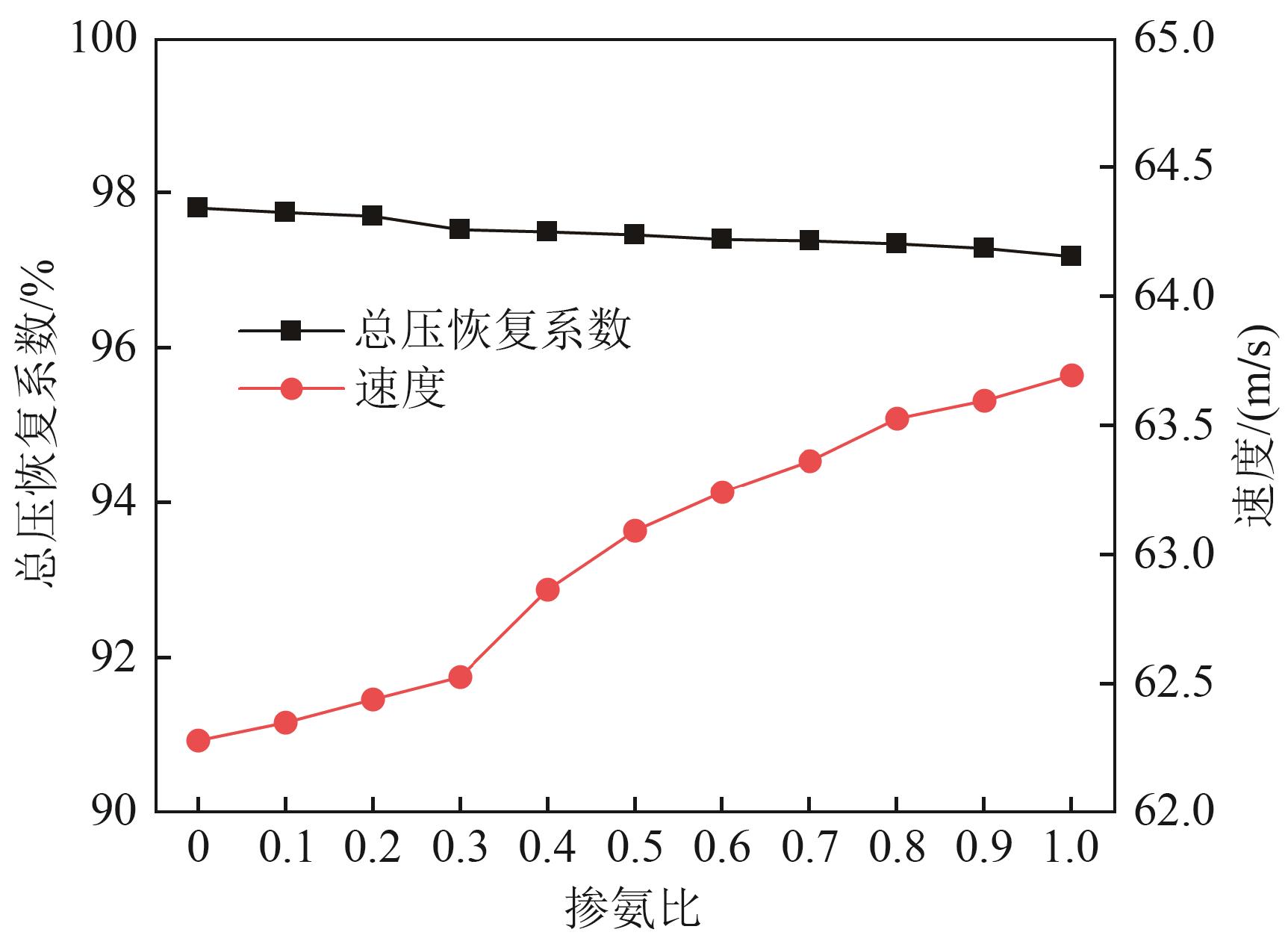
图13 不同掺氨比下燃烧室出口燃气速度和总压恢复系数
Fig. 13 Combustion chamber outlet gas velocity and total pressure recovery coefficients at different ammonia blending ratios
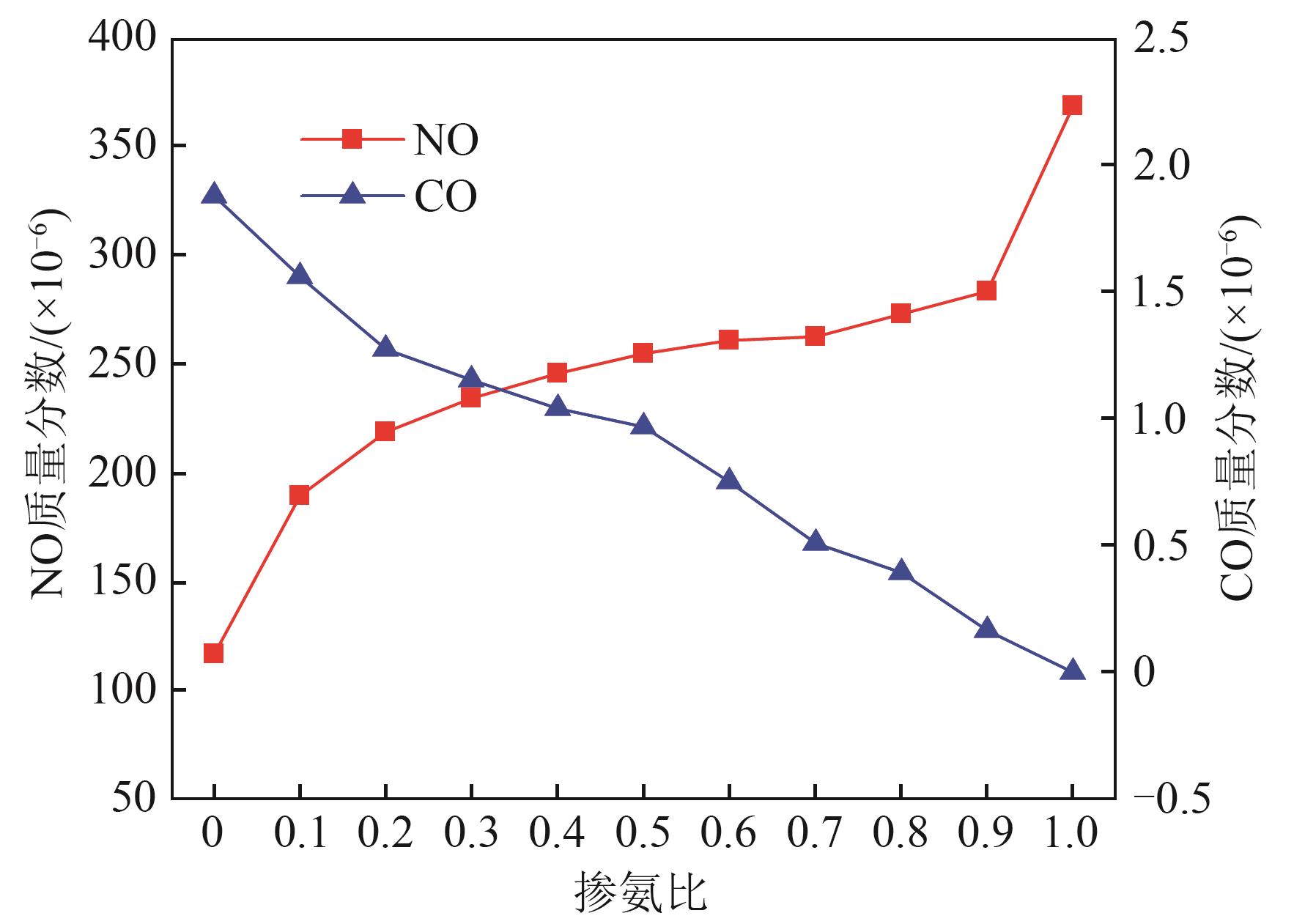
图14 不同掺氨比下燃烧室NO、CO排放量
Fig. 14 NO and CO emissions from combustion chamber with different ammonia blending ratios
| 掺氨比 | ξOTDF | 总压恢复系数/% | 燃烧效率/% |
|---|---|---|---|
| 0 | 0.43 | 97.81 | 98.14 |
| 0.1 | 0.43 | 97.75 | 98.05 |
| 0.2 | 0.42 | 97.70 | 97.99 |
| 0.3 | 0.41 | 97.53 | 97.98 |
| 0.4 | 0.39 | 97.50 | 97.93 |
| 0.5 | 0.38 | 97.46 | 97.90 |
| 0.6 | 0.36 | 97.41 | 97.82 |
| 0.7 | 0.34 | 97.38 | 97.79 |
| 0.8 | 0.30 | 97.34 | 97.76 |
| 0.9 | 0.28 | 97.29 | 97.75 |
| 1.0 | 0.24 | 97.18 | 97.64 |
表3 不同掺氨比下燃烧室的性能指标
Tab. 3 Performance indicators of combustion chamber with different ammonia blending ratios
| 掺氨比 | ξOTDF | 总压恢复系数/% | 燃烧效率/% |
|---|---|---|---|
| 0 | 0.43 | 97.81 | 98.14 |
| 0.1 | 0.43 | 97.75 | 98.05 |
| 0.2 | 0.42 | 97.70 | 97.99 |
| 0.3 | 0.41 | 97.53 | 97.98 |
| 0.4 | 0.39 | 97.50 | 97.93 |
| 0.5 | 0.38 | 97.46 | 97.90 |
| 0.6 | 0.36 | 97.41 | 97.82 |
| 0.7 | 0.34 | 97.38 | 97.79 |
| 0.8 | 0.30 | 97.34 | 97.76 |
| 0.9 | 0.28 | 97.29 | 97.75 |
| 1.0 | 0.24 | 97.18 | 97.64 |
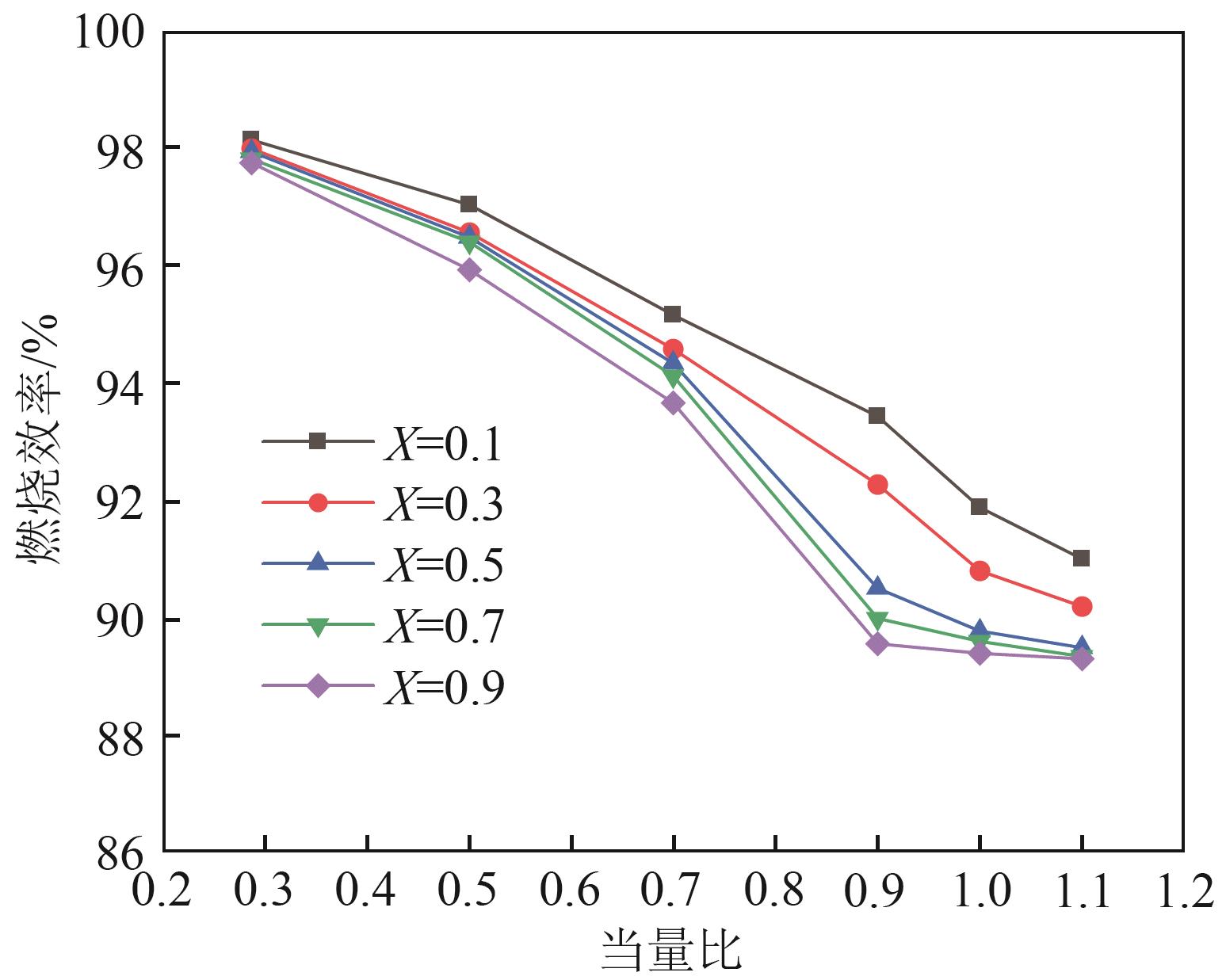
图15 不同当量比和掺氨比下的燃烧效率
Fig. 15 Combustion efficiency at different equivalence ratios and ammonia blending ratios
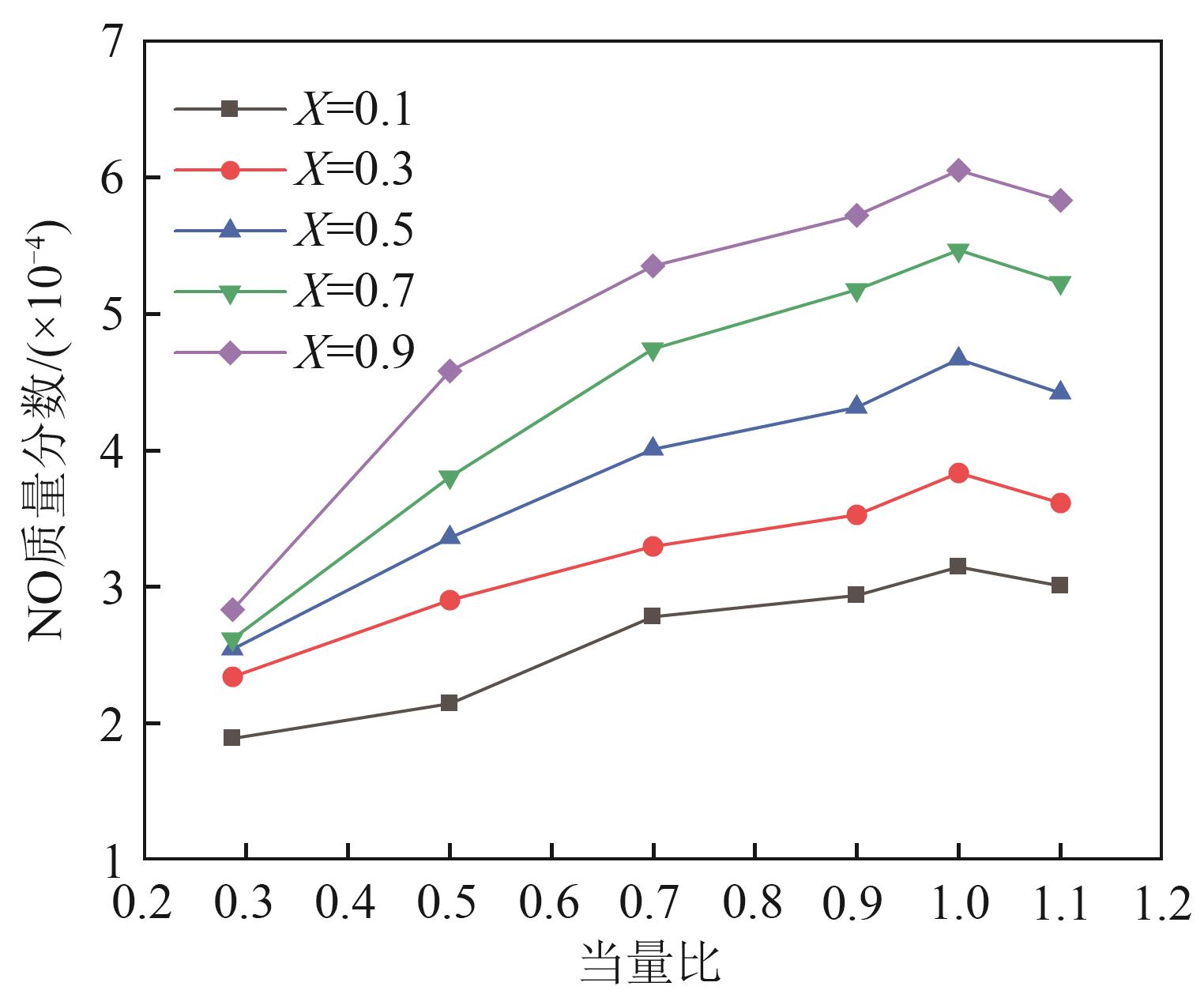
图16 不同当量比下NO排放量
Fig. 16 NO emissions at different equivalence ratios
| [1] | 王放放,杨鹏威,赵光金,等 .新型电力系统下火电机组灵活性运行技术发展及挑战[J].发电技术,2024,45(2):189-198. doi:10.12096/j.2096-4528.pgt.23079 |
| WANG F F, YANG P W, ZHAO G J,et al .Development and challenge of flexible operation technology of thermal power units under new power system[J].Power Generation Technology,2024,45(2):189-198. doi:10.12096/j.2096-4528.pgt.23079 | |
| [2] | 赵德福,袁家海,张健,等 .多层次视角下颠覆性技术驱动的中国能源电力转型路径[J].电力建设,2024,45(8):1-10. doi:10.12204/j.issn.1000-7229.2024.08.001 |
| ZHAO D F, YUAN J H, ZHANG J,et al .China’s energy and power system transition pathways driven by disruptive technologies:a multilevel perspective[J].Electric Power Construction,2024,45(8):1-10. doi:10.12204/j.issn.1000-7229.2024.08.001 | |
| [3] | 高政南,姜楠,陈启鑫,等 .德国电力市场能源转型建设及启示[J].中国电力,2024,57(6):204-214. |
| GAO Z N, JIANG N, CHEN Q X,et al .Construction experience of German electricity market adapting to energy transition[J].Electric Power,2024,57(6):204-214. | |
| [4] | 高超,韦斌,隋宇,等 .能源低碳利用评价指标与技术综述[J].南方能源建设,2024,11(5):178-190. doi:10.16516/j.ceec.2024.5.19 |
| GAO C, WEI B, SUI Y,et al .Review of evaluation indicators and technologies for low-carbon energy utilization[J].Southern Energy Construction,2024,11(5):178-190. doi:10.16516/j.ceec.2024.5.19 | |
| [5] | 任卓亚,郭宁,解佗,等 .我国清洁能源发展规律分析及其与经济系统的协调发展评价[J].电网与清洁能源,2024,40(12):128-134. |
| REN Z Y, GUO N, XIE T,et al .A study on the development patterns of clean energy in China and evaluation of its coordinated development with the economic system[J].Power System and Clean Energy,2024,40(12):128-134. | |
| [6] | 李梦宇,王健,田野 .碳达峰碳中和目标下中国经济产业发展研究[J].全球能源互联网,2024,7(6):629-639. |
| LI M Y, WANG J, TIAN Y .Research on the development of China’s economic industry under the goal of carbon peak and carbon neutrality[J].Journal of Global Energy Interconnection,2024,7(6):629-639. | |
| [7] | 李旭东,谭青博,赵浩辰,等 .碳达峰背景下中国电力行业碳排放因素和脱钩效应[J].中国电力,2024,57(5):88-98. doi:10.11930/j.issn.1004-9649.202306019 |
| LI X D, TAN Q B, ZHAO H C,et al .Carbon emission factors and decoupling effects of China’s power industry under the background of carbon peak[J].Electric Power,2024,57(5):88-98. doi:10.11930/j.issn.1004-9649.202306019 | |
| [8] | 李灏恩,姜雨萌,戚宇辰,等 .碳中和目标下电力需求预测体系构建及华东区域电力需求发展趋势研究[J].电网与清洁能源,2024,40(2):30-36. |
| LI H E, JIANG Y M, QI Y C,et al .A study on the construction of the power demand forecasting system under carbon neutrality goal and the development trend of power demand in East China[J].Power System and Clean Energy,2024,40(2):30-36. | |
| [9] | 周勤勇,李根兆,秦晓辉,等 .能源革命下的电力系统范式转换分析[J].中国电力,2024,57(3):1-11. doi:10.11930/j.issn.1004-9649.202311115 |
| ZHOU Q Y, LI G Z, QIN X H,et al .Analysis of power system paradigm shift under energy revolution[J].Electric Power,2024,57(3):1-11. doi:10.11930/j.issn.1004-9649.202311115 | |
| [10] | 郭婷婷,曹蕃 .低碳能源系统发展趋势与应用实践[J].分布式能源,2025,10(1):1-13. doi:10.16513/j.2096-2185.DE.(2025)010-01-0001-13 |
| GUO T T, CAO F .Development trend and application of low-carbon energy system[J].Distributed Energy,2025,10(1):1-13. doi:10.16513/j.2096-2185.DE.(2025)010-01-0001-13 | |
| [11] | 周上坤,杨文俊,谭厚章,等 .氨燃烧研究进展[J].中国电机工程学报,2021,41(12):4164-4181. doi:10.13334/j.0258-8013.pcsee.201476 |
| ZHOU S K, YANG W J, TAN H Z,et al .Research progress of ammonia combustion[J].Proceedings of the CSEE,2021,41(12):4164-4181. doi:10.13334/j.0258-8013.pcsee.201476 | |
| [12] | 范卫东,陈钧 .氨气燃烧强化措施及NO x 控制策略研究进展[J].华中科技大学学报(自然科学版),2022,50(7):14-23. |
| FAN W D, CHEN J .Research progress of combustion enhancement and NO x control strategies for ammonia combustion[J].Journal of Huazhong University of Science and Technology (Nature Science Edition),2022,50(7):14-23. | |
| [13] | VALERA-MEDINA A, AMER-HATEM F, AZAD A K,et al .Review on ammonia as a potential fuel:from synthesis to economics[J].Energy & Fuels,2021,35(9):6964-7029. doi:10.1021/ACS.ENERGYFUELS.0C03685 |
| [14] | ROCHA R C, COSTA M, BAI X S .Combustion and emission characteristics of ammonia under conditions relevant to modern gas turbines[J].Combustion Science and Technology,2021,193(14):2514-2533. doi:10.1080/00102202.2020.1748018 |
| [15] | OKAFOR E C, NAITO Y, COLSON S,et al .Measurement and modelling of the laminar burning velocity of methane-ammonia-air flames at high pressures using a reduced reaction mechanism[J].Combustion and Flame,2019,204:162-175. doi:10.1016/j.combustflame.2019.03.008 |
| [16] | 高虎,刘凡,李海 .碳中和目标下氨燃料的机遇、挑战及应用前景[J].发电技术,2022,43(3):462-467. doi:10.12096/j.2096-4528.pgt.22059 |
| GAO H, LIU F, LI H .Opportunities,challenges and application prospects of ammonia fuel under the target of carbon neutrality[J].Power Generation Technology,2022,43(3):462-467. doi:10.12096/j.2096-4528.pgt.22059 | |
| [17] | BASTANI M, TABEJAMAAT S, ASHINI H .Numerical and experimental study of combustion and emission characteristics of ammonia/methane fuel mixture in micro gas turbine combustor[J].International Journal of Hydrogen Energy,2024,49:1399-1415. doi:10.1016/j.ijhydene.2023.09.319 |
| [18] | 王凯卉,刘斌,折晓会,等 .氨氢混合燃烧在旋流燃烧器中的动力学特性与NO x 减排机理研究[J].发电技术,2025,46(1):171-179. |
| WANG K H, LIU B, ZHE X H,et al .Kinetic characterization and NO x reduction mechanism of mixed Ammonia-Hydrogen combustion in cyclone combustor[J].Power Generation Technology,2025,46(1):171-179. | |
| [19] | ZHANG M, AN Z H, WEI X T,et al .Emission analysis of the CH4/NH3/air co-firing fuels in a model combustor[J].Fuel,2021,291:120135. doi:10.1016/j.fuel.2021.120135 |
| [20] | KURATA O,IKI N, MATSUNUMA T,et al .Performances and emission characteristics of NH3-air and NH3 CH4-air combustion gas-turbine power generations[J].Proceedings of the Combustion Institute,2017,36(3):3351-3359. doi:10.1016/j.proci.2016.07.088 |
| [21] | IKI N, KURATA O, MATSUNUMA T,et al .Micro gas turbine firing ammonia[C]//Microturbines,Turbochargers and Small Turbomachines;Steam Turbines.Seoul,South Korea:American Society of Mechanical Engineers,2016,8:V008T23A018. doi:10.1115/GT2016-56954 |
| [22] | TIAN Z Y, LI Y Y, ZHANG L D,et al .An experimental and kinetic modeling study of premixed NH3/CH4/O2/Ar flames at low pressure[J].Combustion and Flame,2009,156(7):1413-1426. doi:10.1016/j.combustflame.2009.03.005 |
| [23] | HAYAKAWA A, GOTO T, MIMOTO R,et al .Laminar burning velocity and Markstein length of ammonia/air premixed flames at various pressures[J].Fuel,2015,159:98-106. doi:10.1016/j.fuel.2015.06.070 |
| [24] | OKAFOR E C, NAITO Y, COLSON S,et al .Experimental and numerical study of the laminar burning velocity of CH4-NH3-air premixed flames[J].Combustion and Flame,2018,187:185-198. doi:10.1016/j.combustflame.2017.09.002 |
| [25] | LUCCHINI T, D’ERRICO G, ONORATI A,et al .Modeling non-premixed combustion using tabulated kinetics and different fame structure assumptions[J].SAE International Journal of Engines,2017,10(2):593-607. doi:10.4271/2017-01-0556 |
| [26] | CAI Z H, HUANG M M, WEI G F,et al .Numerical study of the effect of pressure on the combustion characteristics of ammonia/coal-derived syngas mixture under gas turbine operating conditions[J].Fuel,2023,347:128463. doi:10.1016/j.fuel.2023.128463 |
| [27] | TU Y J, XU S T, LIU H .Combustion and emission characteristics of NH3/CH4/air in a model swirl combustor:comparison between premixed and non-premixed modes[J].International Journal of Hydrogen Energy,2023,48(45):17311-17323. doi:10.1016/j.ijhydene.2023.01.235 |
| [28] | WANG J, HU Z W, DU C,et al .Numerical study of effusion cooling of a gas turbine combustor liner[J].Fuel,2021,294:120578. doi:10.1016/j.fuel.2021.120578 |
| [29] | FATEHI M, RENZI M .Modelling and development of ammonia-air non-premixed low NO x combustor in a micro gas turbine:a CFD analysis[J].International Journal of Hydrogen Energy,2024,88:1-10. doi:10.1016/j.ijhydene.2024.09.071 |
| [30] | SWEENEY M S, HOCHGREB S, DUNN M J,et al .The structure of turbulent stratified and premixed methane/air flames I:non-swirling flows[J].Combustion and Flame,2012,159(9):2896-2911. doi:10.1016/j.combustflame.2012.06.001 |
| [31] | SWEENEY M S, HOCHGREB S, BARLOW R S .Cambridge stratified swirl burner technical drawings [EB/OL]. (2012-10-14)[2024-06-23].. doi:10.1016/j.combustflame.2012.05.014 |
| [32] | FANTOZZI F, LARANCI P, BIDINI G .CFD simulation of biomass pyrolysis syngas vs.natural gas in a microturbine annular combustor[C]//ASME Turbo Expo 2010:Power for Land,Sea,and Air, Glasgow,UK.2010:649-658. doi:10.1115/GT2010-23473 |
| [33] | 李东杰,周伯豪,梁骞,等 .微型涡喷发动机燃烧室优化设计[J].清华大学学报(自然科学版),2021,61(10):1212-1220. doi:10.16511/j.cnki.qhdxxb.2020.22.034 |
| LI D J, ZHOU B H, LIANG Q,et al .Optimization of a micro turbojet engine combustion chamber[J].Journal of Tsinghua University (Science and Technology),2021,61(10):1212-1220. doi:10.16511/j.cnki.qhdxxb.2020.22.034 | |
| [34] | 周麒麟 .新型蒸发管研究及在微型燃烧室中的应用[D].南京:南京航空航天大学,2009. doi:10.7666/d.y1812242 |
| ZHOU Q L .Research on new vaporizer for mirco combustor[D].Nanjing:Nanjing University of Aeronautics and Astronautics,2009. doi:10.7666/d.y1812242 | |
| [35] | 杨牧歌 .微型燃气轮机燃烧室的设计与优化[D].哈尔滨:哈尔滨工业大学,2016. |
| YANG M G .Design and optimization of micro gas turbine combustionchamber[D].Harbin:Harbin Institute of Technology,2016. | |
| [36] | PAN W G, KANG L W, CHI Z W,et al .Numerical study on effects of hydrogen doping of natural gas on the combustion characteristics in micro gas turbine combustor[J].Applied Thermal Engineering,2024,255:123989. doi:10.1016/j.applthermaleng.2024.123989 |
| [37] | 汪凤山 .低NO x 排放微型燃气轮机燃烧室的数值模拟及实验研究[D].北京:中国科学院研究生院(工程热物理研究所),2009. |
| WANG F S .Numerical and experimental investigation on a low NO x emission combustor for micro gas turbine[D].Beijing:Institute of Engineering Thermophysics,Chinese Academy of Sciences,2009. | |
| [38] | 黄勇 .燃烧与燃烧室[M].北京:北京航空航天大学出版社,2009. |
| HUANG Y .Combustion and combustion chamber[M].Beijing:Beijing University of Aeronautics & Astronautics Press,2009. | |
| [39] | 宋权斌,赵仙娟,宋彦庆,等 .微型燃气轮机改烧氨气/氢气混合燃料的数值模拟研究[J].热能动力工程,2023,38(5):146-153. doi:10.16146/j.cnki.rndlgc.2023.05.018 |
| SONG Q B, ZHAO X J, SONG Y Q,et al .Numerical simulation of micro-combustion engine to burn ammonia/hydrogen mixed fuel[J].Journal of Engineering for Thermal Energy and Power,2023,38(5):146-153. doi:10.16146/j.cnki.rndlgc.2023.05.018 | |
| [40] | LARANCI P, BIDINI G, D’ALESSANDRO B,et al .Improving lifetime and manufacturability of an RQL combustor for microturbines:design and numerical validation[C]//ASME Turbo Expo 2015:Turbine Technical Conference and Exposition,Montreal,Quebec,Canada:ASME,2015,56673:V003T03A009. doi:10.1115/gt2015-43543 |
| [41] | CHEN X Y, ZHOU W G, JIA Y F,et al .Numerical analysis of the combustion in micro gas turbine with methane/biogas fuels[J].Arabian Journal for Science and Engineering,2021,46(12):11897-11907. doi:10.1007/s13369-021-05731-3 |
| [42] | SUN J H, YANG Q, ZHAO N B,et al .Numerically study of CH4/NH3 combustion characteristics in an industrial gas turbine combustor based on a reduced mechanism[J].Fuel,2022,327:124897. doi:10.1016/j.fuel.2022.124897 |
| [1] | 徐义巍, 洪岩, 赵晓鹏, 隋炳伟. 煤氨混燃对燃煤锅炉受热面传热特性影响分析[J]. 发电技术, 2025, 46(5): 1022-1031. |
| [2] | 郭前鑫, 李建波, 王虎, 梁银堂, 韩新建, 阮雄伟, 卢啸风. 准东煤灰的动态沉积与脱落特性数值模拟研究[J]. 发电技术, 2025, 46(4): 829-838. |
| [3] | 张帅柠, 高明明, 王勇权, 王唯铧, 于浩洋, 黄中. 循环流化床锅炉宽负荷一体化脱硫建模研究[J]. 发电技术, 2025, 46(4): 849-856. |
| [4] | 张立栋, 杨智翔, 李文锋, 冯江哲, 张博, 任淮辉, 陈哲, 王兆新. 导流板对水平轴风力机气动特性影响的数值模拟研究[J]. 发电技术, 2025, 46(2): 336-343. |
| [5] | 张立峰, 董祥虎. 基于鲁棒正则化极限学习机的声学层析温度分布重建[J]. 发电技术, 2025, 46(2): 361-369. |
| [6] | 李凯, 章平衡, 孟志浩, 曹允宁, 徐尧, 刘莉, 李廉明. SCR外置烟道飞灰沉积特性与流场优化数值仿真[J]. 发电技术, 2025, 46(1): 145-153. |
| [7] | 王凯卉, 刘斌, 折晓会, 刘伟, 范昊, 康宗耀, 徐礼. 氨氢混合燃烧在旋流燃烧器中的动力学特性与NO x 减排机理研究[J]. 发电技术, 2025, 46(1): 171-179. |
| [8] | 曾宪民, 李柏云, 沈向阳, 陈嘉澍, 丁力行. 半周受热下太阳能吸热器横纹管的热应力分析[J]. 发电技术, 2025, 46(1): 190-199. |
| [9] | 刘卓, 陈冬林, 汪淑奇, 杨仪江, 闫优洋, 杨展. 减缓脱硫塔除雾器堵塞的流场优化方法[J]. 发电技术, 2024, 45(6): 1087-1094. |
| [10] | 屠楠, 刘家琛, 徐静, 方嘉宾, 马彦花. 管壳式相变蓄热器的蓄释热过程性能分析[J]. 发电技术, 2024, 45(3): 508-516. |
| [11] | 高忠明, 朱德敖, 陈雨佳, 刘三举, 王勤辉. 农林废弃物循环流化床空气气化特性实验研究[J]. 发电技术, 2024, 45(3): 535-544. |
| [12] | 刘学, 李国栋, 张瑞颖, 侯一晨, 陈磊, 杨立军. 电站空冷岛轴流风机模型研究[J]. 发电技术, 2024, 45(3): 545-557. |
| [13] | 蒋海威, 高明明, 李杰, 于浩洋, 岳光溪, 黄中. 生物质振动炉排炉燃烧过程建模及动态特性分析[J]. 发电技术, 2024, 45(2): 250-259. |
| [14] | 龚思琦, 云再鹏, 许明, 敖乐, 李初福, 黄凯, 孙晨. 基于三元催化剂的固体氧化物燃料电池尾气催化燃烧数值模拟[J]. 发电技术, 2024, 45(2): 331-340. |
| [15] | 郑妍, 姚宣, 陈训强. 生物质气化耦合发电体系的合成气组分与能量分析[J]. 发电技术, 2023, 44(6): 859-864. |
| 阅读次数 | ||||||
|
全文 |
|
|||||
|
摘要 |
|
|||||
