

Power Generation Technology ›› 2026, Vol. 47 ›› Issue (2): 274-284.DOI: 10.12096/j.2096-4528.pgt.260205
• Power Generation and Environmental Protection • Previous Articles
Zhiting TONG1,2, Yue FAN1,2, Xinxia LIU1,2, Chao ZHANG1,2
Received:2025-04-17
Revised:2025-05-19
Published:2026-04-30
Online:2026-04-21
Supported by:CLC Number:
Zhiting TONG, Yue FAN, Xinxia LIU, Chao ZHANG. Performance Analysis of Ammonia-Doped Combustion in Micro Gas Turbine Combustion Chamber[J]. Power Generation Technology, 2026, 47(2): 274-284.
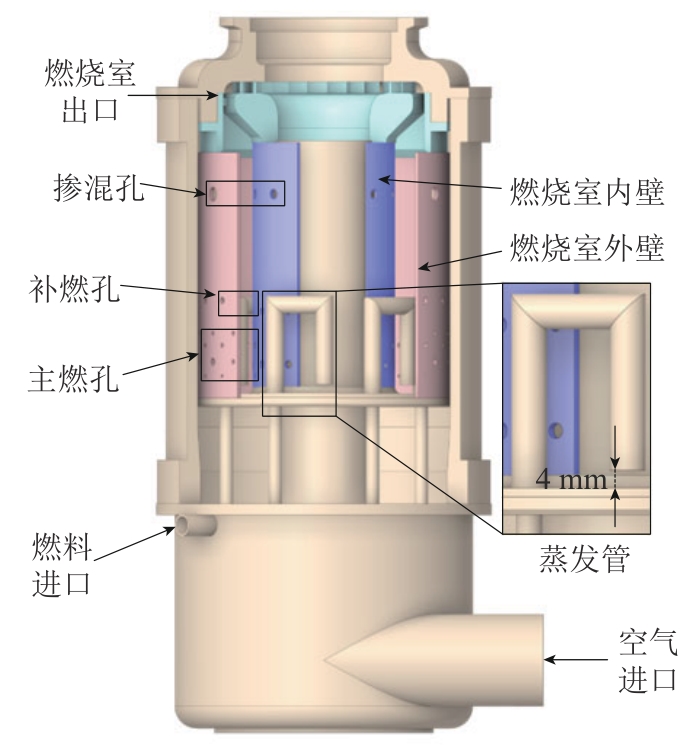
Fig. 1 3D model of micro gas turbine
| 参数 | 数值 |
|---|---|
| 蒸发管数量/个 | 6 |
| 蒸发管内直径/mm | 6.0 |
| 火焰筒内、外直径/mm | 61.0、117.0 |
| 火焰筒高度/mm | 137.0 |
| 主燃孔1、2直径/mm | 1.5、2.0 |
| 补燃孔1、2直径/mm | 2.0、3.0 |
| 掺混孔1、2直径/mm | 6.5、4.5 |
| 火焰筒壁厚/mm | 2.0 |
| 燃气轮机外壳内、外直径/mm | 48.0、144.0 |
| 燃气轮机外壳高度/mm | 325.0 |
| 燃气轮机外壳厚度/mm | 5.5 |
| 空气质量流量/(kg/s) | 0.11 |
| 空气温度/K | 430 |
| 燃料质量流量/(kg/s) | 0.001 837 |
| 燃料温度/K | 300 |
| 压力/kPa | 310 |
Tab. 1 Main parameters of micro gas turbine
| 参数 | 数值 |
|---|---|
| 蒸发管数量/个 | 6 |
| 蒸发管内直径/mm | 6.0 |
| 火焰筒内、外直径/mm | 61.0、117.0 |
| 火焰筒高度/mm | 137.0 |
| 主燃孔1、2直径/mm | 1.5、2.0 |
| 补燃孔1、2直径/mm | 2.0、3.0 |
| 掺混孔1、2直径/mm | 6.5、4.5 |
| 火焰筒壁厚/mm | 2.0 |
| 燃气轮机外壳内、外直径/mm | 48.0、144.0 |
| 燃气轮机外壳高度/mm | 325.0 |
| 燃气轮机外壳厚度/mm | 5.5 |
| 空气质量流量/(kg/s) | 0.11 |
| 空气温度/K | 430 |
| 燃料质量流量/(kg/s) | 0.001 837 |
| 燃料温度/K | 300 |
| 压力/kPa | 310 |
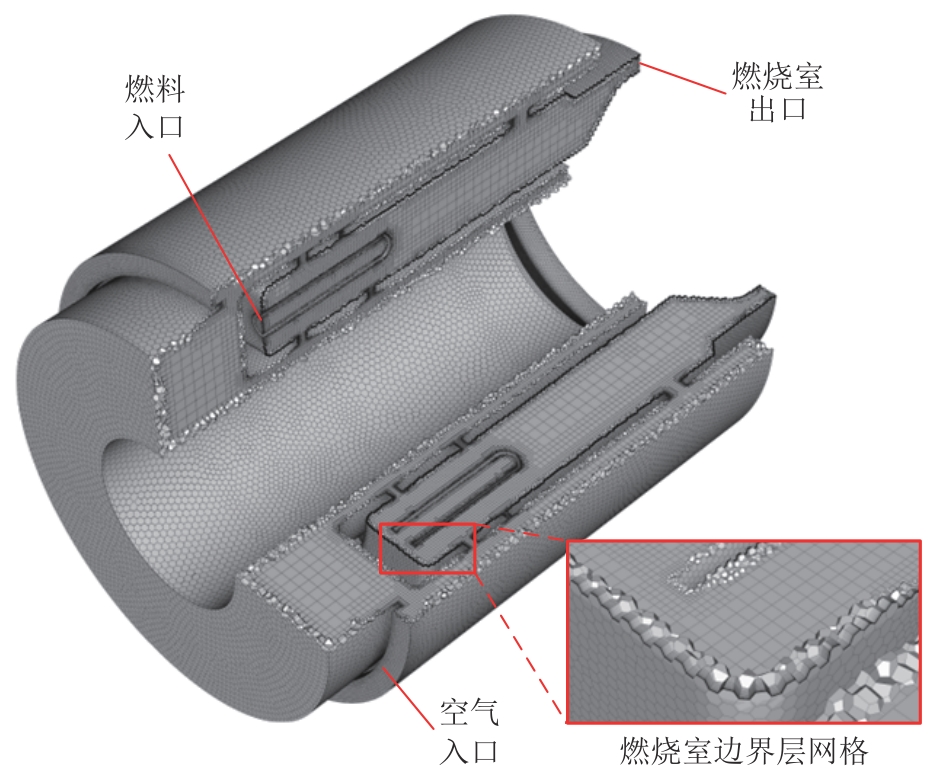
Fig. 2 Mesh of combustion chamber
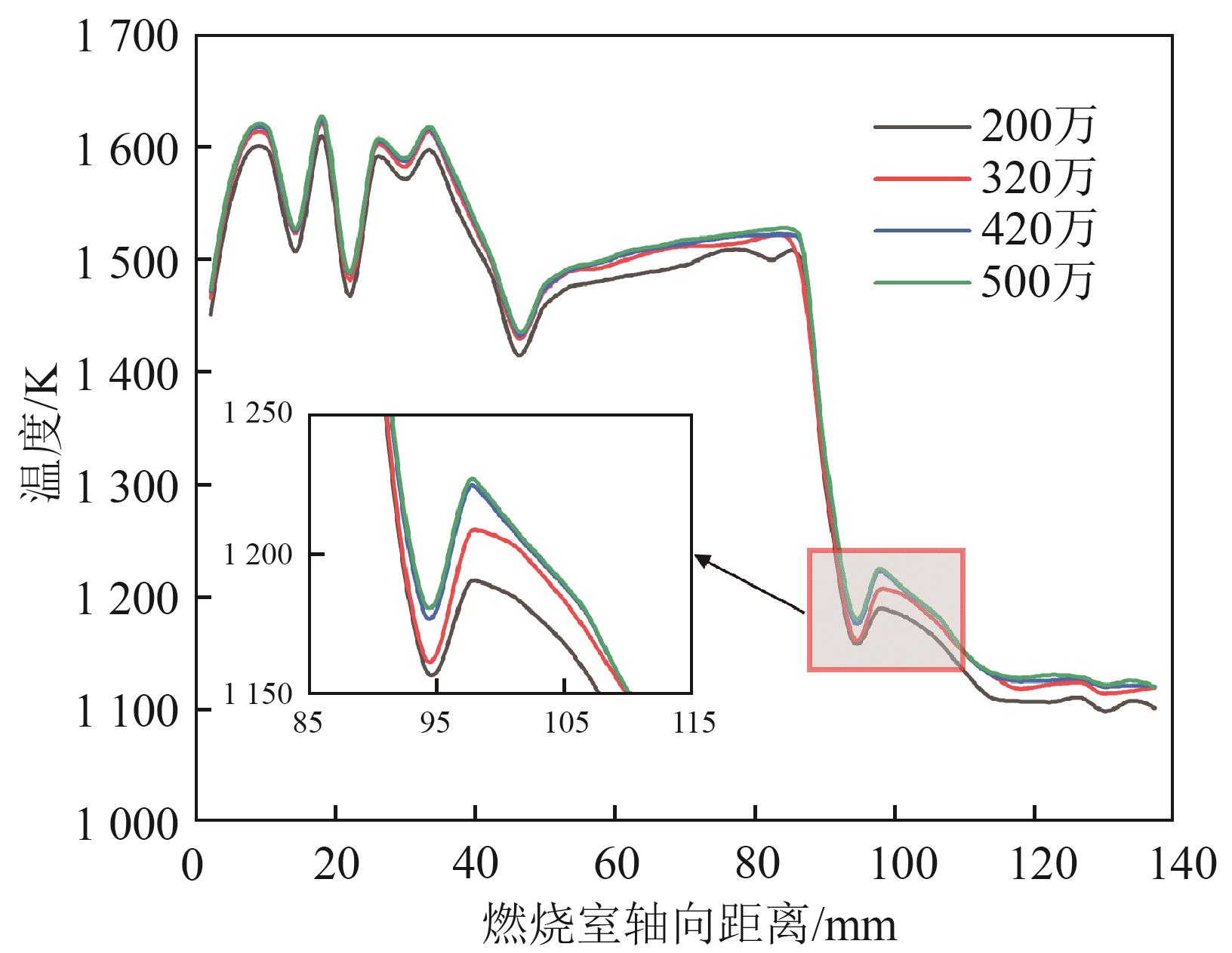
Fig. 3 Mesh-independent verification
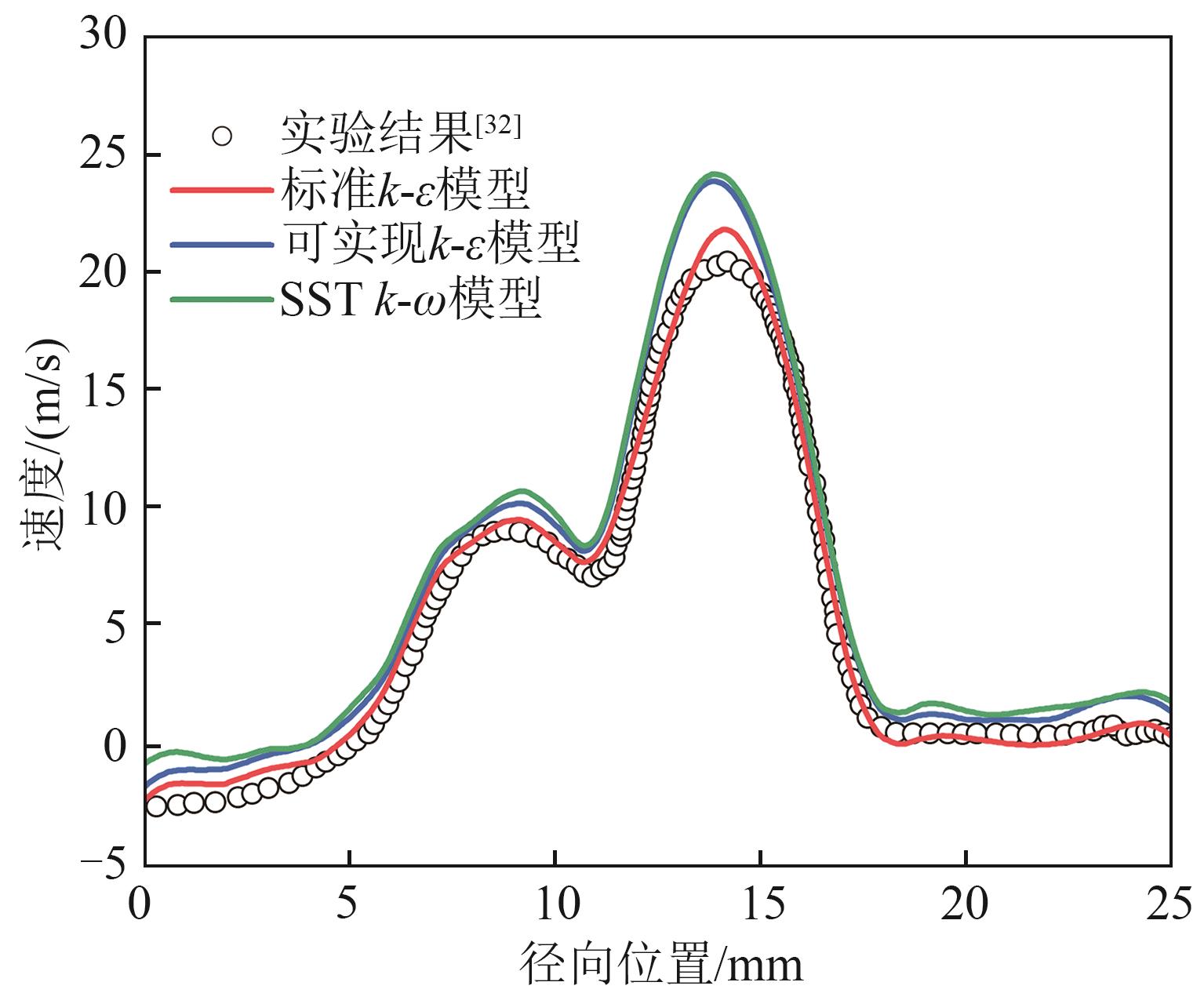
Fig. 4 Comparison of experimental with numerical calculation results
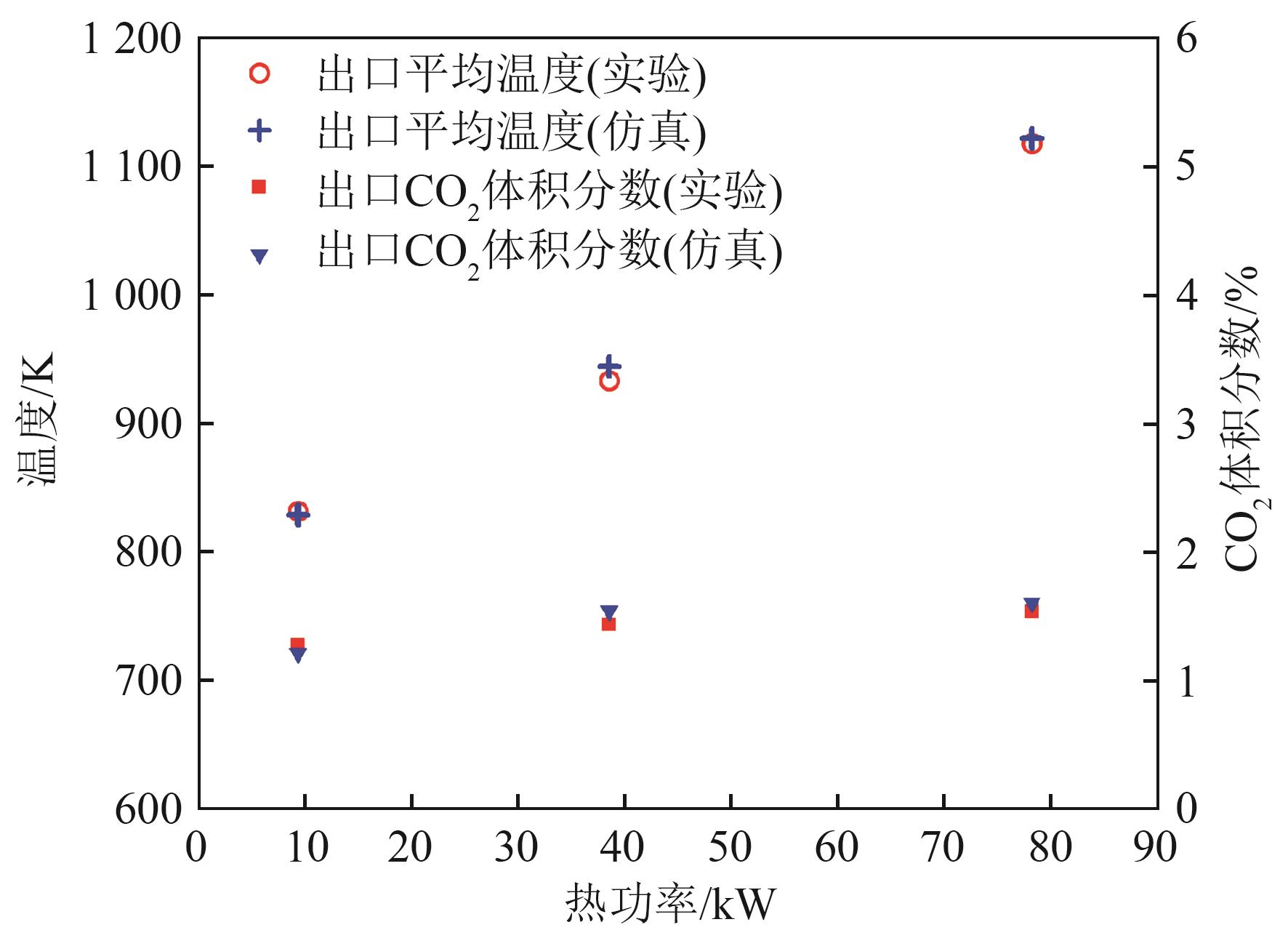
Fig. 5 Comparison of average temperature and CO2 volumetric fraction at combustion chamber outlet between experimental and numerical results
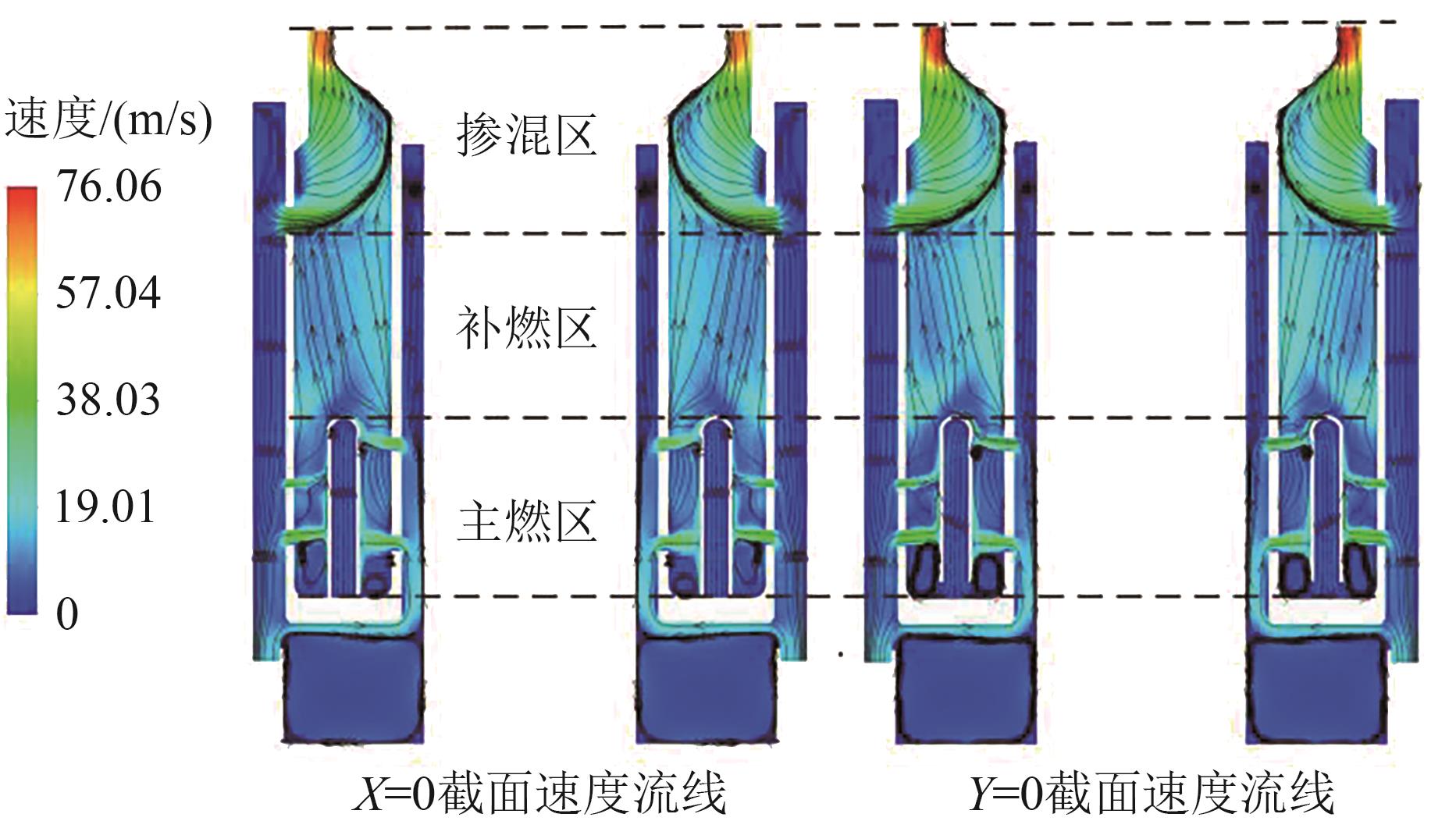
Fig. 6 Velocity streamline at different sections
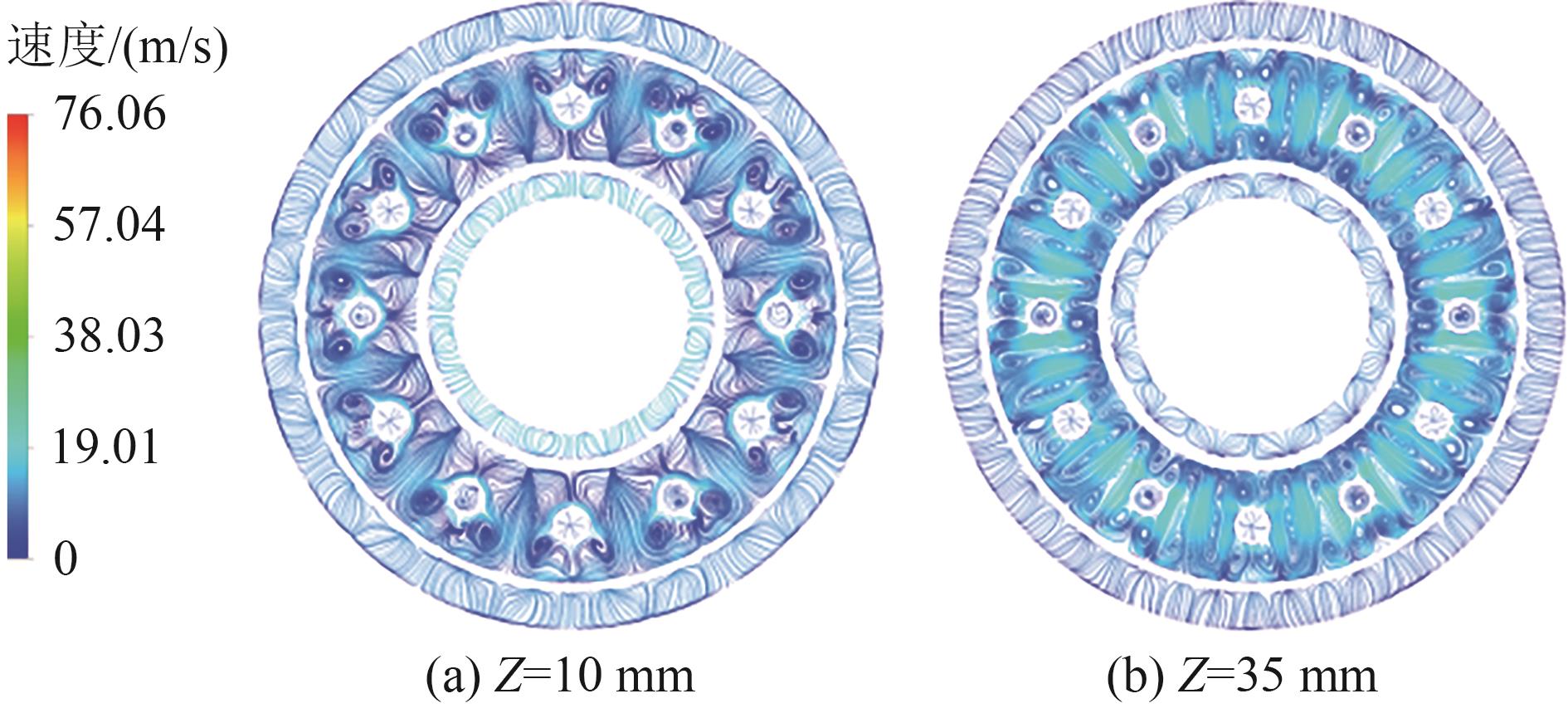
Fig. 7 Cross-sectional velocity streamline of primary combustion zone
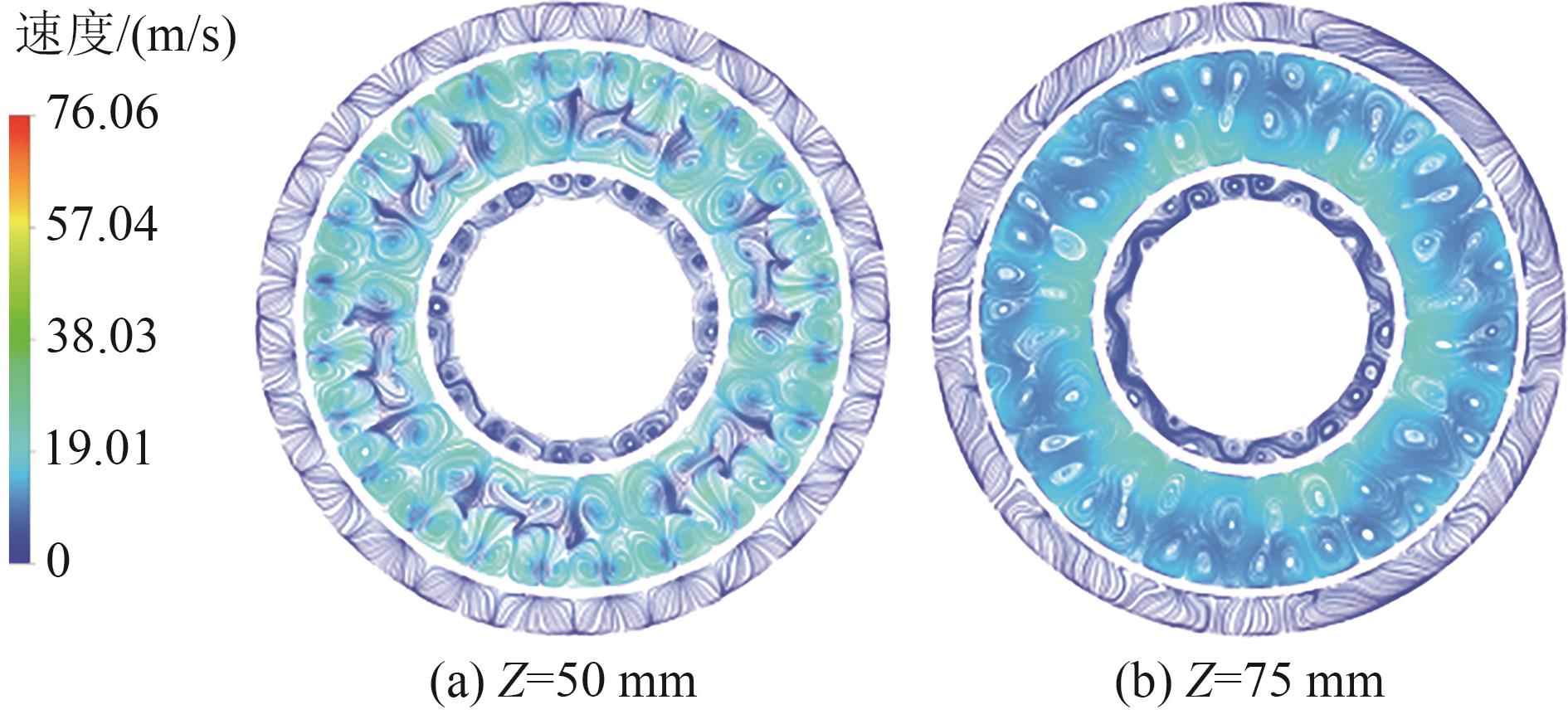
Fig. 8 Cross-sectional velocity streamline of supplementary combustion zone
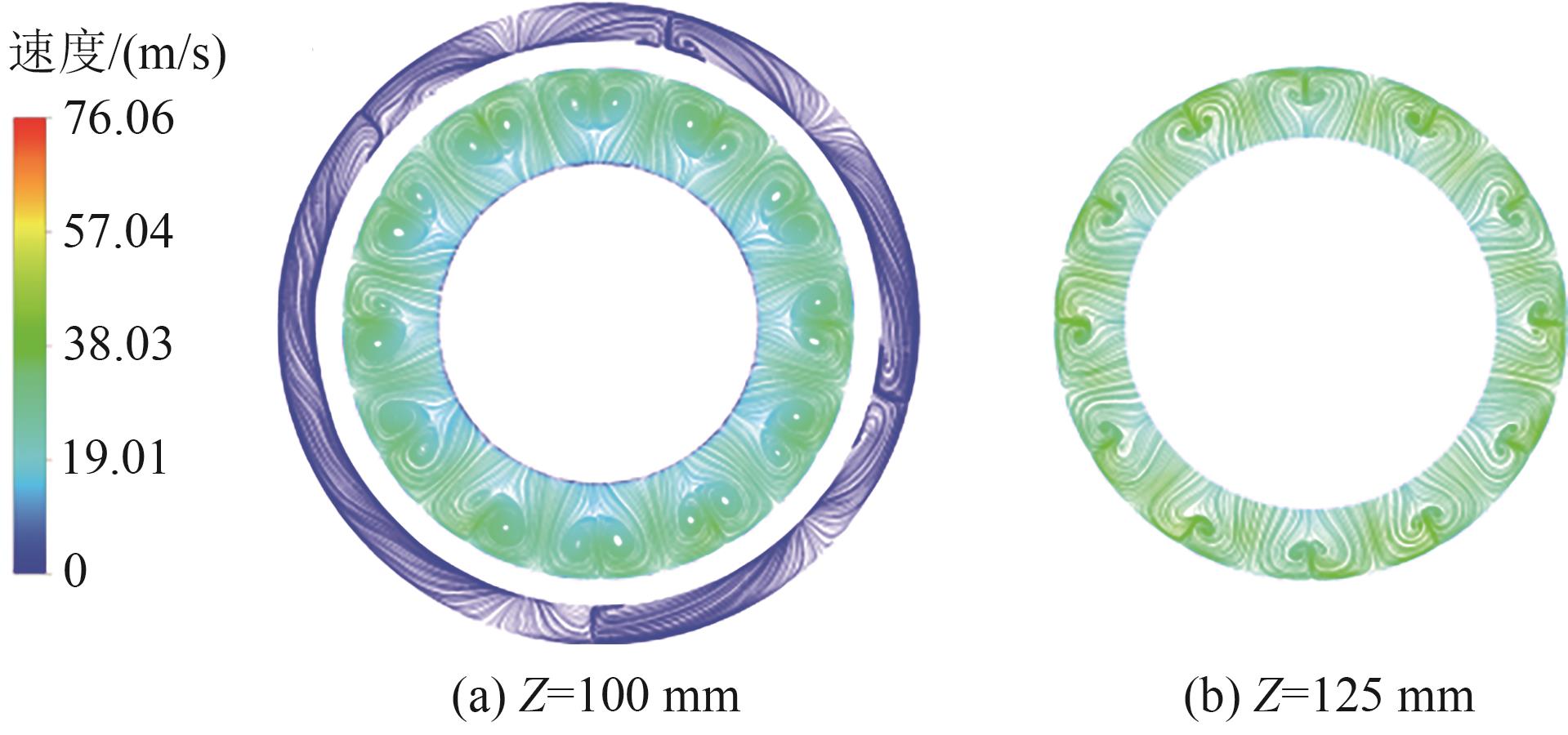
Fig. 9 Cross-sectional velocity streamline of mixing zone
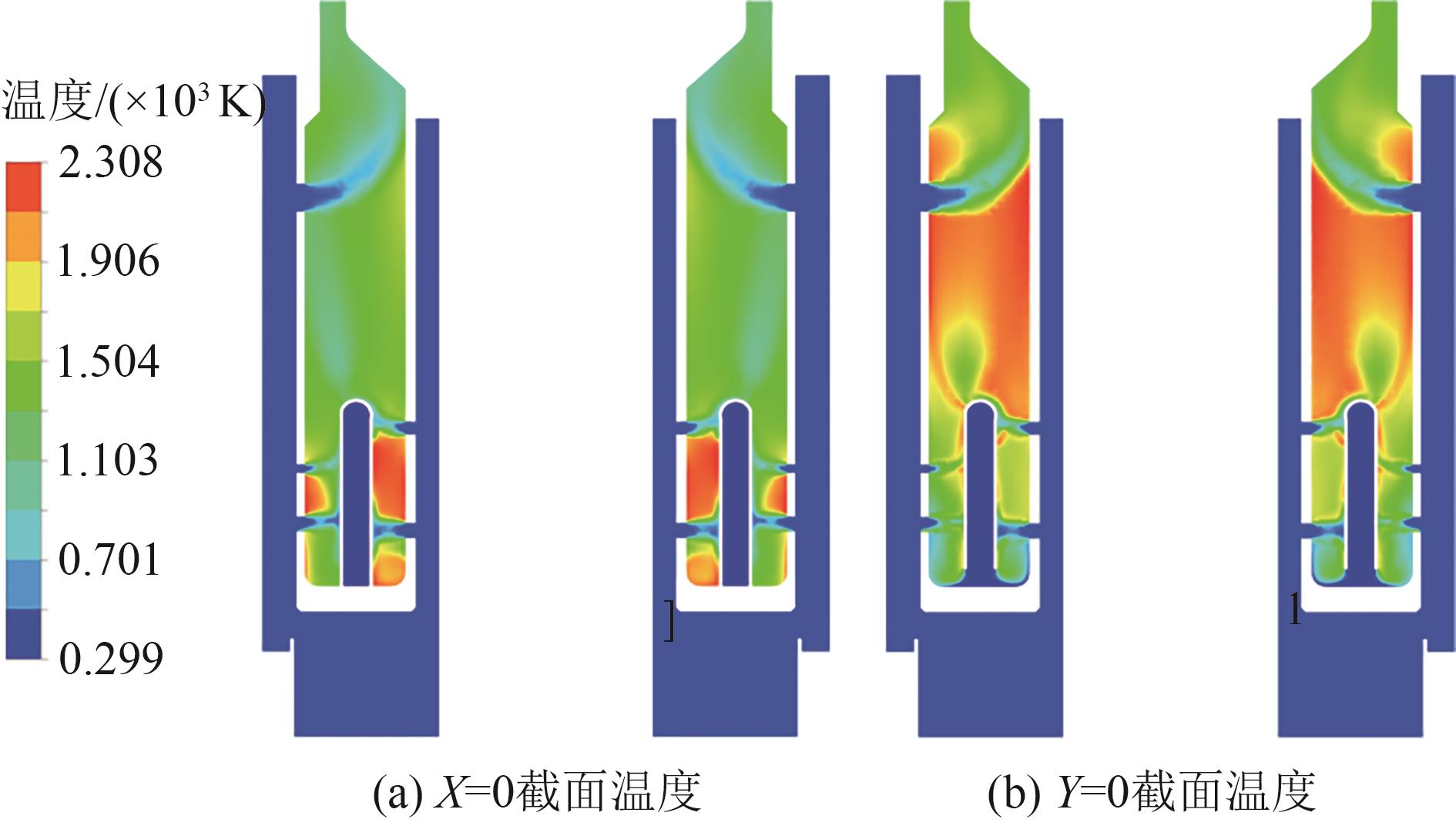
Fig. 10 Temperature distribution in different sections of combustion chamber
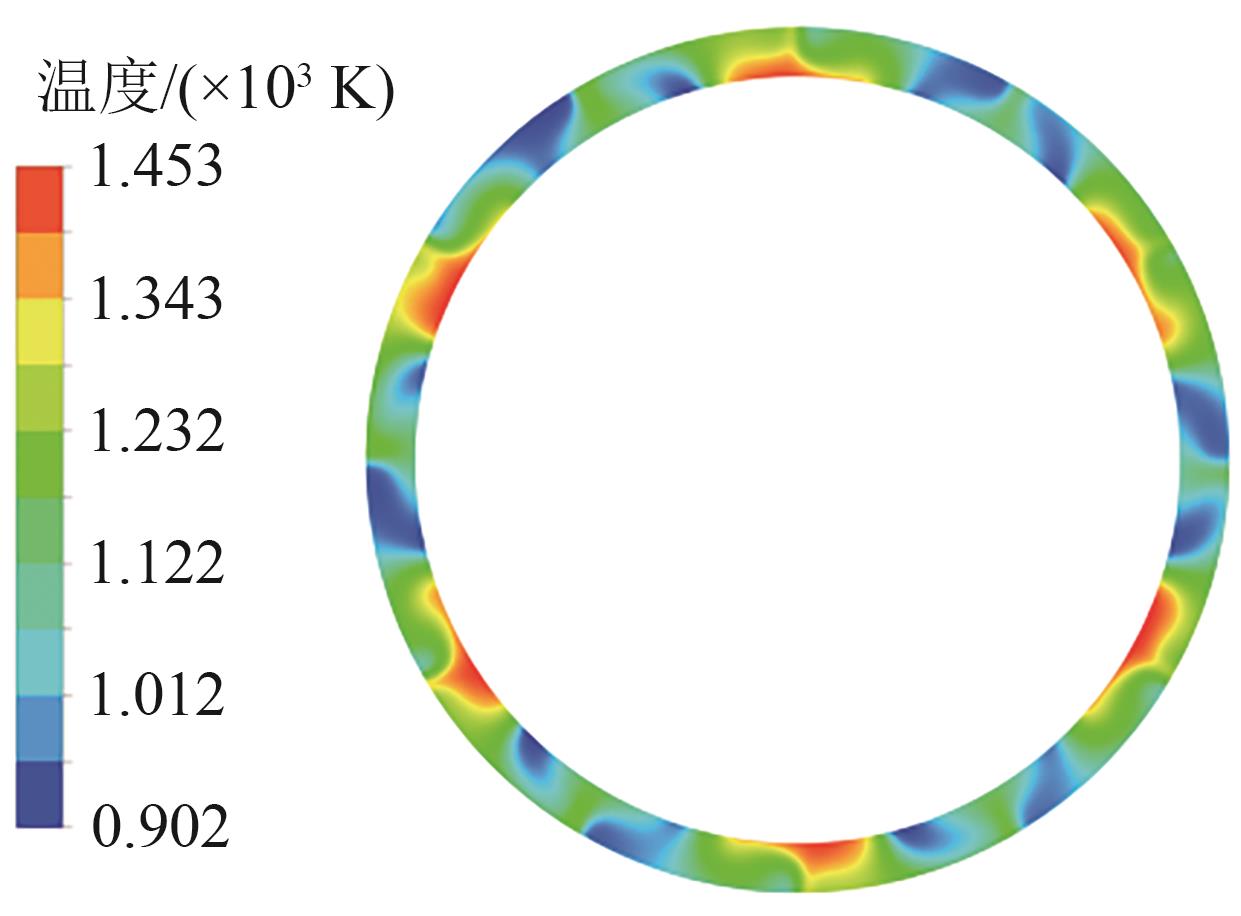
Fig. 11 Temperature distribution at combustion chamber outlet
| 掺氨比 | 燃料质量流量/(kg/s) | 燃料低热值/(kJ/kg) |
|---|---|---|
| 0 | 0.001 837 | 50 028.0 |
| 0.1 | 0.001 960 | 46 885.6 |
| 0.2 | 0.002 101 | 43 743.2 |
| 0.3 | 0.002 264 | 40 600.8 |
| 0.4 | 0.002 453 | 37 458.4 |
| 0.5 | 0.002 678 | 34 316.0 |
| 0.6 | 0.002 948 | 31 173.6 |
| 0.7 | 0.003 279 | 28 031.2 |
| 0.8 | 0.003 692 | 24 888.8 |
| 0.9 | 0.004 226 | 21 746.4 |
| 1.0 | 0.004 940 | 18 604.0 |
Tab. 2 Fuel flow and lower heating value of combustion chamber with different ammonia blending ratios
| 掺氨比 | 燃料质量流量/(kg/s) | 燃料低热值/(kJ/kg) |
|---|---|---|
| 0 | 0.001 837 | 50 028.0 |
| 0.1 | 0.001 960 | 46 885.6 |
| 0.2 | 0.002 101 | 43 743.2 |
| 0.3 | 0.002 264 | 40 600.8 |
| 0.4 | 0.002 453 | 37 458.4 |
| 0.5 | 0.002 678 | 34 316.0 |
| 0.6 | 0.002 948 | 31 173.6 |
| 0.7 | 0.003 279 | 28 031.2 |
| 0.8 | 0.003 692 | 24 888.8 |
| 0.9 | 0.004 226 | 21 746.4 |
| 1.0 | 0.004 940 | 18 604.0 |
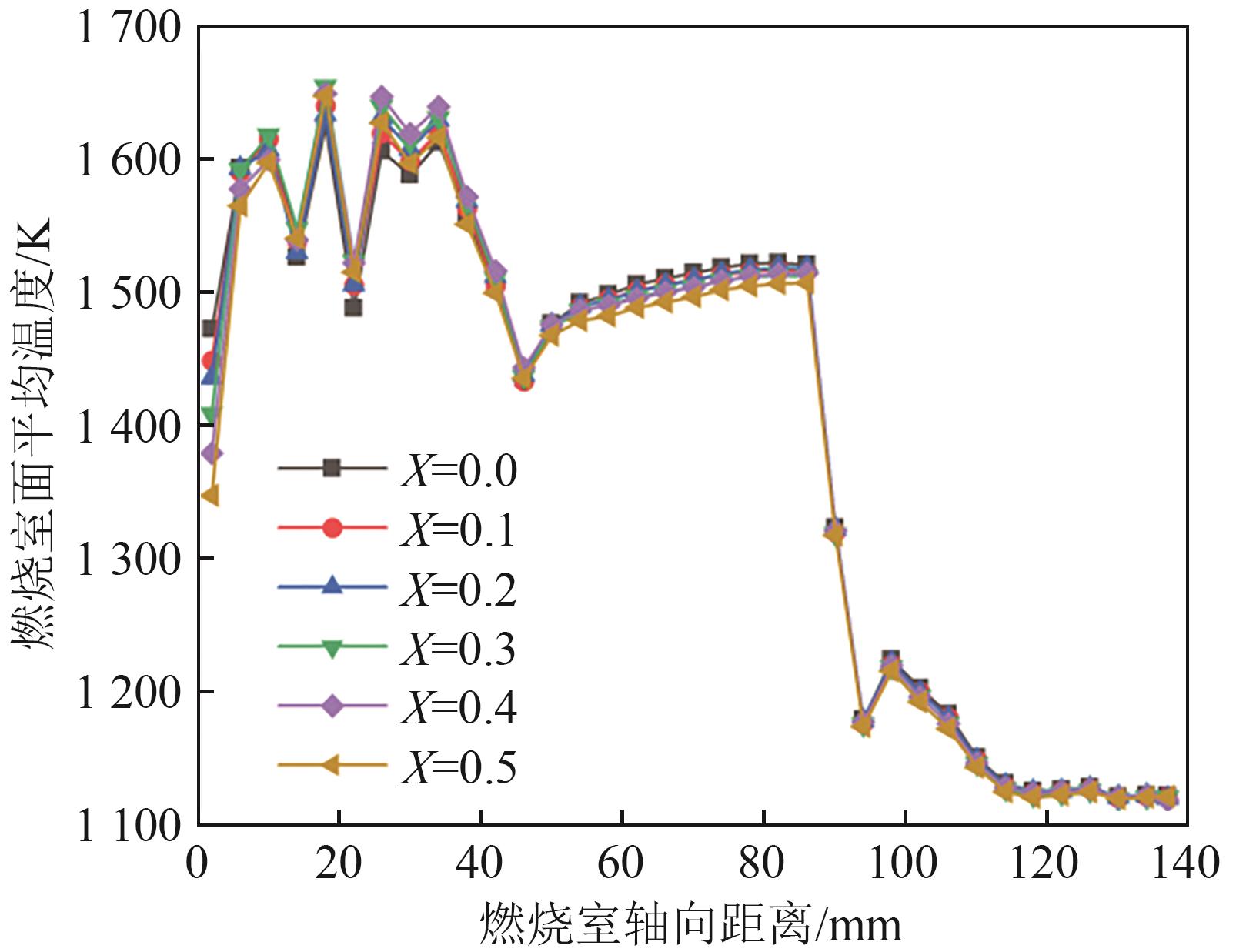
Fig. 12 Axially averaged temperature of combustion chamber with different ammonia blending ratios
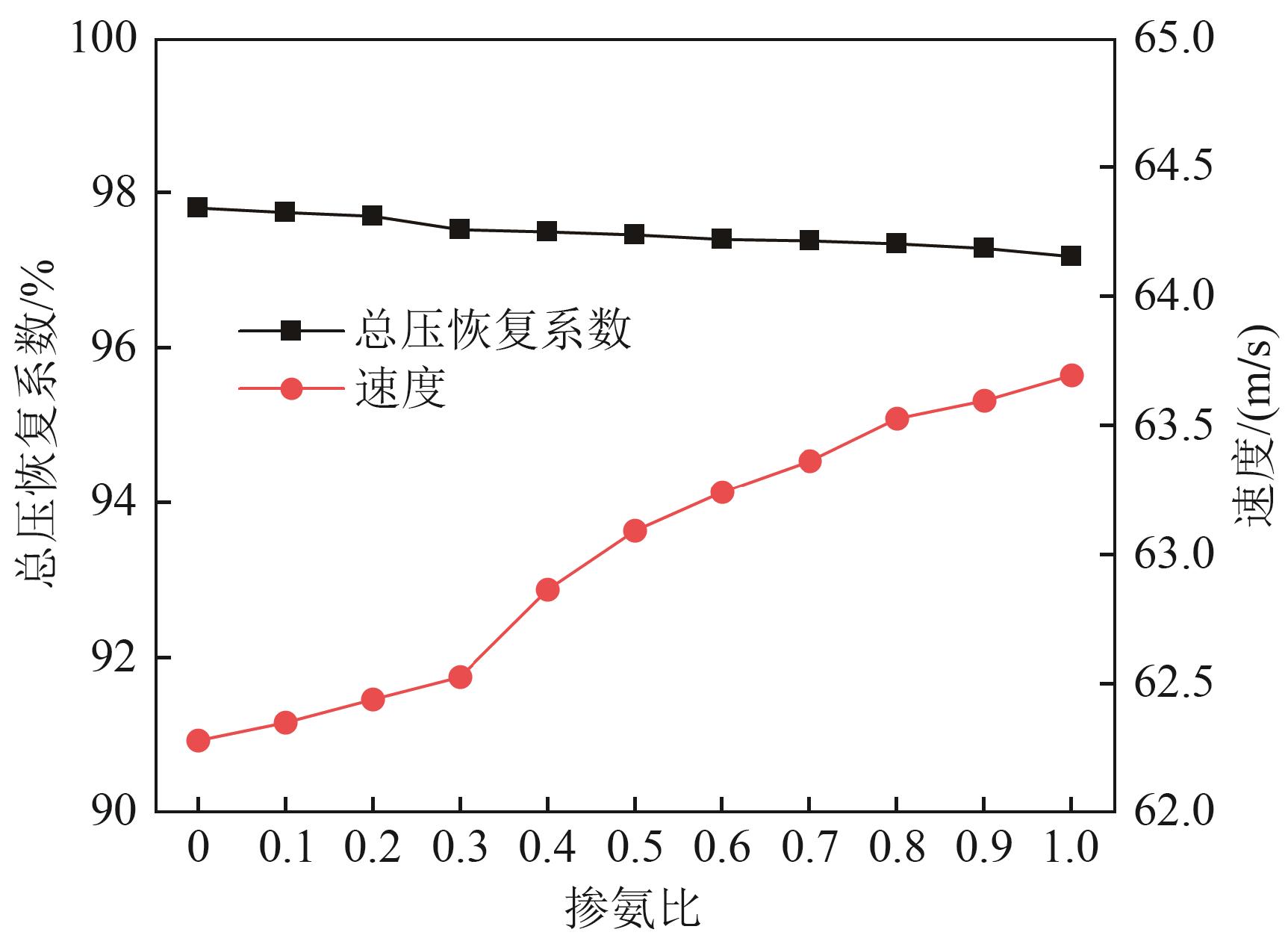
Fig. 13 Combustion chamber outlet gas velocity and total pressure recovery coefficients at different ammonia blending ratios
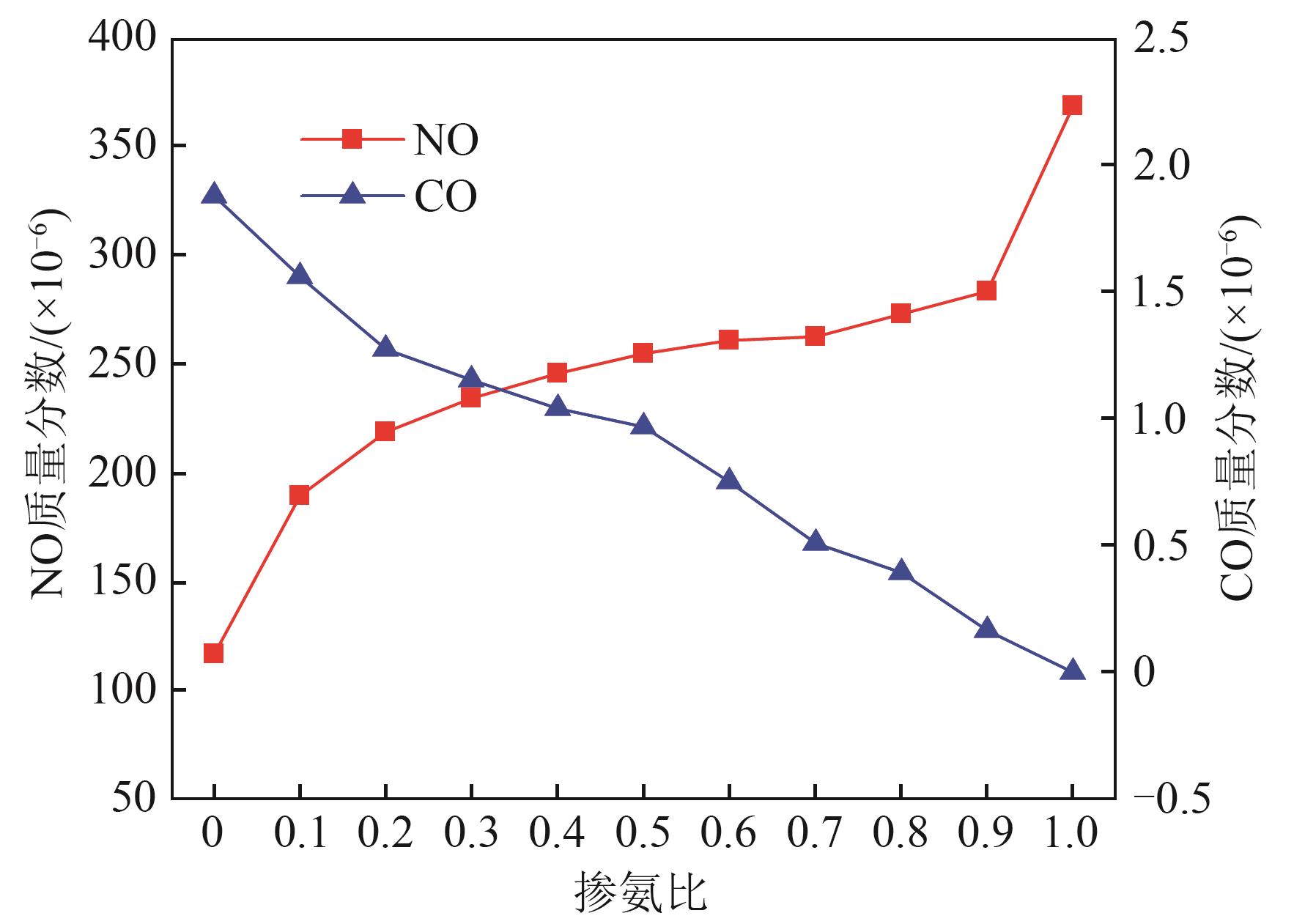
Fig. 14 NO and CO emissions from combustion chamber with different ammonia blending ratios
| 掺氨比 | ξOTDF | 总压恢复系数/% | 燃烧效率/% |
|---|---|---|---|
| 0 | 0.43 | 97.81 | 98.14 |
| 0.1 | 0.43 | 97.75 | 98.05 |
| 0.2 | 0.42 | 97.70 | 97.99 |
| 0.3 | 0.41 | 97.53 | 97.98 |
| 0.4 | 0.39 | 97.50 | 97.93 |
| 0.5 | 0.38 | 97.46 | 97.90 |
| 0.6 | 0.36 | 97.41 | 97.82 |
| 0.7 | 0.34 | 97.38 | 97.79 |
| 0.8 | 0.30 | 97.34 | 97.76 |
| 0.9 | 0.28 | 97.29 | 97.75 |
| 1.0 | 0.24 | 97.18 | 97.64 |
Tab. 3 Performance indicators of combustion chamber with different ammonia blending ratios
| 掺氨比 | ξOTDF | 总压恢复系数/% | 燃烧效率/% |
|---|---|---|---|
| 0 | 0.43 | 97.81 | 98.14 |
| 0.1 | 0.43 | 97.75 | 98.05 |
| 0.2 | 0.42 | 97.70 | 97.99 |
| 0.3 | 0.41 | 97.53 | 97.98 |
| 0.4 | 0.39 | 97.50 | 97.93 |
| 0.5 | 0.38 | 97.46 | 97.90 |
| 0.6 | 0.36 | 97.41 | 97.82 |
| 0.7 | 0.34 | 97.38 | 97.79 |
| 0.8 | 0.30 | 97.34 | 97.76 |
| 0.9 | 0.28 | 97.29 | 97.75 |
| 1.0 | 0.24 | 97.18 | 97.64 |
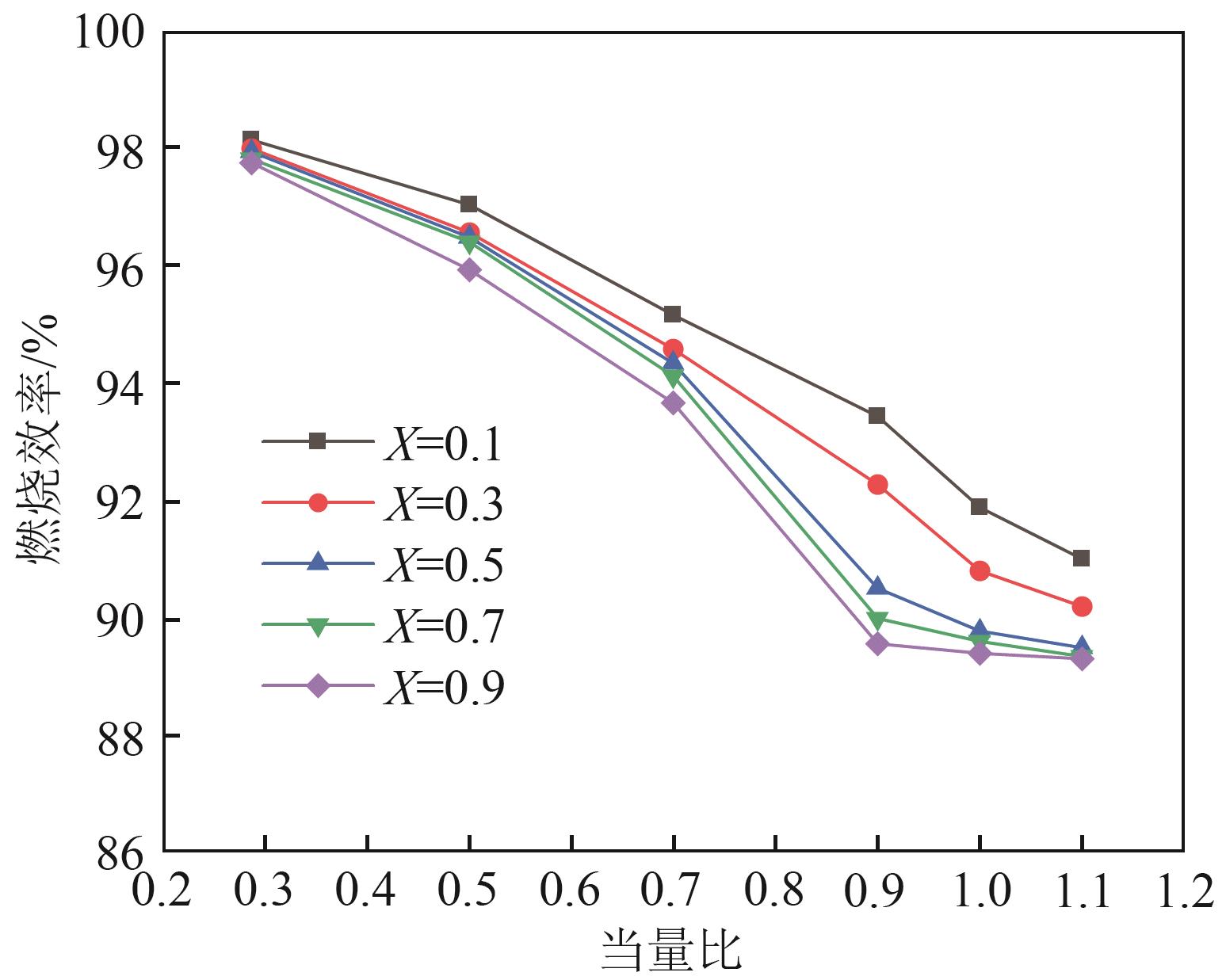
Fig. 15 Combustion efficiency at different equivalence ratios and ammonia blending ratios
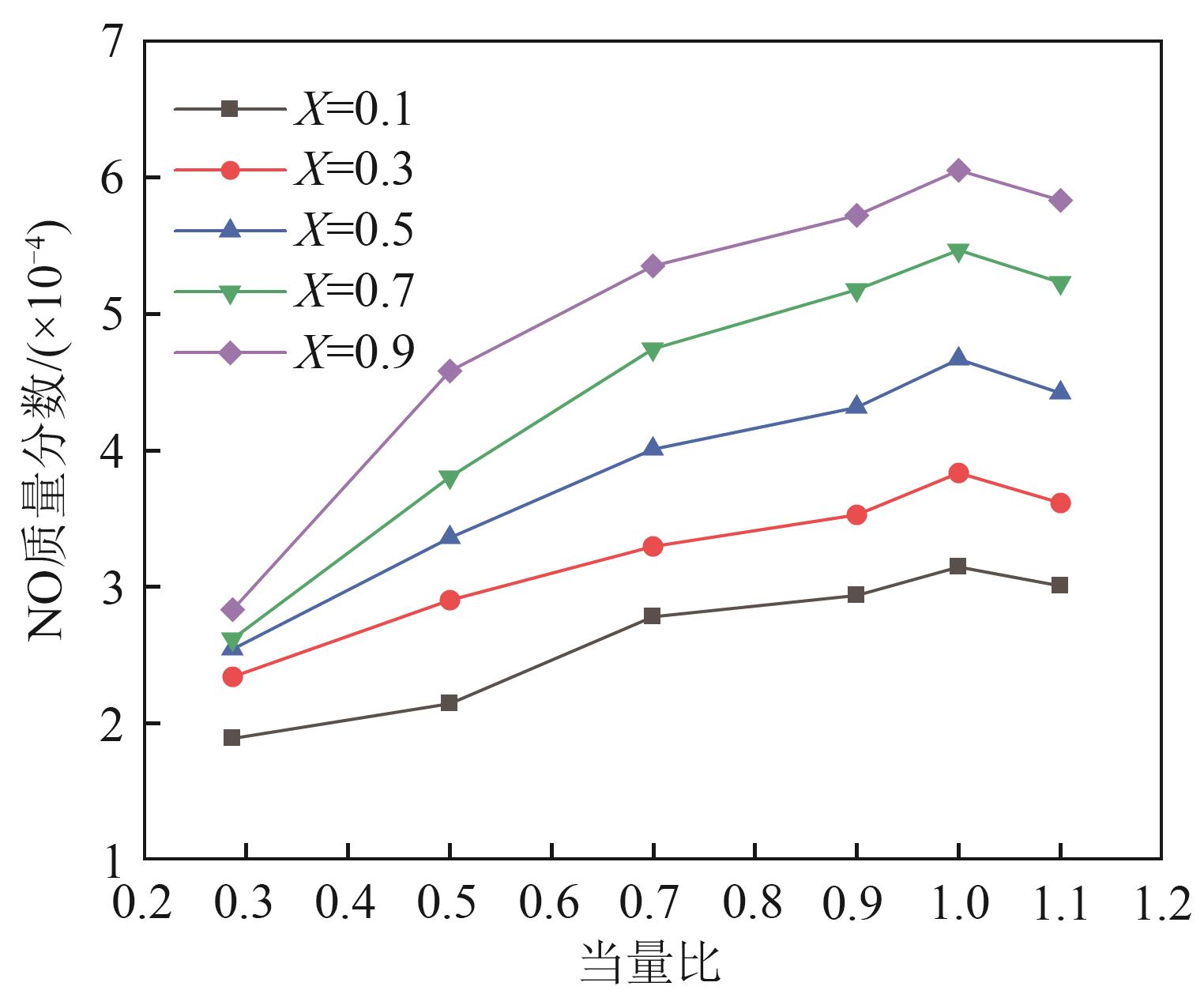
Fig. 16 NO emissions at different equivalence ratios
| [1] | 王放放,杨鹏威,赵光金,等 .新型电力系统下火电机组灵活性运行技术发展及挑战[J].发电技术,2024,45(2):189-198. doi:10.12096/j.2096-4528.pgt.23079 |
| WANG F F, YANG P W, ZHAO G J,et al .Development and challenge of flexible operation technology of thermal power units under new power system[J].Power Generation Technology,2024,45(2):189-198. doi:10.12096/j.2096-4528.pgt.23079 | |
| [2] | 赵德福,袁家海,张健,等 .多层次视角下颠覆性技术驱动的中国能源电力转型路径[J].电力建设,2024,45(8):1-10. doi:10.12204/j.issn.1000-7229.2024.08.001 |
| ZHAO D F, YUAN J H, ZHANG J,et al .China’s energy and power system transition pathways driven by disruptive technologies:a multilevel perspective[J].Electric Power Construction,2024,45(8):1-10. doi:10.12204/j.issn.1000-7229.2024.08.001 | |
| [3] | 高政南,姜楠,陈启鑫,等 .德国电力市场能源转型建设及启示[J].中国电力,2024,57(6):204-214. |
| GAO Z N, JIANG N, CHEN Q X,et al .Construction experience of German electricity market adapting to energy transition[J].Electric Power,2024,57(6):204-214. | |
| [4] | 高超,韦斌,隋宇,等 .能源低碳利用评价指标与技术综述[J].南方能源建设,2024,11(5):178-190. doi:10.16516/j.ceec.2024.5.19 |
| GAO C, WEI B, SUI Y,et al .Review of evaluation indicators and technologies for low-carbon energy utilization[J].Southern Energy Construction,2024,11(5):178-190. doi:10.16516/j.ceec.2024.5.19 | |
| [5] | 任卓亚,郭宁,解佗,等 .我国清洁能源发展规律分析及其与经济系统的协调发展评价[J].电网与清洁能源,2024,40(12):128-134. |
| REN Z Y, GUO N, XIE T,et al .A study on the development patterns of clean energy in China and evaluation of its coordinated development with the economic system[J].Power System and Clean Energy,2024,40(12):128-134. | |
| [6] | 李梦宇,王健,田野 .碳达峰碳中和目标下中国经济产业发展研究[J].全球能源互联网,2024,7(6):629-639. |
| LI M Y, WANG J, TIAN Y .Research on the development of China’s economic industry under the goal of carbon peak and carbon neutrality[J].Journal of Global Energy Interconnection,2024,7(6):629-639. | |
| [7] | 李旭东,谭青博,赵浩辰,等 .碳达峰背景下中国电力行业碳排放因素和脱钩效应[J].中国电力,2024,57(5):88-98. doi:10.11930/j.issn.1004-9649.202306019 |
| LI X D, TAN Q B, ZHAO H C,et al .Carbon emission factors and decoupling effects of China’s power industry under the background of carbon peak[J].Electric Power,2024,57(5):88-98. doi:10.11930/j.issn.1004-9649.202306019 | |
| [8] | 李灏恩,姜雨萌,戚宇辰,等 .碳中和目标下电力需求预测体系构建及华东区域电力需求发展趋势研究[J].电网与清洁能源,2024,40(2):30-36. |
| LI H E, JIANG Y M, QI Y C,et al .A study on the construction of the power demand forecasting system under carbon neutrality goal and the development trend of power demand in East China[J].Power System and Clean Energy,2024,40(2):30-36. | |
| [9] | 周勤勇,李根兆,秦晓辉,等 .能源革命下的电力系统范式转换分析[J].中国电力,2024,57(3):1-11. doi:10.11930/j.issn.1004-9649.202311115 |
| ZHOU Q Y, LI G Z, QIN X H,et al .Analysis of power system paradigm shift under energy revolution[J].Electric Power,2024,57(3):1-11. doi:10.11930/j.issn.1004-9649.202311115 | |
| [10] | 郭婷婷,曹蕃 .低碳能源系统发展趋势与应用实践[J].分布式能源,2025,10(1):1-13. doi:10.16513/j.2096-2185.DE.(2025)010-01-0001-13 |
| GUO T T, CAO F .Development trend and application of low-carbon energy system[J].Distributed Energy,2025,10(1):1-13. doi:10.16513/j.2096-2185.DE.(2025)010-01-0001-13 | |
| [11] | 周上坤,杨文俊,谭厚章,等 .氨燃烧研究进展[J].中国电机工程学报,2021,41(12):4164-4181. doi:10.13334/j.0258-8013.pcsee.201476 |
| ZHOU S K, YANG W J, TAN H Z,et al .Research progress of ammonia combustion[J].Proceedings of the CSEE,2021,41(12):4164-4181. doi:10.13334/j.0258-8013.pcsee.201476 | |
| [12] | 范卫东,陈钧 .氨气燃烧强化措施及NO x 控制策略研究进展[J].华中科技大学学报(自然科学版),2022,50(7):14-23. |
| FAN W D, CHEN J .Research progress of combustion enhancement and NO x control strategies for ammonia combustion[J].Journal of Huazhong University of Science and Technology (Nature Science Edition),2022,50(7):14-23. | |
| [13] | VALERA-MEDINA A, AMER-HATEM F, AZAD A K,et al .Review on ammonia as a potential fuel:from synthesis to economics[J].Energy & Fuels,2021,35(9):6964-7029. doi:10.1021/ACS.ENERGYFUELS.0C03685 |
| [14] | ROCHA R C, COSTA M, BAI X S .Combustion and emission characteristics of ammonia under conditions relevant to modern gas turbines[J].Combustion Science and Technology,2021,193(14):2514-2533. doi:10.1080/00102202.2020.1748018 |
| [15] | OKAFOR E C, NAITO Y, COLSON S,et al .Measurement and modelling of the laminar burning velocity of methane-ammonia-air flames at high pressures using a reduced reaction mechanism[J].Combustion and Flame,2019,204:162-175. doi:10.1016/j.combustflame.2019.03.008 |
| [16] | 高虎,刘凡,李海 .碳中和目标下氨燃料的机遇、挑战及应用前景[J].发电技术,2022,43(3):462-467. doi:10.12096/j.2096-4528.pgt.22059 |
| GAO H, LIU F, LI H .Opportunities,challenges and application prospects of ammonia fuel under the target of carbon neutrality[J].Power Generation Technology,2022,43(3):462-467. doi:10.12096/j.2096-4528.pgt.22059 | |
| [17] | BASTANI M, TABEJAMAAT S, ASHINI H .Numerical and experimental study of combustion and emission characteristics of ammonia/methane fuel mixture in micro gas turbine combustor[J].International Journal of Hydrogen Energy,2024,49:1399-1415. doi:10.1016/j.ijhydene.2023.09.319 |
| [18] | 王凯卉,刘斌,折晓会,等 .氨氢混合燃烧在旋流燃烧器中的动力学特性与NO x 减排机理研究[J].发电技术,2025,46(1):171-179. |
| WANG K H, LIU B, ZHE X H,et al .Kinetic characterization and NO x reduction mechanism of mixed Ammonia-Hydrogen combustion in cyclone combustor[J].Power Generation Technology,2025,46(1):171-179. | |
| [19] | ZHANG M, AN Z H, WEI X T,et al .Emission analysis of the CH4/NH3/air co-firing fuels in a model combustor[J].Fuel,2021,291:120135. doi:10.1016/j.fuel.2021.120135 |
| [20] | KURATA O,IKI N, MATSUNUMA T,et al .Performances and emission characteristics of NH3-air and NH3 CH4-air combustion gas-turbine power generations[J].Proceedings of the Combustion Institute,2017,36(3):3351-3359. doi:10.1016/j.proci.2016.07.088 |
| [21] | IKI N, KURATA O, MATSUNUMA T,et al .Micro gas turbine firing ammonia[C]//Microturbines,Turbochargers and Small Turbomachines;Steam Turbines.Seoul,South Korea:American Society of Mechanical Engineers,2016,8:V008T23A018. doi:10.1115/GT2016-56954 |
| [22] | TIAN Z Y, LI Y Y, ZHANG L D,et al .An experimental and kinetic modeling study of premixed NH3/CH4/O2/Ar flames at low pressure[J].Combustion and Flame,2009,156(7):1413-1426. doi:10.1016/j.combustflame.2009.03.005 |
| [23] | HAYAKAWA A, GOTO T, MIMOTO R,et al .Laminar burning velocity and Markstein length of ammonia/air premixed flames at various pressures[J].Fuel,2015,159:98-106. doi:10.1016/j.fuel.2015.06.070 |
| [24] | OKAFOR E C, NAITO Y, COLSON S,et al .Experimental and numerical study of the laminar burning velocity of CH4-NH3-air premixed flames[J].Combustion and Flame,2018,187:185-198. doi:10.1016/j.combustflame.2017.09.002 |
| [25] | LUCCHINI T, D’ERRICO G, ONORATI A,et al .Modeling non-premixed combustion using tabulated kinetics and different fame structure assumptions[J].SAE International Journal of Engines,2017,10(2):593-607. doi:10.4271/2017-01-0556 |
| [26] | CAI Z H, HUANG M M, WEI G F,et al .Numerical study of the effect of pressure on the combustion characteristics of ammonia/coal-derived syngas mixture under gas turbine operating conditions[J].Fuel,2023,347:128463. doi:10.1016/j.fuel.2023.128463 |
| [27] | TU Y J, XU S T, LIU H .Combustion and emission characteristics of NH3/CH4/air in a model swirl combustor:comparison between premixed and non-premixed modes[J].International Journal of Hydrogen Energy,2023,48(45):17311-17323. doi:10.1016/j.ijhydene.2023.01.235 |
| [28] | WANG J, HU Z W, DU C,et al .Numerical study of effusion cooling of a gas turbine combustor liner[J].Fuel,2021,294:120578. doi:10.1016/j.fuel.2021.120578 |
| [29] | FATEHI M, RENZI M .Modelling and development of ammonia-air non-premixed low NO x combustor in a micro gas turbine:a CFD analysis[J].International Journal of Hydrogen Energy,2024,88:1-10. doi:10.1016/j.ijhydene.2024.09.071 |
| [30] | SWEENEY M S, HOCHGREB S, DUNN M J,et al .The structure of turbulent stratified and premixed methane/air flames I:non-swirling flows[J].Combustion and Flame,2012,159(9):2896-2911. doi:10.1016/j.combustflame.2012.06.001 |
| [31] | SWEENEY M S, HOCHGREB S, BARLOW R S .Cambridge stratified swirl burner technical drawings [EB/OL]. (2012-10-14)[2024-06-23].. doi:10.1016/j.combustflame.2012.05.014 |
| [32] | FANTOZZI F, LARANCI P, BIDINI G .CFD simulation of biomass pyrolysis syngas vs.natural gas in a microturbine annular combustor[C]//ASME Turbo Expo 2010:Power for Land,Sea,and Air, Glasgow,UK.2010:649-658. doi:10.1115/GT2010-23473 |
| [33] | 李东杰,周伯豪,梁骞,等 .微型涡喷发动机燃烧室优化设计[J].清华大学学报(自然科学版),2021,61(10):1212-1220. doi:10.16511/j.cnki.qhdxxb.2020.22.034 |
| LI D J, ZHOU B H, LIANG Q,et al .Optimization of a micro turbojet engine combustion chamber[J].Journal of Tsinghua University (Science and Technology),2021,61(10):1212-1220. doi:10.16511/j.cnki.qhdxxb.2020.22.034 | |
| [34] | 周麒麟 .新型蒸发管研究及在微型燃烧室中的应用[D].南京:南京航空航天大学,2009. doi:10.7666/d.y1812242 |
| ZHOU Q L .Research on new vaporizer for mirco combustor[D].Nanjing:Nanjing University of Aeronautics and Astronautics,2009. doi:10.7666/d.y1812242 | |
| [35] | 杨牧歌 .微型燃气轮机燃烧室的设计与优化[D].哈尔滨:哈尔滨工业大学,2016. |
| YANG M G .Design and optimization of micro gas turbine combustionchamber[D].Harbin:Harbin Institute of Technology,2016. | |
| [36] | PAN W G, KANG L W, CHI Z W,et al .Numerical study on effects of hydrogen doping of natural gas on the combustion characteristics in micro gas turbine combustor[J].Applied Thermal Engineering,2024,255:123989. doi:10.1016/j.applthermaleng.2024.123989 |
| [37] | 汪凤山 .低NO x 排放微型燃气轮机燃烧室的数值模拟及实验研究[D].北京:中国科学院研究生院(工程热物理研究所),2009. |
| WANG F S .Numerical and experimental investigation on a low NO x emission combustor for micro gas turbine[D].Beijing:Institute of Engineering Thermophysics,Chinese Academy of Sciences,2009. | |
| [38] | 黄勇 .燃烧与燃烧室[M].北京:北京航空航天大学出版社,2009. |
| HUANG Y .Combustion and combustion chamber[M].Beijing:Beijing University of Aeronautics & Astronautics Press,2009. | |
| [39] | 宋权斌,赵仙娟,宋彦庆,等 .微型燃气轮机改烧氨气/氢气混合燃料的数值模拟研究[J].热能动力工程,2023,38(5):146-153. doi:10.16146/j.cnki.rndlgc.2023.05.018 |
| SONG Q B, ZHAO X J, SONG Y Q,et al .Numerical simulation of micro-combustion engine to burn ammonia/hydrogen mixed fuel[J].Journal of Engineering for Thermal Energy and Power,2023,38(5):146-153. doi:10.16146/j.cnki.rndlgc.2023.05.018 | |
| [40] | LARANCI P, BIDINI G, D’ALESSANDRO B,et al .Improving lifetime and manufacturability of an RQL combustor for microturbines:design and numerical validation[C]//ASME Turbo Expo 2015:Turbine Technical Conference and Exposition,Montreal,Quebec,Canada:ASME,2015,56673:V003T03A009. doi:10.1115/gt2015-43543 |
| [41] | CHEN X Y, ZHOU W G, JIA Y F,et al .Numerical analysis of the combustion in micro gas turbine with methane/biogas fuels[J].Arabian Journal for Science and Engineering,2021,46(12):11897-11907. doi:10.1007/s13369-021-05731-3 |
| [42] | SUN J H, YANG Q, ZHAO N B,et al .Numerically study of CH4/NH3 combustion characteristics in an industrial gas turbine combustor based on a reduced mechanism[J].Fuel,2022,327:124897. doi:10.1016/j.fuel.2022.124897 |
| [1] | Yiwei XU, Yan HONG, Xiaopeng ZHAO, Bingwei SUI. Analysis of Influence of Coal-Ammonia Co-firing on the Heat Transfer Characteristics of Heating Surfaces in Coal-Fired Boiler [J]. Power Generation Technology, 2025, 46(5): 1022-1031. |
| [2] | Qianxin GUO, Jianbo LI, Hu WANG, Yintang LIANG, Xinjian HAN, Xiongwei RUAN, Xiaofeng LU. Study on Numerical Simulation of Dynamic Deposition and Shedding Characteristics of Zhundong Coal Ash [J]. Power Generation Technology, 2025, 46(4): 829-838. |
| [3] | Lidong ZHANG, Zhixiang YANG, Wenfeng LI, Jiangzhe FENG, Bo ZHANG, Huaihui REN, Zhe CHEN, Zhaoxin WANG. Numerical Simulation Study on Effect of Deflectors on Aerodynamic Characteristics of Horizontal Axis Wind Turbines [J]. Power Generation Technology, 2025, 46(2): 336-343. |
| [4] | Lifeng ZHANG, Xianghu DONG. Reconstruction of Temperature Distribution in Acoustic Tomography Based on Robust Regularized Extreme Learning Machine [J]. Power Generation Technology, 2025, 46(2): 361-369. |
| [5] | Kai LI, Pingheng ZHANG, Zhihao MENG, Yunning CAO, Yao XU, Li LIU, Lianming LI. Numerical Simulation of Fly Ash Deposition Characteristics and Flow Field Optimization for SCR External Flue [J]. Power Generation Technology, 2025, 46(1): 145-153. |
| [6] | Kaihui WANG, Bin LIU, Xiaohui ZHE, Wei LIU, Hao FAN, Zongyao KANG, Li XU. Kinetic Characterization and NO x Reduction Mechanism of Mixed Ammonia-Hydrogen Combustion in Cyclone Combustor [J]. Power Generation Technology, 2025, 46(1): 171-179. |
| [7] | Xianmin ZENG, Boyun LI, Xiangyang SHEN, Jiashu CHEN, Lixing DING. Thermal Stress Analysis of Transversally Corrugated Tube in Solar Receiver Under Semi-Circumference Heating [J]. Power Generation Technology, 2025, 46(1): 190-199. |
| [8] | Zhuo LIU, Donglin CHEN, Shuqi WANG, Yijiang YANG, Youyang YAN, Zhan YANG. Optimization Method of Flow Field for Alleviating Clogging of Mist Eliminator in Desulfurization Tower [J]. Power Generation Technology, 2024, 45(6): 1087-1094. |
| [9] | Mingyang ZHAO, Linlin YIN, Wentao WEI, Yun CHEN, Richen LIU, Jun LI. Impact of Falling Blocks of High Pressure Turbine Rotor Blades With Squealer Tip on the Aerodynamic Performance and Vibration Characteristics [J]. Power Generation Technology, 2024, 45(5): 856-867. |
| [10] | Nan TU, Jiachen LIU, Jing XU, Jiabin FANG, Yanhua MA. Performance Analysis of Heat Storage and Release Process for a Shell-and-Tube Phase Change Heat Exchanger [J]. Power Generation Technology, 2024, 45(3): 508-516. |
| [11] | Xue LIU, Guodong LI, Ruiying ZHANG, Yichen HOU, Lei CHEN, Lijun YANG. Research on Axial Flow Fan Models of Air Cooling Island in Power Plant [J]. Power Generation Technology, 2024, 45(3): 545-557. |
| [12] | Haiwei JIANG, Mingming GAO, Jie LI, Haoyang YU, Guangxi YUE, Zhong HUANG. Modeling and Dynamic Characteristic Analysis of Combustion Process of Biomass Vibrating Grate Furnace [J]. Power Generation Technology, 2024, 45(2): 250-259. |
| [13] | Siqi GONG, Zaipeng YUN, Ming XU, Le AO, Chufu LI, Kai HUANG, Chen SUN. Numerical Simulation of Solid Oxide Fuel Cell Tail Gas Catalytic Combustion Based on Three-Way Catalyst [J]. Power Generation Technology, 2024, 45(2): 331-340. |
| [14] | Yan ZHENG, Xuan YAO, Xunqiang CHEN. Analysis of Syngas Components and Energy in Biomass Gasification Coupled Power Generation System [J]. Power Generation Technology, 2023, 44(6): 859-864. |
| [15] | Yang YANG, Yaoqiang LI, Jinqi ZHANG. Design of Dome Structure for A Lean Premixed Swirled Combustor of Gas Turbine Based on the Numerical Method [J]. Power Generation Technology, 2023, 44(5): 712-721. |
| Viewed | ||||||
|
Full text |
|
|||||
|
Abstract |
|
|||||
