

Power Generation Technology ›› 2026, Vol. 47 ›› Issue (2): 304-314.DOI: 10.12096/j.2096-4528.pgt.260208
• Power Generation and Environmental Protection • Previous Articles
Yiwei ZHANG1, Cheng ZHANG1, Ao HAN1, Lun MA2, Hao HUANG3, Yunong LIU3, Qingyan FANG1, Gang CHEN1
Received:2025-05-30
Revised:2025-08-21
Published:2026-04-30
Online:2026-04-21
Supported by:CLC Number:
Yiwei ZHANG, Cheng ZHANG, Ao HAN, Lun MA, Hao HUANG, Yunong LIU, Qingyan FANG, Gang CHEN. Numerical Simulation of Combustion of Waste Textile Pyrolysis Products in a 660 MW Coal-Fired Boiler[J]. Power Generation Technology, 2026, 47(2): 304-314.
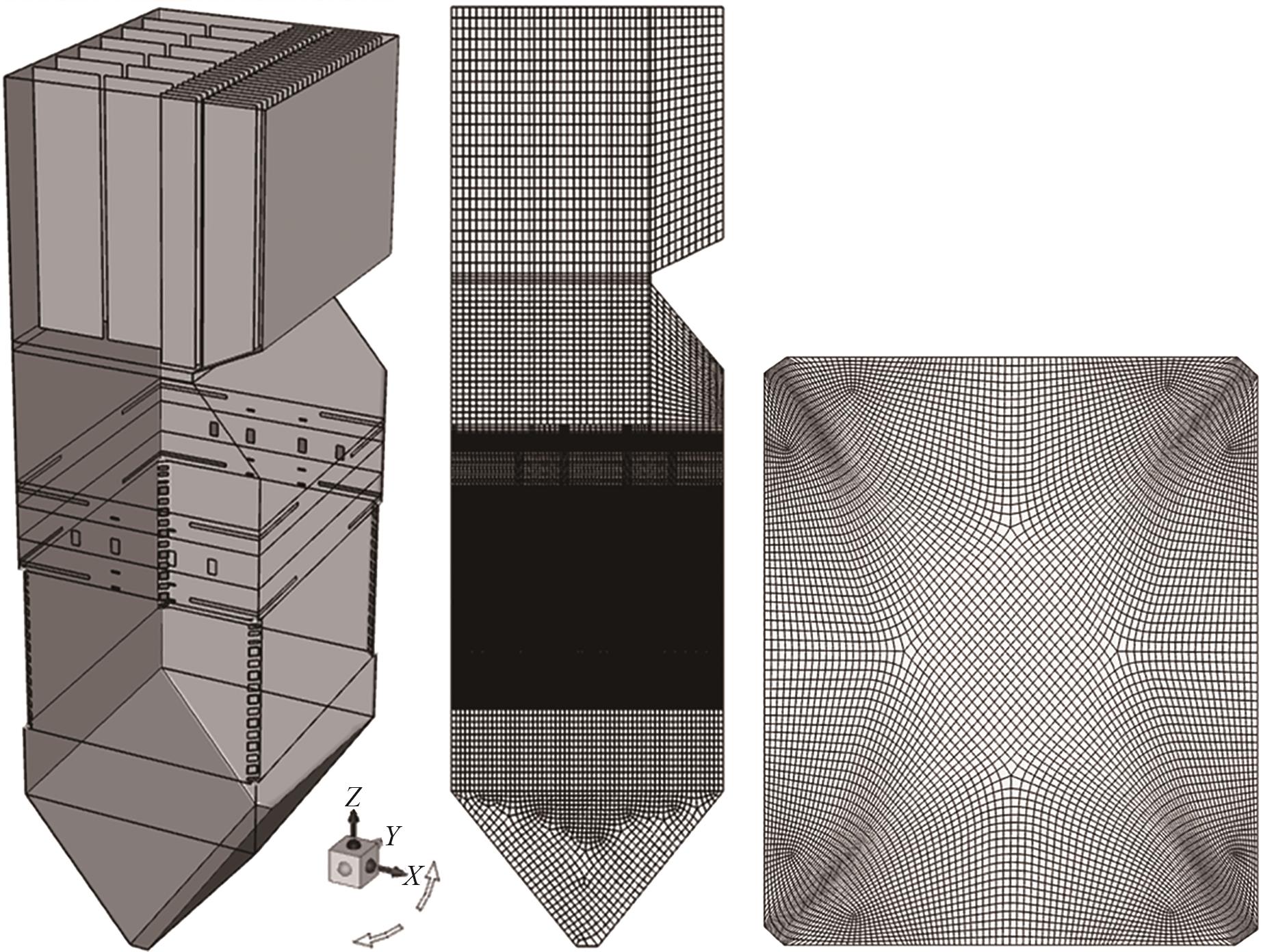
Fig. 1 Furnace structure and mesh division
| 产物 | 热解半焦 | 热解油 | 热解气 |
|---|---|---|---|
| 热解产率/% | 23.30 | 24.43 | 52.27 |
Tab. 1 Pyrolysis yield of waste textiles
| 产物 | 热解半焦 | 热解油 | 热解气 |
|---|---|---|---|
| 热解产率/% | 23.30 | 24.43 | 52.27 |
| 材料名称 | 工业分析 | 元素分析 | Qnet /(kJ/kg) | ||||||
|---|---|---|---|---|---|---|---|---|---|
| Ad /% | Vd /% | FCd /% | Cd /% | Hd /% | Od /% | Nd /% | Sd /% | ||
| 废纺 | 0.24 | 89.81 | 9.95 | 62.60 | 4.79 | 31.90 | 0.47 | 0 | 22 300 |
Tab. 2 Industrial analysis, elemental analysis and calorific value analysis of waste textile feedstock
| 材料名称 | 工业分析 | 元素分析 | Qnet /(kJ/kg) | ||||||
|---|---|---|---|---|---|---|---|---|---|
| Ad /% | Vd /% | FCd /% | Cd /% | Hd /% | Od /% | Nd /% | Sd /% | ||
| 废纺 | 0.24 | 89.81 | 9.95 | 62.60 | 4.79 | 31.90 | 0.47 | 0 | 22 300 |
| 材料名称 | 工业分析 | 元素分析 | Qgr /(kJ/kg) | |||||||
|---|---|---|---|---|---|---|---|---|---|---|
| Mar /% | Var /% | FCar /% | Aar /% | Car /% | Har /% | Oar /% | Nar /% | Sar /% | ||
| 设计煤种-1 | 11.71 | 23.67 | 49.17 | 15.45 | 60.17 | 4.16 | 6.82 | 0.88 | 0.81 | 23 948.25 |
| 设计煤种-2 | 15.69 | 28.50 | 47.17 | 8.64 | 60.43 | 3.77 | 10.35 | 0.71 | 0.41 | 24 510.46 |
| 燃用煤种 | 25.94 | 40.24 | 31.15 | 2.67 | 51.99 | 5.98 | 12.56 | 0.68 | 0.19 | 22 281.51 |
| 热解半焦 | 0 | 16.05 | 82.27 | 1.68 | 83.06 | 3.32 | 10.76 | 1.18 | 0 | 32 087.00 |
Tab. 3 Industrial analysis, elemental analysis and calorific value analysis of design coal, combustion coal and pyrolysis char
| 材料名称 | 工业分析 | 元素分析 | Qgr /(kJ/kg) | |||||||
|---|---|---|---|---|---|---|---|---|---|---|
| Mar /% | Var /% | FCar /% | Aar /% | Car /% | Har /% | Oar /% | Nar /% | Sar /% | ||
| 设计煤种-1 | 11.71 | 23.67 | 49.17 | 15.45 | 60.17 | 4.16 | 6.82 | 0.88 | 0.81 | 23 948.25 |
| 设计煤种-2 | 15.69 | 28.50 | 47.17 | 8.64 | 60.43 | 3.77 | 10.35 | 0.71 | 0.41 | 24 510.46 |
| 燃用煤种 | 25.94 | 40.24 | 31.15 | 2.67 | 51.99 | 5.98 | 12.56 | 0.68 | 0.19 | 22 281.51 |
| 热解半焦 | 0 | 16.05 | 82.27 | 1.68 | 83.06 | 3.32 | 10.76 | 1.18 | 0 | 32 087.00 |
| 参数 | CH4 | CO | CO2 | H2 |
|---|---|---|---|---|
| 质量分数/% | 0.28 | 36.56 | 63.16 | 4.33×10⁻⁴ |
| Qgr /(kJ/kg) | 55 600.45 | 10 108.35 | — | 141 563.98 |
Tab. 4 Mass fractions and calorific values of pyrolysis gas components
| 参数 | CH4 | CO | CO2 | H2 |
|---|---|---|---|---|
| 质量分数/% | 0.28 | 36.56 | 63.16 | 4.33×10⁻⁴ |
| Qgr /(kJ/kg) | 55 600.45 | 10 108.35 | — | 141 563.98 |
| 序号 | 反应式 | A/(×1011 s-1) | E/(J/mol) |
|---|---|---|---|
| R1 | Vol1+0.96O2→0.79CO+0.26CO2+0.83H2O+0.007N2+ 0.002SO2 | 2.119 | 202.7 |
| R2 | Vol2+0.86O2→0.31CO+0.1CO2+2.037H2O+0.052N2 | 2.119 | 202.7 |
| R3 | CO+0.5O2→CO2 | 22.390 | 170.0 |
| R4 | CH4+1.5O2→CO+2H2O | 5.012 | 200.0 |
| R5 | H2+0.5O2→H2O | 0.010 | 31.0 |
Tab. 5 Equations and kinetic parameters of gas-phase combustion reactions
| 序号 | 反应式 | A/(×1011 s-1) | E/(J/mol) |
|---|---|---|---|
| R1 | Vol1+0.96O2→0.79CO+0.26CO2+0.83H2O+0.007N2+ 0.002SO2 | 2.119 | 202.7 |
| R2 | Vol2+0.86O2→0.31CO+0.1CO2+2.037H2O+0.052N2 | 2.119 | 202.7 |
| R3 | CO+0.5O2→CO2 | 22.390 | 170.0 |
| R4 | CH4+1.5O2→CO+2H2O | 5.012 | 200.0 |
| R5 | H2+0.5O2→H2O | 0.010 | 31.0 |
| 工况 | 废纺热解质量流量/(t/d) | 入炉热解半焦及热解气热量掺混比/% | 燃尽风风率/% | 热解气入炉高度/m |
|---|---|---|---|---|
| 1 | 0 | 0 | 23 | — |
| 2 | 300 | 1.66 | 23 | 26.92 |
| 3 | 900 | 4.98 | 23 | 26.92 |
| 4 | 1 800 | 9.96 | 23 | 26.92 |
| 5 | 1 800 | 9.96 | 15 | 26.92 |
| 6 | 1 800 | 9.96 | 31 | 26.92 |
| 7 | 1 800 | 9.96 | 39 | 26.92 |
| 8 | 1 800 | 9.96 | 23 | 25.85 |
| 9 | 1 800 | 9.96 | 23 | 30.02 |
Tab. 6 Simulation operating conditions
| 工况 | 废纺热解质量流量/(t/d) | 入炉热解半焦及热解气热量掺混比/% | 燃尽风风率/% | 热解气入炉高度/m |
|---|---|---|---|---|
| 1 | 0 | 0 | 23 | — |
| 2 | 300 | 1.66 | 23 | 26.92 |
| 3 | 900 | 4.98 | 23 | 26.92 |
| 4 | 1 800 | 9.96 | 23 | 26.92 |
| 5 | 1 800 | 9.96 | 15 | 26.92 |
| 6 | 1 800 | 9.96 | 31 | 26.92 |
| 7 | 1 800 | 9.96 | 39 | 26.92 |
| 8 | 1 800 | 9.96 | 23 | 25.85 |
| 9 | 1 800 | 9.96 | 23 | 30.02 |
| 参数 | 出口O2摩尔分数 | 出口飞灰中残碳质量分数 | 出口NO x 质量浓度 |
|---|---|---|---|
| 相对误差/% | 4.23 | 1.38 | 0.10 |
| 实际数据 | 2.60% | 2.90% | 292.20 mg/m3 |
| 模拟结果 | 2.71% | 2.86% | 292.48 mg/m3 |
Tab. 7 Comparison between simulated results and actual operation measurement data
| 参数 | 出口O2摩尔分数 | 出口飞灰中残碳质量分数 | 出口NO x 质量浓度 |
|---|---|---|---|
| 相对误差/% | 4.23 | 1.38 | 0.10 |
| 实际数据 | 2.60% | 2.90% | 292.20 mg/m3 |
| 模拟结果 | 2.71% | 2.86% | 292.48 mg/m3 |
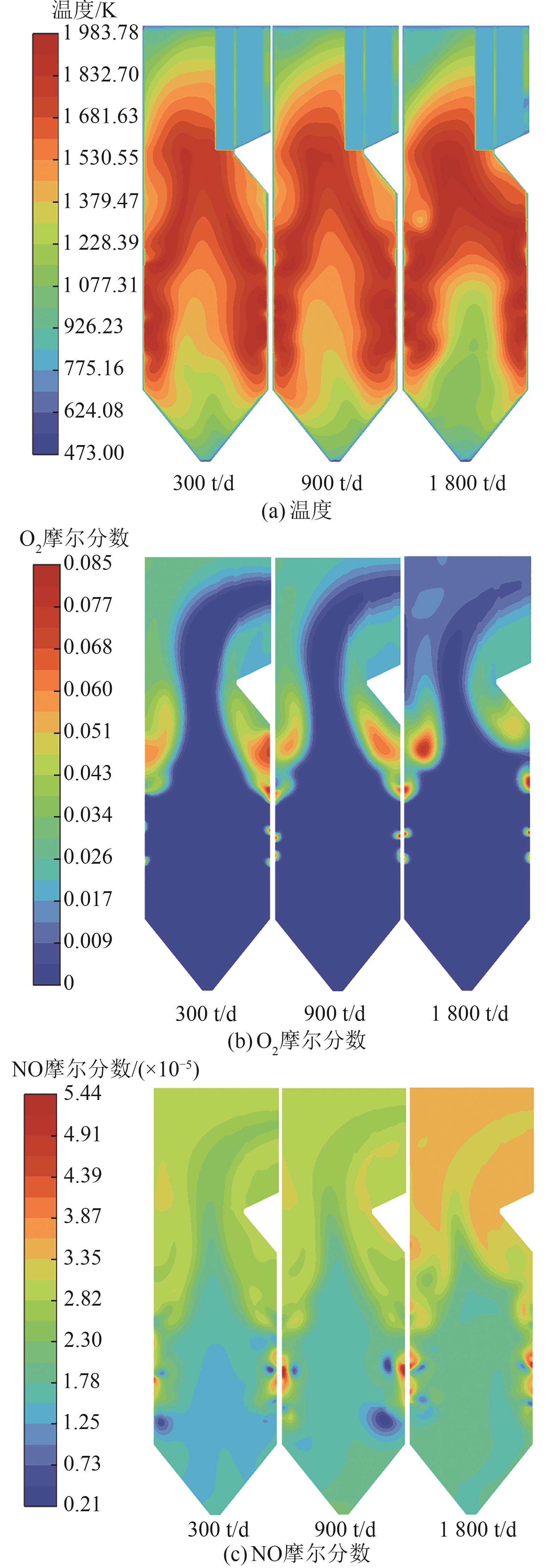
Fig. 2 Cloud diagrams of temperature and component molar fraction at different waste textile pyrolysis mass flow rates
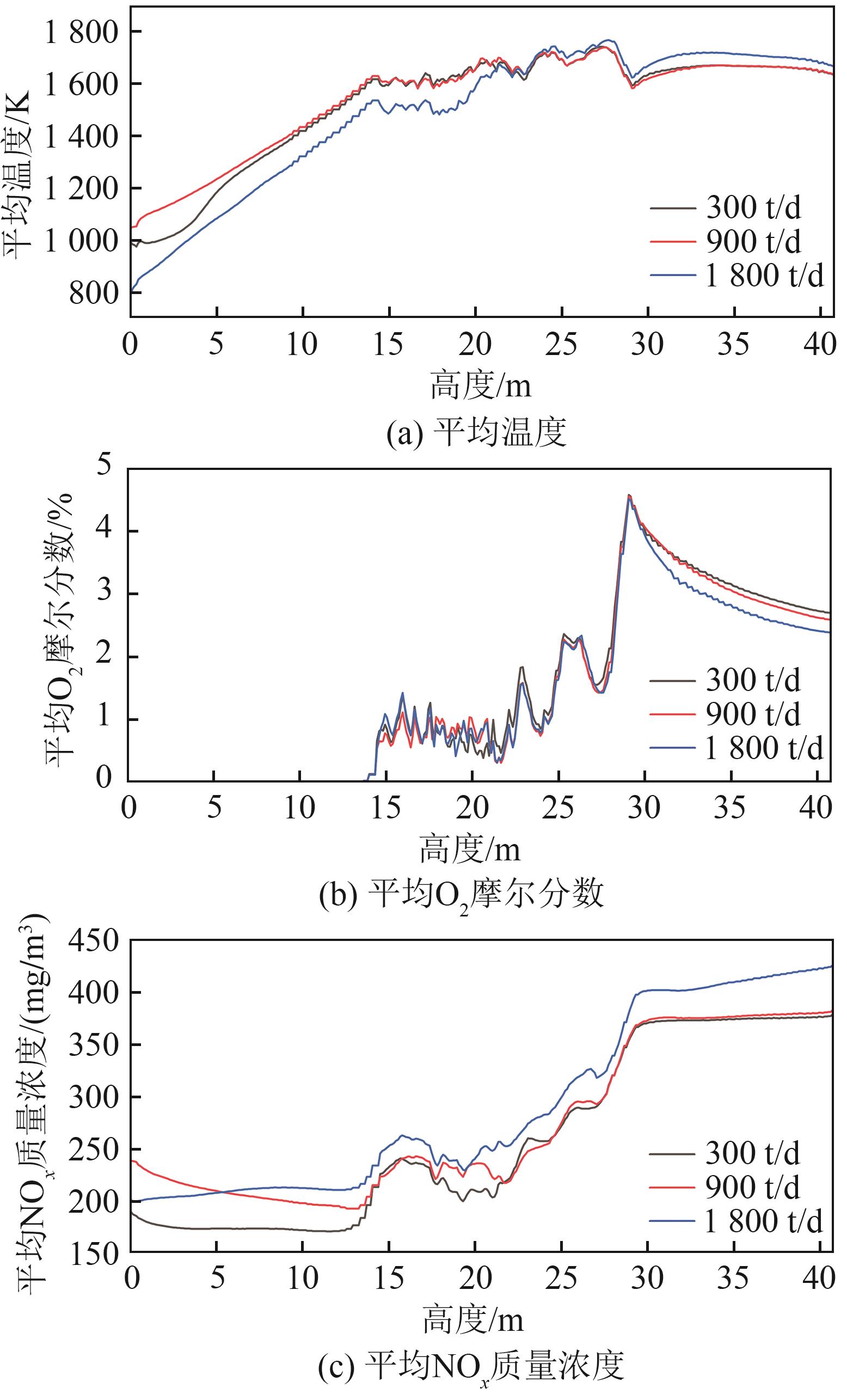
Fig. 3 Distribution of average temperature, O2 mole fraction and NO x mass concentration along height at different waste textile pyrolysis mass flow rates
| 工况 | 屏底烟气温度/K | 出口飞灰中残碳质量分数/% | 出口NO x 质量浓度/(mg/m3) |
|---|---|---|---|
| 2 | 1 634.76 | 1.24 | 373.90 |
| 3 | 1 636.36 | 2.85 | 379.88 |
| 4 | 1 666.55 | 2.53 | 426.24 |
Tab. 8 Parameters of furnace outlet and platen superheater bottom at different waste textile pyrolysis mass flow rates
| 工况 | 屏底烟气温度/K | 出口飞灰中残碳质量分数/% | 出口NO x 质量浓度/(mg/m3) |
|---|---|---|---|
| 2 | 1 634.76 | 1.24 | 373.90 |
| 3 | 1 636.36 | 2.85 | 379.88 |
| 4 | 1 666.55 | 2.53 | 426.24 |
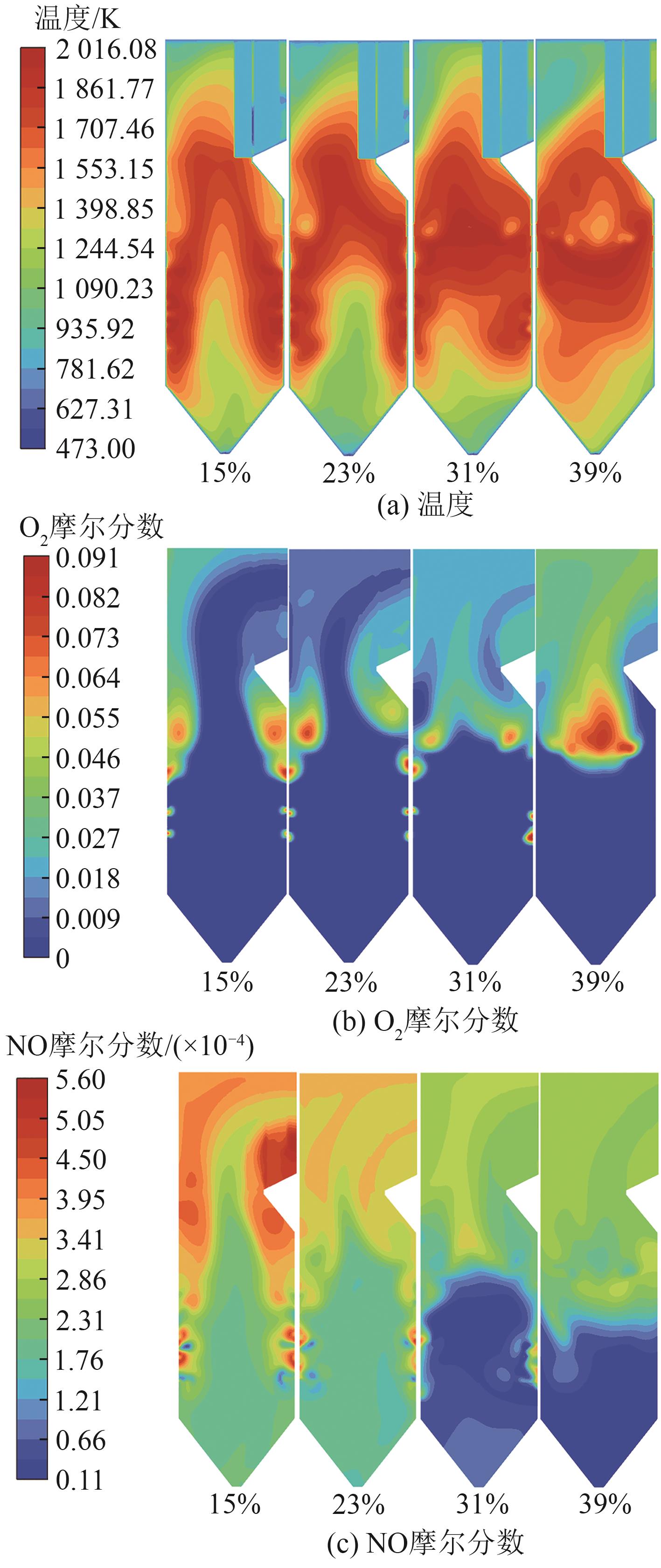
Fig. 4 Cloud diagrams of temperature and component molar fraction at different SOFA air rates
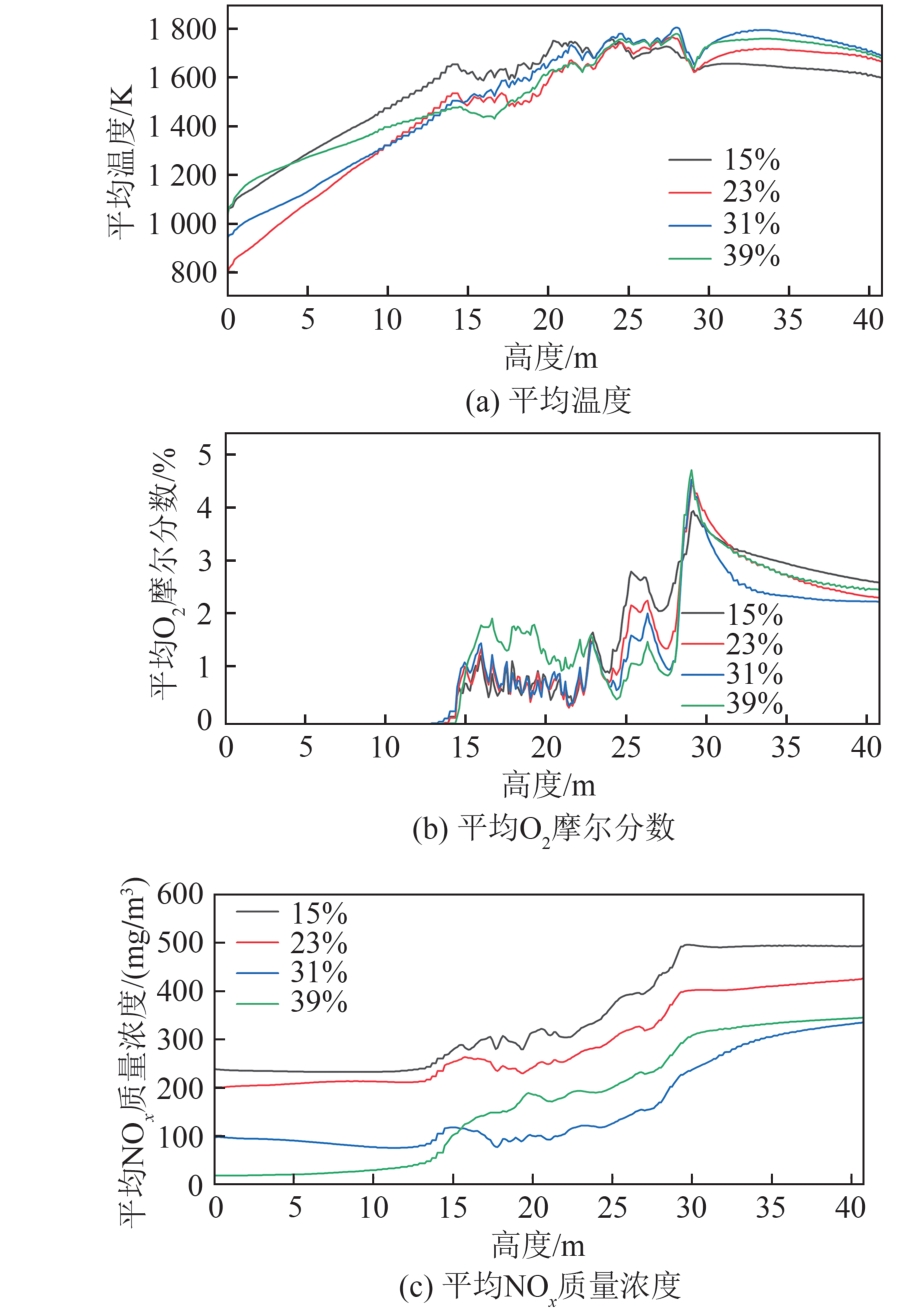
Fig. 5 Distribution of average temperature, O2 mole fraction and NO x mass concentration along height at different SOFA air ratios
| 工况 | 屏底烟气温度/K | 出口中残碳质量分数/% | 出口NO x 质量浓度/(mg/m3) |
|---|---|---|---|
| 5 | 1 599.71 | 5.98 | 533.20 |
| 4 | 1 666.56 | 2.53 | 426.24 |
| 6 | 1 691.10 | 1.81 | 336.94 |
| 7 | 1 680.46 | 4.20 | 346.71 |
Tab. 9 Parameters of furnace outlet and platen superheater bottom at different overfire air ratios
| 工况 | 屏底烟气温度/K | 出口中残碳质量分数/% | 出口NO x 质量浓度/(mg/m3) |
|---|---|---|---|
| 5 | 1 599.71 | 5.98 | 533.20 |
| 4 | 1 666.56 | 2.53 | 426.24 |
| 6 | 1 691.10 | 1.81 | 336.94 |
| 7 | 1 680.46 | 4.20 | 346.71 |
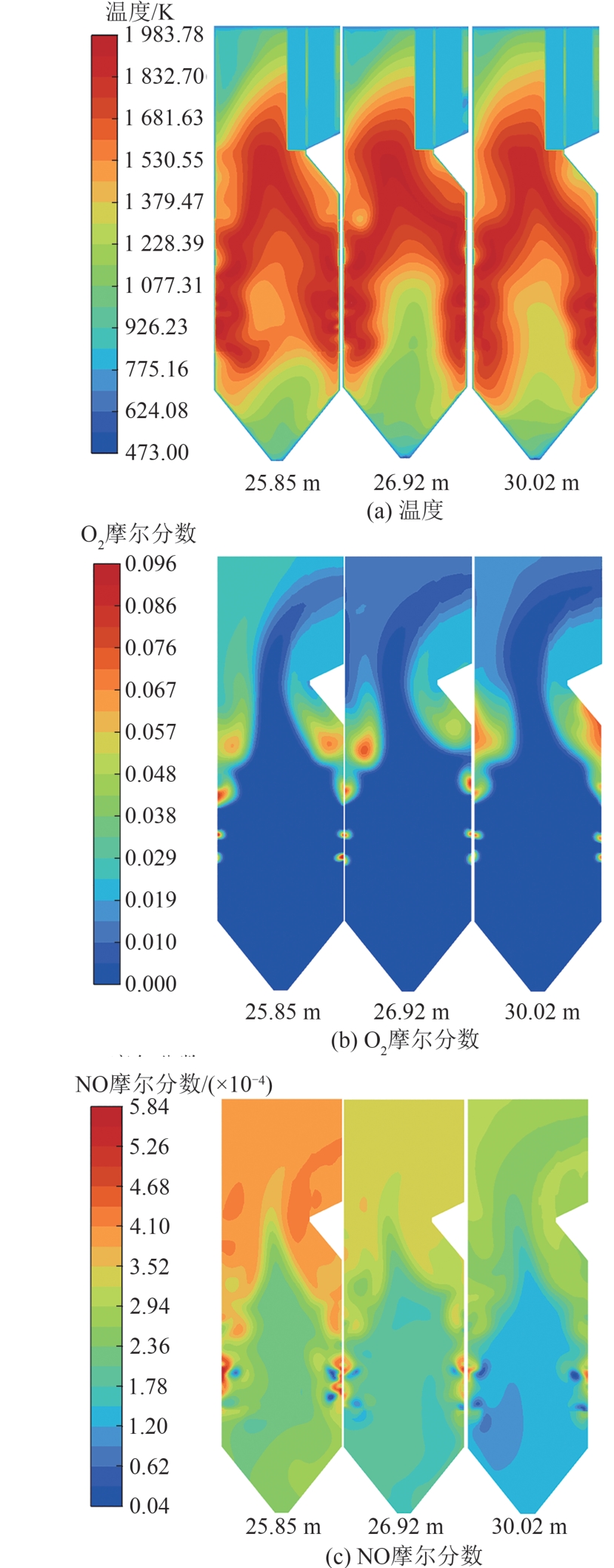
Fig. 6 Effect of pyrolysis gas inlet positions on temperature and component molar fraction
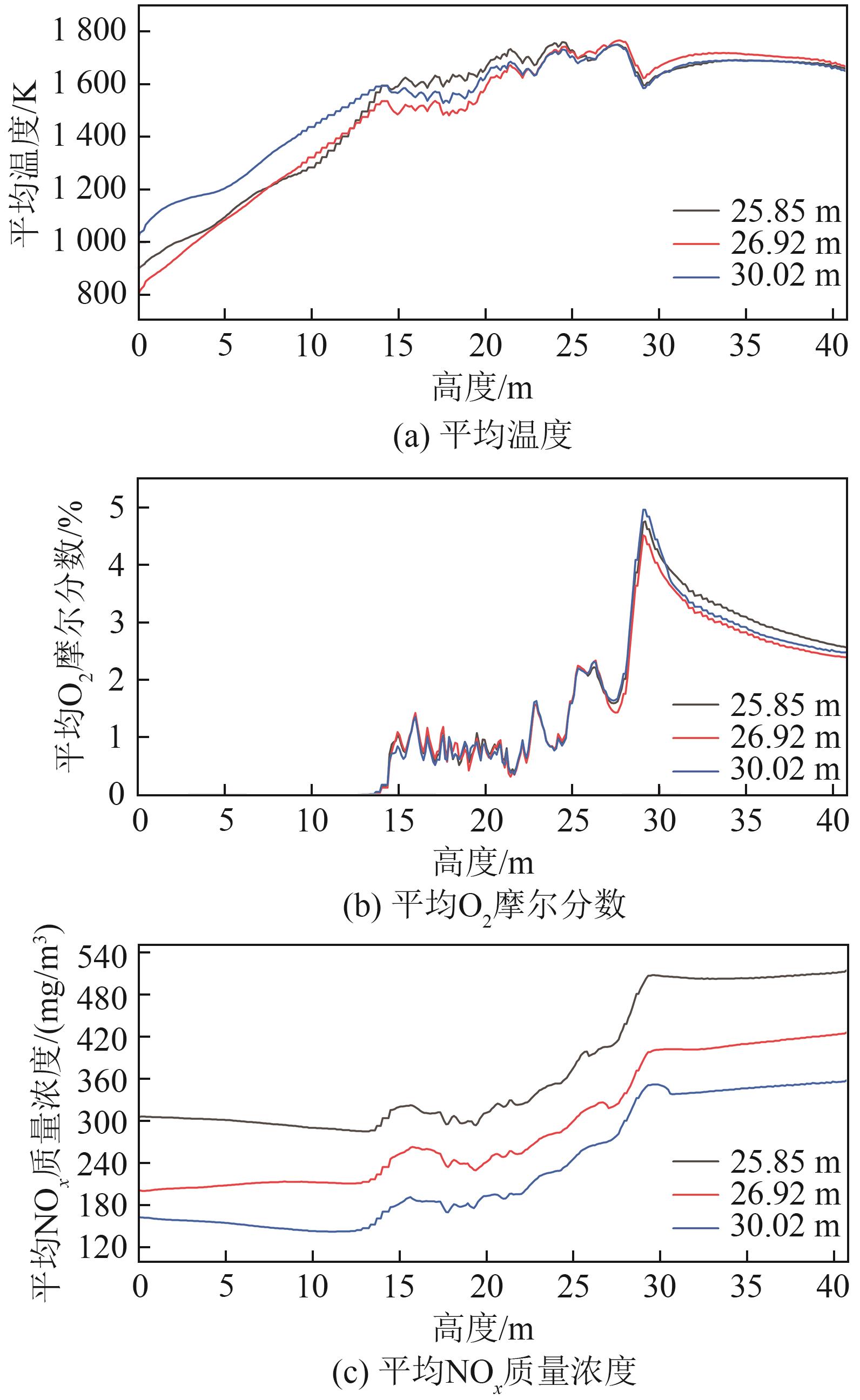
Fig. 7 Effect of pyrolysis gas inlet positions on average temperature, O2 mole fraction and NO x mass fraction along height
| 工况 | 屏底烟气温度/K | 出口飞灰中残碳质量分数/% | 出口NO x 质量浓度/(mg/m3) |
|---|---|---|---|
| 8 | 1 658.62 | 3.88 | 512.01 |
| 4 | 1 666.56 | 2.53 | 426.24 |
| 9 | 1 649.61 | 4.34 | 358.13 |
Tab. 10 Effect of pyrolysis gas inlet positions on parameters of furnace outlet and platen superheater bottom
| 工况 | 屏底烟气温度/K | 出口飞灰中残碳质量分数/% | 出口NO x 质量浓度/(mg/m3) |
|---|---|---|---|
| 8 | 1 658.62 | 3.88 | 512.01 |
| 4 | 1 666.56 | 2.53 | 426.24 |
| 9 | 1 649.61 | 4.34 | 358.13 |
| [1] | 中华人民共和国国家统计局 .中国统计年鉴2024[M].北京:中国统计出版社,2024. |
| National Bureau of Statistics of China .China statistical yearbook 2024[M].Beijing:China Statistics Press,2024. | |
| [2] | 中华人民共和国国家统计局 .中国统计年鉴2021[M].北京:中国统计出版社,2021. doi:10.70190/jq.i88.p97 |
| National Bureau of Statistics of China .China statistical yearbook 2021[M].Beijing:China Statistics Press,2021. doi:10.70190/jq.i88.p97 | |
| [3] | 顾明明,赵凯,赵国樑 .2020—2022年度中国废旧纺织品综合利用发展报告[M].北京:中国纺织出版社,2024. |
| GU M M, ZHAO K, ZHAO G L .Report on the development of the comprehensive utilization of textile waste in China (2020-2022)[M].Beijing:China Textile & Apparel Press,2024. | |
| [4] | 顾明明 .我国废旧纺织品回收利用发展现状及趋势[J].环境保护,2024,52(11):42-45. |
| GU M M .The current situation and development trend of recycling and utilization of the textile waste in China[J].Environmental Protection,2024,52(11):42-45. | |
| [5] | ZHOU Z Z, CHI Y, DONG J,et al .Model development of sustainability assessment from a life cycle perspective:a case study on waste management systems in China[J].Journal of Cleaner Production,2019,210:1005-1014. doi:10.1016/j.jclepro.2018.11.074 |
| [6] | LOMBARDI L, CARNEVALE E, CORTI A .A review of technologies and performances of thermal treatment systems for energy recovery from waste[J].Waste Management,2015,37:26-44. doi:10.1016/j.wasman.2014.11.010 |
| [7] | 李文瀚,马增益,杨恩权,等 .循环流化床垃圾焚烧系统电除尘飞灰和布袋飞灰特性研究[J].中国电机工程学报,2019,39(5):1397-1405. doi:10.13334/j.0258-8013.pcsee.181110 |
| LI W H, MA Z Y, YANG E Q,et al .Characteristics of electrostatic precipitator ash and bag filter ash from a circulating fluidized bed municipal solid waste incinerator[J].Proceedings of the CSEE,2019,39(5):1397-1405. doi:10.13334/j.0258-8013.pcsee.181110 | |
| [8] | 叶文浩,陈耀红,黄力淼,等 .计及碳排放和垃圾发电的综合能源系统日前区间优化[J].电测与仪表,2025,62(9):9-16. doi:10.19753/j.issn1001-1390.2025.09.002 |
| YE W H, CHEN Y H, HUANG L M,et al .Day-ahead interval optimization of integrated energy system considering carbon emissions and waste-to-energy generation[J].Electrical Measurement & Instrumentation,2025,62(9):9-16. doi:10.19753/j.issn1001-1390.2025.09.002 | |
| [9] | 王宸宇,唐忠,魏敏捷,等 .考虑源荷两侧不确定性的含风电‒垃圾焚烧热电联产虚拟电厂协调优化调度[J].电力科学与技术学报,2024,39(6):232-241. |
| WANG C Y, TANG Z, WEI M J,et al .Coordinated and optimized scheduling of virtual power plants with wind power-waste incineration cogeneration considering uncertainty of source and load sides[J].Journal of Electric Power Science and Technology,2024,39(6):232-241. | |
| [10] | 王红叶,程静 .含CSP及WTE的虚拟电厂低碳优化调度[J].电网与清洁能源,2025,41(2):33-42. |
| WANG H Y, CHENG J .The low-carbon optimal scheduling of the virtual power plant with CSP and WTE[J].Power System and Clean Energy,2025,41(2):33-42. | |
| [11] | SU X W, ZHANG L, XIAO Y X,et al .Evaluation of a flue gas cleaning system of a circulating fluidized bed incineration power plant by the analysis of pollutant emissions[J].Powder Technology,2015,286:9-15. doi:10.1016/j.powtec.2015.07.038 |
| [12] | 吴剑,蹇瑞欢,刘涛 .我国生活垃圾焚烧发电厂的能效水平研究[J].环境卫生工程,2018,26(3):39-42. |
| WU J, JIAN R H, LIU T .Research on energy efficiency of municipal solid waste incineration plant in China[J].Environmental Sanitation Engineering,2018,26(3):39-42. | |
| [13] | MEIER D, VAN DE BELD B, BRIDGWATER A V,et al .State-of-the-art of fast pyrolysis in IEA bioenergy member countries[J].Renewable and Sustainable Energy Reviews,2013,20:619-641. doi:10.1016/j.rser.2012.11.061 |
| [14] | 黄付平,黄智宁,谢启军,等 .低温热解耦合高压等离子体技术处理农村生活垃圾工程应用[J].环境工程,2019,37(5):196-199. doi:10.13205/j.hjgc.201905036 |
| HUANG F P, HUANG Z N, XIE Q J,et al .Application of low temperature pyrolysis coupled high pressure plasma technology to rural domestic waste treatment[J].Environmental Engineering,2019,37(5):196-199. doi:10.13205/j.hjgc.201905036 | |
| [15] | 冯福媛,李童宇,李博,等 .基于气化和热解的医疗垃圾-废旧轮胎联合资源化利用系统性能分析[J].发电技术,2024,45(4):611-621. doi:10.12096/j.2096-4528.pgt.22122 |
| FENG F Y, LI T Y, LI B,et al .Performance analysis of combined medical waste-waste tire resource utilization system based on gasification and pyrolysis[J].Power Generation Technology,2024,45(4):611-621. doi:10.12096/j.2096-4528.pgt.22122 | |
| [16] | 陈说,许仪勋,田雨,等 .考虑需求响应和废弃物分类处理的微电网多目标优化配置模型[J].电力科学与技术学报,2025,40(1):199-210. |
| CHEN S, XU Y X, TIAN Y,et al .Multi-objective optimal configuration model of microgrid considering demand response and waste classification treatment[J].Journal of Electric Power Science and Technology,2025,40(1):199-210. | |
| [17] | 刘硕,滕云,陈哲 .融合减碳型多能源微网的城市能源系统环境-经济协调优化模型[J].电工技术学报,2025,40(23):7532-7553. |
| LIU S, TENG Y, CHEN Z .An environment-economic coordination optimization model for urban energy systems integrating carbon-reducing multi-energy microgrids[J].Transactions of China Electrotechnical Society,2025,40(23):7532-7553. | |
| [18] | 冯伟忠,李励 .“双碳” 目标下煤电机组低碳、零碳和负碳化转型发展路径研究与实践[J].发电技术,2022,43(3):452-461. doi:10.12096/j.2096-4528.pgt.22061 |
| FENG W Z, LI L .Research and practice on development path of low-carbon,zero-carbon and negative carbon transformation of coal-fired power units under “double carbon” targets[J].Power Generation Technology,2022,43(3):452-461. doi:10.12096/j.2096-4528.pgt.22061 | |
| [19] | 刘志强,李建锋,潘荔,等 .中国煤电机组改造升级效果分析与展望[J].中国电力,2024,57(7):1-11. doi:10.11930/j.issn.1004-9649.202402031 |
| LIU Z Q, LI J F, PAN L,et al .Analysis and prospect of transformation and upgrading effects of coal-fired power units in China[J].Electric Power,2024,57(7):1-11. doi:10.11930/j.issn.1004-9649.202402031 | |
| [20] | 严新荣,胡志勇,张鹏威,等 .煤电机组运行灵活性提升技术研究与应用[J].发电技术,2024,45(6):1074-1086. doi:10.12096/j.2096-4528.pgt.24170 |
| YAN X R, HU Z Y, ZHANG P W,et al .Research and application of operation flexibility improvement technology for coal-fired power unit[J].Power Generation Technology,2024,45(6):1074-1086. doi:10.12096/j.2096-4528.pgt.24170 | |
| [21] | 刘含笑,单思珂,魏书洲,等 .基于生命周期法的煤电碳足迹评估[J].中国电力,2024,57(7):227-237. doi:10.11930/j.issn.1004-9649.202404039 |
| LIU H X, SHAN S K, WEI S Z,et al .Life-cycle carbon footprint assessment of coal-fired power generation[J].Electric Power,2024,57(7):227-237. doi:10.11930/j.issn.1004-9649.202404039 | |
| [22] | 谢菁,吕涛,方德斌 .低碳转型目标下的电力社会价值研究[J].全球能源互联网,2024,7(6):650-661. |
| XIE J,LYU T, FANG D B .The social value analysis of electric power considering the target of low-carbon transition[J].Journal of Global Energy Interconnection,2024,7(6):650-661. | |
| [23] | HUANG J C, QIAO Y, WANG Z Q,et al .Valorization of food waste via torrefaction:effect of food waste type on the characteristics of torrefaction products[J].Energy & Fuels,2020,34(5):6041-6051. doi:10.1021/acs.energyfuels.0c00790 |
| [24] | 王一坤,贾兆鹏,魏星,等 .燃煤电站耦合生活垃圾发电技术研究[J].热力发电,2021,50(11):83-92. doi:10.19666/j.rlfd.202103032 |
| WANG Y K, JIA Z P, WEI X,et al .Study on power generation technology of coal-fired power station coupled with domestic waste[J].Thermal Power Generation,2021,50(11):83-92. doi:10.19666/j.rlfd.202103032 | |
| [25] | 史兵权,史明哲,张睿 .220 t/h锅炉烟气侧耦合垃圾焚烧数值模拟[J].洁净煤技术,2022,28(3):150-158. doi:10.13226/j.issn.1006-6772.CC21111202 |
| SHI B Q, SHI M Z, ZHANG R .Numerical simulation of flue gas side coupled municipal solid waste incineration in a 220 t/h boiler[J].Clean Coal Technology,2022,28(3):150-158. doi:10.13226/j.issn.1006-6772.CC21111202 | |
| [26] | 付波,方文俊,李超顺,等 .考虑垃圾焚烧烟气处理与电转甲醇的综合能源系统优化调度[J].电力系统保护与控制,2024,52(11):112-126. |
| FU B, FANG W J, LI C S,et al .Optimal scheduling of an integrated energy system considering waste incineration flue gas treatment and power-to-methanol conversion[J].Power System Protection and Control,2024,52(11):112-126. | |
| [27] | 王学斌,周澳,杨明辉,等 .燃煤电厂200 t/d生活垃圾无氧热解耦合协同处置优化[J].煤炭学报,2022,47(11):3897-3905. doi:10.13225/j.cnki.jccs.LC22.1132 |
| WANG X B, ZHOU A, YANG M H,et al .Optimization on 200 t/d garbage co-utilization in a coal-fired power plant through air-free pyrolysis process[J].Journal of China Coal Society,2022,47(11):3897-3905. doi:10.13225/j.cnki.jccs.LC22.1132 | |
| [28] | 王学斌,周澳,马江东,等 .燃煤电厂协同处置生活垃圾及二噁英排放试验[J].洁净煤技术,2023,29(1):161-168. doi:10.13226/j.issn.1006-6772.T22112701 |
| WANG X B, ZHOU A, MA J D,et al .Experiment of co-disposal of domestic waste and dioxins emission in coal-fired power plants[J].Clean Coal Technology,2023,29(1):161-168. doi:10.13226/j.issn.1006-6772.T22112701 | |
| [29] | ÁLVAREZ L, YIN C, RIAZA J,et al .Biomass co-firing under oxy-fuel conditions:a computational fluid dynamics modelling study and experimental validation[J].Fuel Processing Technology,2014,120:22-33. doi:10.1016/j.fuproc.2013.12.005 |
| [30] | 孙倩倩,刘迎春,卿山,等 .600 MW机组煤粉混燃生物质气锅炉燃烧特性研究[J].热力发电,2021,50(5):75-80. doi:10.19666/j.rlfd.202008217 |
| SUN Q Q, LIU Y C, QING S,et al .Combustion characteristics of a 600 MW unit boiler co-firing coal with biomass gas[J].Thermal Power Generation,2021,50(5):75-80. doi:10.19666/j.rlfd.202008217 | |
| [31] | 方庆艳,汪华剑,陈刚,等 .燃尽风对超超临界锅炉燃烧特性影响的数值模拟[J].华中科技大学学报(自然科学版),2010,38(11):92-95. doi:10.1360/972009-1380 |
| FANG Q Y, WANG H J, CHEN G,et al .Numerical simulation on effects of over fire air on the combustion characteristics in an ultra-supercritical boiler[J].Journal of Huazhong University of Science and Technology(Natural Science Edition),2010,38(11):92-95. doi:10.1360/972009-1380 | |
| [32] | 陈鑫科,马启磊,方庆艳,等 .混煤燃烧中的交互作用:掺烧方式和配风对着火和燃尽特性的影响[J].动力工程学报,2019,39(7):524-530. |
| CHEN X K, MA Q L, FANG Q Y,et al .Interaction in blended coal combustion process:effects of coal blend way and air distribution mode on ignition and burnout characteristics of the blended coal[J].Journal of Chinese Society of Power Engineering,2019,39(7):524-530. | |
| [33] | 徐义巍,洪岩,赵晓鹏,等 .煤氨混燃对燃煤锅炉受热面传热特性影响分析[J].发电技术,2025,46(5):1022-1031. doi:10.12096/j.2096-4528.pgt.23160 |
| XU Y W, HONG Y, ZHAO X P,et al .Analysis of influence of coal-ammonia co-firing on the heat transfer characteristics of heating surfaces in coal-fired boiler[J].Power Generation Technology,2025,46(5):1022-1031. doi:10.12096/j.2096-4528.pgt.23160 | |
| [34] | 韩澳,张成,马仑,等 .基于主成分分析的有机固废热解半焦与褐煤混燃特性研究[J/OL].洁净煤技术,2024:1-13.(2024-08-08).. |
| HAN A, ZHANG C, MA L,et al .Characteristics of organic solid waste pyrolysis semi-coke and lignite miscibility study based on principal component analysis[J/OL].Clean Coal Technology,2024:1-13.(2024-08-08).. | |
| [35] | KOBAYASHI H, HOWARD J B, SAROFIM A F .Coal devolatilization at high temperatures[J].Symposium(International) on Combustion,1977,16(1):411-425. doi:10.1016/s0082-0784(77)80341-x |
| [36] | 方庆艳,陈刚,张成,等 .煤粉低NO x 燃烧数值模拟[M].北京:中国电力出版社,2017:23-25. |
| FANG Q Y, CHEN G, ZHANG C,et al .Numerical simulation of low NO x combustion of pulverized coal[M].Beijing:China Electric Power Press,2017:23-25. | |
| [37] | 郑林,刘峰,韦中悬,等 .CH4/air预混气体双层多孔介质燃烧特性数值模拟研究[J].热科学与技术,2021,20(3):278-285. |
| ZHENG L, LIU F, WEI Z X,et al .Numerical simulation of combustion characteristics of CH4/air premixed gas in two-layer porous media[J].Journal of Thermal Science and Technology,2021,20(3):278-285. | |
| [38] | HILL S C, DOUGLAS SMOOT L .Modeling of nitrogen oxides formation and destruction in combustion systems[J].Progress in Energy and Combustion Science,2000,26(4/5/6):417-458. doi:10.1016/s0360-1285(00)00011-3 |
| [39] | DE SOETE G G .Overall reaction rates of NO and N2 formation from fuel nitrogen[J].Symposium(International) on Combustion,1975,15(1):1093-1102. doi:10.1016/s0082-0784(75)80374-2 |
| [1] | Fahua ZHU, Jingxin XU, Fanhui SHEN, Xi ZHANG, Hui LI, Wenxin TIAN, Xiuyong ZHAO, Yuan BAI. Current Situation and Prospects of the Low-Carbon Development of Thermal Power in China [J]. Power Generation Technology, 2026, 47(2): 237-247. |
| [2] | Zhiting TONG, Yue FAN, Xinxia LIU, Chao ZHANG. Performance Analysis of Ammonia-Doped Combustion in Micro Gas Turbine Combustion Chamber [J]. Power Generation Technology, 2026, 47(2): 274-284. |
| [3] | Baoqun GUO, Jiahao YUE, Maozhan CONG, Hongpeng LIU, Baizhong SUN. Low-Load Stable Combustion Technology of 600 MW Supercritical Low-Calorific Value Lignite Octagonal Tangentially Fired Boiler [J]. Power Generation Technology, 2026, 47(2): 295-303. |
| [4] | Lu CHEN, Bo WANG, Dengliang WANG, Weixiong CHEN, Jiping LIU. Research on Performance Optimization of Transient Load Change Process in Coal-Fired Power Units [J]. Power Generation Technology, 2026, 47(1): 157-167. |
| [5] | Yiwei XU, Yan HONG, Xiaopeng ZHAO, Bingwei SUI. Analysis of Influence of Coal-Ammonia Co-firing on the Heat Transfer Characteristics of Heating Surfaces in Coal-Fired Boiler [J]. Power Generation Technology, 2025, 46(5): 1022-1031. |
| [6] | Qianxin GUO, Jianbo LI, Hu WANG, Yintang LIANG, Xinjian HAN, Xiongwei RUAN, Xiaofeng LU. Study on Numerical Simulation of Dynamic Deposition and Shedding Characteristics of Zhundong Coal Ash [J]. Power Generation Technology, 2025, 46(4): 829-838. |
| [7] | Lidong ZHANG, Zhixiang YANG, Wenfeng LI, Jiangzhe FENG, Bo ZHANG, Huaihui REN, Zhe CHEN, Zhaoxin WANG. Numerical Simulation Study on Effect of Deflectors on Aerodynamic Characteristics of Horizontal Axis Wind Turbines [J]. Power Generation Technology, 2025, 46(2): 336-343. |
| [8] | Lifeng ZHANG, Xianghu DONG. Reconstruction of Temperature Distribution in Acoustic Tomography Based on Robust Regularized Extreme Learning Machine [J]. Power Generation Technology, 2025, 46(2): 361-369. |
| [9] | Kai LI, Pingheng ZHANG, Zhihao MENG, Yunning CAO, Yao XU, Li LIU, Lianming LI. Numerical Simulation of Fly Ash Deposition Characteristics and Flow Field Optimization for SCR External Flue [J]. Power Generation Technology, 2025, 46(1): 145-153. |
| [10] | Haibao ZHAO, Yuzhong HE, Hanxiao LIU, Jiang LIANG. Improvement and Engineering Application on Pulse Power Supply of Electrostatic Precipitator in Coal-Fired Power Plant [J]. Power Generation Technology, 2025, 46(1): 154-160. |
| [11] | Kaihui WANG, Bin LIU, Xiaohui ZHE, Wei LIU, Hao FAN, Zongyao KANG, Li XU. Kinetic Characterization and NO x Reduction Mechanism of Mixed Ammonia-Hydrogen Combustion in Cyclone Combustor [J]. Power Generation Technology, 2025, 46(1): 171-179. |
| [12] | Xianmin ZENG, Boyun LI, Xiangyang SHEN, Jiashu CHEN, Lixing DING. Thermal Stress Analysis of Transversally Corrugated Tube in Solar Receiver Under Semi-Circumference Heating [J]. Power Generation Technology, 2025, 46(1): 190-199. |
| [13] | Zhuo LIU, Donglin CHEN, Shuqi WANG, Yijiang YANG, Youyang YAN, Zhan YANG. Optimization Method of Flow Field for Alleviating Clogging of Mist Eliminator in Desulfurization Tower [J]. Power Generation Technology, 2024, 45(6): 1087-1094. |
| [14] | Mingyang ZHAO, Linlin YIN, Wentao WEI, Yun CHEN, Richen LIU, Jun LI. Impact of Falling Blocks of High Pressure Turbine Rotor Blades With Squealer Tip on the Aerodynamic Performance and Vibration Characteristics [J]. Power Generation Technology, 2024, 45(5): 856-867. |
| [15] | Yong DING. Research on Deep Peak Shaving Performance of 1 000 MW Ultra-Supercritical Coal-Fired Boiler [J]. Power Generation Technology, 2024, 45(3): 382-391. |
| Viewed | ||||||
|
Full text |
|
|||||
|
Abstract |
|
|||||
