

发电技术 ›› 2025, Vol. 46 ›› Issue (6): 1200-1211.DOI: 10.12096/j.2096-4528.pgt.25063
• 发电及环境保护 • 上一篇
刘松洋1, 白云鹏2, 陈志董2, 丁亮1, 孙超杰1, 孔艳强2
收稿日期:2025-06-25
修回日期:2025-09-29
出版日期:2025-12-31
发布日期:2025-12-25
通讯作者:
孔艳强
作者简介:基金资助:Songyang LIU1, Yunpeng BAI2, Zhidong CHEN2, Liang DING1, Chaojie SUN1, Yanqiang KONG2
Received:2025-06-25
Revised:2025-09-29
Published:2025-12-31
Online:2025-12-25
Contact:
Yanqiang KONG
Supported by:摘要:
目的 核电机组调峰潜力巨大,但终端负荷峰谷波动,以及核反应堆应具备稳定输出等特征严重影响核电调峰过程的安全高效运行。储热技术可以实现热能的存储,是解决核电源荷需求失衡矛盾的重要途径,因此研究了基于熔盐储热的核电机组调峰特性。 方法 以某实际运行核电机组为研究对象,基于能量梯级利用原则,提出了主蒸汽加热熔盐、高压缸排汽加热熔盐和电加热熔盐3种耦合熔盐储热的核电调峰系统方案,建立了耦合系统仿真模型,并辅以针对性实验验证,研究了5%、10%、15%、20%、25%五种调峰幅度下的系统热力学性能。 结果 耦合熔盐储热的核电调峰系统提高了核电机组的调峰性能,同时可以满足不同供暖需求。高压缸排汽加热熔盐耦合系统方案热力性能最优,主蒸汽加热熔盐耦合系统方案次之,电加热熔盐耦合系统方案最差。在25%调峰幅度下,高压缸排汽加热熔盐耦合系统方案和电加热熔盐耦合系统方案能量效率分别为63.76%和37.84%,㶲效率分别为59.41%和23.04%。 结论 所提出的核电机组熔盐储热方案可应用于市政供暖场景,有助于指导参与电网调峰的核电机组安全高效运行。
中图分类号:
刘松洋, 白云鹏, 陈志董, 丁亮, 孙超杰, 孔艳强. 基于熔盐储热的核电机组调峰特性研究[J]. 发电技术, 2025, 46(6): 1200-1211.
Songyang LIU, Yunpeng BAI, Zhidong CHEN, Liang DING, Chaojie SUN, Yanqiang KONG. Study on Peak Shaving Characteristics of Nuclear Power Unit Based on Molten Salt Heat Storage[J]. Power Generation Technology, 2025, 46(6): 1200-1211.
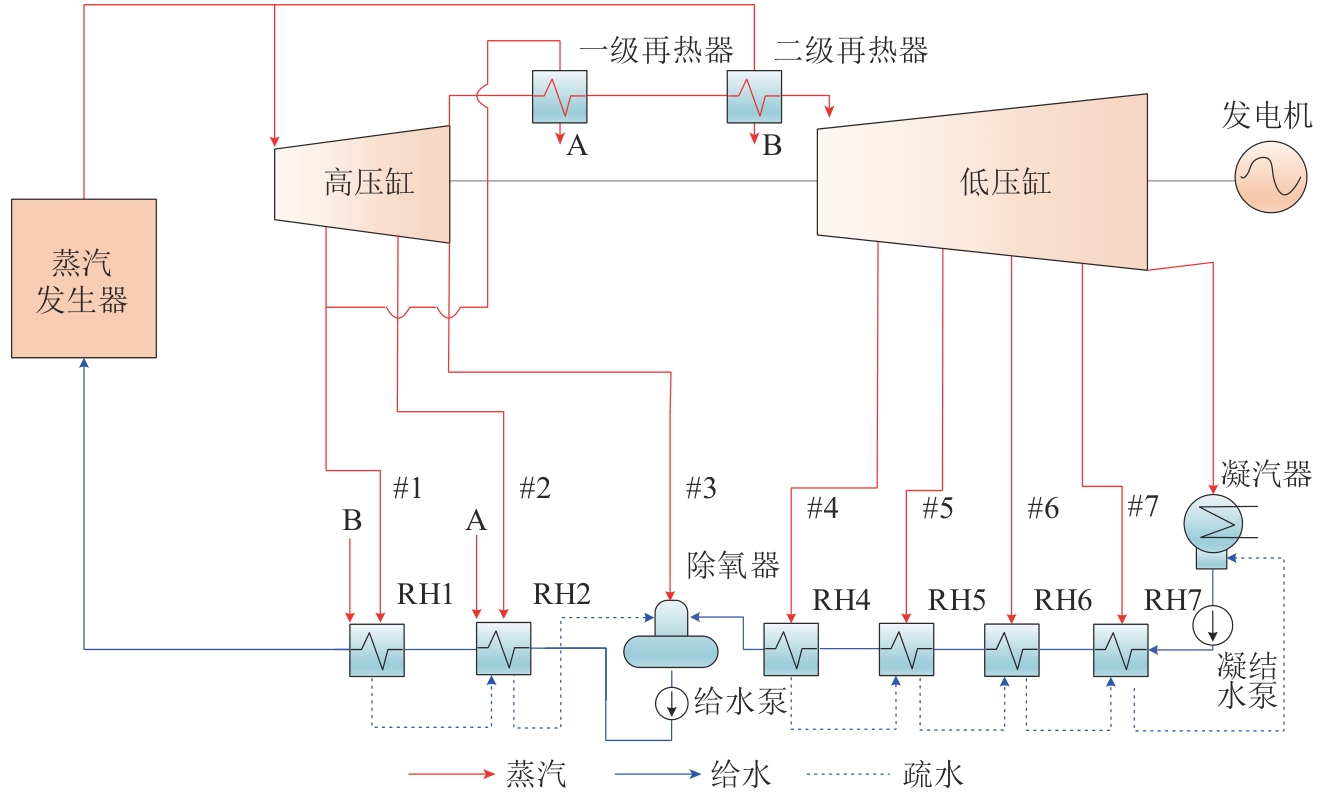
图1 参考核电机组常规岛系统图
Fig. 1 Schematic diagram of conventional island in reference nuclear power unit
| 参数 | 数值 |
|---|---|
| 核能输入功率/MW | 3 191.16 |
| 主蒸汽温度/℃ | 282.0 |
| 主蒸汽压力/MPa | 6.615 |
| 再热蒸汽温度/℃ | 270.1 |
| 再热蒸汽压力/MPa | 0.99 |
| 给水温度/℃ | 226.0 |
| 排汽压力/kPa | 5.10 |
| 发电量/MW | 1 211.68 |
| 能量效率/% | 37.97 |
表1 设计工况下核电常规岛热力学参数
Tab. 1 Thermodynamic parameters of conventional island in nuclear power under design conditions
| 参数 | 数值 |
|---|---|
| 核能输入功率/MW | 3 191.16 |
| 主蒸汽温度/℃ | 282.0 |
| 主蒸汽压力/MPa | 6.615 |
| 再热蒸汽温度/℃ | 270.1 |
| 再热蒸汽压力/MPa | 0.99 |
| 给水温度/℃ | 226.0 |
| 排汽压力/kPa | 5.10 |
| 发电量/MW | 1 211.68 |
| 能量效率/% | 37.97 |
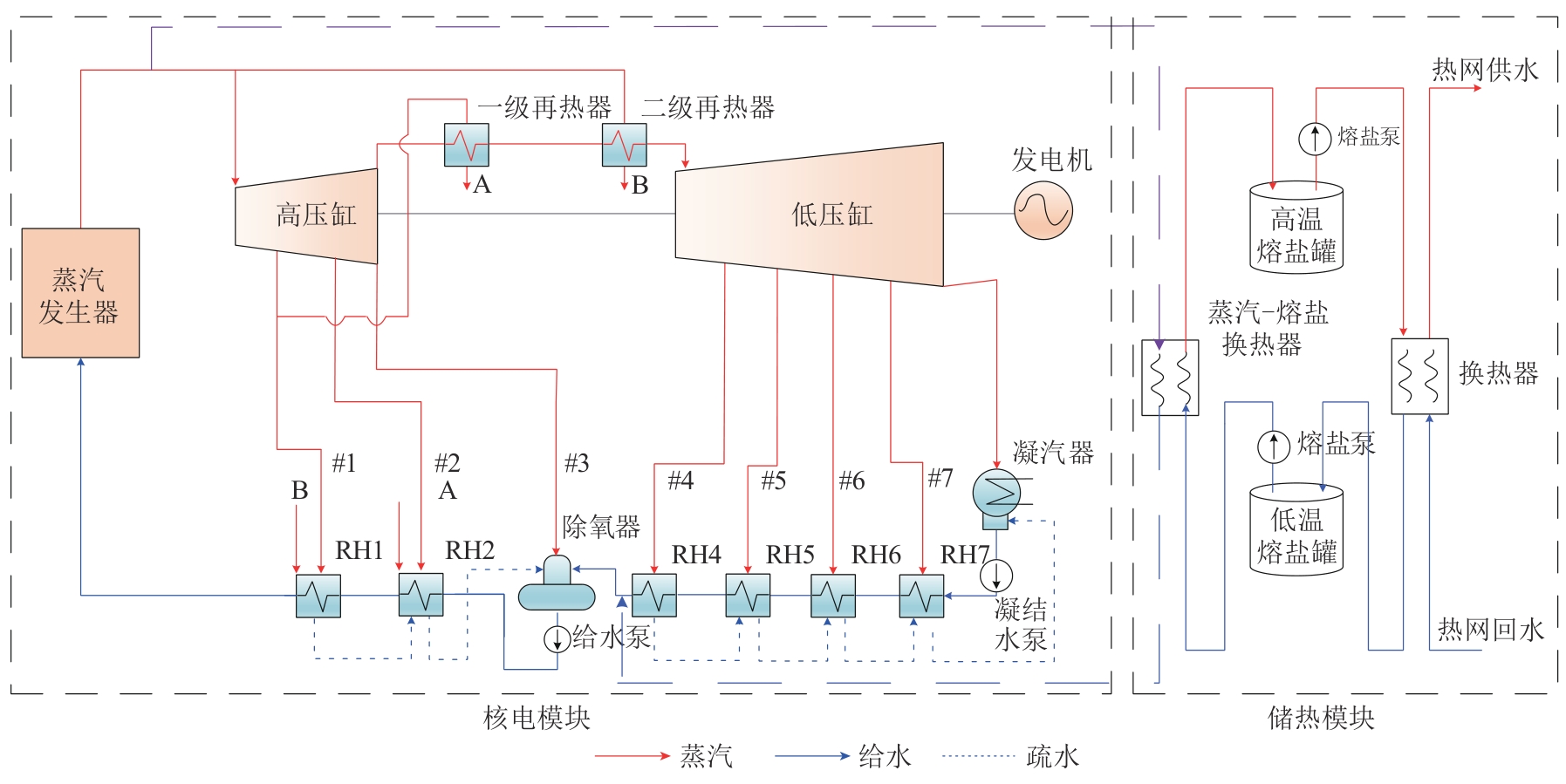
图2 主蒸汽加热熔盐方案系统图
Fig. 2 Schematic diagram of main steam heating molten salt scheme
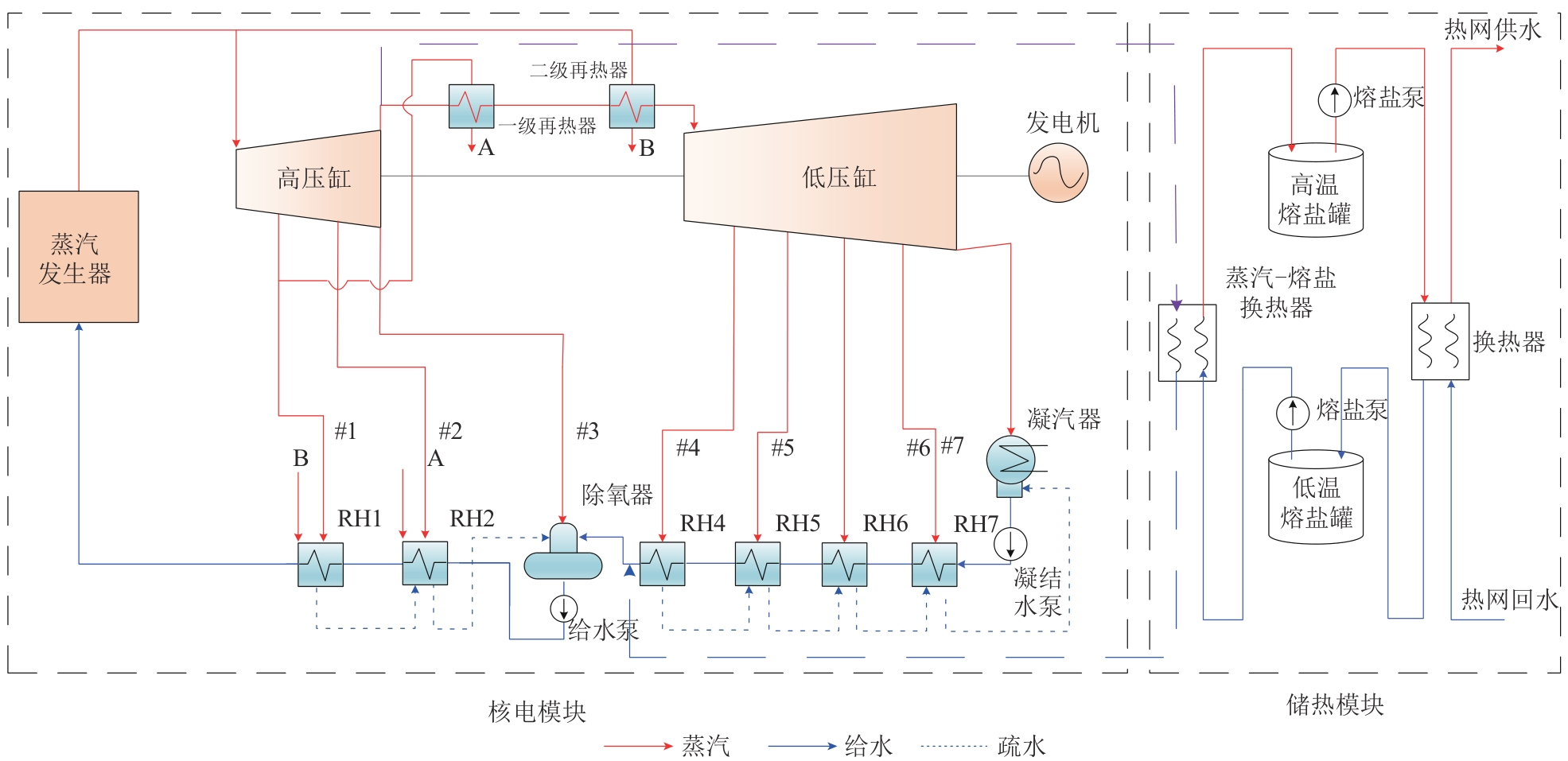
图3 高压缸排汽加热熔盐方案系统图
Fig. 3 Schematic diagram of high-pressure cylinder exhaust steam heating molten salt scheme
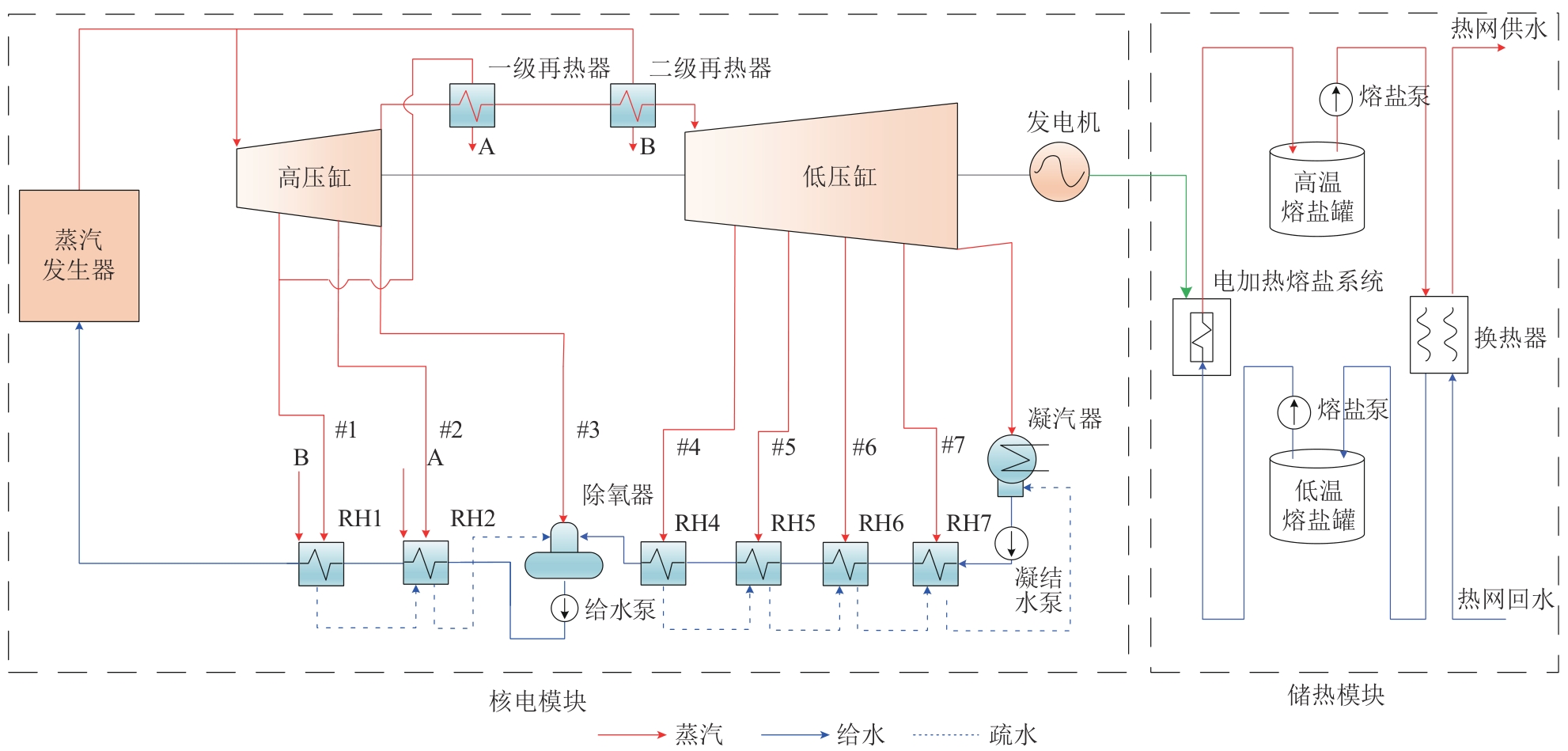
图4 电加热熔盐方案系统图
Fig. 4 Schematic diagram of electric heating molten salt scheme
| 参数 | 数值 | |
|---|---|---|
| 热网回水温度 | 40.0 | |
| 热网供水温度 | 130.0 | |
| 主蒸汽加热熔盐方案 | 高温熔盐温度 | 272.0 |
| 低温熔盐温度 | 150.0 | |
| 高压缸排汽加热熔盐方案 | 高温熔盐温度 | 172.0 |
| 低温熔盐温度 | 150.0 | |
| 电加热熔盐方案 | 高温熔盐温度 | 200.0/240.0 |
| 低温熔盐温度 | 150.0 | |
表2 不同耦合系统方案热力参数 (℃)
Tab. 2 Thermodynamic parameters of different coupled system schemes
| 参数 | 数值 | |
|---|---|---|
| 热网回水温度 | 40.0 | |
| 热网供水温度 | 130.0 | |
| 主蒸汽加热熔盐方案 | 高温熔盐温度 | 272.0 |
| 低温熔盐温度 | 150.0 | |
| 高压缸排汽加热熔盐方案 | 高温熔盐温度 | 172.0 |
| 低温熔盐温度 | 150.0 | |
| 电加热熔盐方案 | 高温熔盐温度 | 200.0/240.0 |
| 低温熔盐温度 | 150.0 | |
| 组成设备 | 软件组件 | 细节 |
|---|---|---|
| 蒸汽发生器 | 蒸汽发生器 | 蒸汽发生器以整体建模,不同工况下的主蒸汽流量设置为定值 |
| 汽轮机 | 汽轮机 | 指定各级的排汽焓值;各级组机械效率设定为99.80% |
| 泵 | 泵 | 等熵效率为83.0%;机械效率为99.8% |
| 发电机 | 发电机 | 发电机效率为99% |
| 加热器 | 给水加热器; 疏水冷却器; 除氧器 | 加热器由给水加热器(冷凝段)和疏水冷却器(疏水冷却段)组成,加热器3为除氧器。规定了每个加热器的上端温差和每个疏水冷却器的下端温差。不同加热器对应的抽汽压力损失范围为3%~5%;热损失忽略不计 |
| 再热器 | 通用换热器 | 指定热流体的入口和出口温度;指定冷流体的入口温度 |
| 凝汽器 | 冷凝器 | 指定冷却水的入口温度和压力;指定凝汽器的终端温差 |
| 高温熔盐罐/低温熔盐罐 | 直接存储 | 指定容器内温度 |
| 电加热装置 | 电锅炉 | 指定效率 |
表3 EBSILON软件各组件的建模细节
Tab. 3 Modeling details of components in EBSILON software
| 组成设备 | 软件组件 | 细节 |
|---|---|---|
| 蒸汽发生器 | 蒸汽发生器 | 蒸汽发生器以整体建模,不同工况下的主蒸汽流量设置为定值 |
| 汽轮机 | 汽轮机 | 指定各级的排汽焓值;各级组机械效率设定为99.80% |
| 泵 | 泵 | 等熵效率为83.0%;机械效率为99.8% |
| 发电机 | 发电机 | 发电机效率为99% |
| 加热器 | 给水加热器; 疏水冷却器; 除氧器 | 加热器由给水加热器(冷凝段)和疏水冷却器(疏水冷却段)组成,加热器3为除氧器。规定了每个加热器的上端温差和每个疏水冷却器的下端温差。不同加热器对应的抽汽压力损失范围为3%~5%;热损失忽略不计 |
| 再热器 | 通用换热器 | 指定热流体的入口和出口温度;指定冷流体的入口温度 |
| 凝汽器 | 冷凝器 | 指定冷却水的入口温度和压力;指定凝汽器的终端温差 |
| 高温熔盐罐/低温熔盐罐 | 直接存储 | 指定容器内温度 |
| 电加热装置 | 电锅炉 | 指定效率 |
| 参数 | 设计值 | 模拟值 | 相对误差 |
|---|---|---|---|
| 发电机功率/MW | 1 212.88 | 1 211.68 | 0.09% |
| 主蒸汽流量/(kg/h) | 6 389 285 | 6 389 285 | 0% |
| 一级再热器进口蒸汽温度/℃ | 181.50 | 181.01 | 0.27% |
| 一级再热器进口蒸汽温度/℃ | 221.98 | 221.62 | 0.16% |
| 二级再热器出口温度/℃ | 270.85 | 270.11 | 0.27% |
表4 核电机组主要热力参数设计值与模拟值对比
Tab. 4 Comparison between design and simulated values of major thermodynamic parameters of nuclear power units
| 参数 | 设计值 | 模拟值 | 相对误差 |
|---|---|---|---|
| 发电机功率/MW | 1 212.88 | 1 211.68 | 0.09% |
| 主蒸汽流量/(kg/h) | 6 389 285 | 6 389 285 | 0% |
| 一级再热器进口蒸汽温度/℃ | 181.50 | 181.01 | 0.27% |
| 一级再热器进口蒸汽温度/℃ | 221.98 | 221.62 | 0.16% |
| 二级再热器出口温度/℃ | 270.85 | 270.11 | 0.27% |
| 参数 | 设计值 |
|---|---|
| 供暖热价/(元/GJ) | 45 |
| 熔盐储热成本/[元/(kW∙h)] | 450 |
| 电加热器成本/(元/kW) | 700 |
| 设备使用寿命/年 | 30 |
| 折现率/% | 6 |
| 系统年运行小时数/h | 7 000 |
| 年供暖总时长/h | 1 200 |
| 调峰补贴/[元/(kW∙h)] | 0.3 |
| 上网电价/[元/(kW∙h)] | 0.393 2 |
表5 耦合系统供暖方案经济性计算数据
Tab. 5 Economic calculation data for heating schemes of coupled system
| 参数 | 设计值 |
|---|---|
| 供暖热价/(元/GJ) | 45 |
| 熔盐储热成本/[元/(kW∙h)] | 450 |
| 电加热器成本/(元/kW) | 700 |
| 设备使用寿命/年 | 30 |
| 折现率/% | 6 |
| 系统年运行小时数/h | 7 000 |
| 年供暖总时长/h | 1 200 |
| 调峰补贴/[元/(kW∙h)] | 0.3 |
| 上网电价/[元/(kW∙h)] | 0.393 2 |
| 参数 | 调峰幅度 | |||||
|---|---|---|---|---|---|---|
| 5% | 10% | 15% | 20% | 25% | ||
| 供热量/MW | 164.19 | 328.98 | 494.05 | 659.13 | 824.21 | |
| 高/低温熔盐温度/℃ | 271.99/150.00 | 271.99/150.00 | 271.99/150.00 | 271.99/150.00 | 271.99/150.00 | |
| 用于加热熔盐的主蒸汽 | 温度/℃ | 281.99 | 281.99 | 281.99 | 281.99 | 281.99 |
| 压力/MPa | 6.62 | 6.62 | 6.62 | 6.62 | 6.62 | |
| 流量/(t/h) | 281.91 | 564.86 | 848.31 | 1 131.76 | 1 415.21 | |
| 核电发电量/MW | 1 151.40 | 1 090.80 | 1 030.20 | 969.60 | 909.00 | |
| 能量效率/% | 41.23 | 44.49 | 47.76 | 51.04 | 54.31 | |
表6 主蒸汽加热熔盐方案计算结果
Tab. 6 Calculation results of main steam heating molten salt scheme
| 参数 | 调峰幅度 | |||||
|---|---|---|---|---|---|---|
| 5% | 10% | 15% | 20% | 25% | ||
| 供热量/MW | 164.19 | 328.98 | 494.05 | 659.13 | 824.21 | |
| 高/低温熔盐温度/℃ | 271.99/150.00 | 271.99/150.00 | 271.99/150.00 | 271.99/150.00 | 271.99/150.00 | |
| 用于加热熔盐的主蒸汽 | 温度/℃ | 281.99 | 281.99 | 281.99 | 281.99 | 281.99 |
| 压力/MPa | 6.62 | 6.62 | 6.62 | 6.62 | 6.62 | |
| 流量/(t/h) | 281.91 | 564.86 | 848.31 | 1 131.76 | 1 415.21 | |
| 核电发电量/MW | 1 151.40 | 1 090.80 | 1 030.20 | 969.60 | 909.00 | |
| 能量效率/% | 41.23 | 44.49 | 47.76 | 51.04 | 54.31 | |
| 参数 | 调峰幅度 | |||||
|---|---|---|---|---|---|---|
| 5% | 10% | 15% | 20% | 25% | ||
| 供热量/MW | 223.83 | 449.29 | 674.74 | 900.19 | 1 125.64 | |
| 高/低温熔盐温度/℃ | 171.98/150.00 | 171.98/150.00 | 171.98/150.00 | 171.98/150.00 | 171.98/150.00 | |
| 用于加热熔盐的高压缸排汽 | 温度/℃ | 181.98 | 181.98 | 181.98 | 181.98 | 181.98 |
| 压力/MPa | 1.05 | 1.05 | 1.05 | 1.05 | 1.05 | |
| 流量/(t/h) | 436.04 | 875.23 | 1 314.42 | 1 753.61 | 2 192.80 | |
| 核电发电量/MW | 1 151.40 | 1 090.80 | 1 030.20 | 969.60 | 909.00 | |
| 能量效率/% | 43.09 | 48.26 | 53.43 | 58.59 | 63.76 | |
表7 高压缸排汽加热熔盐方案计算结果
Tab. 7 Calculation results of high-pressure cylinder exhaust steam heating molten salt scheme
| 参数 | 调峰幅度 | |||||
|---|---|---|---|---|---|---|
| 5% | 10% | 15% | 20% | 25% | ||
| 供热量/MW | 223.83 | 449.29 | 674.74 | 900.19 | 1 125.64 | |
| 高/低温熔盐温度/℃ | 171.98/150.00 | 171.98/150.00 | 171.98/150.00 | 171.98/150.00 | 171.98/150.00 | |
| 用于加热熔盐的高压缸排汽 | 温度/℃ | 181.98 | 181.98 | 181.98 | 181.98 | 181.98 |
| 压力/MPa | 1.05 | 1.05 | 1.05 | 1.05 | 1.05 | |
| 流量/(t/h) | 436.04 | 875.23 | 1 314.42 | 1 753.61 | 2 192.80 | |
| 核电发电量/MW | 1 151.40 | 1 090.80 | 1 030.20 | 969.60 | 909.00 | |
| 能量效率/% | 43.09 | 48.26 | 53.43 | 58.59 | 63.76 | |
| 参数 | 调峰幅度 | |||||
|---|---|---|---|---|---|---|
| 5% | 10% | 15% | 20% | 25% | ||
| 高温熔盐200 ℃ | 高/低温熔盐温度/℃ | 200.00/150.00 | 200.00/150.00 | 200.00/150.00 | 200.00/150.00 | 200.00/150.00 |
| 供热量/MW | 59.46 | 119.24 | 179.02 | 238.79 | 298.57 | |
| 电加热器耗电量/MW | 60.28 | 120.88 | 181.48 | 242.08 | 302.68 | |
| 发电量/MW | 1 151.40 | 1 090.80 | 1 030.20 | 969.60 | 909.00 | |
| 能量效率/% | 37.94 | 37.92 | 37.89 | 37.87 | 37.84 | |
| 高温熔盐240 ℃ | 高/低温熔盐温度/℃ | 240.00/150.00 | 240.00/150.00 | 240.00/150.00 | 240.00/150.00 | 240.00/150.00 |
| 供热量/MW | 59.29 | 118.90 | 178.50 | 238.11 | 297.72 | |
| 电加热器耗电量/MW | 60.28 | 120.88 | 181.48 | 242.08 | 302.68 | |
| 发电量/MW | 1 151.40 | 1 090.80 | 1 030.20 | 969.60 | 909.00 | |
| 能量效率/% | 37.93 | 37.91 | 37.88 | 37.85 | 37.81 | |
表8 电加热熔盐方案计算结果
Tab. 8 Calculation results of electric heating molten salt scheme
| 参数 | 调峰幅度 | |||||
|---|---|---|---|---|---|---|
| 5% | 10% | 15% | 20% | 25% | ||
| 高温熔盐200 ℃ | 高/低温熔盐温度/℃ | 200.00/150.00 | 200.00/150.00 | 200.00/150.00 | 200.00/150.00 | 200.00/150.00 |
| 供热量/MW | 59.46 | 119.24 | 179.02 | 238.79 | 298.57 | |
| 电加热器耗电量/MW | 60.28 | 120.88 | 181.48 | 242.08 | 302.68 | |
| 发电量/MW | 1 151.40 | 1 090.80 | 1 030.20 | 969.60 | 909.00 | |
| 能量效率/% | 37.94 | 37.92 | 37.89 | 37.87 | 37.84 | |
| 高温熔盐240 ℃ | 高/低温熔盐温度/℃ | 240.00/150.00 | 240.00/150.00 | 240.00/150.00 | 240.00/150.00 | 240.00/150.00 |
| 供热量/MW | 59.29 | 118.90 | 178.50 | 238.11 | 297.72 | |
| 电加热器耗电量/MW | 60.28 | 120.88 | 181.48 | 242.08 | 302.68 | |
| 发电量/MW | 1 151.40 | 1 090.80 | 1 030.20 | 969.60 | 909.00 | |
| 能量效率/% | 37.93 | 37.91 | 37.88 | 37.85 | 37.81 | |
| 项目 | 调峰幅度 | ||||
|---|---|---|---|---|---|
| 5% | 10% | 15% | 20% | 25% | |
| 主蒸汽质量流量/(kg/s) | 78.31 | 156.91 | 235.64 | 314.38 | 393.11 |
| 主蒸汽净㶲输入/MW | 80.46 | 161.21 | 242.10 | 322.99 | 403.89 |
| 热网回水净㶲输出/MW | 38.35 | 76.84 | 115.40 | 153.97 | 192.53 |
| 㶲损失/MW | 42.11 | 84.37 | 126.7 | 169.02 | 211.36 |
| 㶲效率/% | 47.67 | 47.67 | 47.67 | 47.67 | 47.67 |
表9 主蒸汽加热熔盐方案㶲分析
Tab. 9 Exergy analysis of main steam heating molten salt scheme
| 项目 | 调峰幅度 | ||||
|---|---|---|---|---|---|
| 5% | 10% | 15% | 20% | 25% | |
| 主蒸汽质量流量/(kg/s) | 78.31 | 156.91 | 235.64 | 314.38 | 393.11 |
| 主蒸汽净㶲输入/MW | 80.46 | 161.21 | 242.10 | 322.99 | 403.89 |
| 热网回水净㶲输出/MW | 38.35 | 76.84 | 115.40 | 153.97 | 192.53 |
| 㶲损失/MW | 42.11 | 84.37 | 126.7 | 169.02 | 211.36 |
| 㶲效率/% | 47.67 | 47.67 | 47.67 | 47.67 | 47.67 |
| 参数 | 调峰幅度 | ||||
|---|---|---|---|---|---|
| 5% | 10% | 15% | 20% | 25% | |
| 高压缸排汽质量流量/(kg/s) | 121.12 | 243.12 | 365.12 | 487.11 | 609.11 |
| 高压缸排汽净㶲输入/MW | 88.01 | 176.67 | 265.31 | 353.96 | 442.61 |
| 热网回水净㶲输出/MW | 52.28 | 104.95 | 157.61 | 210.27 | 262.94 |
| 㶲损失/MW | 35.73 | 71.72 | 107.7 | 143.69 | 179.67 |
| 㶲效率/% | 59.41 | 59.41 | 59.41 | 59.41 | 59.41 |
表10 高压缸排汽加热熔盐方案㶲分析结果
Tab. 10 Exergy analysis results of high-pressure cylinder exhaust steam heating molten salt scheme
| 参数 | 调峰幅度 | ||||
|---|---|---|---|---|---|
| 5% | 10% | 15% | 20% | 25% | |
| 高压缸排汽质量流量/(kg/s) | 121.12 | 243.12 | 365.12 | 487.11 | 609.11 |
| 高压缸排汽净㶲输入/MW | 88.01 | 176.67 | 265.31 | 353.96 | 442.61 |
| 热网回水净㶲输出/MW | 52.28 | 104.95 | 157.61 | 210.27 | 262.94 |
| 㶲损失/MW | 35.73 | 71.72 | 107.7 | 143.69 | 179.67 |
| 㶲效率/% | 59.41 | 59.41 | 59.41 | 59.41 | 59.41 |
| 项目 | 调峰幅度 | |||||
|---|---|---|---|---|---|---|
| 5% | 10% | 15% | 20% | 25% | ||
| 高温熔盐200 ℃ | 电加热器功率/MW | 60.28 | 120.88 | 181.48 | 242.08 | 302.68 |
| 热网回水净㶲输出/MW | 13.89 | 27.85 | 41.82 | 55.78 | 69.74 | |
| 㶲损失/MW | 46.39 | 93.03 | 139.66 | 186.3 | 232.94 | |
| 㶲效率/% | 23.04 | 23.04 | 23.04 | 23.04 | 23.04 | |
| 高温熔盐240 ℃ | 电加热器功率/MW | 60.28 | 120.88 | 181.48 | 242.08 | 302.68 |
| 热网回水净㶲输出/MW | 13.85 | 27.77 | 41.70 | 55.62 | 69.54 | |
| 㶲损失/MW | 46.43 | 93.11 | 139.78 | 186.46 | 233.14 | |
| 㶲效率/% | 22.98 | 22.98 | 22.98 | 22.98 | 22.98 | |
表11 电加热熔盐方案㶲分析结果
Tab. 11 Exergy analysis results of electric heating molten salt scheme
| 项目 | 调峰幅度 | |||||
|---|---|---|---|---|---|---|
| 5% | 10% | 15% | 20% | 25% | ||
| 高温熔盐200 ℃ | 电加热器功率/MW | 60.28 | 120.88 | 181.48 | 242.08 | 302.68 |
| 热网回水净㶲输出/MW | 13.89 | 27.85 | 41.82 | 55.78 | 69.74 | |
| 㶲损失/MW | 46.39 | 93.03 | 139.66 | 186.3 | 232.94 | |
| 㶲效率/% | 23.04 | 23.04 | 23.04 | 23.04 | 23.04 | |
| 高温熔盐240 ℃ | 电加热器功率/MW | 60.28 | 120.88 | 181.48 | 242.08 | 302.68 |
| 热网回水净㶲输出/MW | 13.85 | 27.77 | 41.70 | 55.62 | 69.54 | |
| 㶲损失/MW | 46.43 | 93.11 | 139.78 | 186.46 | 233.14 | |
| 㶲效率/% | 22.98 | 22.98 | 22.98 | 22.98 | 22.98 | |
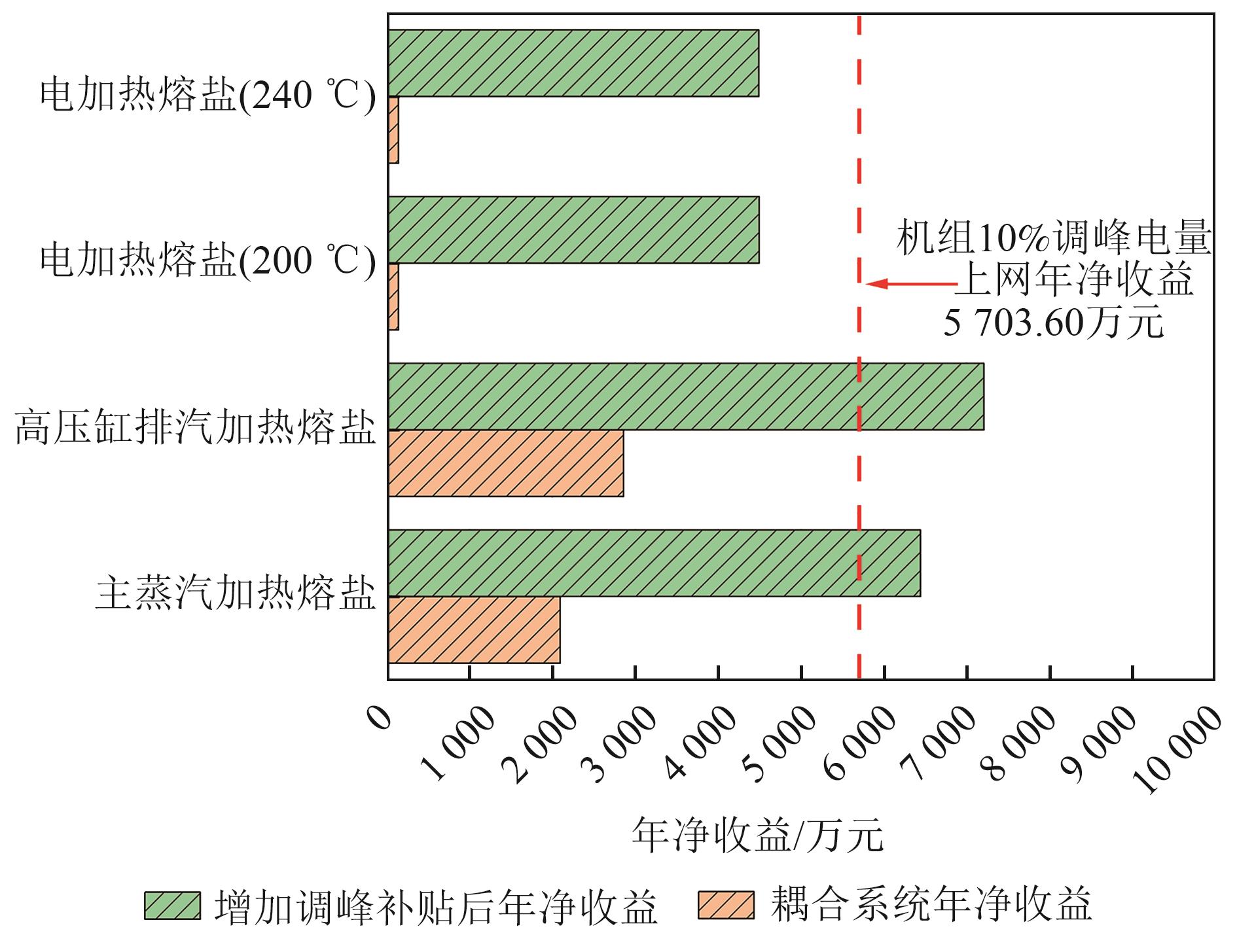
图5 各方案经济性对比
Fig. 5 Comparison of economic performance among different schemes
| [1] | 国家能源局 .可再生能源装机实现两大突破[EB/OL].(2024-10-30)[2025-04-15].. doi:10.1097/00152193-200512000-00027 |
| National Energy Administration .Renewable energy installed capacity achieved two major breakthroughs[EB/OL].(2024-10-30)[2025-04-15].. doi:10.1097/00152193-200512000-00027 | |
| [2] | 张思海,李超然,万广亮,等 .330 MW循环流化床锅炉深度调峰技术[J].发电技术,2024,45(2):199-206. |
| ZHANG S H, LI C R, WAN G L,et al .Deep peak shaving technology for 330 MW circulating fluidized bed boiler[J].Power Generation Technology,2024,45(2):199-206. | |
| [3] | 李军徽,安晨宇,李翠萍,等 .计及调峰市场交易的储能-新能源-火电多目标优化调度[J].电工技术学报,2023,38(23):6391-6406. |
| LI J H, AN C Y, LI C P,et al .Multi-objective optimization scheduling method considering peak regulating market transactions for energy storage-new energy-thermal power[J].Transactions of China Electrotechnical Society,2023,38(23):6391-6406. | |
| [4] | 胡迎迎,李强,张琳娜,等 .基于模糊层次分析法- TOPSIS的多元化储能典型场景适用性评估[J].电测与仪表,2024,61(6):126-132. doi:10.1016/s0306-9877(03)00144-0 |
| HU Y Y, LI Q, ZHANG L N,et al .Applicability evaluation of diversified energy storage typical scenarios based on fuzzy analytic hierarchy process-TOPSIS[J].Electrical Measurement & Instrumentation,2024,61(6):126-132. doi:10.1016/s0306-9877(03)00144-0 | |
| [5] | 陈灵,黄兴华,张功林,等 .考虑削峰填谷的分布式电源集群协同控制方法[J].智慧电力,2023,51(4):8-15. doi:10.3969/j.issn.1673-7598.2023.04.002 |
| CHEN L, HUANG X H, ZHANG G L,et al .Distributed generations clusters collaborative control method considering peak load shifting[J].Smart Power,2023,51(4):8-15. doi:10.3969/j.issn.1673-7598.2023.04.002 | |
| [6] | 王海洋,荣健 .碳达峰、碳中和目标下中国核能发展路径分析[J].中国电力,2021,54(6):86-94. |
| WANG H Y, RONG J .Analysis on China’s nuclear energy development path under the goal of peaking carbon emissions and achieving carbon neutrality[J].Electric Power,2021,54(6):86-94. | |
| [7] | 吴祖胜,彭翠玲 .核电厂风冷冷水机组框架结构的力学分析与评定[J].发电技术,2018,39(5):483-486. |
| WU Z S, PENG C L .Mechanical analysis and evaluation of fram structure of air-cooled chiller unit for nuclear power plant[J].Power Generation Technology,2018,39(5):483-486. | |
| [8] | 王文兴 .热电联产核电机组与熔盐储热集成的性能评估和优化调度[D].济南:山东大学,2024. |
| WANG W X .Performance evaluation and optimal scheduling of combined heat and power nuclear power units integrated with molten salt thermal storage[D].Jinan:Shandong University,2024. | |
| [9] | 段立强,王婧,庞力平,等 .二次再热机组高效灵活发电创新理论与方法[J].中国电力,2019,52(5):1-12. |
| DUAN L Q, WANG J, PANG L P,et al .Innovative theory and methods for high-efficiency and flexible power generation of ultra-supercritical double-reheat coal-fired power generation unit[J].Electric Power,2019,52(5):1-12. | |
| [10] | 张宇恒,宋晓辉,杨荣贵,等 .基于再热蒸汽抽汽-熔盐储热的火电系统分析[J].动力工程学报,2024,44(3):447-454. |
| ZHANG Y H, SONG X H, YANG R G,et al .Analysis of thermal power system based on reheat steam extraction and molten salt heat storage[J].Journal of Chinese Society of Power Engineering,2024,44(3):447-454. | |
| [11] | 李峻,祝培旺,王辉,等 .基于高温熔盐储热的火电机组灵活性改造技术及其应用前景分析[J].南方能源建设,2021,8(3):63-70. |
| LI J, ZHU P W, WANG H,et al .Flexible modification technology and application prospect of thermal power unit based on high temperature molten salt heat storage[J].Southern Energy Construction,2021,8(3):63-70. | |
| [12] | 庞力平,张世刚,段立强 .高温熔盐储能提高二次再热机组灵活性研究[J].中国电机工程学报,2021,41(8):2682-2691. doi:10.13334/j.0258-8013.pcsee.200771 |
| PANG L P, ZHANG S G, DUAN L Q .Flexibility improvement study on the double reheat power generation unit with a high temperature molten salt thermal energy storage[J].Proceedings of the CSEE,2021,41(8):2682-2691. doi:10.13334/j.0258-8013.pcsee.200771 | |
| [13] | 彭家辉,倪永中,王元良,等 .基于熔盐储热的燃煤机组调峰可行性分析[J].热力发电,2024,53(1):99-106. |
| PENG J H, NI Y Z, WANG Y L,et al .Feasibility analysis of peak shaving for coal-fired units based on molten salt heat storage[J].Thermal Power Generation,2024,53(1):99-106. | |
| [14] | 邹小刚,刘明,肖海丰,等 .火电机组耦合熔盐储热深度调峰系统设计及性能分析[J].热力发电,2023,52(2):146-153. |
| ZOU X G, LIU M, XIAO H F,et al .Design and performance analysis of deep peak shaving system of thermal power units coupled with molten salt heat storage[J].Thermal Power Generation,2023,52(2):146-153. | |
| [15] | 张显荣,徐玉杰,杨立军,等 .多类型火电-储热耦合系统性能分析与比较[J].储能科学与技术,2021,10(5):1565-1578. |
| ZHANG X R, XU Y J, YANG L J,et al .Performance analysis and comparison of multi-type thermal power-thermal storage coupling system[J].Energy Storage Science and Technology,2021,10(5):1565-1578. | |
| [16] | 刘金恺,鹿院卫,魏海姣,等 .熔盐储热辅助燃煤机组调峰系统设计及性能对比[J].热力发电,2023,52(2):111-118. |
| LIU J K, LU Y W, WEI H J,et al .Design and performance comparison of peak shaving system of coal-fired unit aided by molten salt heat storage[J].Thermal Power Generation,2023,52(2):111-118. | |
| [17] | 任景,程松,高敏,等 .集成熔盐储热燃煤发电系统的灵活性与能耗特性分析[J].热能动力工程,2024,39(2):145-153. |
| REN J, CHENG S, GAO M,et al .Analysis of flexibility and energy consumption characteristics of coal-fired power system integrated with molten salt thermal storage[J].Journal of Engineering for Thermal Energy and Power,2024,39(2):145-153. | |
| [18] | 苗林,刘明,张可臻,等 .集成电制热熔盐储热的燃煤发电系统热力性能研究[J].工程热物理学报,2023,44(11):2999-3007. |
| MIAO L, LIU M, ZHANG K Z,et al .Thermodynamic analysis on the coal-fired power plant integrated with power-to-heat molten salt thermal energy storage system[J].Journal of Engineering Thermophysics,2023,44(11):2999-3007. | |
| [19] | 王辉,李峻,祝培旺,等 .应用于火电机组深度调峰的百兆瓦级熔盐储能技术[J].储能科学与技术,2021,10(5):1760-1767. |
| WANG H, LI J, ZHU P W,et al .100 MW molten salt energy storage technology applied to deep peak shaving of thermal power units[J].Energy Storage Science and Technology,2021,10(5):1760-1767. | |
| [20] | CHEN Z D, HOU Y C, LIU M Y,et al .Thermodynamic and economic analyses of sewage sludge resource utilization systems integrating drying,incineration,and power generation processes[J].Applied Energy,2022,327:120093. doi:10.1016/j.apenergy.2022.120093 |
| [21] | XU C, LI X S, XIN T T,et al .A thermodynamic analysis and economic assessment of a modified de-carbonization coal-fired power plant incorporating a supercritical CO2 power cycle and an absorption heat transformer[J].Energy,2019,179:30-45. doi:10.1016/j.energy.2019.05.017 |
| [22] | WANG G, DONG B Y, CHEN Z S .Design and behaviour estimate of a novel concentrated solar-driven power and desalination system using S-CO2 Brayton cycle and MSF technology[J].Renewable Energy,2021,176:555-564. doi:10.1016/j.renene.2021.05.091 |
| [23] | CHEN H, WU Y Y, XU S,et al .Thermodynamic and economic evaluation of a novel heat supply design using low-pressure feedwater in a cogeneration plant[J].Applied Thermal Engineering,2020,166:114672. doi:10.1016/j.applthermaleng.2019.114672 |
| [24] | CHEN H, YAO X H, LI J,et al .Thermodynamic analysis of a novel combined heat and power system incorporating a CO2 heat pump cycle for enhancing flexibility[J].Applied Thermal Engineering,2019,161:114160. doi:10.1016/j.applthermaleng.2019.114160 |
| [25] | LI S, JIN H G, GAO L,et al .Techno-economic performance and cost reduction potential for the substitute/synthetic natural gas and power cogeneration plant with CO2 capture[J].Energy Conversion and Management,2014,85:875-887. doi:10.1016/j.enconman.2013.12.071 |
| [1] | 罗城鑫, 吕彦龙, 刘润宝, 谢玉荣, 王雨昊, 刘锋, 隋军. 基于热泵技术的低碳排冷热电联供系统㶲经济性能研究[J]. 发电技术, 2025, 46(6): 1085-1096. |
| [2] | 罗晟, 王磊, 李杨, 孟庆明, 张贵彬, 赵元宾. 变流量配水对湿冷塔冷却特性的影响及其优化[J]. 发电技术, 2025, 46(5): 1041-1049. |
| [3] | 张鹏新, 高明明, 解沛然, 于浩洋, 张洪福, 黄中. 基于数据驱动的循环流化床机组深度调峰NO x 预测[J]. 发电技术, 2025, 46(3): 627-636. |
| [4] | 张佳鑫, 彭勇刚, 孙静. 考虑需求响应和碳交易的园区氢电耦合系统两阶段鲁棒优化调度[J]. 发电技术, 2025, 46(2): 252-262. |
| [5] | 严新荣, 胡志勇, 张鹏威, 郑成航, 向军, 唐郭安, 刘金亮, 郭剑雄, 黄一博, 于鹏峰, 高翔. 煤电机组运行灵活性提升技术研究与应用[J]. 发电技术, 2024, 45(6): 1074-1086. |
| [6] | 姬海民, 薛磊, 周方盛, 王电, 陈诚, 李靖, 刘辉, 薛宁, 张知翔, 徐党旗. 非补燃液态压缩空气储能系统性能模拟研究[J]. 发电技术, 2024, 45(5): 910-918. |
| [7] | 郑淇薇, 赵欣悦, 卢荻, 陈衡, 潘佩媛, 刘彤. 多类型小容量火电机组热电解耦潜力与经济性对比评估[J]. 发电技术, 2024, 45(5): 929-940. |
| [8] | 袁鑫, 刘骏, 陈衡, 潘佩媛, 徐钢, 王修彦. 碳捕集技术应用对燃煤机组调峰能力的影响[J]. 发电技术, 2024, 45(3): 373-381. |
| [9] | 丁湧. 1 000 MW超超临界燃煤锅炉深度调峰研究[J]. 发电技术, 2024, 45(3): 382-391. |
| [10] | 陈晓峰, 左川, 赵宁, 黄凯, 王惠杰. 集成蓄热装置的火电机组调峰特性分析[J]. 发电技术, 2024, 45(3): 392-400. |
| [11] | 代华松, 浦绍旭, 柴国旭, 金李, 陈为平, 解明亮. 350 MW超临界流化床机组深度调峰研究与应用[J]. 发电技术, 2024, 45(3): 401-411. |
| [12] | 李军徽, 陈国航, 马腾, 李翠萍, 朱星旭, 贾晨. 高风电渗透率下液流电池储能系统调峰优化控制策略[J]. 发电技术, 2024, 45(3): 434-447. |
| [13] | 张思海, 李超然, 万广亮, 刘印学, 徐海楠, 黄中, 杨海瑞. 330 MW 循环流化床锅炉深度调峰技术[J]. 发电技术, 2024, 45(2): 199-206. |
| [14] | 郑淇薇, 王华霆, 陈衡, 潘佩媛, 徐钢. 深度调峰背景下火电机组热电解耦技术路径对比分析[J]. 发电技术, 2024, 45(2): 207-215. |
| [15] | 贾志军, 范伟, 任少君, 魏唐斌. 600 MW亚临界机组长时间深度调峰燃烧稳定性研究[J]. 发电技术, 2024, 45(2): 216-225. |
| 阅读次数 | ||||||
|
全文 |
|
|||||
|
摘要 |
|
|||||
