

发电技术 ›› 2025, Vol. 46 ›› Issue (6): 1085-1096.DOI: 10.12096/j.2096-4528.pgt.25331
• 分布式能源 • 上一篇
罗城鑫1, 吕彦龙2, 刘润宝1, 谢玉荣1, 王雨昊2, 刘锋2, 隋军2
收稿日期:2025-07-29
修回日期:2025-08-20
出版日期:2025-12-31
发布日期:2025-12-25
通讯作者:
刘锋
作者简介:基金资助:Chengxin LUO1, Yanlong LÜ2, Runbao LIU1, Yurong XIE1, Yuhao WANG2, Feng LIU2, Jun SUI2
Received:2025-07-29
Revised:2025-08-20
Published:2025-12-31
Online:2025-12-25
Contact:
Feng LIU
Supported by:摘要:
目的 在“双碳”战略与全球能源结构转型背景下,如何实现传统能源系统的高效低碳化运行是当前亟需突破的难题。为此,构建了一种耦合热泵(heat pump,HP)技术的低碳排冷热电联供(combined cooling, heating, and power,CCHP)系统。 方法 通过多级余热回收与温区协同匹配机制,优化能量梯级利用路径;建立涵盖热力学、环境友好性、经济及㶲经济性能的多维度评价模型,并与传统系统性能进行了对比。 结果 经济性分析结果显示,HP的引入使单位产电成本从1.24元/(kW⋅h)增至1.43元/(kW⋅h),但单位产能成本从0.24元/(kW⋅h)降至0.22元/(kW⋅h),综合能效提升;灵敏度分析结果显示,运行时间与利率对成本影响最大;㶲经济分析表明,透平、碳捕集与封存(carbon capture and storage,CCS)系统和压缩机分别贡献67.019%、17.107%和8.169%的㶲损失,是未来优化的核心方向。 结论 研究成果为低碳排CCHP系统的设计与推广提供了理论支撑。
中图分类号:
罗城鑫, 吕彦龙, 刘润宝, 谢玉荣, 王雨昊, 刘锋, 隋军. 基于热泵技术的低碳排冷热电联供系统㶲经济性能研究[J]. 发电技术, 2025, 46(6): 1085-1096.
Chengxin LUO, Yanlong LÜ, Runbao LIU, Yurong XIE, Yuhao WANG, Feng LIU, Jun SUI. Exergoeconomic Research on Low-Carbon-Emission Combined Cooling, Heating, and Power System Based on Heat Pump Technology[J]. Power Generation Technology, 2025, 46(6): 1085-1096.
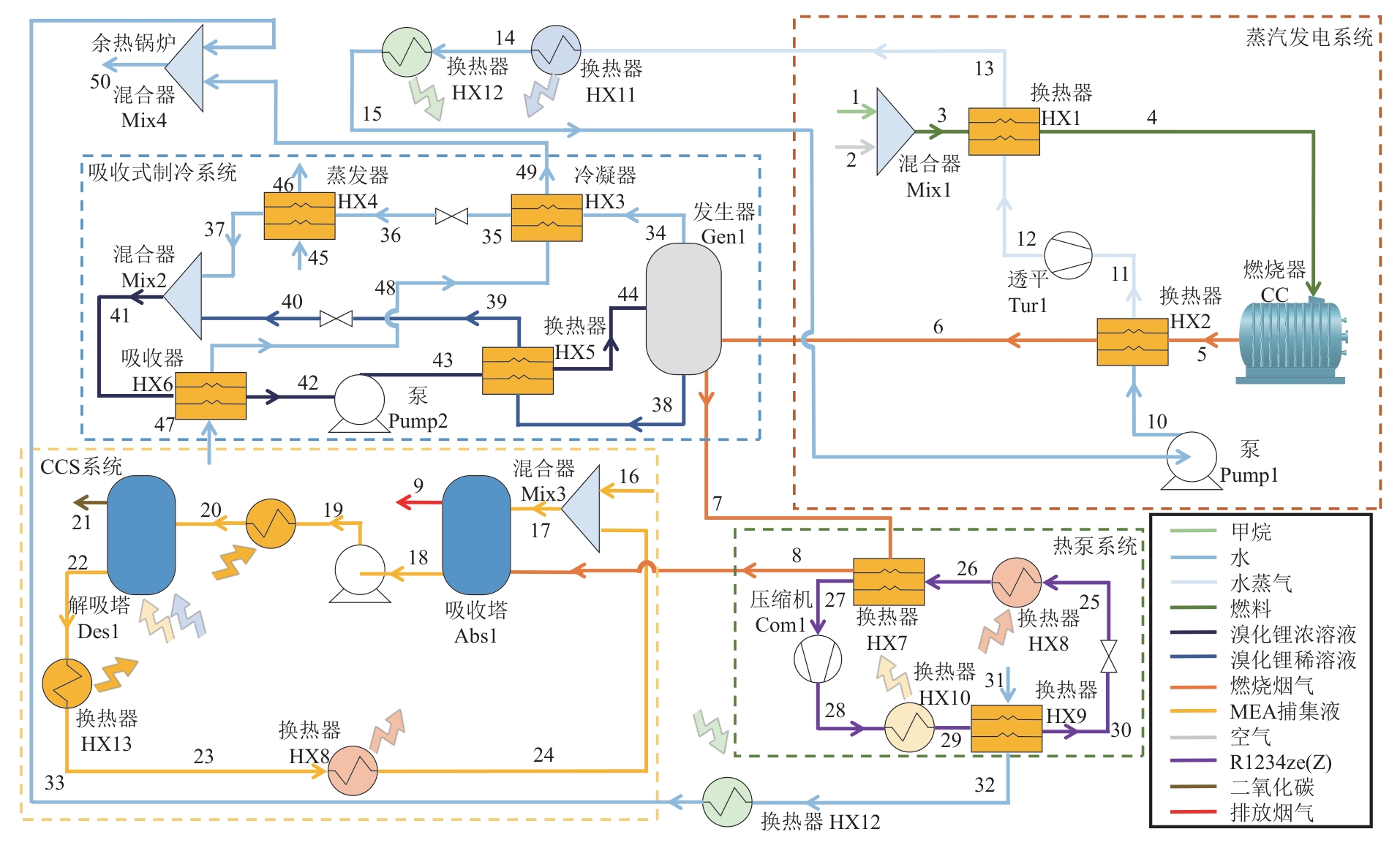
图1 低碳排CCHP系统示意图
Fig. 1 Schematic diagram of low-carbon-emission CCHP system
| 部件 | 热力学平衡方程 |
|---|---|
| Com1 | |
| HX7 | |
| HX8 | |
| HX9 | |
| HX10 |
表1 HP系统中各部件的热力学模型
Tab. 1 Thermodynamic model of each component in HP system
| 部件 | 热力学平衡方程 |
|---|---|
| Com1 | |
| HX7 | |
| HX8 | |
| HX9 | |
| HX10 |

图2 参比CCHP系统示意图
Fig. 2 Schematic diagram of reference CCHP system
| 子系统 | 部件 | 主要参数 |
|---|---|---|
| 蒸汽发电系统 | CC | 压力100 kPa;温度1 878 ℃ |
| HX1 | 冷流股出口温度:90 ℃ | |
| HX2 | 冷流股出口温度:1 000 ℃ | |
| HX11 | 热流股出口温度:95 ℃ | |
| HX12 | 冷流股出口温度:90 ℃ | |
| Tur1 | 排放压力40 kPa;等熵效率90% | |
| Pump1 | 排放压力2 500 kPa;泵效率90% | |
| HP系统 | HX7 | 热流股出口温度:40 ℃ |
| HX9 | 热流股出口温度:80 ℃ | |
| HX10 | 热流股出口温度:27 ℃ | |
| Com1 | 出口压力2 400 kPa;等熵效率90% | |
| CCS系统 | Abs1 | 塔板数15;压力100 kPa |
| HX8 | 换热器负荷:118.88 kW | |
| HX13 | 热进口-冷出口温差:15 ℃ | |
| Des1 | 塔板数10;压力200 kPa | |
| 吸收式制冷系统 | HX3 | 热流股出口温度:45 ℃ |
| HX4 | 热流股出口温度:9 ℃ | |
| HX5 | 热流股出口温度:80 ℃ | |
| HX6 | 热流股出口温度:40 ℃ | |
| Gen1 | 温度99.47 ℃;压力9.6 kPa | |
| Pump2 | 出口压力9.6 kPa;泵效率90% |
表2 低碳排CCHP系统各部件主要设计参数
Tab. 2 Main design parameters of each component in low-carbon-emission CCHP system
| 子系统 | 部件 | 主要参数 |
|---|---|---|
| 蒸汽发电系统 | CC | 压力100 kPa;温度1 878 ℃ |
| HX1 | 冷流股出口温度:90 ℃ | |
| HX2 | 冷流股出口温度:1 000 ℃ | |
| HX11 | 热流股出口温度:95 ℃ | |
| HX12 | 冷流股出口温度:90 ℃ | |
| Tur1 | 排放压力40 kPa;等熵效率90% | |
| Pump1 | 排放压力2 500 kPa;泵效率90% | |
| HP系统 | HX7 | 热流股出口温度:40 ℃ |
| HX9 | 热流股出口温度:80 ℃ | |
| HX10 | 热流股出口温度:27 ℃ | |
| Com1 | 出口压力2 400 kPa;等熵效率90% | |
| CCS系统 | Abs1 | 塔板数15;压力100 kPa |
| HX8 | 换热器负荷:118.88 kW | |
| HX13 | 热进口-冷出口温差:15 ℃ | |
| Des1 | 塔板数10;压力200 kPa | |
| 吸收式制冷系统 | HX3 | 热流股出口温度:45 ℃ |
| HX4 | 热流股出口温度:9 ℃ | |
| HX5 | 热流股出口温度:80 ℃ | |
| HX6 | 热流股出口温度:40 ℃ | |
| Gen1 | 温度99.47 ℃;压力9.6 kPa | |
| Pump2 | 出口压力9.6 kPa;泵效率90% |
| 阶段 | 部件 | 参数 | 数值 |
|---|---|---|---|
| 生产 | CC | 额定产热量/kW | 4 828.94 |
| CCS | CO2处理量/kg | 742.50 | |
| HX | 换热量/kW | 10 446.67 | |
| Tur | 做功量/kW | 540.86 | |
| Com | 功耗/kW | 278.85 | |
| 运行 | CC | 产热量/kW | 4 828.94 |
| CC | 运行时间/h | 90 000.00 | |
| HX | 换热量/kW | 10 446.67 | |
| Com | 功耗/kW | 278.85 |
表3 LCA评估对象
Tab. 3 Assessment objects of LCA
| 阶段 | 部件 | 参数 | 数值 |
|---|---|---|---|
| 生产 | CC | 额定产热量/kW | 4 828.94 |
| CCS | CO2处理量/kg | 742.50 | |
| HX | 换热量/kW | 10 446.67 | |
| Tur | 做功量/kW | 540.86 | |
| Com | 功耗/kW | 278.85 | |
| 运行 | CC | 产热量/kW | 4 828.94 |
| CC | 运行时间/h | 90 000.00 | |
| HX | 换热量/kW | 10 446.67 | |
| Com | 功耗/kW | 278.85 |
| 部件 | 成本方程 | 来源 |
|---|---|---|
| Pump | 文献[ | |
| Gen | 文献[ | |
| Com | 文献[ | |
| HX | 文献[ | |
| CC | 文献[ | |
| CCS | 文献[ | |
| Tur | 文献[ |
表4 系统中各部件的成本方程
Tab. 4 Cost equations for each component in system
| 部件 | 成本方程 | 来源 |
|---|---|---|
| Pump | 文献[ | |
| Gen | 文献[ | |
| Com | 文献[ | |
| HX | 文献[ | |
| CC | 文献[ | |
| CCS | 文献[ | |
| Tur | 文献[ |
| 部件 | 㶲经济平衡方程 | 辅助方程 |
|---|---|---|
| HX1 | ||
| HX2 | ||
| HX3 | ||
| HX4 | ||
| HX5 | ||
| HX6 | ||
| HX7 | ||
| HX8 | ||
| HX9 | ||
| Mix | ||
| Gen | ||
| Tur | ||
| CC | ||
| CCS |
表5 各部件的㶲经济平衡方程和辅助方程
Tab. 5 Exergoeconomic balance equations and auxiliary equations for each component
| 部件 | 㶲经济平衡方程 | 辅助方程 |
|---|---|---|
| HX1 | ||
| HX2 | ||
| HX3 | ||
| HX4 | ||
| HX5 | ||
| HX6 | ||
| HX7 | ||
| HX8 | ||
| HX9 | ||
| Mix | ||
| Gen | ||
| Tur | ||
| CC | ||
| CCS |
| 指标 | 设计系统 | 参比系统 |
|---|---|---|
| 输入热量/kW | 4 951.71 | 4 951.71 |
| 碳捕集耗能/kW | 1 039.27 | 1 039.27 |
| 热泵COP | 2.72 | — |
| 发电量/kW | 540.86 | 820.99 |
| 制冷量/kW | 964.01 | 828.19 |
| 制热量/kW | 3 137.84 | 2 352.30 |
| 余热回收率/% | 89.85 | 73.59 |
| 热效率/% | 81.22 | 74.24 |
| 㶲损失/kW | 3 205.36 | 3 387.89 |
| 㶲效率/% | 65.07 | 53.95 |
表6 系统热力学分析结果
Tab. 6 Thermodynamic analysis results of system
| 指标 | 设计系统 | 参比系统 |
|---|---|---|
| 输入热量/kW | 4 951.71 | 4 951.71 |
| 碳捕集耗能/kW | 1 039.27 | 1 039.27 |
| 热泵COP | 2.72 | — |
| 发电量/kW | 540.86 | 820.99 |
| 制冷量/kW | 964.01 | 828.19 |
| 制热量/kW | 3 137.84 | 2 352.30 |
| 余热回收率/% | 89.85 | 73.59 |
| 热效率/% | 81.22 | 74.24 |
| 㶲损失/kW | 3 205.36 | 3 387.89 |
| 㶲效率/% | 65.07 | 53.95 |
| 指标 | 生产 | 运行 |
|---|---|---|
| AP/(×103 kg SO2- Equiv) | 0.327 7 | 4.219 8 |
| GWP/(×107 kg CO2 Equiv) | 0.004 2 | 2.588 5 |
| FAETP/(×105 kg 1, 4-DCB Equiv) | 1.195 4 | 0.011 8 |
| MAETP/(×108 kg 1, 4-DCB Equiv) | 1.390 9 | 0.000 4 |
| TETP/(×102 kg 1,4-DCB Equiv) | 3.338 0 | 4.393 1 |
| ADP/(×105 MJ) | 4.659 2 | 0.000 1 |
| EP/(×102 kg PO4 Equiv) | 0.136 3 | 1.080 3 |
| HTP/(×105 kg 1,4-DCB Equiv) | 0.266 1 | 2.998 8 |
表7 设计系统LCA结果
Tab. 7 LCA results of designed system
| 指标 | 生产 | 运行 |
|---|---|---|
| AP/(×103 kg SO2- Equiv) | 0.327 7 | 4.219 8 |
| GWP/(×107 kg CO2 Equiv) | 0.004 2 | 2.588 5 |
| FAETP/(×105 kg 1, 4-DCB Equiv) | 1.195 4 | 0.011 8 |
| MAETP/(×108 kg 1, 4-DCB Equiv) | 1.390 9 | 0.000 4 |
| TETP/(×102 kg 1,4-DCB Equiv) | 3.338 0 | 4.393 1 |
| ADP/(×105 MJ) | 4.659 2 | 0.000 1 |
| EP/(×102 kg PO4 Equiv) | 0.136 3 | 1.080 3 |
| HTP/(×105 kg 1,4-DCB Equiv) | 0.266 1 | 2.998 8 |
| 部件 | 成本/元 | 非能量成本率/(元/h) |
|---|---|---|
| 合计 | 5 881 644.72 | 202.74 |
| CC | 130 298.40 | 4.49 |
| Tur | 3 893 486.40 | 134.21 |
| HX1 | 5 775.84 | 0.20 |
| HX2 | 121 039.20 | 4.17 |
| HX3 | 56 455.20 | 1.95 |
| HX4 | 45 352.80 | 1.56 |
| HX5 | 7 163.28 | 0.25 |
| HX6 | 57 592.80 | 1.99 |
| HX7 | 18 194.40 | 0.63 |
| HX8 | 5 263.20 | 0.18 |
| HX9 | 24 991.20 | 0.86 |
| HX10 | 10 692.00 | 0.37 |
| Com1 | 474 652.80 | 16.36 |
| Gen | 36 871.20 | 1.27 |
| CCS | 993 816.00 | 34.26 |
表8 各部件的成本贡献情况
Tab. 8 The cost contribution of each component
| 部件 | 成本/元 | 非能量成本率/(元/h) |
|---|---|---|
| 合计 | 5 881 644.72 | 202.74 |
| CC | 130 298.40 | 4.49 |
| Tur | 3 893 486.40 | 134.21 |
| HX1 | 5 775.84 | 0.20 |
| HX2 | 121 039.20 | 4.17 |
| HX3 | 56 455.20 | 1.95 |
| HX4 | 45 352.80 | 1.56 |
| HX5 | 7 163.28 | 0.25 |
| HX6 | 57 592.80 | 1.99 |
| HX7 | 18 194.40 | 0.63 |
| HX8 | 5 263.20 | 0.18 |
| HX9 | 24 991.20 | 0.86 |
| HX10 | 10 692.00 | 0.37 |
| Com1 | 474 652.80 | 16.36 |
| Gen | 36 871.20 | 1.27 |
| CCS | 993 816.00 | 34.26 |
| 系统 | 投资成本 | 燃料成本 | 环境成本 | 总成本 |
|---|---|---|---|---|
| 设计系统 | 28.16 | 114.82 | 1.35 | 144.33 |
| 参比系统 | 25.48 | 114.82 | 1.35 | 141.65 |
表9 系统的总经济成本对比元/h
Tab. 9 Comparison of the total economic cost of systems
| 系统 | 投资成本 | 燃料成本 | 环境成本 | 总成本 |
|---|---|---|---|---|
| 设计系统 | 28.16 | 114.82 | 1.35 | 144.33 |
| 参比系统 | 25.48 | 114.82 | 1.35 | 141.65 |
| 指标 | 设计系统 | 参比系统 |
|---|---|---|
| 0.22 | 0.24 | |
| 1.43 | 1.24 |
表10 系统的经济性对比
Tab. 10 Economic comparison of systems
| 指标 | 设计系统 | 参比系统 |
|---|---|---|
| 0.22 | 0.24 | |
| 1.43 | 1.24 |
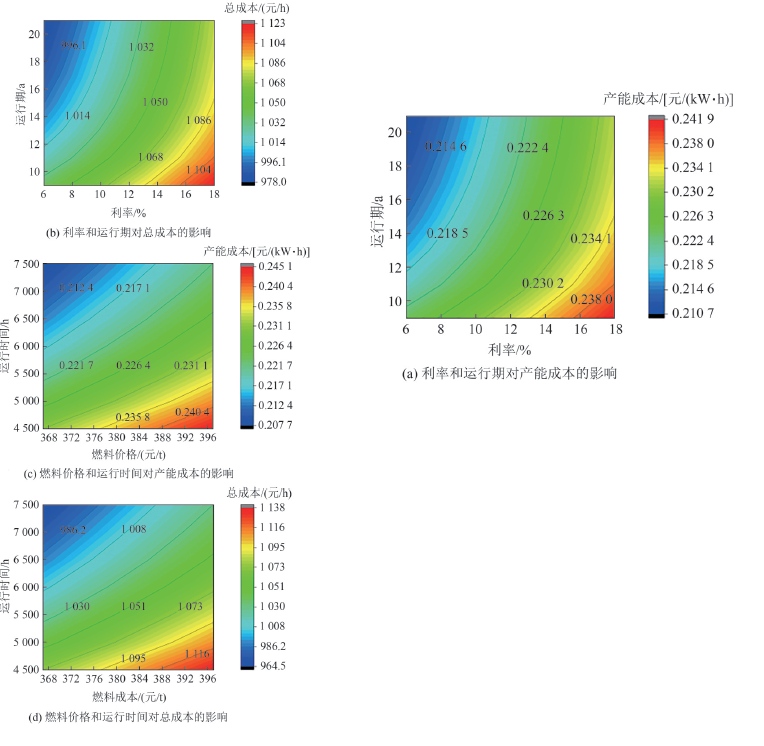
图3 经济性参数对系统成本的影响
Fig. 3 Impact of economic parameters on system cost
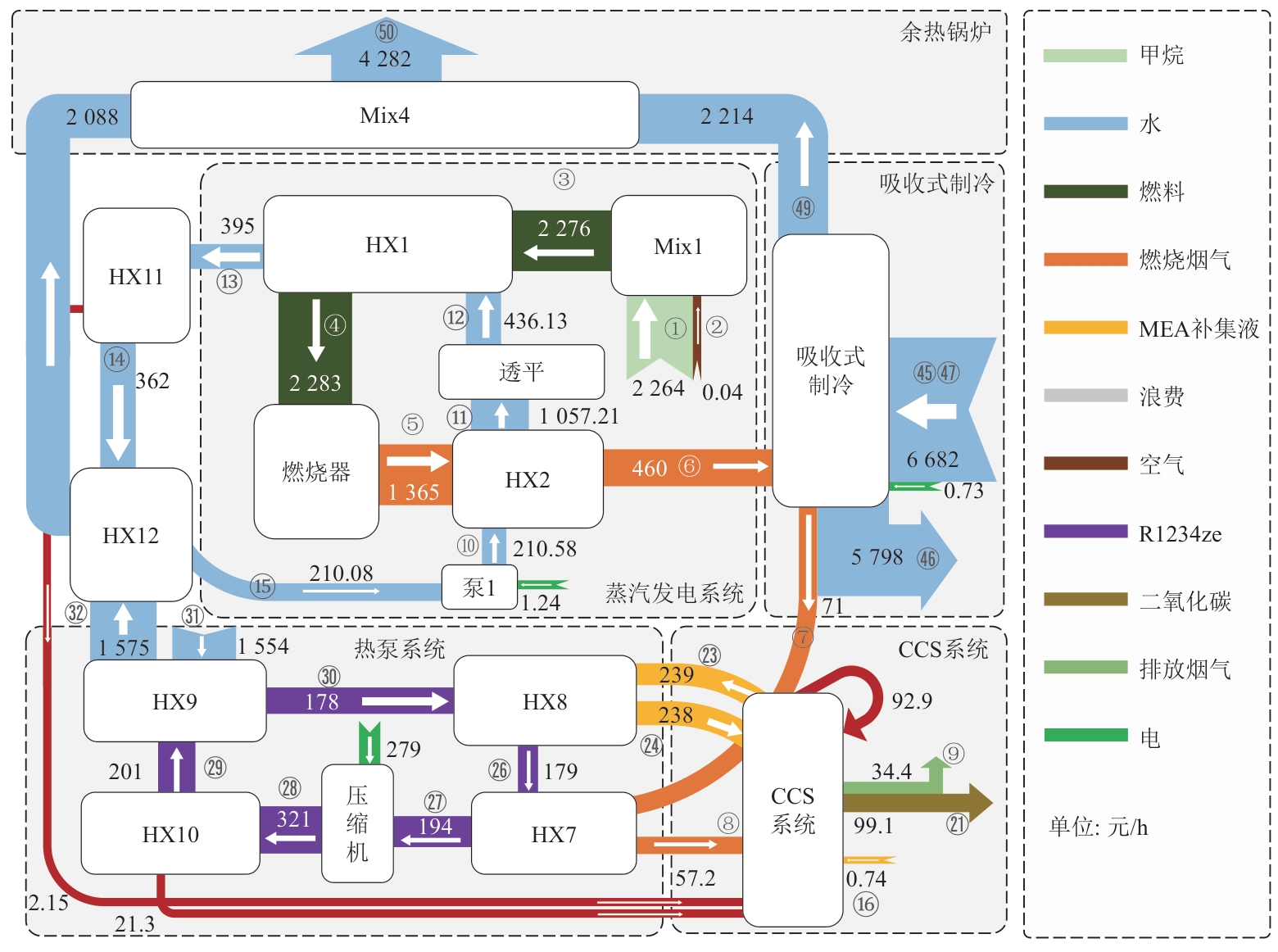
图4 低碳排CCHP系统㶲成本流图
Fig. 4 Exergy cost flow diagram of low-carbon-emission CCHP system
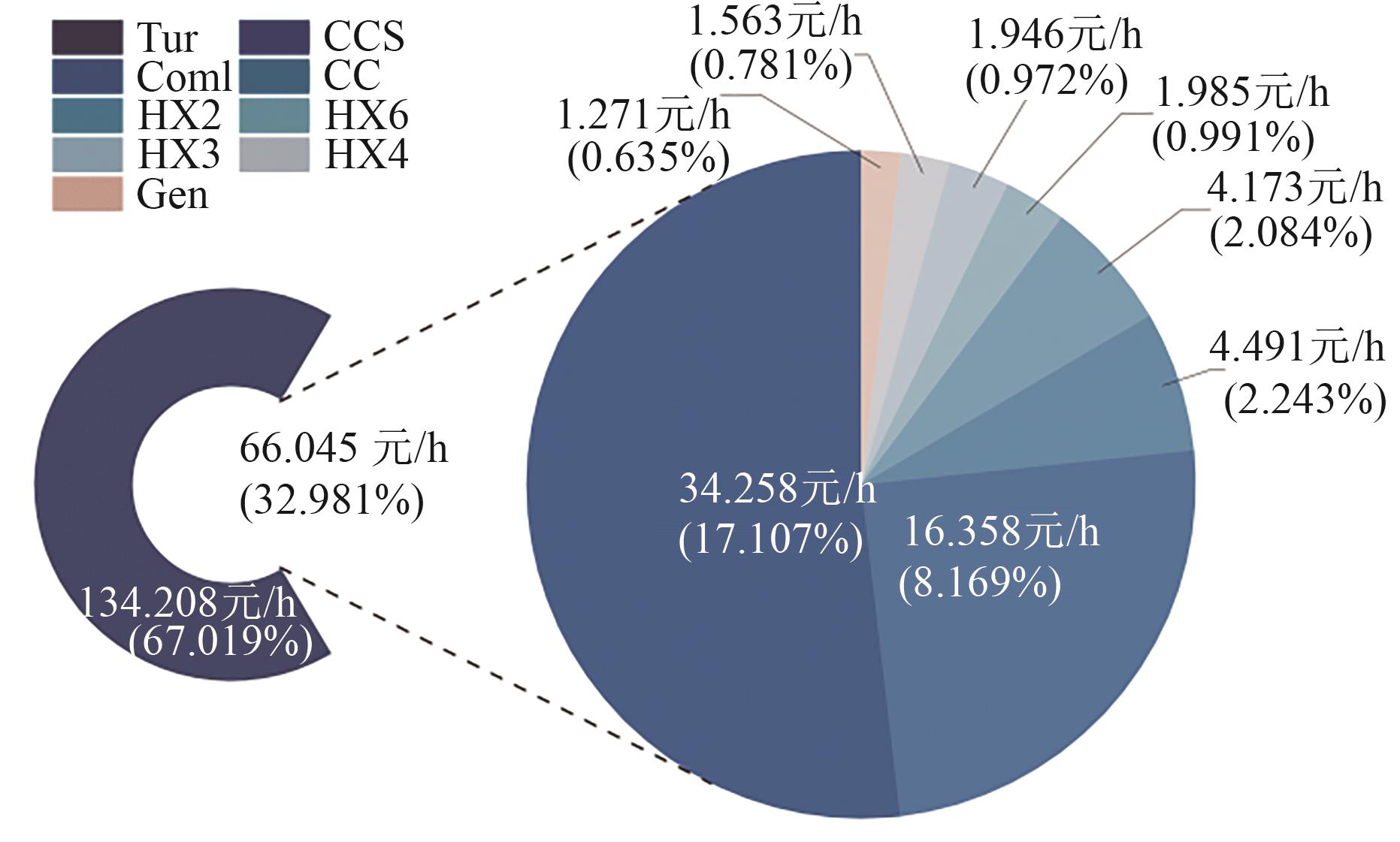
图5 各部件的㶲经济损失
Fig. 5 Exergoeconomic loss of each component
| [1] | 张全斌,周琼芳 .基于“双碳”目标的中国火力发电技术发展路径研究[J].发电技术,2023,44(2):143-154. doi:10.12096/j.2096-4528.pgt.22092 |
| ZHANG Q B, ZHOU Q F .Research on the development path of China’s thermal power generation technology based on the goal of “carbon peak and carbon neutralization”[J].Power Generation Technology,2023,44(2):143-154. doi:10.12096/j.2096-4528.pgt.22092 | |
| [2] | JING Y, LIU F, LIU T X,et al .Numerical and experimental investigation of the dynamic performance of absorption heat transformers under different solution conditions[J].International Journal of Refrigeration,2021,127:47-58. doi:10.1016/j.ijrefrig.2021.02.001 |
| [3] | 韩丽,王冲,于晓娇,等 .考虑风电爬坡灵活调节的碳捕集电厂低碳经济调度[J].电工技术学报,2024,39(7):2033-2045. |
| HAN L, WANG C, YU X J,et al .Low-carbon and economic dispatch considering the carbon capture power plants with flexible adjustment of wind power ramp[J].Transactions of China Electrotechnical Society,2024,39(7):2033-2045. | |
| [4] | 潘超,范宫博,王锦鹏,等 .灵活性资源参与的电热综合能源系统低碳优化[J].电工技术学报,2023,38(6):1633-1647. |
| PAN C, FAN G B, WANG J P,et al .Low-carbon optimization of electric and heating integrated energy system with flexible resource participation[J].Transactions of China Electrotechnical Society,2023,38(6):1633-1647. | |
| [5] | 张娜,王欢,宋坤,等 .基于多能源需求响应的综合能源系统动态优化控制研究[J].电测与仪表,2023,60(2):16-24. |
| ZHANG N, WANG H, SONG K,et al .Study on dynamic optimal control of integrated energy system based on multi-energy demand response[J].Electrical Measurement & Instrumentation,2023,60(2):16-24. | |
| [6] | ZHANG D W, YANG X Y, LI H,et al .4E analysis and parameter study of a solar-thermochemical energy storage CCHP system[J].Energy Conversion and Management,2024,301:118002. doi:10.1016/j.enconman.2023.118002 |
| [7] | HOU X K, SUN R F, HUANG J K,et al .4E evaluation and optimization of a hybrid CCHP system integrated PEM fuel cell and adsorption chiller[J].Renewable Energy,2024,231:120981. doi:10.1016/j.renene.2024.120981 |
| [8] | 赵振宇,包格日乐图,李炘薪 .基于信息间隙决策理论的含碳捕集-电转气综合能源系统优化调度[J].发电技术,2024,45(4):651-665. |
| ZHAO Z Y, BAO G, LI X X .Optimization and scheduling of integrated energy systems with carbon capture and storage-power to gas based on information gap decision theory[J].Power Generation Technology,2024,45(4):651-665. | |
| [9] | 李畸勇,郑一飞,刘斌,等 .基于主从博弈的含碳捕集与热电联产综合能源系统优化运行[J].电测与仪表,2024,61(6):10-19. |
| LI J Y, ZHENG Y F, LIU B,et al .Optimal operation of an integrated energy system with carbon capture system and combined heating and power based on a master-slave game[J].Electrical Measurement & Instrumentation,2024,61(6):10-19. | |
| [10] | HAI T, ASADOLLAHZADEH M, SINGH CHAUHAN B,et al .Machine learning optimization and 4E analysis of a CCHP system integrated into a greenhouse system for carbon dioxide capturing[J].Energy,2024,309:133028. doi:10.1016/j.energy.2024.133028 |
| [11] | YANG S, LIU Y R, YU Y G,et al .Thermodynamic and parametric analyses of a zero-carbon emission SOFC-based CCHP system using LNG cold energy[J].Energy,2024,307:132748. doi:10.1016/j.energy.2024.132748 |
| [12] | LV Y L, GONG Y T, LIU F,et al .Thermodynamic properties and corrosivity of water+ imidazolium-based ionic liquids as new working pairs for absorption heat transformer cycle[J].International Journal of Refrigeration,2025,171:165-179. doi:10.1016/j.ijrefrig.2025.01.006 |
| [13] | 张俊博,金旭,刘忠彦,等 .吸收式热泵余热回收先进技术综述[J].发电技术,2020,41(3):269-280. doi:10.12096/j.2096-4528.pgt.19170 |
| ZHANG J B, JIN X, LIU Z Y,et al .Review on advanced technology for waste heat recovery of absorption heat pump[J].Power Generation Technology,2020,41(3):269-280. doi:10.12096/j.2096-4528.pgt.19170 | |
| [14] | ZHANG C Z, YANG M, LU M,et al .Experimental research on LiBr refrigeration-heat pump system applied in CCHP system[J].Applied Thermal Engineering,2011,31(17/18):3706-3712. doi:10.1016/j.applthermaleng.2011.02.004 |
| [15] | WEGENER M, MALMQUIST A, ISALGUE A,et al .A techno-economic optimization model of a biomass-based CCHP/heat pump system under evolving climate conditions[J].Energy Conversion and Management,2020,223:113256. doi:10.1016/j.enconman.2020.113256 |
| [16] | MCCONNACHIE M, KONAROVA M, SMART S .Literature review of the catalytic pyrolysis of methane for hydrogen and carbon production[J].International Journal of Hydrogen Energy,2023,48(66):25660-25682. doi:10.1016/j.ijhydene.2023.03.123 |
| [17] | WANG D D, LI S, LIU F,et al .Post combustion CO2 capture in power plant using low temperature steam upgraded by double absorption heat transformer[J].Applied Energy,2018,227:603-612. doi:10.1016/j.apenergy.2017.08.009 |
| [18] | STOLL T, YOUNG D, BANDHAUER T .Data center sustainability:the role of flexible fuel CCHP in mitigating grid emissions and power constraints[J].Energy Conversion and Management,2025,326:119455. doi:10.1016/j.enconman.2024.119455 |
| [19] | ZHANG Q Y, LIU Y X, CAO Y H,et al .Parametric study and optimization of MEA-based carbon capture for a coal and biomass co-firing power plant[J].Renewable Energy,2023,205:838-850. doi:10.1016/j.renene.2022.12.099 |
| [20] | YANG W W, CAO X Q, HE Y L,et al .Theoretical study of a high-temperature heat pump system composed of a CO2 transcritical heat pump cycle and a R152a subcritical heat pump cycle[J].Applied Thermal Engineering,2017,120:228-238. doi:10.1016/j.applthermaleng.2017.03.098 |
| [21] | LIU X B, YANG X, YU M X,et al .Energy,exergy,economic and environmental (4E) analysis of an integrated process combining CO2 capture and storage,an organic Rankine cycle and an absorption refrigeration cycle[J].Energy Conversion and Management,2020,210:112738. doi:10.1016/j.enconman.2020.112738 |
| [22] | LV Y L, LIU F, WANG Y H,et al .Efficient hydrogen production through a novel methanol steam reforming system coupled with a two-stage heat pump and carbon capture:a thermodynamic and thermoeconomic study[J].International Journal of Hydrogen Energy,2024,88:858-877. doi:10.1016/j.ijhydene.2024.09.234 |
| [23] | MOHEBALI NEJADIAN M, AHMADI P, HOUSHFAR E .Comparative optimization study of three novel integrated hydrogen production systems with SOEC,PEM,and alkaline electrolyzer[J].Fuel,2023,336:126835. doi:10.1016/j.fuel.2022.126835 |
| [24] | LI G, MA S Q, LIU F,et al .Economic assessment of acetaldehyde production from oxidative dehydrogenation of bioethanol through chemical looping air separation[J].Sustainable Energy Technologies and Assessments,2024,70:103967. doi:10.1016/j.seta.2024.103967 |
| [25] | LEE Y D, AHN K Y, MOROSUK T,et al .Exergetic and exergoeconomic evaluation of an SOFC-engine hybrid power generation system[J].Energy,2018,145:810-822. doi:10.1016/j.energy.2017.12.102 |
| [26] | WANG J J, LI S W, ZHANG G Q,et al .Performance investigation of a solar-assisted hybrid combined cooling,heating and power system based on energy,exergy,exergo-economic and exergo-environmental analyses[J].Energy Conversion and Management,2019,196:227-241. doi:10.1016/j.enconman.2019.05.108 |
| [27] | JIANG J T, LI C X, KONG M D,et al .Insights into 4E evaluation of a novel solar-assisted gas-fired decarburization power generation system with oxygen-enriched combustion[J].Energy,2023,278:127771. doi:10.1016/j.energy.2023.127771 |
| [28] | XIA J L, LI J L .Design and detailed examinations of a geothermal-biomass driven integrated multigeneration system with CO2 capturing unit:Stability and 4E evaluations[J].Fuel,2022,330:125300. doi:10.1016/j.fuel.2022.125300 |
| [29] | KERMANI A A, HOUSHFAR E .Design and energy,exergy,and exergoeconomic analyses of a novel biomass-based green hydrogen and power generation system integrated with carbon capture and power-to-gas[J].International Journal of Hydrogen Energy,2024,52:177-189. doi:10.1016/j.ijhydene.2023.10.084 |
| [30] | MOGHIMI M, EMADI M, AHMADI P,et al .4E analysis and multi-objective optimization of a CCHP cycle based on gas turbine and ejector refrigeration[J].Applied Thermal Engineering,2018,141:516-530. doi:10.1016/j.applthermaleng.2018.05.075 |
| [31] | LIU J Y, ZHOU T, YANG S .Advanced exergy and exergoeconomic analysis of a multi-stage Rankine cycle system combined with hydrate energy storage recovering LNG cold energy[J].Energy,2024,288:129810. doi:10.1016/j.energy.2023.129810 |
| [32] | WU Z, ZHU P F, YAO J,et al .Combined biomass gasification,SOFC,IC engine,and waste heat recovery system for power and heat generation:energy,exergy,exergoeconomic,environmental (4E) evaluations[J].Applied Energy,2020,279:115794. doi:10.1016/j.apenergy.2020.115794 |
| [1] | 杨龙, 郝黎明, 寻志伟, 顾永正, 于芳, 邓博文, 高腾飞. Mo掺杂石墨烯催化CO2加氢制甲醇的机理研究[J]. 发电技术, 2025, 46(5): 923-929. |
| [2] | 陈璟, 刘辉, 朱萌, 王灿, 陈磊, 周敬, 许凯, 江龙, 胡松, 向军. 125 MW超临界CO2燃煤发电机组烟气再循环对锅炉热力性能及经济性的影响分析[J]. 发电技术, 2025, 46(5): 986-995. |
| [3] | 赵雅卓, 张文杰, 廖颖慧, 林晋磊, 张荣勇, 段远源. 核电厂低品位余热发电技术研究[J]. 发电技术, 2025, 46(4): 818-828. |
| [4] | 王文静, 韩依璇, 李继宾, 沈晓旭, 霍兆义, 冯亮花. 燃气-蒸汽联合循环发电系统多目标优化分析[J]. 发电技术, 2025, 46(4): 839-848. |
| [5] | 王永康, 易俊, 谢晓頔. 风光氢氨醇一体化技术和产业综述[J]. 发电技术, 2025, 46(3): 556-569. |
| [6] | 郑杨, 任禹丞, 王雨薇, 徐丁吉, 杨慧敏. 基于改进云模型的区域电网电能替代综合效益评价[J]. 发电技术, 2025, 46(2): 399-408. |
| [7] | 胡山鹰, 金涌, 张臻烨. 发展新质生产力,实现碳中和[J]. 发电技术, 2025, 46(1): 1-8. |
| [8] | 李昌陵, 常喜强, 卢浩. 新疆能耗双控向碳排放双控转变分析和预测[J]. 发电技术, 2024, 45(6): 1114-1120. |
| [9] | 单思珂, 刘含笑, 刘美玲, 王帅, 崔盈. 我国火电行业碳足迹评估综述[J]. 发电技术, 2024, 45(4): 575-589. |
| [10] | 赵振宇, 包格日乐图, 李炘薪. 基于信息间隙决策理论的含碳捕集-电转气综合能源系统优化调度[J]. 发电技术, 2024, 45(4): 651-665. |
| [11] | 袁家海, 胡玥琳, 张健. 基于改进三阶段松弛测量-数据包络模型的火电上市公司碳排放效率评估研究[J]. 发电技术, 2024, 45(3): 458-467. |
| [12] | 龚思琦, 云再鹏, 许明, 敖乐, 李初福, 黄凯, 孙晨. 基于三元催化剂的固体氧化物燃料电池尾气催化燃烧数值模拟[J]. 发电技术, 2024, 45(2): 331-340. |
| [13] | 霍丽新, 王日成. 水电联产机组低负荷工况海水淡化系统供汽方案研究[J]. 发电技术, 2023, 44(5): 722-730. |
| [14] | 陈思勤, 朱伊囡, 李晓辰, 王学海. 基于双层规划的碳减排配煤优化方法研究[J]. 发电技术, 2023, 44(2): 155-162. |
| [15] | 黄宇箴, 陈彦奇, 吴志聪, 徐钢, 刘彤. 碳中和背景下热电联产机组抽汽分配节能优化[J]. 发电技术, 2023, 44(1): 85-93. |
| 阅读次数 | ||||||
|
全文 |
|
|||||
|
摘要 |
|
|||||
