

发电技术 ›› 2026, Vol. 47 ›› Issue (2): 370-382.DOI: 10.12096/j.2096-4528.pgt.260214
何耀耀, 王雅生
收稿日期:2025-04-27
修回日期:2025-06-08
出版日期:2026-04-30
发布日期:2026-04-21
作者简介:基金资助:Yaoyao HE, Yasheng WANG
Received:2025-04-27
Revised:2025-06-08
Published:2026-04-30
Online:2026-04-21
Supported by:摘要:
目的 在实现“双碳”目标的过程中,虚拟电厂作为新型能源管理系统,能够提升电网灵活性和能源效率。但电转气(power to gas,P2G)、碳捕集系统(carbon capture system,CCS)耦合失效,能量利用率低,可再生能源波动性高,以及减排政策激励不足等问题影响了虚拟电厂的经济性,为此,基于储液式CCS和燃气掺氢设备提出一种兼顾低碳性和经济性的优化调度模型。 方法 从新型低碳设备和碳交易政策2个角度出发,首先建立了储液式碳捕集耦合电转气设备、燃气轮机、电热炉以及储能设备等的数学模型;其次,针对不同碳排量设计了阶梯式碳交易价格,并引入价格补偿因子和价格增长因子来激励虚拟电厂减排,提出了以经济性和低碳性为目标函数的优化调度策略;最后,使用线性化方法处理了模型以便高效求解。算例分析设置了不同掺氢比场景、不同耦合设备场景,以及不同碳交易机制场景以验证所提模型的有效性。 结果 与改动之前的虚拟电厂相比,变掺氢运行和储液式P2G-CCS耦合设备分别使得运行成本降低了6.21%、12.62%,阶梯式碳交易价格使得虚拟电厂碳排量减少了12.96%。 结论 该调度模型可以有效实现低碳排放,提升风电的消纳能力以及降低虚拟电厂的运行成本。
中图分类号:
何耀耀, 王雅生. 燃气掺氢和储液式碳捕集系统耦合电转气的虚拟电厂低碳经济调度[J]. 发电技术, 2026, 47(2): 370-382.
Yaoyao HE, Yasheng WANG. Low-Carbon Economic Scheduling of Virtual Power Plants With Hydrogen-Blended Gas and Liquid-Storage CCS Coupled P2G[J]. Power Generation Technology, 2026, 47(2): 370-382.
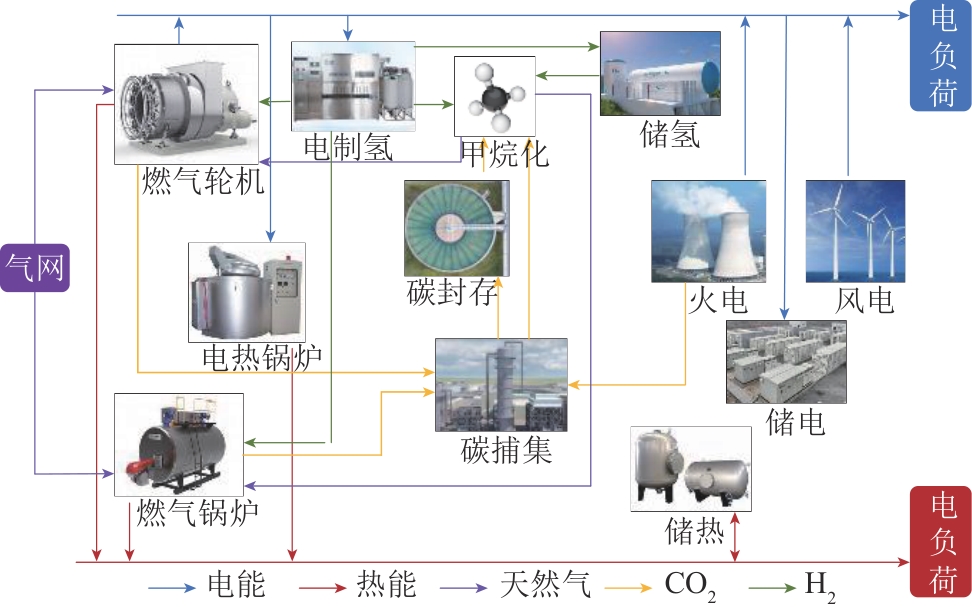
图1 储液式CCS-P2G和燃气掺氢的VPP结构
Fig. 1 VPP structure of liquid storage CCS-P2G and hydrogen-blended gas
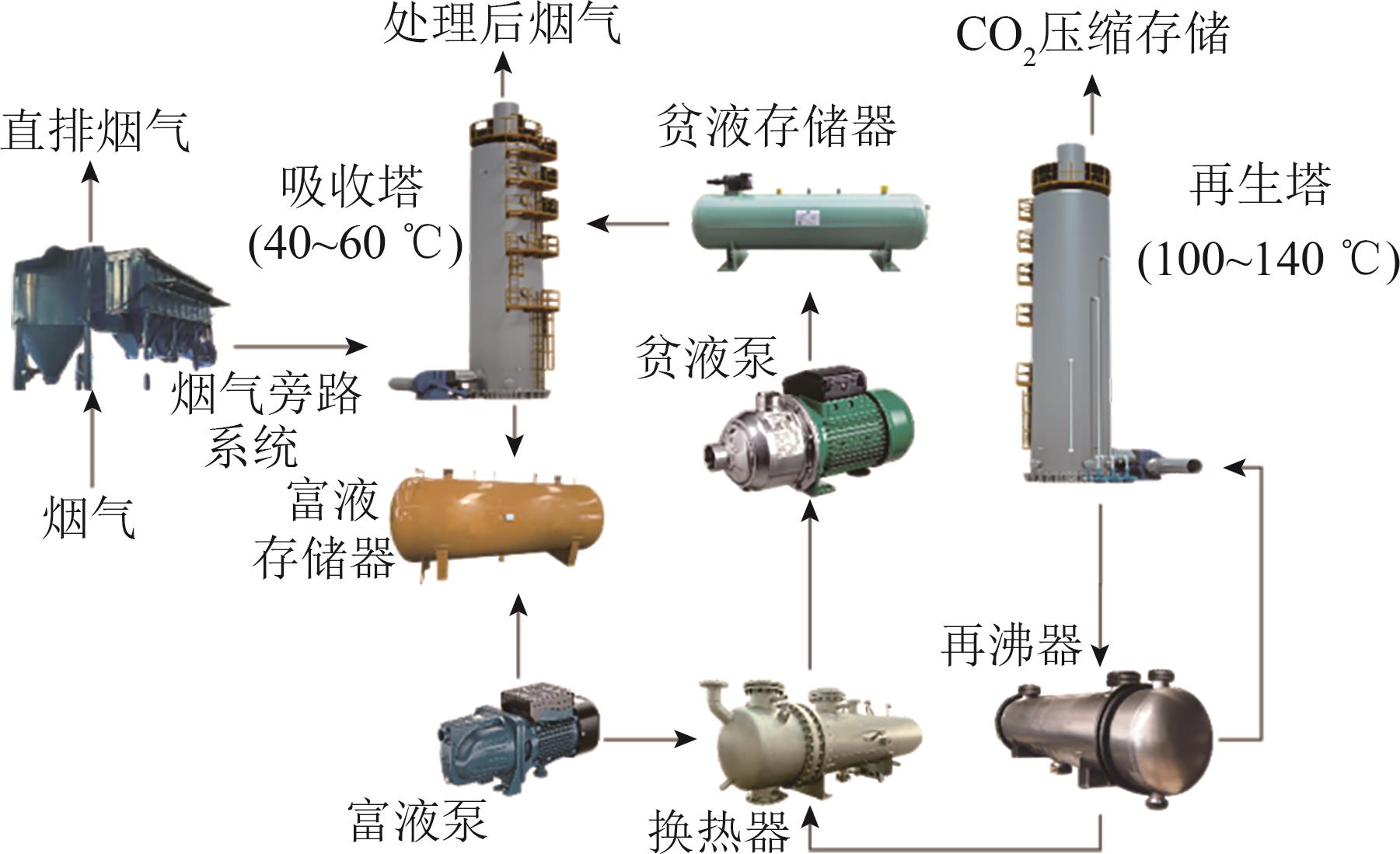
图2 储液式碳捕集系统
Fig. 2 Liquid-storage carbon capture system
| 设备 | 参数 | 数值 |
|---|---|---|
| 火电机组 | 最大(最小)发电功率/MW | 85(0) |
| 爬坡功率上限(下限)/MW | 100(-100) | |
| 电转气机组 | 甲烷化效率 | 0.75 |
| 电转氢效率 | 0.85 | |
| 最大(最小)耗电功率/MW | 125(0) | |
| 碳捕集设备 | 最大耗电功率/MW | 135 |
| 贫液存储设备最大(最小)容量/m3 | 27 000(0) | |
| 富液存储设备最大(最小)容量/m3 | 27 000(0) | |
| 燃气轮机 | 最大(最小)发电功率/MW | 350(0) |
| 最大(最小)产热功率/MW | 300(0) | |
| 爬坡功率上限(下限)/MW | 150(-150) | |
| 产电(热)效率 | 0.5(0.45) | |
| 燃气锅炉 | 最大(最小)产热功率/MW | 80(0) |
| 爬坡功率上限(下限)/MW | 25(-25) | |
| 电热炉 | 最大(最小)产热功率/MW | 45(0) |
| 爬坡功率上限(下限)/MW | 10(-10) | |
| 其他 | 燃煤价格/(元/t) | 500 |
| 碳封存成本/(元/t) | 50 | |
| 天然气价格/(元/m3) | 3.5 | |
| 初始碳价/(元/t) | 205 | |
| 再生塔处理CO2能耗系数/(MW⋅h/t) | 0.269 |
表1 参数设置
Tab. 1 Parameter settings
| 设备 | 参数 | 数值 |
|---|---|---|
| 火电机组 | 最大(最小)发电功率/MW | 85(0) |
| 爬坡功率上限(下限)/MW | 100(-100) | |
| 电转气机组 | 甲烷化效率 | 0.75 |
| 电转氢效率 | 0.85 | |
| 最大(最小)耗电功率/MW | 125(0) | |
| 碳捕集设备 | 最大耗电功率/MW | 135 |
| 贫液存储设备最大(最小)容量/m3 | 27 000(0) | |
| 富液存储设备最大(最小)容量/m3 | 27 000(0) | |
| 燃气轮机 | 最大(最小)发电功率/MW | 350(0) |
| 最大(最小)产热功率/MW | 300(0) | |
| 爬坡功率上限(下限)/MW | 150(-150) | |
| 产电(热)效率 | 0.5(0.45) | |
| 燃气锅炉 | 最大(最小)产热功率/MW | 80(0) |
| 爬坡功率上限(下限)/MW | 25(-25) | |
| 电热炉 | 最大(最小)产热功率/MW | 45(0) |
| 爬坡功率上限(下限)/MW | 10(-10) | |
| 其他 | 燃煤价格/(元/t) | 500 |
| 碳封存成本/(元/t) | 50 | |
| 天然气价格/(元/m3) | 3.5 | |
| 初始碳价/(元/t) | 205 | |
| 再生塔处理CO2能耗系数/(MW⋅h/t) | 0.269 |
| 成本 | 场景1 | 场景2 | 场景3 |
|---|---|---|---|
| 总成本 | 502.12 | 484.54 | 472.76 |
| 启停成本 | 15.62 | 15.52 | 15.01 |
| 购气成本 | 419.28 | 412.18 | 410.06 |
| 碳交易成本 | 1.76 | -2.55 | -10.49 |
| 碳封存成本 | 0 | 1.02 | 2.38 |
| 弃风成本 | 25.02 | 16.21 | 11.42 |
| 燃煤成本 | 40.44 | 42.16 | 44.38 |
表2 不同掺氢场景的调度结果 (万元)
Tab. 2 Scheduling results under different hydrogen blending scenarios
| 成本 | 场景1 | 场景2 | 场景3 |
|---|---|---|---|
| 总成本 | 502.12 | 484.54 | 472.76 |
| 启停成本 | 15.62 | 15.52 | 15.01 |
| 购气成本 | 419.28 | 412.18 | 410.06 |
| 碳交易成本 | 1.76 | -2.55 | -10.49 |
| 碳封存成本 | 0 | 1.02 | 2.38 |
| 弃风成本 | 25.02 | 16.21 | 11.42 |
| 燃煤成本 | 40.44 | 42.16 | 44.38 |
| 机组设备出力 | 场景1 | 场景2 | 场景3 |
|---|---|---|---|
| 火电机组功率/MW | 1 228.09 | 1 346.99 | 1 382.05 |
| 燃气轮机电功率/MW | 3 809.51 | 3 789.344 | 4 102.06 |
| 燃气轮机热功率/MW | 4 353.72 | 4 326.67 | 4 330.69 |
| 燃气锅炉热功率/MW | 1 910.49 | 1 913.14 | 1 920 |
| 电热炉电功率/MW | 920.21 | 940.839 | 934.13 |
| CCS设备消耗电功率/MW | 110.39 | 113.51 | 177.39 |
| P2G设备消耗电功率/MW | 1 564.12 | 1 636.59 | 1 456.56 |
表3 不同掺氢场景的设备出力
Tab.3 Equipment output under different hydrogen blending scenarios
| 机组设备出力 | 场景1 | 场景2 | 场景3 |
|---|---|---|---|
| 火电机组功率/MW | 1 228.09 | 1 346.99 | 1 382.05 |
| 燃气轮机电功率/MW | 3 809.51 | 3 789.344 | 4 102.06 |
| 燃气轮机热功率/MW | 4 353.72 | 4 326.67 | 4 330.69 |
| 燃气锅炉热功率/MW | 1 910.49 | 1 913.14 | 1 920 |
| 电热炉电功率/MW | 920.21 | 940.839 | 934.13 |
| CCS设备消耗电功率/MW | 110.39 | 113.51 | 177.39 |
| P2G设备消耗电功率/MW | 1 564.12 | 1 636.59 | 1 456.56 |
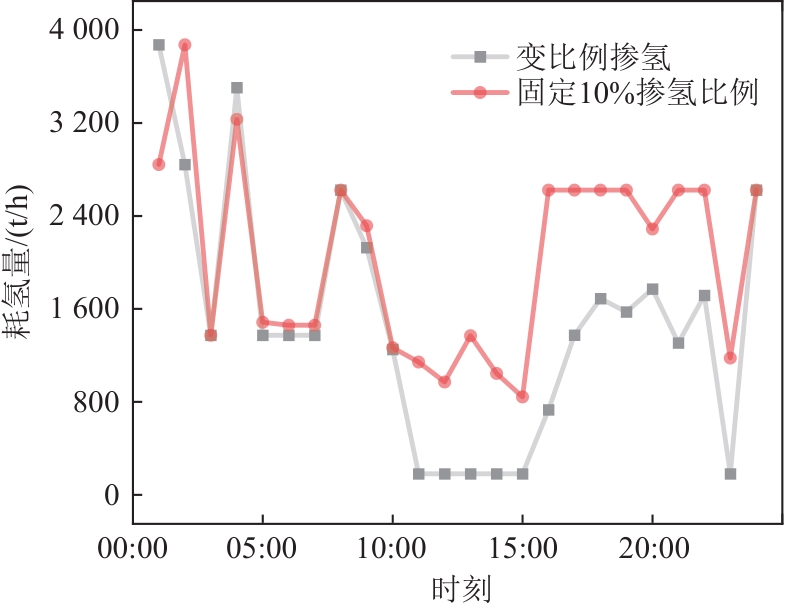
图3 不同掺氢比例的耗氢功率
Fig. 3 Hydrogen consumption power under different hydrogen blending ratios
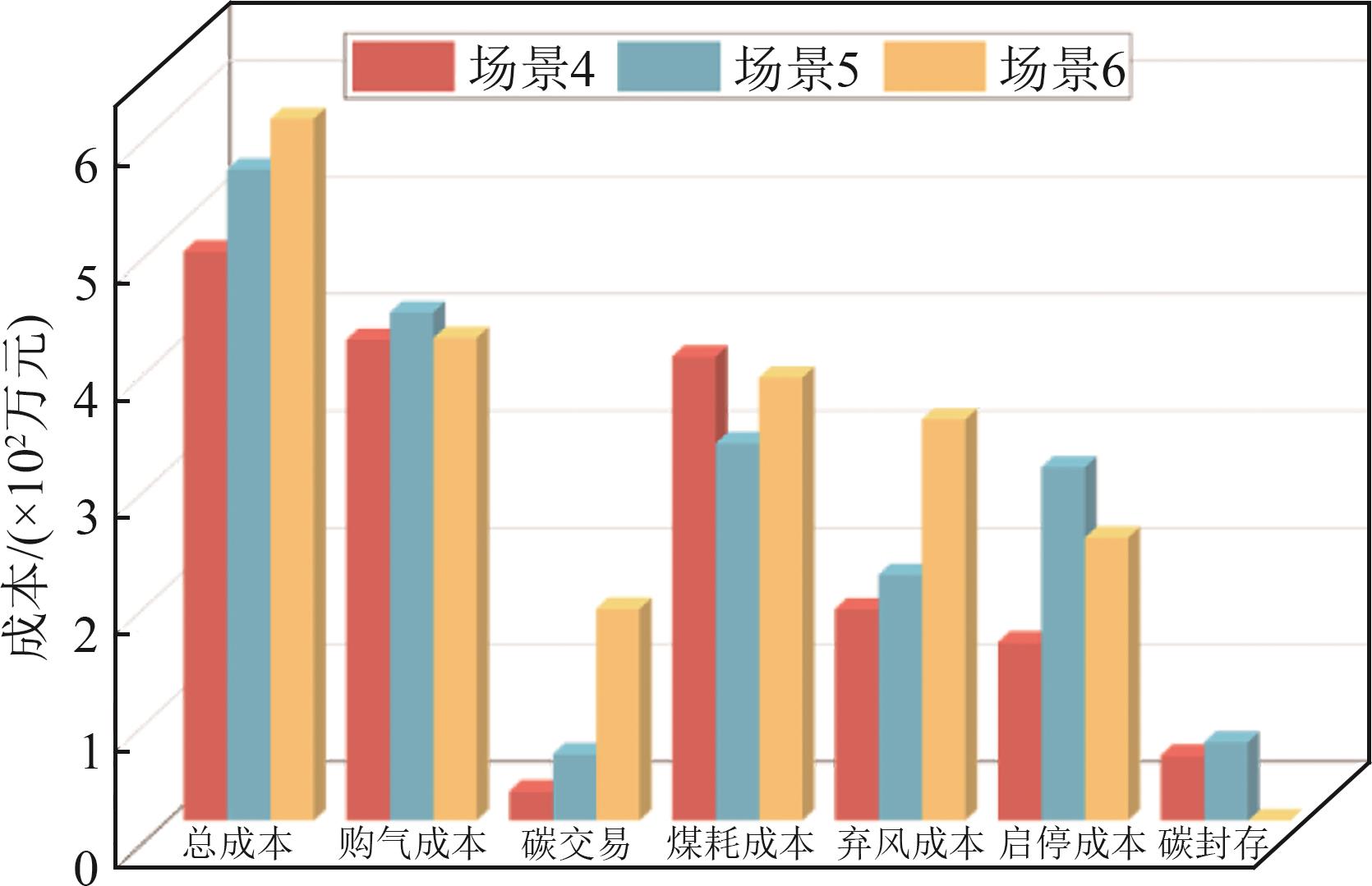
图4 不同设备场景的调度结果
Fig. 4 Scheduling results under different equipment scenarios
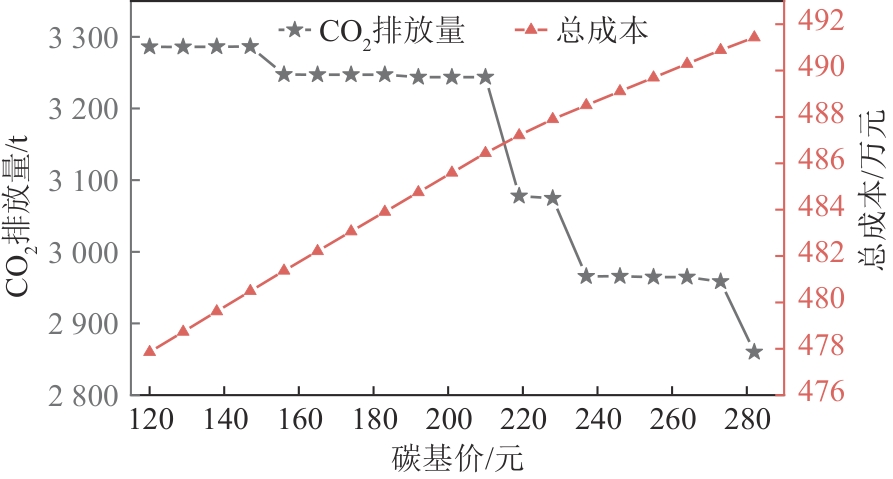
图5 阶梯式碳交易下的CO2排放量和总成本
Fig. 5 CO2 emissions and total costs under a tiered carbon trading system
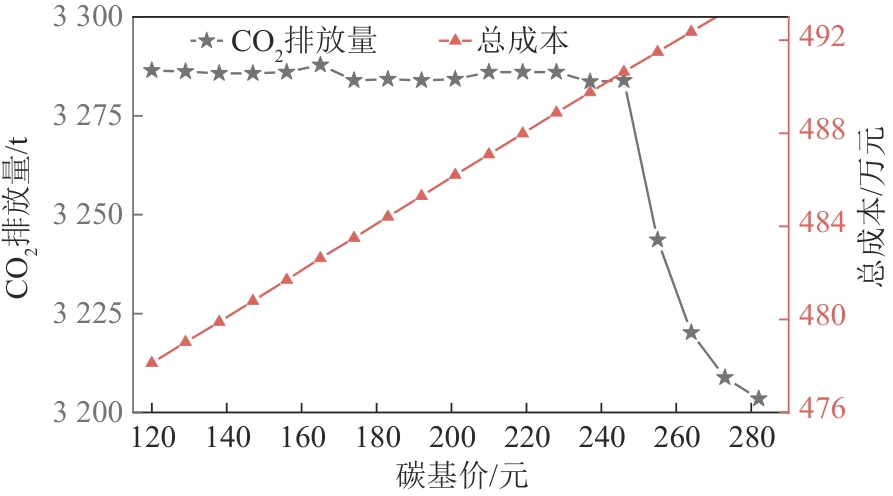
图6 固定式碳交易的CO2排放量和总成本
Fig. 6 CO2 emissions and total costs under a fixed carbon trading system
| 碳价格/元 | 阶梯式 | 固定式 | ||
|---|---|---|---|---|
| 140 | 3 232.47 | 53.21 | 3 289.21 | 54.34 |
| 160 | 3 204.23 | 52.35 | 3 285.14 | 54.32 |
| 180 | 3 198.24 | 53.98 | 3 283.96 | 55.48 |
| 200 | 3 087.24 | 49.21 | 3 271.04 | 52.19 |
| 220 | 3 012.65 | 48.82 | 3 182.34 | 52.22 |
| 240 | 2 823.25 | 48.82 | 3 166.12 | 52.23 |
| 260 | 2 822.98 | 48.83 | 3 163.08 | 51.75 |
| 280 | 2 820.76 | 48.81 | 3 161.28 | 52.72 |
表4 不同碳交易价格下碳排放来源及其排放量变化
Tab. 4 Variation in carbon emission sources and their quantities under different carbon trading prices
| 碳价格/元 | 阶梯式 | 固定式 | ||
|---|---|---|---|---|
| 140 | 3 232.47 | 53.21 | 3 289.21 | 54.34 |
| 160 | 3 204.23 | 52.35 | 3 285.14 | 54.32 |
| 180 | 3 198.24 | 53.98 | 3 283.96 | 55.48 |
| 200 | 3 087.24 | 49.21 | 3 271.04 | 52.19 |
| 220 | 3 012.65 | 48.82 | 3 182.34 | 52.22 |
| 240 | 2 823.25 | 48.82 | 3 166.12 | 52.23 |
| 260 | 2 822.98 | 48.83 | 3 163.08 | 51.75 |
| 280 | 2 820.76 | 48.81 | 3 161.28 | 52.72 |
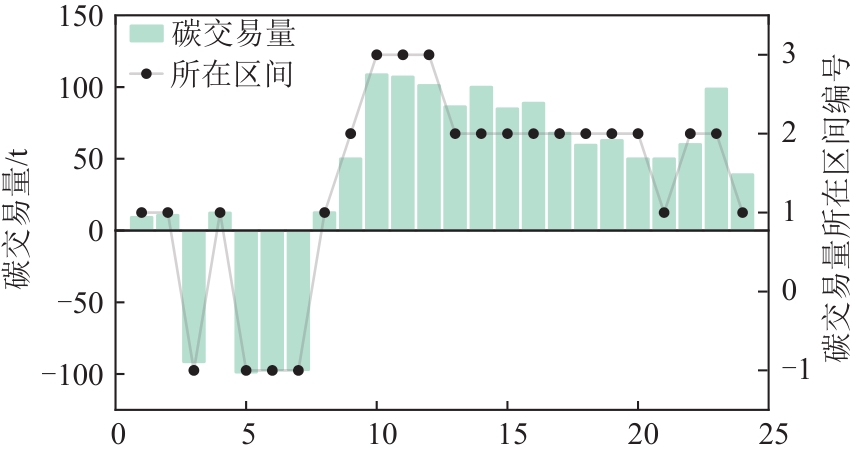
图7 阶梯式碳交易下的碳交易量和所处交易区间
Fig. 7 Carbon trading volumes and trading intervals under a tiered carbon trading system
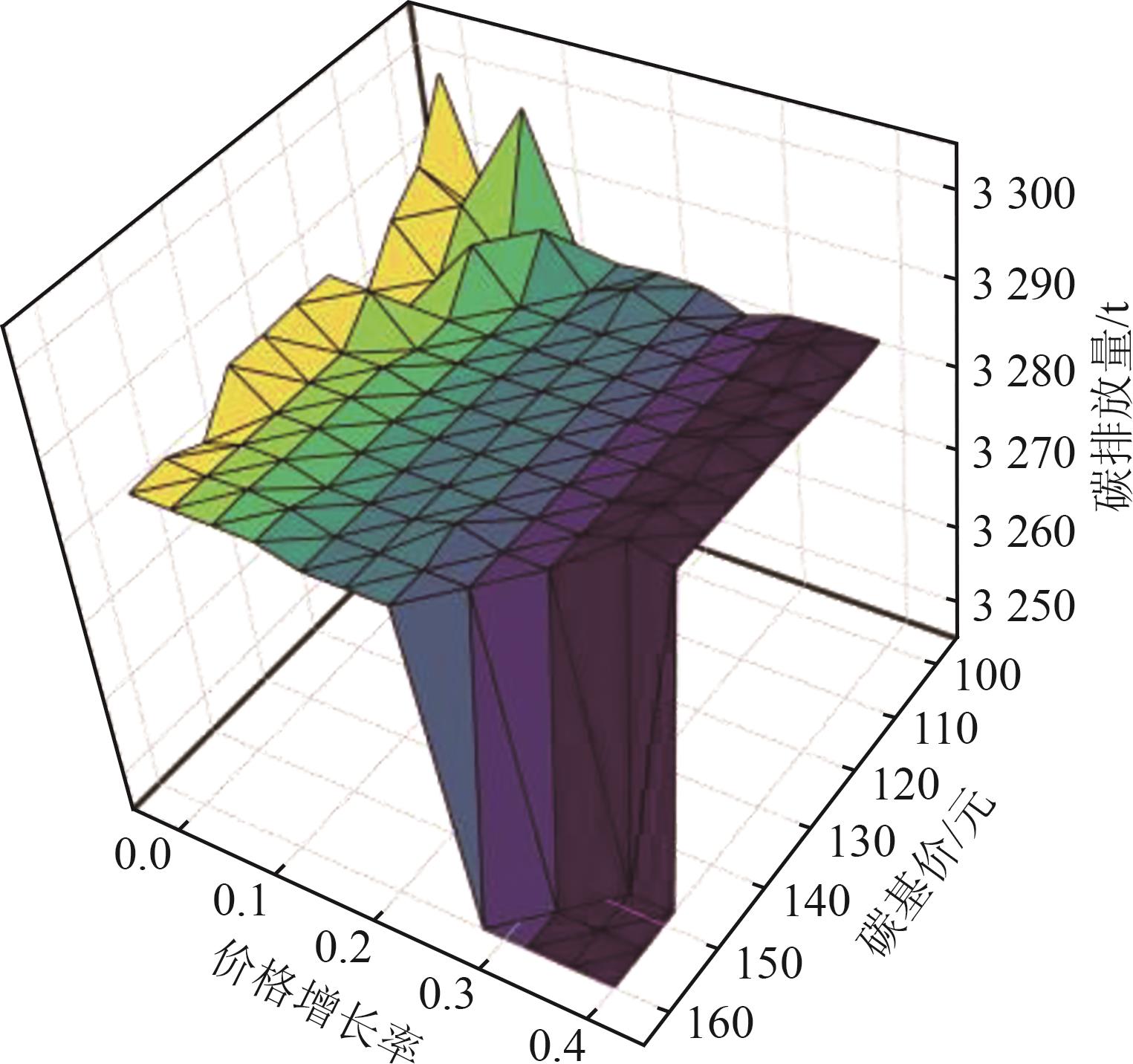
图8 碳基价和价格增长率对碳排放的影响
Fig. 8 Effect of base price and price growth rate on carbon emissions
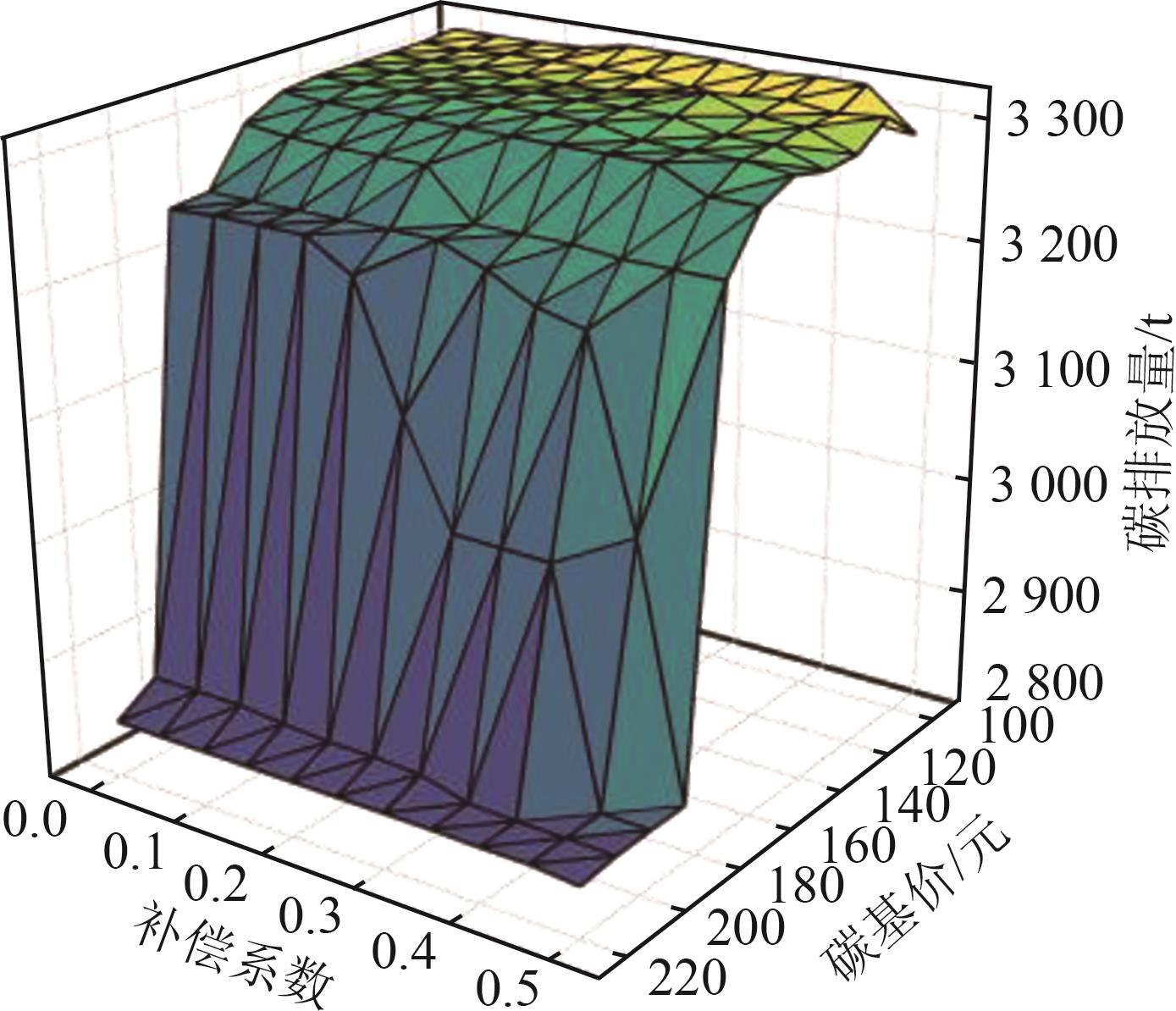
图9 碳基价和补偿系数对碳排放的影响
Fig. 9 Effect of base price and compensation coefficient on carbon emissions
| [1] | 吴晓刚,唐家俊,吴新华,等 .“双碳”目标下虚拟电厂关键技术与建设现状[J].浙江电力,2022,41(10):64-71. doi:10.19585/j.zjdl.202210009 |
| WU X G, TANG J J, WU X H,et al .Key technologies and present situation of virtual power plant under “dual-carbon” goals[J].Zhejiang Electric Power,2022,41(10):64-71. doi:10.19585/j.zjdl.202210009 | |
| [2] | 吴桂良 .虚拟电厂的关键技术[J].中国工业和信息化,2022(9):18-23. |
| WU G L .Key technologies of virtual power plants[J].China Industry & Information Technology,2022(9):18-23. | |
| [3] | 陈妤,卫志农,胥峥,等 .电力体制改革下的多虚拟电厂联合优化调度策略[J].电力系统自动化,2019,43(7):42-49. doi:10.7500/AEPS20180429005 |
| CHEN Y, WEI Z N, XU Z,et al .Optimal scheduling strategy of multiple virtual power plants under electricity market reform[J].Automation of Electric Power Systems,2019,43(7):42-49. doi:10.7500/AEPS20180429005 | |
| [4] | 张宁,杨凌霄,李炫浓,等 .基于分层深度强化学习的多能虚拟电厂区域消纳优化策略[J].电力系统保护与控制,2025,53(20):153-163. |
| ZHANG N, YANG L X, LI X N,et al .Regional consumption optimization strategy for multi-energy virtual power plants based on hierarchical deep reinforcement learning[J].Power System Protection and Control,2025,53(20):153-163. | |
| [5] | 王鹏,张勤,季益俊 .“双碳”目标下考虑多主体互动的虚拟电厂合作博弈鲁棒优化策略[J].电测与仪表,2025,62(10):85-95. doi:10.19753/j.issn1001-1390.2025.10.010 |
| WANG P, ZHANG Q, JI Y J .Robust optimization strategy for the cooperative game of virtual power plant considering multi-agent interaction under the dual carbon target[J].Electrical Measurement & Instrumentation,2025,62(10):85-95. doi:10.19753/j.issn1001-1390.2025.10.010 | |
| [6] | 高洪超,康重庆,李嘉宇,等 .新型电力系统下虚拟电厂的技术演进研判与运营挑战分析[J].电工技术学报,2025,40(19):6057-6071. |
| GAO H C, KANG C Q, LI J Y,et al .Analysis of technological evolution and operational challenges for virtual power plants in new power systems[J].Transactions of China Electrotechnical Society,2025,40(19):6057-6071. | |
| [7] | 黄松涛,赵雪楠,尚国政,等 .考虑储能与多类型制氢装置协同的虚拟电厂优化调度[J].中国电力,2026,59(2):37-46. |
| HUANG S T, ZHAO X N, SHANG G Z,et al .Optimization scheduling of virtual power plants with collaborations of energy storage devices and multi-type power-to-hydrogen units[J].Electric Power,2026,59(2):37-46. | |
| [8] | 王家怡,贺帅佳 .计及新型分布式资源与电碳交易的虚拟电厂分布鲁棒低碳调度模型[J].电力建设,2025,46(7):13-26. |
| WANG J Y, HE S J .Distributionally robust low-carbon scheduling model for virtual power plants considering emerging distributed resources and electricity carbon trading[J].Electric Power Construction,2025,46(7):13-26. | |
| [9] | 张昊,米阳,马思源,等 .考虑综合需求响应与碳交易的多能源虚拟电厂两阶段随机优化调度策略[J].广东电力,2025,38(5):1-15. |
| ZHANG H, MI Y, MA S Y,et al .Two-stage stochastic scheduling strategy for multi-energy virtual power plant incorporating integrated demand response and carbon trading mechanism[J].Guangdong Electric Power,2025,38(5):1-15. | |
| [10] | 吴迟绿,杨晓辉,万钊,等 .计及碳-绿证互联交易的虚拟电厂两阶段鲁棒优化调度[J].智慧电力,2025,53(5):16-23. |
| WU C L, YANG X H, WAN Z,et al .Two-stage robust optimal scheduling for virtual power plants considering carbon-green certificate interlinked trading[J].Smart Power,2025,53(5):16-23. | |
| [11] | 魏春晖,单林森,胡大栋,等 .面向需求响应的园区虚拟电厂优化调度策略[J].中国电力,2025,58(6):112-121. |
| WEI C H, SHAN L S, HU D D,et al .Optimal scheduling strategy of park-level virtual power plant for demand response[J].Electric Power,2025,58(6):112-121. | |
| [12] | 程远林,张舒,张毅,等 .计及价格敏感区间下惩罚型碳价的CCS-P2G虚拟电厂鲁棒优化[J].电力科学与技术学报,2024,39(6):251-259. |
| CHENG Y L, ZHANG S, ZHANG Y,et al .Robust optimization of CCS-P2G virtual power plants considering penalized carbon prices in price-sensitive intervals[J].Journal of Electric Power Science and Technology,2024,39(6):251-259. | |
| [13] | 杨丰任,王鸿,王致杰 .基于碳排放生产优先级的综合能源虚拟电厂优化运行策略[J].电力科学与技术学报,2024,39(5):192-202. doi:10.19781/j.issn.1673-9140.2024.05.020 |
| YANG F R, WANG H, WANG Z J .Optimal operation strategy of integrated energy virtual power plant based on production priority of carbon emission[J].Journal of Electric Power Science and Technology,2024,39(5):192-202. doi:10.19781/j.issn.1673-9140.2024.05.020 | |
| [14] | 张叶青,陈文彬,徐律军,等 .面向多虚拟电厂的分层分区多层互补动态聚合调控策略[J].发电技术,2024,45(1):162-169. doi:10.12096/j.2096-4528.pgt.23027 |
| ZHANG Y Q, CHEN W B, XU L J,et al .Multi-virtual power plant-oriented dynamic aggregation control strategy based on hierarchical partition and multi-layer complementation[J].Power Generation Technology,2024,45(1):162-169. doi:10.12096/j.2096-4528.pgt.23027 | |
| [15] | 王宇绅,陈皓勇,黄宇翔,等 .多重不确定性下的虚拟电厂参与电能量和需求响应市场鲁棒优化调度策略[J].发电技术,2024,45(6):1173-1185. doi:10.12096/j.2096-4528.pgt.23073 |
| WANG Y S, CHEN H Y, HUANG Y X,et al .Robust optimal scheduling strategy for virtual power plant participation in electric energy and demand response markets under multiple uncertainties[J].Power Generation Technology,2024,45(6):1173-1185. doi:10.12096/j.2096-4528.pgt.23073 | |
| [16] | 刘雨佳,樊艳芳 .计及5G基站储能和技术节能措施的虚拟电厂调度优化策略[J].电力系统及其自动化学报,2022,34(1):8-15. doi:10.19635/j.cnki.csu-epsa.000809 |
| LIU Y J, FAN Y F .Optimal scheduling strategy for virtual power plant considering 5G base station technology,energy-storage,and energy-saving measures[J].Proceedings of the CSU-EPSA,2022,34(1):8-15. doi:10.19635/j.cnki.csu-epsa.000809 | |
| [17] | 杨秀,胡晓龙,孙改平,等 .考虑电能共享的楼宇虚拟电厂协调优化调度[J].电力科学与技术学报,2022,37(1):96-105. doi:10.19781/j.issn.1673-9140.2022.01.012 |
| YANG X, HU X L, SUN G P,et al .Coordinated optimization scheduling of building virtual power plant considering power sharing[J].Journal of Electric Power Science and Technology,2022,37(1):96-105. doi:10.19781/j.issn.1673-9140.2022.01.012 | |
| [18] | GUO W, LIU P, SHU X .Optimal dispatching of electric-thermal interconnected virtual power plant considering market trading mechanism[J].Journal of Cleaner Production,2021,279:123446. doi:10.1016/j.jclepro.2020.123446 |
| [19] | 张宁,朱昊,杨凌霄,等 .考虑可再生能源消纳的多能互补虚拟电厂优化调度策略[J].发电技术,2023,44(5):625-633. doi:10.12096/j.2096-4528.pgt.23037 |
| ZHANG N, ZHU H, YANG L X,et al .Optimal scheduling strategy of multi-energy complementary virtual power plant considering renewable energy consumption[J].Power Generation Technology,2023,44(5):625-633. doi:10.12096/j.2096-4528.pgt.23037 | |
| [20] | 彭道刚,税纪钧,王丹豪,等 .“双碳”背景下虚拟电厂研究综述[J].发电技术,2023,44(5):602-615. |
| PENG D G, SHUI J J, WANG D H,et al .Review of virtual power plant under the background of “dual carbon”[J].Power Generation Technology,2023,44(5):602-615. | |
| [21] | 王佳惠,牛玉广,陈玥,等 .电-碳联合市场下虚拟电厂主从博弈优化调度[J].电力自动化设备,2023,43(5):235-242. |
| WANG J H, NIU Y G, CHEN Y,et al .Master-slave game optimal dispatching of virtual power plant under electricity-carbon joint market[J].Electric Power Automation Equipment,2023,43(5):235-242. | |
| [22] | 郁海彬,张煜晨,刘扬洋,等 .碳交易机制下多主体虚拟电厂参与电力市场的优化调度竞标策略[J].发电技术,2023,44(5):634-644. doi:10.12096/j.2096-4528.pgt.23004 |
| YU H B, ZHANG Y C, LIU Y Y,et al .Optimal dispatching bidding strategy of multi-agent virtual power plant participating in electricity market under carbon trading mechanism[J].Power Generation Technology,2023,44(5):634-644. doi:10.12096/j.2096-4528.pgt.23004 | |
| [23] | 李东东,王啸林,沈运帷,等 .考虑多重不确定性的含需求响应及电碳交易的虚拟电厂优化调度策略[J].电力自动化设备,2023,43(5):210-217. doi:10.16081/j.epae.202303024 |
| LI D D, WANG X L, SHEN Y W,et al .Optimal scheduling strategy of virtual power plant with demand response and electricity-carbon trading considering multiple uncertainties[J].Electric Power Automation Equipment,2023,43(5):210-217. doi:10.16081/j.epae.202303024 | |
| [24] | 陈登勇,刘方,刘帅 .基于阶梯碳交易的含P2G-CCS耦合和燃气掺氢的虚拟电厂优化调度[J].电网技术,2022,46(6):2042-2054. |
| CHEN D Y, LIU F, LIU S .Optimization of virtual power plant scheduling coupling with P2G-CCS and doped with gas hydrogen based on stepped carbon trading[J].Power System Technology,2022,46(6):2042-2054. | |
| [25] | 陈巍,江岳文 .碳-绿证-电量市场耦合交易优化研究[J].电网技术,2023,47(6):2273-2287. |
| CHEN W, JIANG Y W .Trading optimization of carbon-green certificate-electricity market coupling[J].Power System Technology,2023,47(6):2273-2287. | |
| [26] | 王瑞,程杉,汪业乔,等 .基于多主体主从博弈的区域综合能源系统低碳经济优化调度[J].电力系统保护与控制,2022,50(5):12-21. |
| WANG R, CHENG S, WANG Y Q,et al .Low-carbon and economic optimization of a regional integrated energy system based on a master-slave game with multiple stakeholders[J].Power System Protection and Control,2022,50(5):12-21. | |
| [27] | 闫庆友,刘达,李金孟,等 .基于场景生成与IGDT的风光-碳捕集-P2G虚拟电厂经济调度[J].智慧电力,2023,51(2):1-7. doi:10.3969/j.issn.1673-7598.2023.02.002 |
| YAN Q Y, LIU D, LI J M,et al .Economic dispatching of wind power-PV-carbon capture-P2G virtual power plant based on scenario generating and IGDT[J].Smart Power,2023,51(2):1-7. doi:10.3969/j.issn.1673-7598.2023.02.002 | |
| [28] | 寇洋,武家辉,张华,等 .考虑碳捕集与CVaR的电力系统低碳经济调度[J].电力系统保护与控制,2023,51(11):131-140. |
| KOU Y, WU J H, ZHANG H,et al .Low carbon economic dispatch for a power system considering carbon capture and CVaR[J].Power System Protection and Control,2023,51(11):131-140. | |
| [29] | 胡道成,王睿,赵瑞,等 .二氧化碳捕集技术及适用场景分析[J].发电技术,2023,44(4):502-513. doi:10.12096/j.2096-4528.pgt.22056 |
| HU D C, WANG R, ZHAO R,et al .Research on carbon dioxide capture technology and suitable scenarios[J].Power Generation Technology,2023,44(4):502-513. doi:10.12096/j.2096-4528.pgt.22056 | |
| [30] | 崔杨,曾鹏,仲悟之,等 .考虑富氧燃烧技术的电-气-热综合能源系统低碳经济调度[J].中国电机工程学报,2021,41(2):592-608. doi:10.13334/j.0258-8013.pcsee.191708 |
| CUI Y, ZENG P, ZHONG W Z,et al .Low-carbon economic dispatch of electro-gas-thermal integrated energy system based on oxy-combustion technology[J].Proceedings of the CSEE,2021,41(2):592-608. doi:10.13334/j.0258-8013.pcsee.191708 | |
| [31] | ZHANG X, ZHANG Y .Environment-friendly and economical scheduling optimization for integrated energy system considering power-to-gas technology and carbon capture power plant[J].Journal of Cleaner Production,2020,276:123348. doi:10.1016/j.jclepro.2020.123348 |
| [32] | 齐先军,蒋中琦,张晶晶,等 .考虑碳捕集与综合需求响应互补的综合能源系统优化调度[J].电力自动化设备,2023,43(7):133-141. doi:10.16081/j.epae.202208026 |
| QI X J, JIANG Z Q, ZHANG J J,et al .Optimal dispatching of integrated energy system considering complementation of carbon capture and integrated demand response[J].Electric Power Automation Equipment,2023,43(7):133-141. doi:10.16081/j.epae.202208026 | |
| [33] | 彭元,娄素华,吴耀武,等 .考虑储液式碳捕集电厂的含风电系统低碳经济调度[J].电工技术学报,2021,36(21):4508-4516. |
| PENG Y, LOU S H, WU Y W,et al .Low-carbon economic dispatch of power system with wind power considering solvent-storaged carbon capture power plant[J].Transactions of China Electrotechnical Society,2021,36(21):4508-4516. | |
| [34] | 王志强,杭丹炜,刘潇,等 .氢燃料的制储运及其在燃气轮机中的应用[J].燃气轮机技术,2024,37(2):1-15. |
| WANG Z Q, HANG D W, LIU X,et al .Production,storage and transportation of hydrogen fuel and its application in gas turbines[J].Gas Turbine Technology,2024,37(2):1-15. | |
| [35] | 李丛,赵雷,徐连勇,等 .掺氢/纯氢环境下燃气轮机的氢致损伤研究进展[J].材料导报,2025,39(9):122-131. |
| LI C, ZHAO L, XU L Y,et al .Research advances in hydrogen induced damage of gas turbines in hydrogen-containing/pure-hydrogen circumstances[J].Materials Reports,2025,39(9):122-131. | |
| [36] | 张艺,刘蕊 .考虑不确定性风险的虚拟电厂优化调度模型研究[J].智慧电力,2024,52(8):9-18. doi:10.3969/j.issn.1673-7598.2024.08.003 |
| ZHANG Y, LIU R .Virtual power plant optimal scheduling model considering uncertain risks[J].Smart Power,2024,52(8):9-18. doi:10.3969/j.issn.1673-7598.2024.08.003 |
| [1] | 朱法华, 徐静馨, 沈凡卉, 张西, 李辉, 田文鑫, 赵秀勇, 柏源. 中国火电低碳发展现状及展望[J]. 发电技术, 2026, 47(2): 237-247. |
| [2] | 姚晨翔, 王争荣, 夏芝香, 李超, 孙路长, 王凯亮, 胡昔鸣, 方梦祥. 燃煤烟气碳捕集混合胺吸收剂降解性能研究[J]. 发电技术, 2026, 47(2): 248-256. |
| [3] | 邵雁, 谢颖, 刘子豪, 方梦祥, 许晓明, 胡昔鸣, 夏阳, 陈伟, 朴永玉. 钢铁行业碳捕集与利用技术研究进展[J]. 发电技术, 2026, 47(1): 1-13. |
| [4] | 王秀云, 章婉钰. 考虑电转气-碳捕集电厂联动的综合能源系统㶲经济分析[J]. 发电技术, 2026, 47(1): 14-25. |
| [5] | 冯德品, 刘正奇, 徐兵, 陈涛, 崔波, 王成福, 董晓明. 虚拟电厂鲁棒调度特性可信量化与协调调度方法[J]. 发电技术, 2026, 47(1): 225-236. |
| [6] | 罗城鑫, 吕彦龙, 刘润宝, 谢玉荣, 王雨昊, 刘锋, 隋军. 基于热泵技术的低碳排冷热电联供系统㶲经济性能研究[J]. 发电技术, 2025, 46(6): 1085-1096. |
| [7] | 路诗梦, 孙建林, 曾凡杰, 林小杰, 吴均湛, 马添翼, 钟崴, 谢立坤, 谢伟. 零碳地热能综合利用技术研究进展[J]. 发电技术, 2025, 46(5): 909-922. |
| [8] | 杨龙, 郝黎明, 寻志伟, 顾永正, 于芳, 邓博文, 高腾飞. Mo掺杂石墨烯催化CO2加氢制甲醇的机理研究[J]. 发电技术, 2025, 46(5): 923-929. |
| [9] | 张佳鑫, 彭勇刚, 孙静. 考虑需求响应和碳交易的园区氢电耦合系统两阶段鲁棒优化调度[J]. 发电技术, 2025, 46(2): 252-262. |
| [10] | 马恺, 袁至, 李骥. 考虑氢能多元化利用的综合能源系统低碳经济调度[J]. 发电技术, 2025, 46(2): 263-273. |
| [11] | 胡昔鸣, 董文峰, 王争荣, 孙路长, 王凯亮, 李超, 方梦祥, 李治甫. 二氧化碳捕集塔内熔融共混亲水改性聚丙烯规整填料性能研究[J]. 发电技术, 2025, 46(2): 296-303. |
| [12] | 黄忠源, 金绪良, 孟凡钦, 殷爱鸣, 张丽, 陈绍云. 天然气电厂新型多元胺基CO2吸收剂试验与应用研究[J]. 发电技术, 2025, 46(2): 304-313. |
| [13] | 胡山鹰, 金涌, 张臻烨. 发展新质生产力,实现碳中和[J]. 发电技术, 2025, 46(1): 1-8. |
| [14] | 王宇绅, 陈皓勇, 黄宇翔, 吴晓彬, 朱彦瑾, 张健彬. 多重不确定性下的虚拟电厂参与电能量和需求响应市场鲁棒优化调度策略[J]. 发电技术, 2024, 45(6): 1173-1185. |
| [15] | 郑淇薇, 赵欣悦, 卢荻, 陈衡, 潘佩媛, 刘彤. 多类型小容量火电机组热电解耦潜力与经济性对比评估[J]. 发电技术, 2024, 45(5): 929-940. |
| 阅读次数 | ||||||
|
全文 |
|
|||||
|
摘要 |
|
|||||
