

发电技术 ›› 2025, Vol. 46 ›› Issue (6): 1097-1111.DOI: 10.12096/j.2096-4528.pgt.24231
• 新能源 • 上一篇
罗斌1, 白小龙1, 臧天磊1, 黄燕1, 张琳1, 李萌1, 张雪霞2, 蒋永龙2
收稿日期:2024-10-29
修回日期:2024-12-30
出版日期:2025-12-31
发布日期:2025-12-25
通讯作者:
张雪霞
作者简介:基金资助:Bin LUO1, Xiaolong BAI1, Tianlei ZANG1, Yan HUANG1, Lin ZHANG1, Meng LI1, Xuexia ZHANG2, Yonglong JIANG2
Received:2024-10-29
Revised:2024-12-30
Published:2025-12-31
Online:2025-12-25
Contact:
Xuexia ZHANG
Supported by:摘要:
目的 以风光水为主的可再生能源发电是实现“双碳”目标的现实途径之一,因此有必要对日益成熟、渐成体系的风光水互补发电系统的研究进行综述。 方法 首先,概述了风光水互补发电系统的研究背景与工作原理。随后,回顾了风光水互补发电系统的研究进展,包括风光水多能源功率预测、配置比例评估、一体化调度、结合储能技术的风光水互补等研究。 结果 风光水预测在时间尺度上难以同步,且短期精度不如水电;容量配比主要采用比较优选法和直接求优法;一体化调度以不确定性建模为主流,智能优化算法在求解非线性问题上优于传统算法;储能技术中抽水蓄能与新型储能的混合配置最具发展前景。 结论 未来可从提升多尺度协同预测精度、增强水电及储能灵活调节能力、建设智能调度平台、优化建模求解算法4个方面寻求突破,以支撑我国“十四五”清洁能源体系建设。
中图分类号:
罗斌, 白小龙, 臧天磊, 黄燕, 张琳, 李萌, 张雪霞, 蒋永龙. 风光水互补发电系统研究综述[J]. 发电技术, 2025, 46(6): 1097-1111.
Bin LUO, Xiaolong BAI, Tianlei ZANG, Yan HUANG, Lin ZHANG, Meng LI, Xuexia ZHANG, Yonglong JIANG. Review of Research on Wind-Solar-Hydro Complementary Power Generation Systems[J]. Power Generation Technology, 2025, 46(6): 1097-1111.
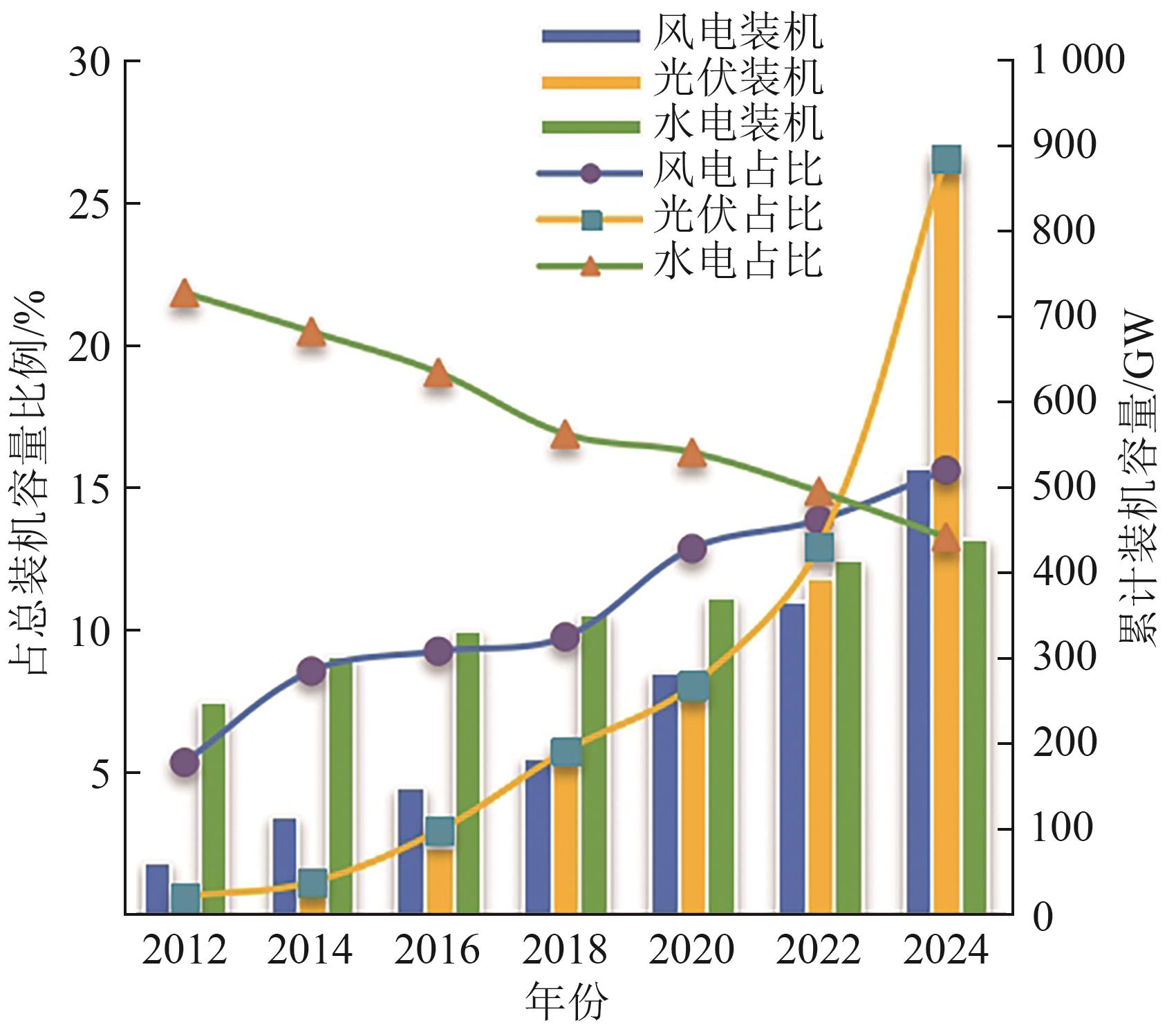
图1 2012—2024年中国风光水装机容量及占比变化情况
Fig. 1 Changes in installed capacity and share of wind, solar, and hydro power in China (2012-2024)
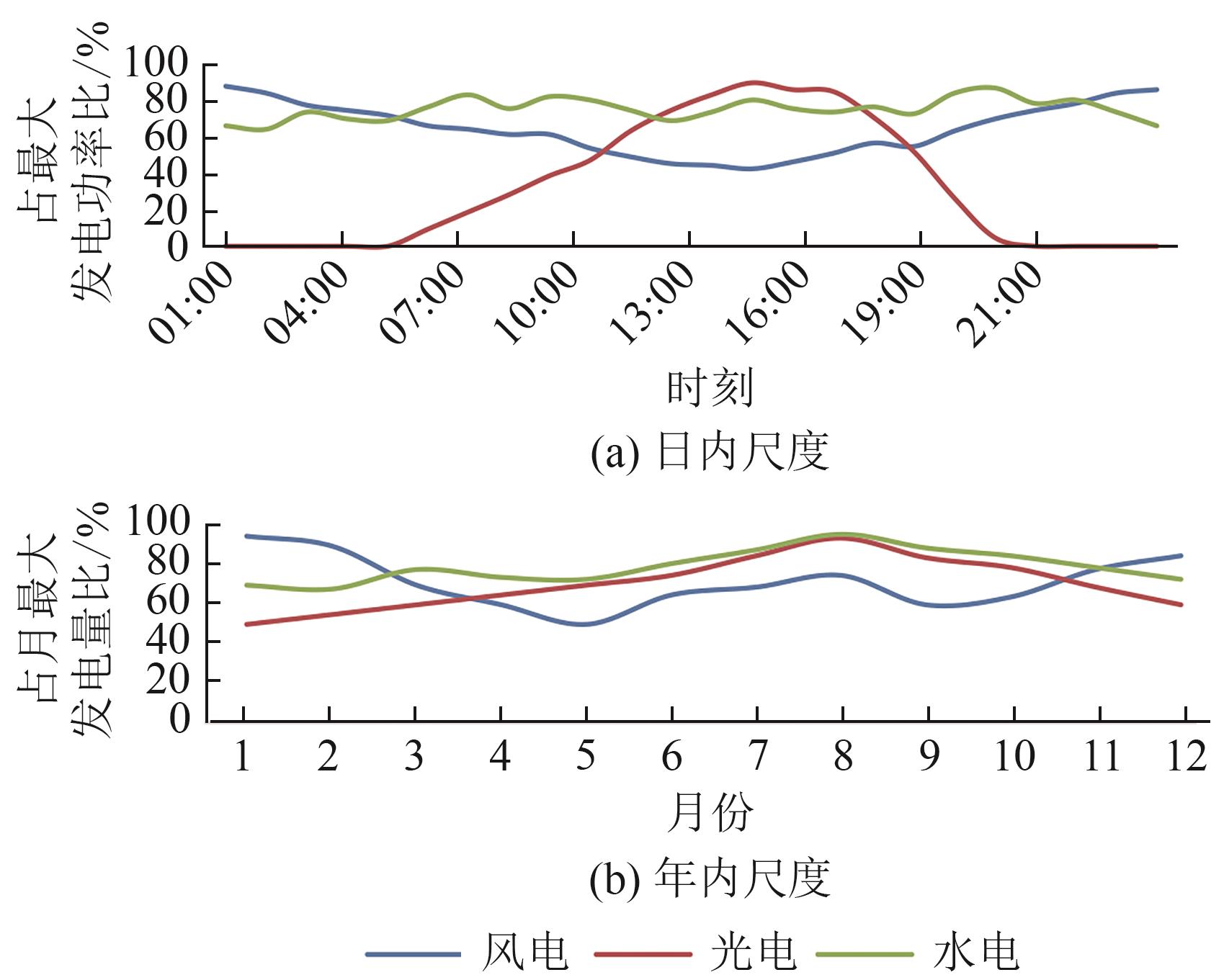
图2 风光水发电在日内尺度和年内尺度的典型互补趋势
Fig. 2 Typical complementary trends of wind, solar, and hydro power generation at intra-day and intra-year scales
| 政策文件 | 发布时间 | 涉及风光水互补发电的内容 |
|---|---|---|
| 《关于开展“风光水火储一体化”“源网荷储一体化”的指导意见(征求意见稿)》 | 2020年8月 | 文件指出,要因地制宜开展风光水互补发电、强化电源侧灵活调节作用、优化各类电源规模配比、加强市场机制建设和政策引导、引入一定比例储能等,这些措施将对推动能源供给结构改革、增强各类能源互补协同能力至关重要 |
| 《中共中央关于制定国民经济和社会发展第十四个五年规划和二〇三五年远景目标的建议》 | 2020年10月 | “十四五”期间要重点发展含风光水互补发电的能源基地就有4个,分布在风光水资源丰富的金沙江上下游流域、黄河上游流域及雅砻江流域,这些举措有力推动了风光水互补发电技术的研发与应用 |
| 《黄河流域生态保护和高质量发展规划纲要》 | 2021年10月 | 纲要强调,对过度开发的小水电项目进行全面清理与整治,同时应充分利用黄河上游水电站及电网系统的调控优势,为风能、太阳能资源充裕的青海、甘肃、四川等地提供支持,助力其构建风光水多能互补的电力系统 |
| 《“十四五”能源领域科技创新规划》 | 2021年12月 | 规划着重于大规模高占比可再生能源的开发应用,研发更高效、更经济的可再生能源先进发电利用技术,支撑风光水多能互补系统的建设和高效运行,强调加快电网基础设施建设,提高电网对清洁能源的接纳和配置能力 |
| 《新型电力系统发展蓝皮书》 | 2023年6月 | 蓝皮书强调风光水储等多种能源的互补与协调发展,指出风光水等可再生能源将成为电量的主要提供者,储能作为重要支撑,通过科学统筹源网荷储各环节,共同发力,实现电力系统的安全高效运行 |
| 《2024年能源工作指导意见》 | 2024年3月 | 巩固扩大风电光伏良好发展态势,在条件具备地区组织实施“驭风”和“沐光”行动,编制主要江河流域风光水综合清洁能源基地规划,制定长江流域水电规划利用方案,为后续大型水电项目工程开展做好准备工作 |
表1 支持风光水互补发电的相关政策文件
Tab. 1 Relevant policy documents supporting wind-solar-hydro complementary power generation
| 政策文件 | 发布时间 | 涉及风光水互补发电的内容 |
|---|---|---|
| 《关于开展“风光水火储一体化”“源网荷储一体化”的指导意见(征求意见稿)》 | 2020年8月 | 文件指出,要因地制宜开展风光水互补发电、强化电源侧灵活调节作用、优化各类电源规模配比、加强市场机制建设和政策引导、引入一定比例储能等,这些措施将对推动能源供给结构改革、增强各类能源互补协同能力至关重要 |
| 《中共中央关于制定国民经济和社会发展第十四个五年规划和二〇三五年远景目标的建议》 | 2020年10月 | “十四五”期间要重点发展含风光水互补发电的能源基地就有4个,分布在风光水资源丰富的金沙江上下游流域、黄河上游流域及雅砻江流域,这些举措有力推动了风光水互补发电技术的研发与应用 |
| 《黄河流域生态保护和高质量发展规划纲要》 | 2021年10月 | 纲要强调,对过度开发的小水电项目进行全面清理与整治,同时应充分利用黄河上游水电站及电网系统的调控优势,为风能、太阳能资源充裕的青海、甘肃、四川等地提供支持,助力其构建风光水多能互补的电力系统 |
| 《“十四五”能源领域科技创新规划》 | 2021年12月 | 规划着重于大规模高占比可再生能源的开发应用,研发更高效、更经济的可再生能源先进发电利用技术,支撑风光水多能互补系统的建设和高效运行,强调加快电网基础设施建设,提高电网对清洁能源的接纳和配置能力 |
| 《新型电力系统发展蓝皮书》 | 2023年6月 | 蓝皮书强调风光水储等多种能源的互补与协调发展,指出风光水等可再生能源将成为电量的主要提供者,储能作为重要支撑,通过科学统筹源网荷储各环节,共同发力,实现电力系统的安全高效运行 |
| 《2024年能源工作指导意见》 | 2024年3月 | 巩固扩大风电光伏良好发展态势,在条件具备地区组织实施“驭风”和“沐光”行动,编制主要江河流域风光水综合清洁能源基地规划,制定长江流域水电规划利用方案,为后续大型水电项目工程开展做好准备工作 |
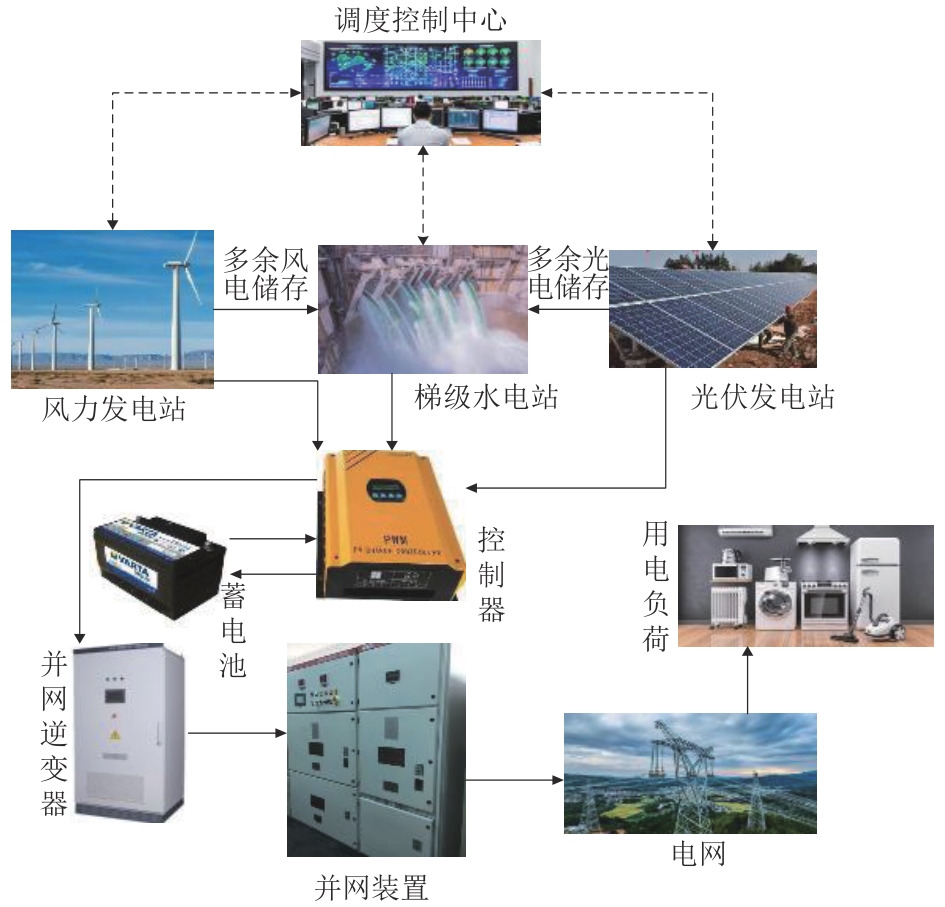
图3 风光水互补发电系统组成结构
Fig. 3 Composition and structure of wind-solar-hydro complementary power generation systems
| 关键 | 细分 | 举例 |
|---|---|---|
| 建模方法 | 时序模拟法[ | 通过模拟系统在不同时间尺度下的运行状态来构建模型,包括滚动调度、动态模拟、情景分析等 |
| 确定性建模法[ | 基于已知且确定的输入参数构建模型,包括线性规划、非线性规划、混合整数规划等 | |
| 不确定性建模法[ | 考虑风光水出力、负荷需求等参数的不确定性,包括场景分析、随机规划、模糊规划、鲁棒优化等 | |
| 调度模型类型 | 多目标优化[ | 在多个相互冲突的目标之间寻求平衡,如非支配解集多目标优化法等 |
| 分层优化[ | 上层关注系统级优化目标,如系统总成本最小化、净负荷波动最小化等,下层关注设备级优化目标,如各发电单元的运行成本最小化、弃电率最小化等 | |
| 场景分析[ | 利用蒙特卡洛模拟、场景抽样等技术生成场景,随后构建基于场景的调度模型并进行求解 | |
| 随机优化[ | 通过随机变量描述风光水出力的不确定性,随后构建相应的随机优化模型并进行求解 | |
| 优化目标 | 经济性优化[ | 如运维成本/全生命周期成本最小化、售电收益/辅助服务市场收益最大化等 |
| 可靠性优化[ | 如负荷满足率最大化、备用容量充足性提升、频率/电压稳定性提升等 | |
| 环境效益优化[ | 如碳排放/其他污染物排放最小化、可再生能源利用率最大化等 | |
| 约束条件 | 系统平衡约束[ | 实时电力平衡约束、每调度时段风光水总出力与负荷需求相等 |
| 运行约束[ | 发电单元运行约束,包括风电/光伏/水电等运行约束 | |
| 经济稳定约束[ | 频率/电压等稳定性约束、成本-收益约束等 | |
| 其他约束[ | 碳/污染物排放约束、传输容量约束、水资源利用约束等 | |
| 协同互补类型 | 多能源类型协同互补[ | 风光水自然互补、储能协同互补、跨流域水电互补、多能互补微电网等 |
| 多时间尺度协同互补[ | 日前、日内、中长期等时间尺度调度互补 | |
| 多区域层级协同互补[ | 集中式调度协同(区域/国家调度协同等)和分布式调度协同(微电网自治调度协同、局部电网分布式调度协同等) | |
| 求解算法 | 经典优化算法[ | 包括线性规划、非线性规划、动态规划、随机规划、鲁棒优化算法、MILP等 |
| 智能优化算法[ | 包括遗传算法、多目标粒子群算法、贪心算法、差分进化算法、模拟退火算法、机器学习、神经网络、深度学习、支持向量机等 |
表2 风光水一体化调度现有研究梳理与归纳
Tab. 2 Review and summary of existing research on integrated scheduling of wind, solar, and hydro power
| 关键 | 细分 | 举例 |
|---|---|---|
| 建模方法 | 时序模拟法[ | 通过模拟系统在不同时间尺度下的运行状态来构建模型,包括滚动调度、动态模拟、情景分析等 |
| 确定性建模法[ | 基于已知且确定的输入参数构建模型,包括线性规划、非线性规划、混合整数规划等 | |
| 不确定性建模法[ | 考虑风光水出力、负荷需求等参数的不确定性,包括场景分析、随机规划、模糊规划、鲁棒优化等 | |
| 调度模型类型 | 多目标优化[ | 在多个相互冲突的目标之间寻求平衡,如非支配解集多目标优化法等 |
| 分层优化[ | 上层关注系统级优化目标,如系统总成本最小化、净负荷波动最小化等,下层关注设备级优化目标,如各发电单元的运行成本最小化、弃电率最小化等 | |
| 场景分析[ | 利用蒙特卡洛模拟、场景抽样等技术生成场景,随后构建基于场景的调度模型并进行求解 | |
| 随机优化[ | 通过随机变量描述风光水出力的不确定性,随后构建相应的随机优化模型并进行求解 | |
| 优化目标 | 经济性优化[ | 如运维成本/全生命周期成本最小化、售电收益/辅助服务市场收益最大化等 |
| 可靠性优化[ | 如负荷满足率最大化、备用容量充足性提升、频率/电压稳定性提升等 | |
| 环境效益优化[ | 如碳排放/其他污染物排放最小化、可再生能源利用率最大化等 | |
| 约束条件 | 系统平衡约束[ | 实时电力平衡约束、每调度时段风光水总出力与负荷需求相等 |
| 运行约束[ | 发电单元运行约束,包括风电/光伏/水电等运行约束 | |
| 经济稳定约束[ | 频率/电压等稳定性约束、成本-收益约束等 | |
| 其他约束[ | 碳/污染物排放约束、传输容量约束、水资源利用约束等 | |
| 协同互补类型 | 多能源类型协同互补[ | 风光水自然互补、储能协同互补、跨流域水电互补、多能互补微电网等 |
| 多时间尺度协同互补[ | 日前、日内、中长期等时间尺度调度互补 | |
| 多区域层级协同互补[ | 集中式调度协同(区域/国家调度协同等)和分布式调度协同(微电网自治调度协同、局部电网分布式调度协同等) | |
| 求解算法 | 经典优化算法[ | 包括线性规划、非线性规划、动态规划、随机规划、鲁棒优化算法、MILP等 |
| 智能优化算法[ | 包括遗传算法、多目标粒子群算法、贪心算法、差分进化算法、模拟退火算法、机器学习、神经网络、深度学习、支持向量机等 |
| 储能类型 | 使用寿命/(a/次) | 循环效率/% | 能量密度/(W | 功率密度/(W/kg) | 应用时间 | 响应时间 | 应用场景 |
|---|---|---|---|---|---|---|---|
| 抽水储能 | 30~60 | 60~85 | 0.5~1.5 | 0.5~1.5 | 日级 | 小时级 | 削峰填谷、系统备用等 |
| 压缩空气 | 20~60 | 60~95 | 35~60 | 0.5~2.0 | 日级 | 分钟级 | 辅助微电网运行、调峰稳压等 |
| 氢储能 | 5~15 | 30~50 | 500~3 000 | — | 数日级 | 分钟级 | 新能源消纳、大规模长时储能等 |
| 锂电池 | 3 000~5 000 | 90~98 | 150~500 | 2 000~11 000 | 小时级 | 秒级 | 负荷平衡、频率调节、削峰填谷等 |
| 铅酸电池 | 500~2 500 | 85~95 | 50~70 | 50~500 | 小时级 | 秒级 | 可作备用电源、新能源消纳等 |
| 液流电池 | 9 000~11 000 | 70~85 | 20~50 | 0.5~3.0 | 小时级 | 秒级 | 促进新能源并网、长时储能等 |
| 钠硫电池 | 3 000~15 000 | 75~95 | 200~500 | 150~230 | 小时级 | 秒级 | 可作应急电源、缓解电网阻塞等 |
| 超导磁储能 | 20 000~90 000 | 85~96 | 1 000~5 000 | 10 000~50 000 | 分钟级 | 毫秒级 | 应急备用、提供电压支撑等 |
| 超级电容 | 9 000~11 000 | 85~98 | 10~30 | 3 000~20 000 | 分钟级 | 毫秒级 | 削峰填谷、用于分布式消纳等 |
| 电储热 | 5~30 | 30~60 | 80~250 | 80~120 | 分钟级 | 秒级 | 促进新能源消纳、提高能源利用率等 |
表3 储能技术特点
Tab. 3 Energy storage technology characteristics
| 储能类型 | 使用寿命/(a/次) | 循环效率/% | 能量密度/(W | 功率密度/(W/kg) | 应用时间 | 响应时间 | 应用场景 |
|---|---|---|---|---|---|---|---|
| 抽水储能 | 30~60 | 60~85 | 0.5~1.5 | 0.5~1.5 | 日级 | 小时级 | 削峰填谷、系统备用等 |
| 压缩空气 | 20~60 | 60~95 | 35~60 | 0.5~2.0 | 日级 | 分钟级 | 辅助微电网运行、调峰稳压等 |
| 氢储能 | 5~15 | 30~50 | 500~3 000 | — | 数日级 | 分钟级 | 新能源消纳、大规模长时储能等 |
| 锂电池 | 3 000~5 000 | 90~98 | 150~500 | 2 000~11 000 | 小时级 | 秒级 | 负荷平衡、频率调节、削峰填谷等 |
| 铅酸电池 | 500~2 500 | 85~95 | 50~70 | 50~500 | 小时级 | 秒级 | 可作备用电源、新能源消纳等 |
| 液流电池 | 9 000~11 000 | 70~85 | 20~50 | 0.5~3.0 | 小时级 | 秒级 | 促进新能源并网、长时储能等 |
| 钠硫电池 | 3 000~15 000 | 75~95 | 200~500 | 150~230 | 小时级 | 秒级 | 可作应急电源、缓解电网阻塞等 |
| 超导磁储能 | 20 000~90 000 | 85~96 | 1 000~5 000 | 10 000~50 000 | 分钟级 | 毫秒级 | 应急备用、提供电压支撑等 |
| 超级电容 | 9 000~11 000 | 85~98 | 10~30 | 3 000~20 000 | 分钟级 | 毫秒级 | 削峰填谷、用于分布式消纳等 |
| 电储热 | 5~30 | 30~60 | 80~250 | 80~120 | 分钟级 | 秒级 | 促进新能源消纳、提高能源利用率等 |
| [1] | BELGE A T, MISHRA S, ALEGAVI S .A review on alternative energy sources[C]//2022 5th International Conference on Advances in Science and Technology (ICAST).Mumbai,India:IEEE,2022:558-563. doi:10.1109/icast55766.2022.10039637 |
| [2] | SUN J, LI M J, ZHANG Z G,et al .Renewable energy transmission by HVDC across the continent:system challenges and opportunities[J].CSEE Journal of Power and Energy Systems,2017,3(4):353-364. doi:10.17775/cseejpes.2017.01200 |
| [3] | 国家发展改革委,国家能源局 .关于促进新时代新能源高质量发展的实施方案[EB/OL].(2022-05-30)[2024-04-16].. |
| National Development and Reform Commission,National Energy Administration .Implementation plan for promoting the high-quality development of new energy in the new era[EB/OL].(2022-05-30)[2024-04-16].. | |
| [4] | HOU Q C, DU E S, ZHANG N,et al .Impact of high renewable penetration on the power system operation mode:a data-driven approach[J].IEEE Transactions on Power Systems,2020,35(1):731-741. doi:10.1109/tpwrs.2019.2929276 |
| [5] | TELUKUNTA V, PRADHAN J, AGRAWAL A,et al .Protection challenges under bulk penetration of renewable energy resources in power systems:a review[J].CSEE Journal of Power and Energy Systems,2017,3(4):365-379. doi:10.17775/cseejpes.2017.00030 |
| [6] | LIU S Y, LIN Z Z, ZHAO Y X,et al .Robust system separation strategy considering online wide-area coherency identification and uncertainties of renewable energy sources[J].IEEE Transactions on Power Systems,2020,35(5):3574-3587. doi:10.1109/tpwrs.2020.2971966 |
| [7] | WANG X, MEI Y, KONG Y,et al .Improved multi-objective model and analysis of the coordinated operation of a hydro-wind-photovoltaic system[J].Energy,2017,134:813-839. doi:10.1016/j.energy.2017.06.047 |
| [8] | 汪宇航,李琰,应飞祥,等 .计及可靠性成本的风光储微电网储能容量协同优化[J].电测与仪表,2023,60(5):59-65. |
| WANG Y H, LI Y, YING F X,et al .Collaborative optimization for energy storage capacity of wind-solar-battery micro-grid considering reliability cost[J].Electrical Measurement & Instrumentation,2023,60(5):59-65. | |
| [9] | 李昕阳,刘为锋,郭旭宁,等 .流域风光水电出力互补特性[J].浙江大学学报(工学版),2024,58(7):1505-1515. |
| LI X Y, LIU W F, GUO X N,et al .Complementary characteristics of wind-photovoltaic-hydropower output in basin[J].Journal of Zhejiang University (Engineering Science),2024,58(7):1505-1515. | |
| [10] | 程春田 .碳中和下的水电角色重塑及其关键问题[J].电力系统自动化,2021,45(16):29-36. |
| CHENG C T .Function remolding of hydropower systems for carbon neutral and its key problems[J].Automation of Electric Power Systems,2021,45(16):29-36. | |
| [11] | 周建平,杜效鹄,周兴波 .面向新型电力系统的水电发展战略研究[J].水力发电学报,2022,41(7):106-115. |
| ZHOU J P, DU X H, ZHOU X B .Study on hydropower development strategy for new power systems[J].Journal of Hydroelectric Engineering,2022,41(7):106-115. | |
| [12] | 明波,成楸语,黄强,等 .梯级互补储能对新能源的长期消纳作用分析[J].水利学报,2022,53(11):1280-1290. |
| MING B, CHENG Q Y, HUANG Q,et al .Analysis of long-term consumption effects of cascade complementary energy storage on new energies[J].Journal of Hydraulic Engineering,2022,53(11):1280-1290. | |
| [13] | 中国水力发电工程学会 .十八大以来我国水电开发重大成就[EB/OL].(2022-07-31)[2023-03-01].. |
| China Society for Hydropower Engineering .Major achievements in China’s hydropower development since the 18th National Congress of the Communist Party of China[EB/OL].(2022-07-31)[2023-03-01].. | |
| [14] | HUNT J D, FALCHETTA G, PARKINSON S,et al .Hydropower and seasonal pumped hydropower storage in the Indus basin:pros and cons[J].Journal of Energy Storage,2021,41:102916. doi:10.1016/j.est.2021.102916 |
| [15] | 李莉,刘永前,杨勇平,等 .基于CFD流场预计算的短期风速预测方法[J].中国电机工程学报,2013,33(7):27-32. |
| LI L, LIU Y Q, YANG Y P,et al .Short-term wind speed forecasting based on CFD pre-calculated flow fields[J].Proceedings of the CSEE,2013,33(7):27-32. | |
| [16] | 彭小圣,熊磊,文劲宇,等 .风电集群短期及超短期功率预测精度改进方法综述[J].中国电机工程学报,2016,36(23):6315-6326. |
| PENG X S, XIONG L, WEN J Y,et al .A summary of the state of the art for short-term and ultra-short-term wind power prediction of regions[J].Proceedings of the CSEE,2016,36(23):6315-6326. | |
| [17] | 邓小亮,曹伟,胡斌奇,等 .考虑动态风速变异因子的风电功率预测[J].电工技术,2021(5):19-23. |
| DENG X L, CAO W, HU B Q,et al .Prediction of wind power considering dynamic wind speed variation coefficient[J].Electric Engineering,2021(5):19-23. | |
| [18] | SOBRI S, KOOHI-KAMALI S, RAHIM N A .Solar photovoltaic generation forecasting methods:a review[J].Energy Conversion and Management,2018,156:459-497. doi:10.1016/j.enconman.2017.11.019 |
| [19] | 田壁源,李永新,文玉玲,等 .光伏功率预测技术与方法[J].电工技术,2019(15):25-27. |
| TIAN B Y, LI Y X, WEN Y L,et al .Technology and method of PV power prediction[J].Electric Engineering,2019(15):25-27. | |
| [20] | LONG H, ZHANG Z J, SU Y .Analysis of daily solar power prediction with data-driven approaches[J].Applied Energy,2014,126:29-37. doi:10.1016/j.apenergy.2014.03.084 |
| [21] | 阎洁,刘永前,韩爽,等 .分位数回归在风电功率预测不确定性分析中的应用[J].太阳能学报,2013,34(12):2101-2107. |
| YAN J, LIU Y Q, HAN S,et al .Quantile regression in uncertainty analysis of wind power forecasting[J].Acta Energiae Solaris Sinica,2013,34(12):2101-2107. | |
| [22] | 刘建行,刘方 .基于深度强化学习的梯级水蓄风光互补系统优化调度策略研究[J].广东电力,2024,37(5):10-22. |
| LIU J H, LIU F .Research on optimized dispatching strategy of cascade hydropower-pumping-storage-wind-photovoltaic multi-energy complementary system based on deep reinforcement learning[J].Guangdong Electric Power,2024,37(5):10-22. | |
| [23] | 吴晓刚,阎洁,葛畅,等 .基于改进GRU-CNN的风光水一体化超短期功率预测方法[J].中国电力,2023,56(9):178-186. |
| WU X G, YAN J, GE C,et al .Ultra-short-term power forecasting method for wind-solar-hydro integration based on improved GRU-CNN[J].Electric Power,2023,56(9):178-186. | |
| [24] | ZHANG J, SUN B, Guo J,et al .A novel hybrid model for solar power forecasting considering meteorological factors and historical data[J].IEEE Journal of Photovoltaics,2024,14(4):1443-1450. |
| [25] | WANG Y, XU H H, HUANG Y H,et al .An end-to-end ensemble learning approach for enhancing wind power forecasting[J].IEEE Transactions on Sustainable Energy,2025:1-14. doi:10.1109/tste.2025.3582425 |
| [26] | 左翔,马剑波,丛小飞 .基于并行自适应遗传算法的水文模型率定研究[J].水利水电技术(中英文),2024,55(3):102-112. |
| ZUO X, MA J B, CONG X F .Research on hydrologic model calibration based on parallel adaptive genetic algorithm[J].Water Resources and Hydropower Engineering,2024,55(3):102-112. | |
| [27] | 刘文琨,罗增良,周鹏程,等 .气候变化下澜沧江流域径流及水电站发电能力预测[J].人民长江,2024,55(8):103-113. |
| LIU W K, LUO Z L, ZHOU P C,et al .Prediction on runoff and hydropower generation capacity of Lancang River Basin under climate changes[J].Yangtze River,2024,55(8):103-113. | |
| [28] | 张晓菁,刘攀,周丽婷,等 .考虑水文模型参数时变的水库水位多预见期实时预报:以水布垭水库为例[J].水利学报,2023,54(4):426-438. |
| ZHANG X J, LIU P, ZHOU L T,et al .Real-time forecasting of reservoir water levels over multiple lead times considering time-varying hydrological model parameters and its application in the Shuibuya Reservoir[J].Journal of Hydraulic Engineering,2023,54(4):426-438. | |
| [29] | 孙娜 .机器学习理论在径流智能预报中的应用研究[D].武汉:华中科技大学,2019. |
| SUN N .Research on application of machine learning theory in runoff intelligent forecast[D].Wuhan:Huazhong University of Science and Technology,2019. | |
| [30] | 刘亚新,徐杨 .基于机器学习的葛洲坝水电站日均出力预测[J].人民长江,2022,53(4):201-209. |
| LIU Y X, XU Y .Prediction of daily power output of Gezhouba Hydropower Station during non-discarded water period based on machine learning[J].Yangtze River,2022,53(4):201-209. | |
| [31] | 陈珺,黄燕华,洪朋,等 .基于机器学习模型的河道水位预测[J].水利水电科技进展,2023,43(3):9-14. |
| CHEN J, HUANG Y H, HONG P,et al .Prediction of river water level based on machine learning model[J].Advances in Science and Technology of Water Resources,2023,43(3):9-14. | |
| [32] | 贺元康,刘瑞丰,陈天恩,等 .全清洁能源特高压青豫直流初期打捆外送模式[J].中国电力,2021,54(7):83-92. |
| HE Y K, LIU R F, CHEN T E,et al .Exploration of bundled transaction model for all clean energy transmission of Qing-yu UHV DC project[J].Electric Power,2021,54(7):83-92. | |
| [33] | 郭怿,明波,黄强,等 .考虑输电功率平稳性的水-风-光-储多能互补日前鲁棒优化调度[J].电工技术学报,2023,38(9):2350-2363. |
| GUO Y, MING B, HUANG Q,et al .Day-ahead robust optimal scheduling of hydro-wind-PV-storage complementary system considering the steadiness of power delivery[J].Transactions of China Electrotechnical Society,2023,38(9):2350-2363. | |
| [34] | GUO Y, MING B, HUANG Q,et al .Risk-averse day-ahead generation scheduling of hydro-wind-photovoltaic complementary systems considering the steady requirement of power delivery[J].Applied Energy,2022,309:118467. doi:10.1016/j.apenergy.2021.118467 |
| [35] | ZHU F L, ZHONG P G, XU B,et al .Short-term stochastic optimization of a hydro-wind-photovoltaic hybrid system under multiple uncertainties[J].Energy Conversion and Management,2020,214:112902. doi:10.1016/j.enconman.2020.112902 |
| [36] | HU W, ZHANG H X, DONG Y,et al .Short-term optimal operation of hydro-wind-solar hybrid system with improved generative adversarial networks[J].Applied Energy,2019,250:389-403. doi:10.1016/j.apenergy.2019.04.090 |
| [37] | MING B, LIU P, GUO S L,et al .Robust hydroelectric unit commitment considering integration of large-scale photovoltaic power:a case study in China[J].Applied Energy,2018,228:1341-1352. doi:10.1016/j.apenergy.2018.07.019 |
| [38] | ZHANG X J, ELIA CAMPANA P, BI X J,et al .Capacity configuration of a hydro-wind-solar-storage bundling system with transmission constraints of the receiving-end power grid and its techno-economic evaluation[J].Energy Conversion and Management,2022,270:116177. doi:10.1016/j.enconman.2022.116177 |
| [39] | GUO Y, MING B, HUANG Q,et al .Evaluating effects of battery storage on day-ahead generation scheduling of large hydro-wind-photovoltaic complementary systems[J].Applied Energy,2022,324:119781. doi:10.1016/j.apenergy.2022.119781 |
| [40] | 丰俊杰,曾平良,李亚楼,等 .考虑充放电策略对储能寿命影响的新型分布式储能优化配置研究[J].电测与仪表,2024,61(3):26-32. |
| FENG J J, ZENG P L, LI Y L,et al .Research on optimal configuration of novel distributed energy storage considering the impact of charging and discharging strategy on energy storage life[J].Electrical Measurement & Instrumentation,2024,61(3):26-32. | |
| [41] | 刘洪波,刘珅诚,盖雪扬,等 .高比例新能源接入的主动配电网规划综述[J].发电技术,2024,45(1):151-161. doi:10.12096/j.2096-4528.pgt.22106 |
| LIU H B, LIU S C, GAI X Y,et al .Overview of active distribution network planning with high proportion of new energy access[J].Power Generation Technology,2024,45(1):151-161. doi:10.12096/j.2096-4528.pgt.22106 | |
| [42] | 兰天楷,孙华东,王琦,等 .考虑分布式新能源的有源综合负荷模型[J].电工技术学报,2024,39(23):7365-7378. doi:10.1109/tpwrs.2023.3250648 |
| LAN T K, SUN H D, WANG Q,et al .Active synthesis load model considering distributed renewable energy source[J].Transactions of China Electrotechnical Society,2024,39(23):7365-7378. doi:10.1109/tpwrs.2023.3250648 | |
| [43] | 于晓军,刘志远,王洪炳,等 .考虑新能源并网影响的零序过电压解列策略[J].电测与仪表,2024,61(6):111-117. |
| YU X J, LIU Z Y, WANG H B,et al .Zero-sequence overvoltage splitting strategy considering the impact of new energy grid connection[J].Electrical Measurement & Instrumentation,2024,61(6):111-117. | |
| [44] | REN Y, SUN K T, ZHANG K,et al .Optimization of the capacity configuration of an abandoned mine pumped storage/wind/photovoltaic integrated system[J].Applied Energy,2024,374:124089. doi:10.1016/j.apenergy.2024.124089 |
| [45] | CUI Y T, SU C G, YUAN W L,et al .Capacity configuration of cascaded hydro-wind-photovoltaic complementary systems considering comprehensive benefits based on a synergetic-orderly framework[J].Energy Conversion and Management,2024,319:118916. doi:10.1016/j.enconman.2024.118916 |
| [46] | ZHANG Y S, LIAN J J, MA C,et al .Optimal sizing of the grid-connected hybrid system integrating hydropower,photovoltaic,and wind considering cascade reservoir connection and photovoltaic-wind complementarity[J].Journal of Cleaner Production,2020,274:123100. doi:10.1016/j.jclepro.2020.123100 |
| [47] | 端木陈睿,史林军,蹇德平,等 .计及多时间尺度的梯级水-风-光互补基地储能容量优化配置[J].电力自动化设备,2024,44(7):173-179. |
| DUANMU C R, SHI L J, JIAN D P,et al .Optimization of energy storage capacity allocation in multi-time scales cascaded hydro-wind-solar base[J].Electric Power Automation Equipment,2024,44(7):173-179. | |
| [48] | 刘晓颖,郭春义,迟永宁 .不同风光水配比下多类型电源打捆直流外送系统的功率传输能力研究[J].中国电机工程学报,2024,44(13):5051-5063. |
| LIU X Y, GUO C Y, CHI Y N .Study on the power transmission capacity of multiple type power bundled HVDC transmission system under different wind-PV-hydro ratio conditions[J].Proceedings of the CSEE,2024,44(13):5051-5063. | |
| [49] | HE Y Y, HONG X Y, WANG C,et al .Optimal capacity configuration of the hydro-wind-photovoltaic complementary system considering cascade reservoir connection[J].Applied Energy,2023,352:121927. doi:10.1016/j.apenergy.2023.121927 |
| [50] | 戚永志,黄越辉,王伟胜,等 .高比例清洁能源下水风光消纳能力分析方法研究[J].电网与清洁能源,2020,36(1):55-63. |
| QI Y Z, HUANG Y H, WANG W S,et al .A study on hydro-wind-solar consumption analysis method for high proportion of clean energy[J].Power System and Clean Energy,2020,36(1):55-63. | |
| [51] | 陈典,陆润钊,张健,等 .实用化水火风光系统时序电力电量平衡方法[J].水力发电学报,2023,42(5):25-34. |
| CHEN D, LU R Z, ZHANG J,et al .Sequential power and energy balance practical method for hydro-thermal-wind-solar power systems[J].Journal of Hydroelectric Engineering,2023,42(5):25-34. | |
| [52] | 燕志宇,宋福龙,梁才浩,等 .考虑水电机组振动区的水风光协同规划模型[J].全球能源互联网,2024,7(3):243-255. |
| YAN Z Y, SONG F L, LIANG C H,et al .Complementary planning of hydro-wind-photovoltaic systems considering hydropower unit vibration zones[J].Journal of Global Energy Interconnection,2024,7(3):243-255. | |
| [53] | 张秋艳,谢俊,潘学萍,等 .考虑动态频率响应的风光水互补发电短期优化调度模型[J].太阳能学报,2023,44(1):516-524. |
| ZHANG Q Y, XIE J, PAN X P,et al .Short-term optimal scheduling model for wind-solar-hydro hybrid power generation system considering dynamic frequency response[J].Acta Energiae Solaris Sinica,2023,44(1):516-524. | |
| [54] | HUANG K D, LIU P, MING B,et al .Economic operation of a wind-solar-hydro complementary system considering risks of output shortage,power curtailment and spilled water[J].Applied Energy,2021,290:116805. doi:10.1016/j.apenergy.2021.116805 |
| [55] | LU L, YUAN W L, SU C G,et al .Optimization model for the short-term joint operation of a grid-connected wind-photovoltaic-hydro hybrid energy system with cascade hydropower plants[J].Energy Conversion and Management,2021,236:114055. doi:10.1016/j.enconman.2021.114055 |
| [56] | ZHANG Z D, QIN H, LI J,et al .Short-term optimal operation of wind-solar-hydro hybrid system considering uncertainties[J].Energy Conversion and Management,2020,205:112405. doi:10.1016/j.enconman.2019.112405 |
| [57] | LIU W F, ZHU F L, ZHAO T,et al .Optimal stochastic scheduling of hydropower-based compensation for combined wind and photovoltaic power outputs[J].Applied Energy,2020,276:115501. doi:10.1016/j.apenergy.2020.115501 |
| [58] | YANG Y Q, ZHOU J Z, LIU G B,et al .Multi-plan formulation of hydropower generation considering uncertainty of wind power[J].Applied Energy,2020,260:114239. doi:10.1016/j.apenergy.2019.114239 |
| [59] | LI X, LIU P, CHENG L,et al .Strategic bidding for a hydro-wind-photovoltaic hybrid system considering the profit beyond forecast time[J].Renewable Energy,2023,204:277-289. doi:10.1016/j.renene.2022.12.098 |
| [60] | ZHANG Z D, QIN H, LI J,et al .Operation rule extraction based on deep learning model with attention mechanism for wind-solar-hydro hybrid system under multiple uncertainties[J].Renewable Energy,2021,170:92-106. doi:10.1016/j.renene.2021.01.115 |
| [61] | 王义民,刘世帆,李婷婷,等 .雅砻江能源基地水风光互补短期调度运行模式对比研究[J].水利学报,2023,54(4):439-450. |
| WANG Y M, LIU S F, LI T T,et al .A comparative study on the short term operation modes of water-wind-solar energy complementary dispatching in Yalong River Energy Base[J].Journal of Hydraulic Engineering,2023,54(4):439-450. | |
| [62] | GONG Y, LIU P, LIU Y N,et al .Robust operation interval of a large-scale hydro-photovoltaic power system to cope with emergencies[J].Applied Energy,2021,290:116612. doi:10.1016/j.apenergy.2021.116612 |
| [63] | YANG Z K, LIU P, CHENG L,et al .Deriving operating rules for a large-scale hydro-photovoltaic power system using implicit stochastic optimization[J].Journal of Cleaner Production,2018,195:562-572. doi:10.1016/j.jclepro.2018.05.154 |
| [64] | 易锦桂,朱自伟,谢青 .基于改进场景聚类算法的海上风电储能优化配置研究[J].中国电力,2022,55(12):2-10. |
| YI J G, ZHU Z W, XIE Q .Research on optimal configuration of offshore wind power energy storage based on improved scene clustering algorithm[J].Electric Power,2022,55(12):2-10. | |
| [65] | 徐婉迪,罗俊,范薇薇 .不确定环境下并网型光储微电网的容量规划[J].系统工程理论与实践,2022,42(4):981-1000. |
| XU W D, LUO J, FAN W W .Capacity planning of grid-connected PV-and-storage microgrid under uncertainty[J].Systems Engineering-Theory & Practice,2022,42(4):981-1000. | |
| [66] | GONG Y, LIU P, MING B,et al .Deriving pack rules for hydro-photovoltaic hybrid power systems considering diminishing marginal benefit of energy[J].Applied Energy,2021,304:117858. doi:10.1016/j.apenergy.2021.117858 |
| [67] | ZHANG Y, CHENG C T, CAI H X,et al .Long-term stochastic model predictive control and efficiency assessment for hydro-wind-solar renewable energy supply system[J].Applied Energy,2022,316:119134. doi:10.1016/j.apenergy.2022.119134 |
| [68] | LI Y, MING B, HUANG Q,et al .Identifying effective operating rules for large hydro-solar-wind hybrid systems based on an implicit stochastic optimization framework[J].Energy,2022,245:123260. doi:10.1016/j.energy.2022.123260 |
| [69] | JIANG J H, MING B, LIU P,et al .Refining long-term operation of large hydro-photovoltaic-wind hybrid systems by nesting response functions[J].Renewable Energy,2023,204:359-371. doi:10.1016/j.renene.2022.12.128 |
| [70] | MING B, LIU P, GUO S L,et al .Hydropower reservoir reoperation to adapt to large-scale photovoltaic power generation[J].Energy,2019,179:268-279. doi:10.1016/j.energy.2019.04.209 |
| [71] | 孙惠娟,巩磊,彭春华,等 .考虑风光水多重不确定性置信风险的多目标动态分解优化调度[J].电网技术,2022,46(9):3416-3428. |
| SUN H J, GONG L, PENG C H,et al .Multi-objective dynamic decomposition optimal dispatch considering wind-photovoltaic-hydro multiple uncertainty confidence risk[J].Power System Technology,2022,46(9):3416-3428. | |
| [72] | 尚文强,李广磊,丁月明,等 .考虑源荷不确定性和新能源消纳的综合能源系统协同调度方法[J].电网技术,2024,48(2):517-532. |
| SHANG W Q, LI G L, DING Y M,et al .Collaborative scheduling for integrated energy system considering uncertainty of source load and absorption of new energy[J].Power System Technology,2024,48(2):517-532. | |
| [73] | 郑圣,谭书平,张清周,等 .基于负荷场景多层聚类的储能精细化规划研究[J].浙江电力,2024,43(2):79-87. |
| ZHENG S, TAN S P, ZHANG Q Z,et al .Research on refined energy storage planning based on multi-layer clustering of load scenarios[J].Zhejiang Electric Power,2024,43(2):79-87. | |
| [74] | 张德隆, MUBAARAK Saif,蒋思宇,等 .基于概率潮流的光伏电站中储能系统的优化配置方法[J].储能科学与技术,2021,10(6):2244-2251. |
| ZHANG D L, MUBAARAK S, JIANG S Y,et al .Optimal allocation method of energy storage in PV station based on probabilistic power flow[J].Energy Storage Science and Technology,2021,10(6):2244-2251. | |
| [75] | 虞启辉,田利,李晓飞,等 .考虑风能不确定性的压缩空气储能容量配置及经济性评估[J].储能科学与技术,2021,10(5):1614-1623. |
| YU Q H, TIAN L, LI X F,et al .Compressed air energy storage capacity configuration and economic evaluation considering the uncertainty of wind energy[J].Energy Storage Science and Technology,2021,10(5):1614-1623. | |
| [76] | 李笑竹,王维庆 .基于贝叶斯理论的分布鲁棒优化在储能配置上的应用[J].电网技术,2022,46(10):4001-4011. |
| LI X Z, WANG W Q .Application of distributed robust optimization based on Bayesian theory in allocation of energy storage[J].Power System Technology,2022,46(10):4001-4011. | |
| [77] | 李笑竹,王维庆,王海云,等 .基于鲁棒优化的风光储联合发电系统储能配置策略[J].太阳能学报,2020,41(8):67-78. |
| LI X Z, WANG W Q, WANG H Y,et al .Energy storage allocation strategy of wind-solar-storage combined system based on robust optimization[J].Acta Energiae Solaris Sinica,2020,41(8):67-78. | |
| [78] | LIU B X, LUND J R, LIAO S L,et al .Optimal power peak shaving using hydropower to complement wind and solar power uncertainty[J].Energy Conversion and Management,2020,209:112628. doi:10.1016/j.enconman.2020.112628 |
| [79] | YUAN W L, WANG X Q, SU C G,et al .Stochastic optimization model for the short-term joint operation of photovoltaic power and hydropower plants based on chance-constrained programming[J].Energy,2021,222:119996. doi:10.1016/j.energy.2021.119996 |
| [80] | ZHANG J T, CHENG C T, YU S,et al .Chance-constrained co-optimization for day-ahead generation and reserve scheduling of cascade hydropower-variable renewable energy hybrid systems[J].Applied Energy,2022,324:119732. doi:10.1016/j.apenergy.2022.119732 |
| [81] | 宋妍萌,芮钧,赵宇 .风光水火储多能互补双层优化调度研究[J].中国农村水利水电,2024(3):34-40. |
| SONG Y M, RUI J, ZHAO Y .Research on bi-level optimal scheduling of wind-PV-hydro-thermal-storage multi-energy complementary systems[J].China Rural Water and Hydropower,2024(3):34-40. | |
| [82] | 安源,郑申印,苏瑞,等 .风光水储多能互补发电系统双层优化研究[J].太阳能学报,2023,44(12):510-517. |
| AN Y, ZHENG S Y, SU R,et al .Research on two-layer optimization of wind-solar-water-storage multi energy complementary power generation system[J].Acta Energiae Solaris Sinica,2023,44(12):510-517. | |
| [83] | SUN T, WANG W D, WEN X .Optimal operation strategy of wind-hydrogen integrated energy system based on NSGA-II algorithm[J].Journal of Computational Methods in Sciences and Engineering,2023,23(1):499-511. doi:10.3233/jcm-226730 |
| [84] | ZHU Y, YAO S Y, ZHANG Y N,et al .Environmental and economic scheduling for wind-pumped storage-thermal integrated energy system based on priority ranking[J].Electric Power Systems Research,2024,231:110353. doi:10.1016/j.epsr.2024.110353 |
| [85] | HAN S, HE M J, ZHAO Z W,et al .Overcoming the uncertainty and volatility of wind power:day-ahead scheduling of hydro-wind hybrid power generation system by coordinating power regulation and frequency response flexibility[J].Applied Energy,2023,333:120555. doi:10.1016/j.apenergy.2022.120555 |
| [86] | NITTA N, WU F X, LEE J T,et al .Li-ion battery materials:present and future[J].Materials Today,2015,18(5):252-264. doi:10.1016/j.mattod.2014.10.040 |
| [87] | GUNEY M S, TEPE Y .Classification and assessment of energy storage systems[J].Renewable and Sustainable Energy Reviews,2017,75:1187-1197. doi:10.1016/j.rser.2016.11.102 |
| [88] | 李红霞,李建林,米阳 .新能源侧储能优化配置技术研究进展[J].储能科学与技术,2022,11(10):3257-3267. |
| LI H X, LI J L, MI Y .Summary of research on new energy side energy storage optimization configuration technology[J].Energy Storage Science and Technology,2022,11(10):3257-3267. | |
| [89] | 陆秋瑜,杨银国,陈俊生,等 .考虑选型的混合储能平抑海上风电波动的容量优化研究[J].武汉大学学报(工学版),2024,57(6):782-791. |
| LU Q Y, YANG Y G, CHEN J S,et al .Research on capacity optimization of hybrid energy storage to stabilize offshore wind power fluctuation considering energy storage selection[J].Engineering Journal of Wuhan University,2024,57(6):782-791. | |
| [90] | 康俊杰,赵春阳,周国鹏,等 .风光水火储多能互补示范项目发展现状及实施路径研究[J].发电技术,2023,44(3):407-416. doi:10.12096/j.2096-4528.pgt.22048 |
| KANG J J, ZHAO C Y, ZHOU G P,et al .Research on development status and implementation path of wind-solar-water-thermal-energy storage multi-energy complementary demonstration project[J].Power Generation Technology,2023,44(3):407-416. doi:10.12096/j.2096-4528.pgt.22048 | |
| [91] | 李军徽,安晨宇,李翠萍,等 .计及调峰市场交易的储能-新能源-火电多目标优化调度[J].电工技术学报,2023,38(23):6391-6406. |
| LI J H, AN C Y, LI C P,et al .Multi-objective optimization scheduling method considering peak regulating market transactions for energy storage-new energy-thermal power[J].Transactions of China Electrotechnical Society,2023,38(23):6391-6406. | |
| [92] | 王志成,赵峰,张德本,等 .循环水泵出口蝶阀电气回路及控制程序优化[J].发电技术,2018,39(6):542-545. |
| WANG Z C, ZHAO F, ZHANG D B,et al .Optimization of electric circuit and control program for outlet butterfly valve of circulating water pump[J].Power Generation Technology,2018,39(6):542-545. |
| [1] | 王志康, 张儒琪, 袁少可, 韩东江, 隋军. 有机朗肯-蒸汽压缩循环系统研究进展[J]. 发电技术, 2025, 46(6): 1059-1073. |
| [2] | 展宗波, 任吉平, 丁立平, 孙兆龙, 丁衡, 曹越. 高背压抽凝热电联供系统建模及快速变负荷控制策略研究[J]. 发电技术, 2025, 46(6): 1074-1084. |
| [3] | 李建林, 彭禹宸, 王茜, 姜晓霞, 王垒. 锂离子电池建模研究现状与展望[J]. 发电技术, 2025, 46(5): 857-871. |
| [4] | 邹博, 任建地, 许道明, 邓立生, 廖力达, 肖俊兵. 氯化物熔盐储热技术应用于新能源发电的研究进展[J]. 发电技术, 2025, 46(5): 872-884. |
| [5] | 马宁, 赵攀, 刘艾杰, 许文盼, 王江峰. 纯氢补燃型和天然气补燃型压缩空气储能系统特性与㶲经济性对比[J]. 发电技术, 2025, 46(5): 885-896. |
| [6] | 董福贵, 张伟. 考虑容量价值的独立新型储能电站运行策略优化研究[J]. 发电技术, 2025, 46(5): 897-908. |
| [7] | 路诗梦, 孙建林, 曾凡杰, 林小杰, 吴均湛, 马添翼, 钟崴, 谢立坤, 谢伟. 零碳地热能综合利用技术研究进展[J]. 发电技术, 2025, 46(5): 909-922. |
| [8] | 庄坤, 汪中宏, 张一凡, 殷文倩, 雷茂云, 朱静, 李锋, 叶季蕾. 整县屋顶分布式光伏发电经济性模型及关键影响因素[J]. 发电技术, 2025, 46(5): 950-958. |
| [9] | 龙潇, 张晋宾, 陈令特. 未来能源技术展望[J]. 发电技术, 2025, 46(4): 651-693. |
| [10] | 罗宗龙, 刘世林. 基于信息间隙决策理论鲁棒模型的户用微电网优化运行[J]. 发电技术, 2025, 46(4): 705-714. |
| [11] | 鲁亚楠, 徐涛, 刘泽楠. 制氢系统对双馈风机串补系统次同步振荡特性的影响[J]. 发电技术, 2025, 46(4): 715-726. |
| [12] | 马浩然, 袁至, 王维庆, 李骥. 考虑数据中心和储能接入的主动配电网经济调度研究[J]. 发电技术, 2025, 46(4): 748-757. |
| [13] | 王杰, 徐立军, 李笑竹, 樊小朝, 古丽扎提∙海拉提null, 王维庆. 计及灵活性不足风险的配电网智能软开关与多类型共享储能协调优化[J]. 发电技术, 2025, 46(4): 758-767. |
| [14] | 卫广宇, 应笑冬, 姚延军, 杨小芳, 翁楚迪, 彭勇刚, 李海龙. 计及荷电状态的并网型直流微电网功率协同控制策略[J]. 发电技术, 2025, 46(4): 788-796. |
| [15] | 刘佳佳, 巨星. 弃电热储能光伏-光热复合发电系统技术经济性分析[J]. 发电技术, 2025, 46(4): 807-817. |
| 阅读次数 | ||||||
|
全文 |
|
|||||
|
摘要 |
|
|||||
