

发电技术 ›› 2025, Vol. 46 ›› Issue (6): 1059-1073.DOI: 10.12096/j.2096-4528.pgt.24270
• 分布式能源 •
王志康1,2,3, 张儒琪2,3, 袁少可2,3, 韩东江2,3, 隋军2,3
收稿日期:2024-12-16
修回日期:2025-03-12
出版日期:2025-12-31
发布日期:2025-12-25
通讯作者:
韩东江
作者简介:基金资助:Zhikang WANG1,2,3, Ruqi ZHANG2,3, Shaoke YUAN2,3, Dongjiang HAN2,3, Jun SUI2,3
Received:2024-12-16
Revised:2025-03-12
Published:2025-12-31
Online:2025-12-25
Contact:
Dongjiang HAN
Supported by:摘要:
目的 近年来,有机朗肯 (organic Rankine cycle,ORC)-蒸汽压缩循环系统(vapor-compression cycle,VCC)系统以其结构紧凑、低碳节能等优势,在低品位热能利用及冷、热供应领域取得了长足的发展,为此,聚焦于循环构型、工质选择和应用方向3个关键环节,回顾了ORC-VCC系统的最新研究进展。 方法 首先,概述了5种不同的循环构型,并阐明其原理和特点,以展示ORC-VCC系统的结构多样性和工况适应性。随后,深入探讨了工质的发展历程,并从热物性、环保性和经济性等多个维度归纳工质筛选原则。总结了不同研究中对系统的经济性评估结果,点明经济性分析的重要性。此外,从供、需两侧总结了系统的潜在应用领域,并展示了与其他系统集成的应用案例,以期揭示ORC-VCC系统广阔的研究和应用潜力。最后,指出当前研究中的不足之处,并对未来的研究方向做出展望。 结论 ORC-VCC系统发展前景广阔,发展潜力巨大,其在能源领域的应用将为实现低碳、节能、可持续发展目标做出重要贡献。
中图分类号:
王志康, 张儒琪, 袁少可, 韩东江, 隋军. 有机朗肯-蒸汽压缩循环系统研究进展[J]. 发电技术, 2025, 46(6): 1059-1073.
Zhikang WANG, Ruqi ZHANG, Shaoke YUAN, Dongjiang HAN, Jun SUI. Research Progress on Organic Rankine Cycle-Vapor Compression Cycle Systems[J]. Power Generation Technology, 2025, 46(6): 1059-1073.
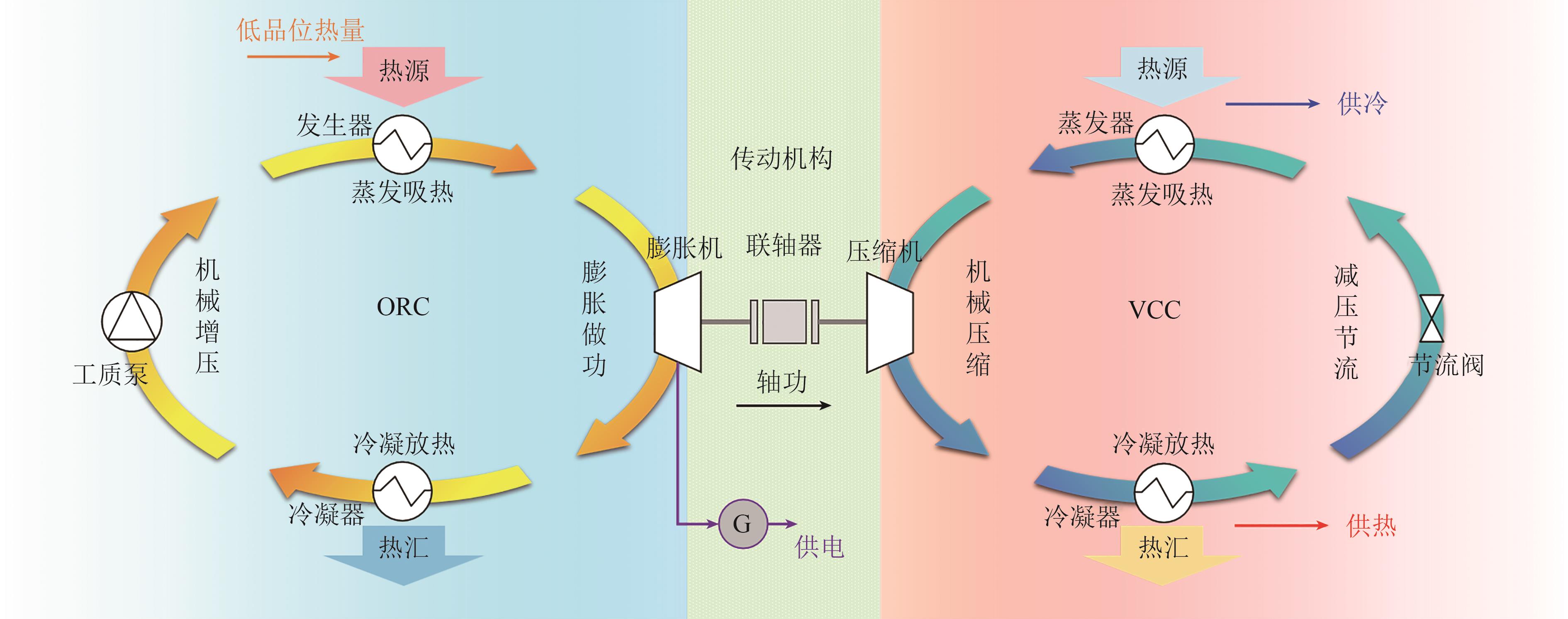
图1 ORC-VCC工作原理图
Fig. 1 Working principle of ORC-VCC
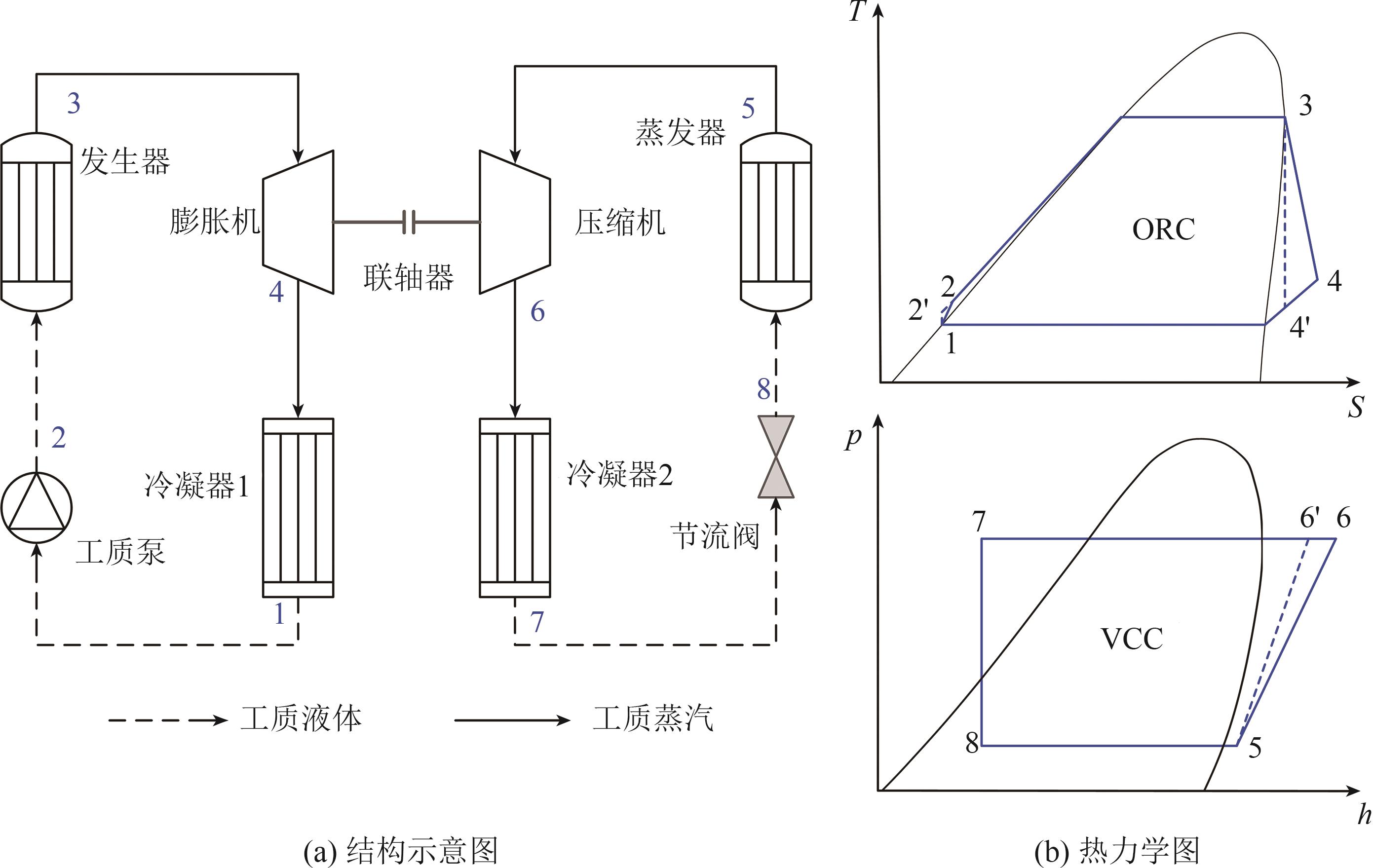
图2 基本构型结构示意图及热力学图
Fig. 2 Structural schematic diagram and thermodynamic diagram of basic configuration
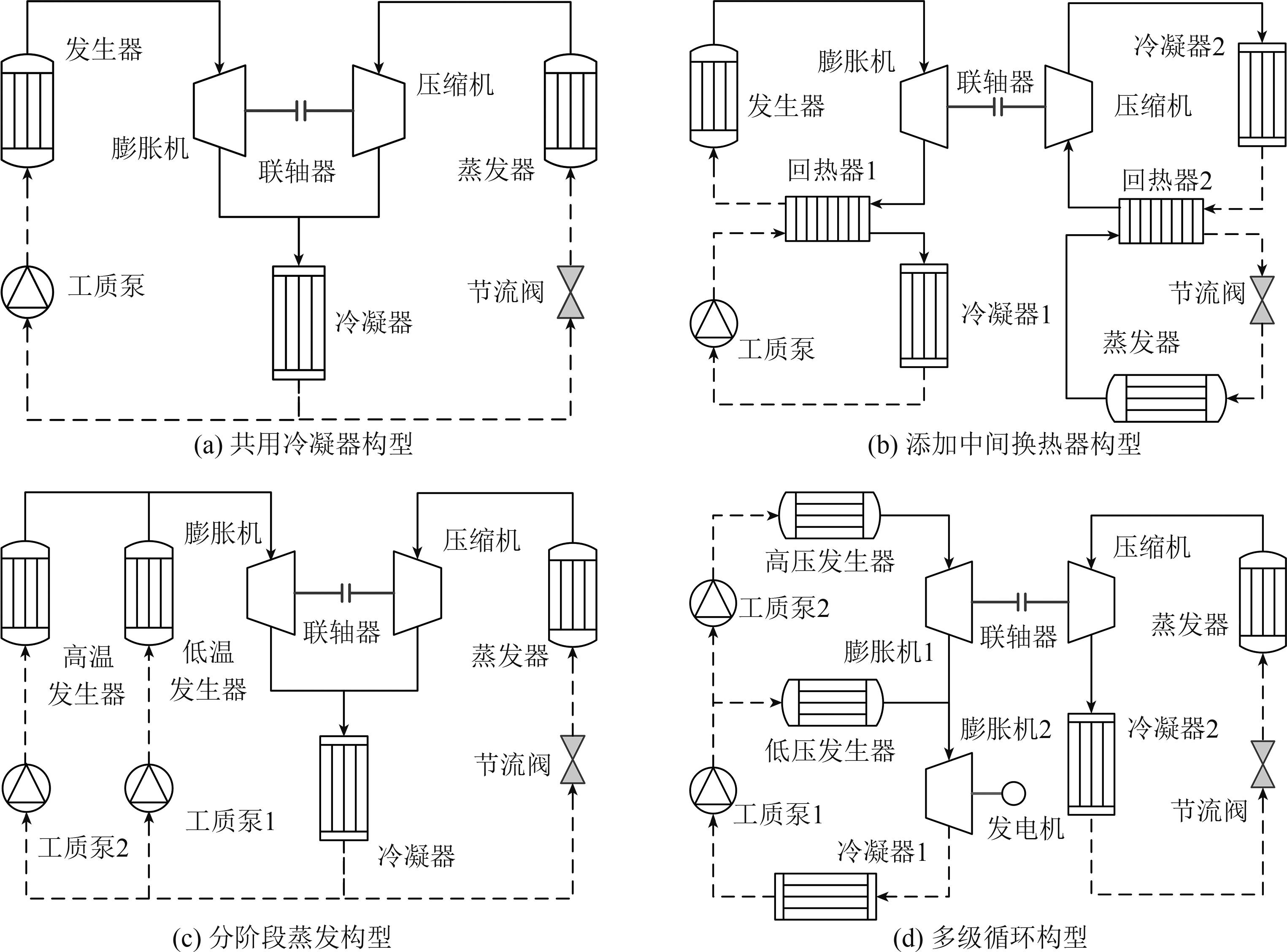
图3 ORC-VCC系统典型构型
Fig. 3 Typical configurations of ORC-VCC systems
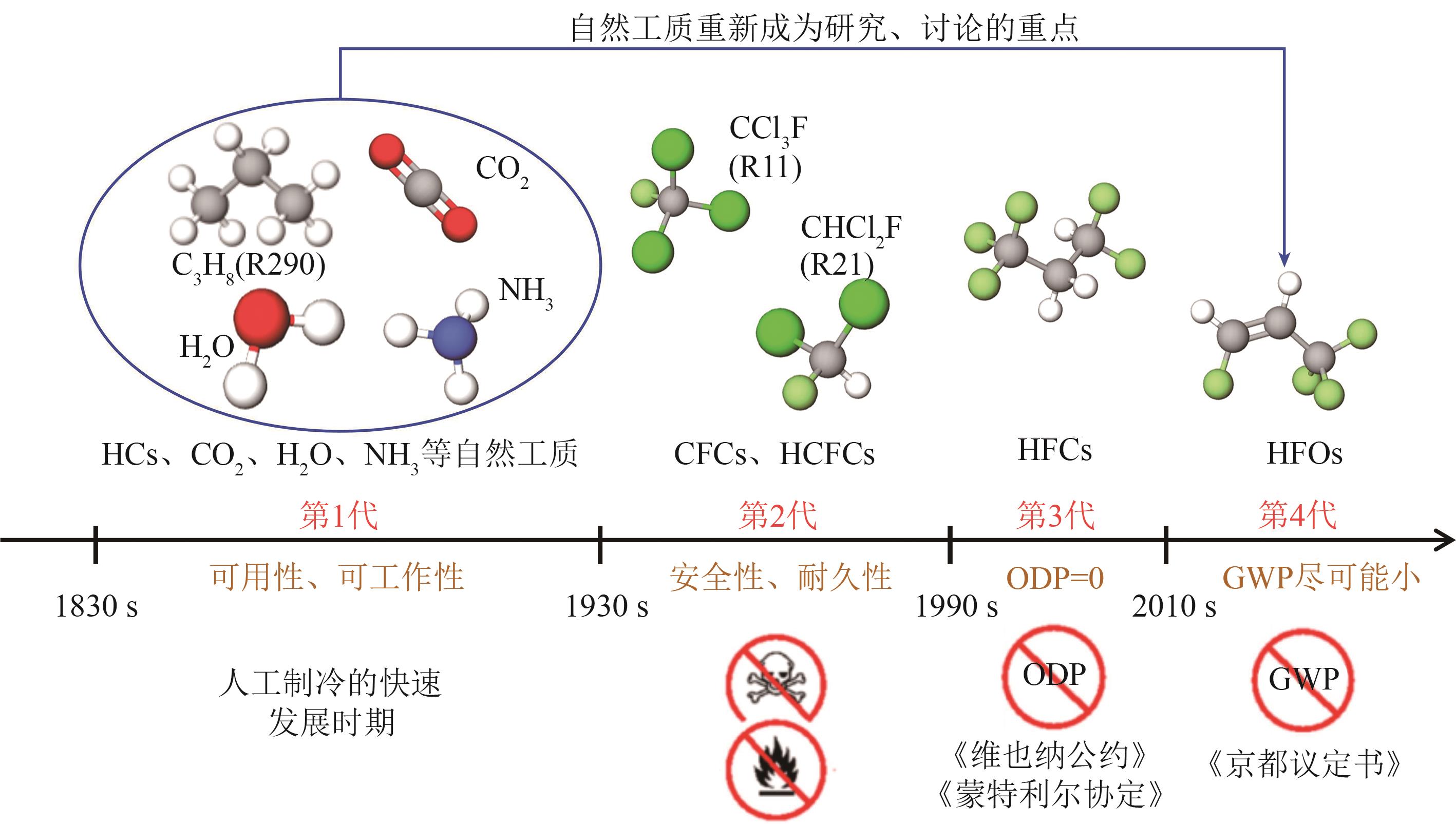
图4 工质发展历程
Fig. 4 Development history of working fluids
| 工质 | 工质种类 | 参考文献 |
|---|---|---|
| R1234ze(E) | HFO | [ |
| R1234yf | HFO | [ |
| R1224yd(Z) | HFO | [ |
| R1233zd(E) | HFO | [ |
| R602 | HC | [ |
| R601 | HC | [ |
表1 采用新型工质和自然工质的相关研究
Tab. 1 Relevant studies on use of novel and natural working fluids
| 工质 | 工质种类 | 参考文献 |
|---|---|---|
| R1234ze(E) | HFO | [ |
| R1234yf | HFO | [ |
| R1224yd(Z) | HFO | [ |
| R1233zd(E) | HFO | [ |
| R602 | HC | [ |
| R601 | HC | [ |
| 类型 | 工质 | 临界温度/℃ | ODP | GWP | 安全等级 |
|---|---|---|---|---|---|
| HFC | R134a | 101.1 | 0 | 1 300 | A1 |
| R152a | 113.3 | 0 | 138 | A2 | |
| R245fa | 154 | 0 | 858 | B1 | |
| HFO | R1234yf | 94.7 | 0 | <1 | A2L |
| R1234ze(E) | 109.4 | 0 | <1 | A2L | |
| R1234ze(Z) | 150.1 | 0 | <1 | A2L | |
| R1336mzz(Z) | 171.3 | 0 | 2 | A1 | |
| HCFO | R1224yd(Z) | 155.5 | ≈0 | <1 | A1 |
| R1233zd(Z) | 166.5 | ≈0 | 1 | A1 | |
| HC | R600 | 152 | 0 | 4 | A3 |
| R600a | 134.7 | 0 | 3 | A3 | |
| R601 | 196.6 | 0 | 5 | A3 | |
| R601a | 187.8 | 0 | 4 | A3 |
表2 常用工质及其相关参数
Tab. 2 Typical working fluids and their related parameters
| 类型 | 工质 | 临界温度/℃ | ODP | GWP | 安全等级 |
|---|---|---|---|---|---|
| HFC | R134a | 101.1 | 0 | 1 300 | A1 |
| R152a | 113.3 | 0 | 138 | A2 | |
| R245fa | 154 | 0 | 858 | B1 | |
| HFO | R1234yf | 94.7 | 0 | <1 | A2L |
| R1234ze(E) | 109.4 | 0 | <1 | A2L | |
| R1234ze(Z) | 150.1 | 0 | <1 | A2L | |
| R1336mzz(Z) | 171.3 | 0 | 2 | A1 | |
| HCFO | R1224yd(Z) | 155.5 | ≈0 | <1 | A1 |
| R1233zd(Z) | 166.5 | ≈0 | 1 | A1 | |
| HC | R600 | 152 | 0 | 4 | A3 |
| R600a | 134.7 | 0 | 3 | A3 | |
| R601 | 196.6 | 0 | 5 | A3 | |
| R601a | 187.8 | 0 | 4 | A3 |
| 序号 | HFO | HCFO | HC |
|---|---|---|---|
| 1 | R1336mzz(Z) | R1233zd(Z) | R600 |
| 2 | R1234ze(Z) | R1224yd(Z) | R601 |
表3 适用于高温热泵的工质
Tab. 3 Working fluids suitable for high-temperature heat pumps
| 序号 | HFO | HCFO | HC |
|---|---|---|---|
| 1 | R1336mzz(Z) | R1233zd(Z) | R600 |
| 2 | R1234ze(Z) | R1224yd(Z) | R601 |
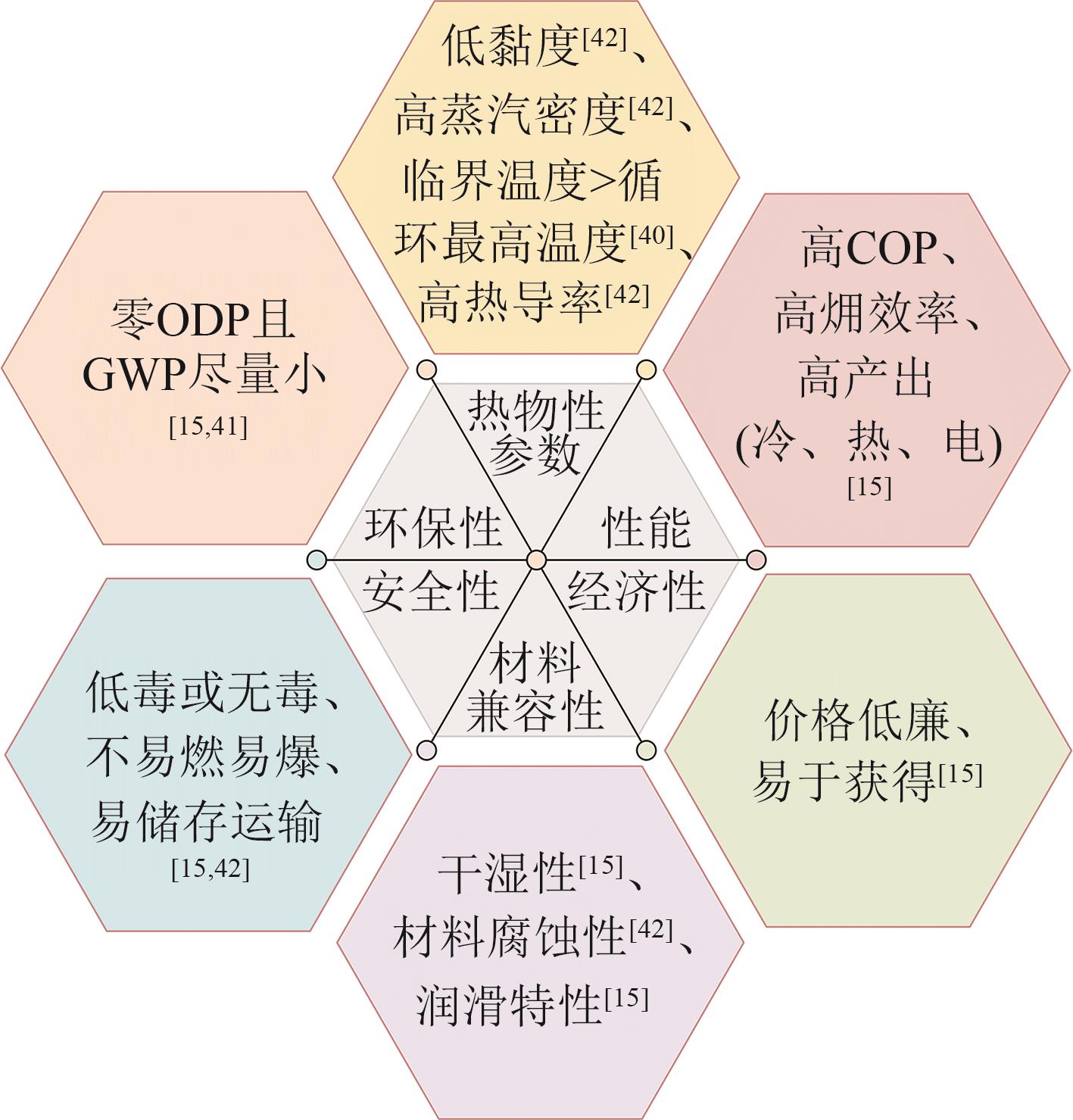
图5 工质筛选原则
Fig. 5 Screening principles of working fluids

图6 纯工质与非共沸工质ORC的热力过程对比
Fig. 6 Comparison of thermodynamic processes between pure and non-azeotropic working fluids in ORC
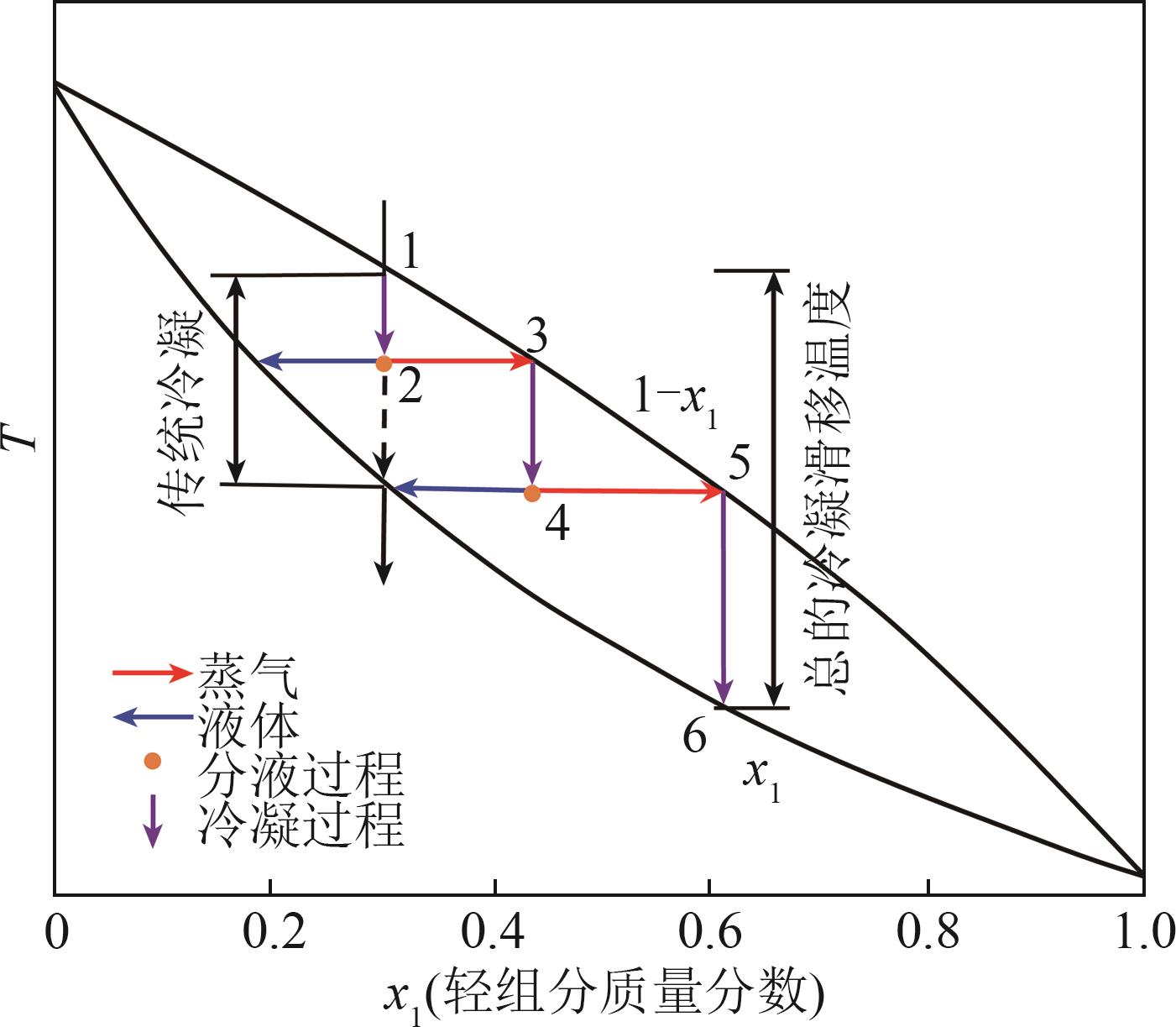
图7 分液冷凝过程示意图]
Fig. 7 Schematic diagram of liquid separation and condensation process
| 序号 | 系统描述 | PB | 参考文献 |
|---|---|---|---|
| 1 | 双蒸发器ORC-VCR系统 | 5.8年 | [ |
| 2 | ORC-VCC微型多联产系统 | 7年 | [ |
| 3 | ORC-VCR车辆空调系统 | 769 h | [ |
| 4 | ORC-VCR空气压缩空分系统 | 3.1年 | [ |
| 5 | ORC-VCR汽车能源系统 | 7 520 h | [ |
| 6 | 太阳能ORC-VCC三联产系统 | 8.5年 | [ |
表4 相关研究的投资回收期情况
Tab. 4 Payback periods of relevant studies
| 序号 | 系统描述 | PB | 参考文献 |
|---|---|---|---|
| 1 | 双蒸发器ORC-VCR系统 | 5.8年 | [ |
| 2 | ORC-VCC微型多联产系统 | 7年 | [ |
| 3 | ORC-VCR车辆空调系统 | 769 h | [ |
| 4 | ORC-VCR空气压缩空分系统 | 3.1年 | [ |
| 5 | ORC-VCR汽车能源系统 | 7 520 h | [ |
| 6 | 太阳能ORC-VCC三联产系统 | 8.5年 | [ |
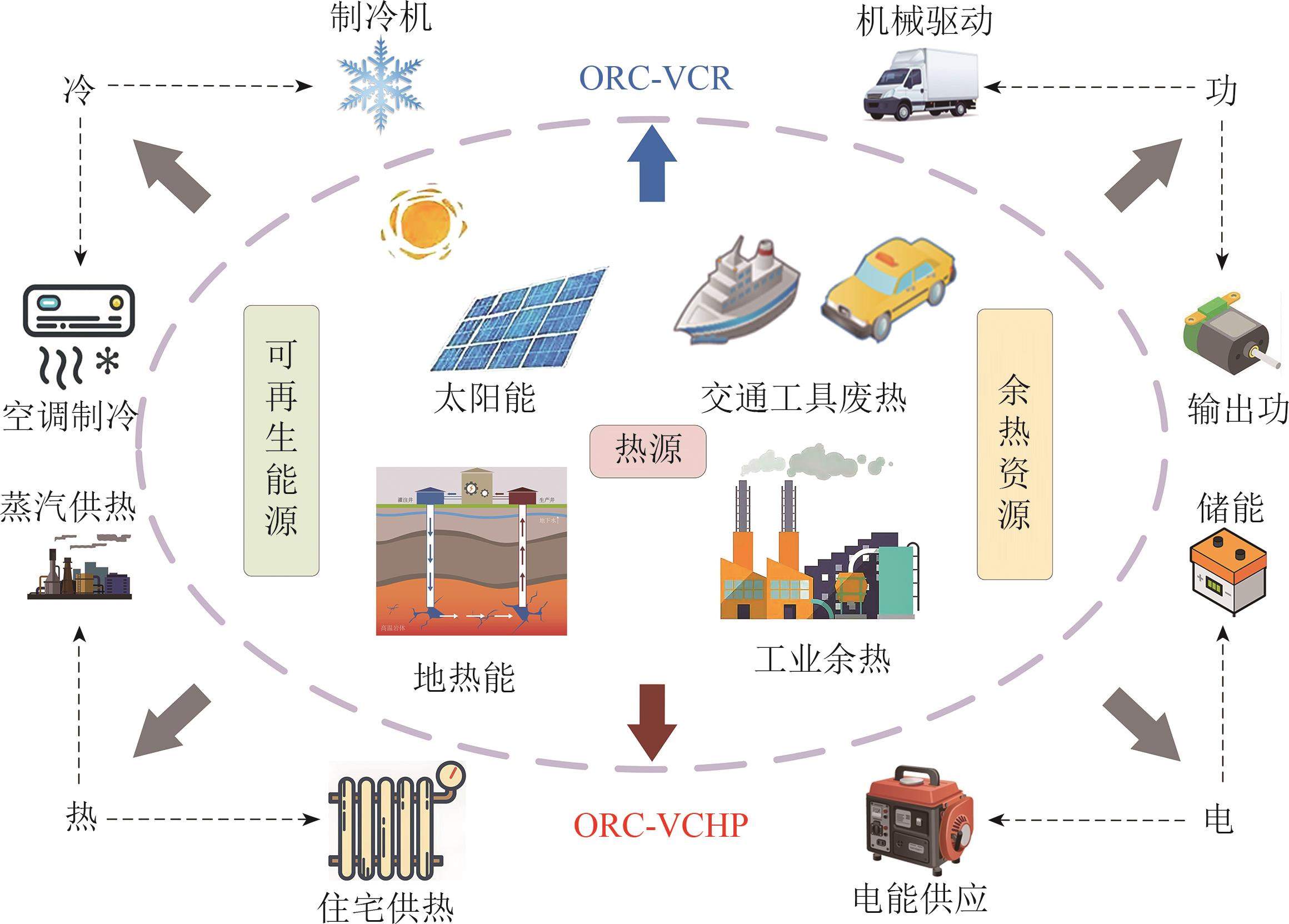
图8 ORC-VCC系统应用方向
Fig. 8 Application directions of ORC-VCC systems

图9 ORC-VCC集成于其他系统的应用案例
Fig. 9 Application cases of ORC-VCC integrated with other systems
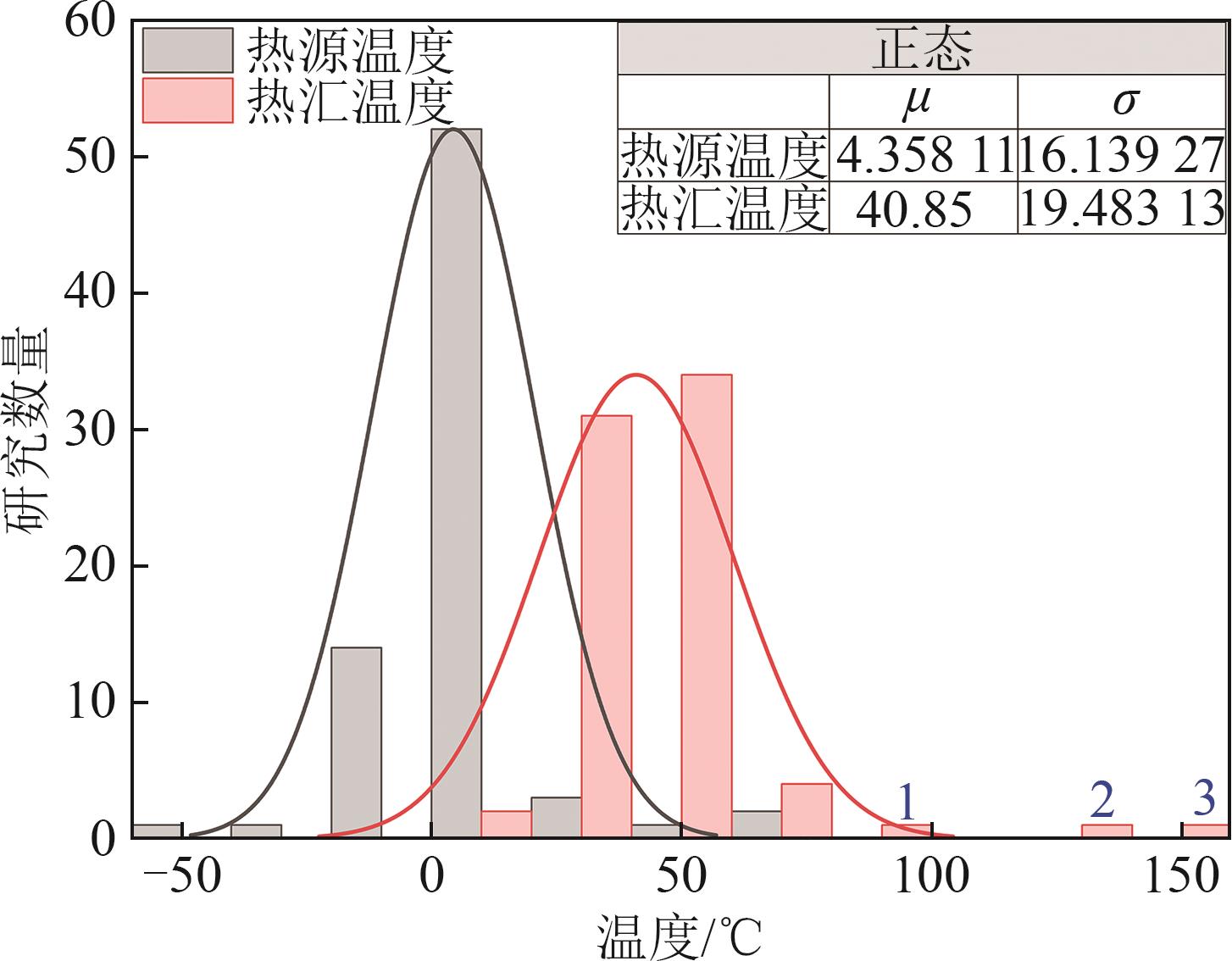
图10 VCC子系统热源与热汇温度分布
Fig. 10 Temperature distribution of heat source and heat sink in VCC subsystem
| [1] | 李家桐,谢宁,王承民,等.基于CHP机组碳排放分析的综合能源系统低碳调度优化方法[J].智慧电力,2024,52(6):31-37. |
| LI J T, XIE N, WANG C M,et al .Low-carbon dispatch optimization method for integrated energy system based on carbon emission analysis of CHP units[J].Smart Power,2024,52(6):31-37. | |
| [2] | 兰天楷,孙华东,王琦,等 .考虑分布式新能源的有源综合负荷模型[J].电工技术学报,2024,39(23):7365-7378. doi:10.1109/tpwrs.2023.3250648 |
| LAN T K, SUN H D, WANG Q,et al .Active synthesis load model considering distributed renewable energy source[J].Transactions of China Electrotechnical Society,2024,39(23):7365-7378. doi:10.1109/tpwrs.2023.3250648 | |
| [3] | 邵宜祥,刘剑,胡丽萍,等 .一种改进组合神经网络的超短期风速预测方法研究[J].发电技术,2024,45(2):323-330. |
| SHAO Y X, LIU J, HU L P,et al .Research on an ultra-short-term wind speed prediction method based on improved combined neural networks[J].Power Generation Technology,2024,45(2):323-330. | |
| [4] | 张海涛,李文娟,李雪峰,等 .基于变分模态分解和时间注意力机制TCN网络的光伏发电功率预测[J].电测与仪表,2024,61(12):156-163. |
| ZHANG H T, LI E J, LI X F,et al .Photovoltaic power forecasting based on TPA-TCN model and variational modal decomposition[J].Electrical Merasurement & Instrumentation,2024,61(12):156-163. | |
| [5] | XU Z Y, WANG R Z, YANG C .Perspectives for low-temperature waste heat recovery[J].Energy,2019,176:1037-1043. doi:10.1016/j.energy.2019.04.001 |
| [6] | HUR S, KIM S, KIM H S,et al .Low-grade waste heat recovery scenarios:pyroelectric,thermomagnetic,and thermogalvanic thermal energy harvesting[J].Nano Energy,2023,114:108596. doi:10.1016/j.nanoen.2023.108596 |
| [7] | YAN H Z, ZHANG C, SHAO Z,et al .The underestimated role of the heat pump in achieving China’s goal of carbon neutrality by 2060[J].Engineering,2023,23:13-18. doi:10.1016/j.eng.2022.08.015 |
| [8] | HAMID K, SAJJAD U, AHRENS M U,et al .Potential evaluation of integrated high temperature heat pumps: a review of recent advances[J].Applied Thermal Engineering,2023,230:120720. doi:10.1016/j.applthermaleng.2023.120720 |
| [9] | SEO J H, KANG S, KIM K,et al .Compact heat pipe heat exchanger for waste heat recovery within a low- temperature range[J].International Communications in Heat and Mass Transfer,2024,155:107550. doi:10.1016/j.icheatmasstransfer.2024.107550 |
| [10] | LI J, PENG X Y, YANG Z,et al .Design,improvements and applications of dual-pressure evaporation organic Rankine cycles:a review[J].Applied Energy,2022,311:118609. doi:10.1016/j.apenergy.2022.118609 |
| [11] | SILVA-ROMERO J C, BELMAN-FLORES J M, ACEVES S M .A review of small-scale vapor compression refrigeration technologies[J].Applied Sciences,2024,14(7):3069. doi:10.3390/app14073069 |
| [12] | GRUBER S, ROLA K, URBANCL D,et al .Recent advances in ejector-enhanced vapor compression heat pump and refrigeration systems-a review[J].Energies,2024,17(16):4043-4051. doi:10.3390/en17164043 |
| [13] | MOUNIER V, MENDOZA L C, SCHIFFMANN J. Thermo-economic optimization of an ORC driven heat pump based on small scale turbomachinery and comparison with absorption heat pumps[J]. International Journal of Refrigeration,2017,81:96-110. doi:10.1016/j.ijrefrig.2017.05.021 |
| [14] | ANEKE M, AGNEW B, UNDERWOOD C,et al. Thermodynamic analysis of alternative refrigeration cycles driven from waste heat in a food processing application[J].International Journal of Refrigeration,2012,35(5):1349-1358. doi:10.1016/j.ijrefrig.2012.04.008 |
| [15] | 王英洁 .低温余热驱动的有机朗肯耦合蒸汽压缩制冷循环系统性能模拟[D].大连:大连理工大学,2019. |
| WANG Y J .Performance analysis of organic Rankine cycle coupled with vapor compression refrigeration cycle system driven by low-grade waste heat[D]. Dalian:Dalian University of Technology,2019. | |
| [16] | 马国远,房磊,许树学,等 .不同工质有机朗肯-蒸汽压缩复合式热泵系统的能效特性比较[J].北京工业大学学报,2016,42(2):296-301. |
| MA G Y, FANG L, XU S X,et al .Comparison study of energy ratio of ORC compound with vapor compression heat pump system using different working fluid[J].Journal of Beijing University of Technology, 2016,42(2):296-301. | |
| [17] | ZHAR R, ALLOUHI A, GHODBANE M,et al. Parametric analysis and multi-objective optimization of a combined organic Rankine cycle and vapor compression cycle[J].Sustainable Energy Technologies and Assessments,2021,47:101401. doi:10.1016/j.seta.2021.101401 |
| [18] | 黄成达,马国远,许树学,等 .有机朗肯-蒸汽压缩复合式热泵系统性能研究[J].低温与超导,2017,45(1):74-79. |
| HUANG C D, MA G Y, XU S X,et al .Characteristic study on ORC-vapour compression compound heat pump system[J].Cryogenics and Superconductivity, 2017,45(1):74-79. | |
| [19] | ZHENG N, WEI J J, ZHAO L .Analysis of a solar Rankine cycle powered refrigerator with zeotropic mixtures[J].Solar Energy,2018,162:57-66. doi:10.1016/j.solener.2018.01.011 |
| [20] | PEKTEZEL O, ACAR H I .Energy and exergy analysis of combined organic Rankine cycle-single and dual evaporator vapor compression refrigeration cycle[J].Applied Sciences,2019,9(23):5028-5035. doi:10.3390/app9235028 |
| [21] | WANG Z Q, ZHOU Q Y, XIA X X,et al .Performance comparison and analysis of a combined power and cooling system based on organic Rankine cycle[J].Journal of Central South University,2017,24:353-359. doi:10.1007/s11771-017-3437-5 |
| [22] | SHERWANI A F .Thermodynamic analysis of hybrid heat source driven organic Rankine cycle integrated flash tank vapor-compression refrigeration system[J].International Journal of Refrigeration,2021,129:267-277. doi:10.1016/j.ijrefrig.2021.05.006 |
| [23] | SALIM M S, KIM M H .Multi-objective thermos- economic optimization of a combined organic Rankine cycle and vapour compression refrigeration cycle[J].Energy Conversion and Management,2019,199:112054. doi:10.1016/j.enconman.2019.112054 |
| [24] | 张霞玲,张美琼,王燕,等 .法律法规引导下制冷剂的替代趋势[J].润滑油,2019,34(3):1-6. |
| ZHANG X L, ZHANG M Q, WANG Y,et al .The alternative trend of refrigerant guided by laws and regulations[J].Lubricating Oil,2019,34(3):1-6. | |
| [25] | MCLINDEN M O, HUBER M L .Evolution of refrigerants[J].Journal of Chemical & Engineering Data,2020,65(9):4176-4193. doi:10.1021/acs.jced.0c00338 |
| [26] | 黄志华 .制冷剂的可持续发展与未来[J].冷藏技术,2020,43(4):1-5. |
| HUANG Z H .Sustainable development and future of refrigerants[J].Journal of Refrigeration Technology,2020,43(4):1-5. | |
| [27] | PRIGMORE D, BARBER R .Cooling with the sun’s heat design considerations and test data for a Rankine cycle prototype[J].Solar Energy,1975,17(3):185-192. doi:10.1016/0038-092x(75)90058-4 |
| [28] | GRAUBERGER A, YOUNG D, BANDHAUER T. Off-design performance of an organic Rankine-vapor compression cooling cycle using R1234ze(E)[J]. Applied Energy,2022,321:119421. doi:10.1016/j.apenergy.2022.119421 |
| [29] | AKTEMUR C, HACIPASAOGLU G .Assessment of an integrated organic Rankine cycle (ORC)-vapor compression refrigeration (VCR) system using the energy, conventional exergy,and advanced exergy analysis[J].Heat Transfer Research,2021,52(15):168-175. doi:10.1615/heattransres.2021037536 |
| [30] | BAO J J, ZHANG L, SONG C X,et al .Comparative study of combined organic Rankine cycle and vapor compression cycle for refrigeration:Single fluid or dual fluid[J].Sustainable Energy Technologies and Assessments,2020,37:100595. doi:10.1016/j.seta.2019.100595 |
| [31] | TABAN D, APOSTOL V, GROSU L,et al. Exergoeconomic analysis of a mechanical compression refrigeration unit run by an ORC[J].Entropy,2023,25(11):1531-1539. doi:10.3390/e25111531 |
| [32] | NASIR M T, EKWONU M C, ESFAHANI J A,et al. Integrated vapor compression chiller with bottoming organic Rankine cycle and onsite low-grade renewable energy[J].Energies,2021,14(19):6401-6410. doi:10.3390/en14196401 |
| [33] | LI T L, WANG J Y, JIN F Y,et al .Techno- economic and environmental performance of a novel poly-generation system under different energy-supply scenarios and temperature and humidity independent control[J].Case Studies in Thermal Engineering,2023,50:103447. doi:10.1016/j.csite.2023.103447 |
| [34] | ASHWNI G, SHERWANI A F, TIWARI D,et al. Sensitivity analysis and multi-objective optimization of organic Rankine cycle integrated with vapor compression refrigeration system[J].Energy Sources, Part A:Recovery,Utilization,and Environmental Effects,2021:1-13. doi:10.1016/j.ijrefrig.2021.02.005 |
| [35] | SHERWANI A F .Analysis of solar energy driven organic Rankine cycle-vapor compression refrigeration system[J].Thermal Science and Engineering Progress,2022,35:101477. doi:10.1016/j.tsep.2022.101477 |
| [36] | LI T L, LI X L, GAO H Y,et al .Thermodynamic performance of geothermal energy cascade utilization for combined heating and power based on organic Rankine cycle and vapor compression cycle [J]. Energies,2022,15(19):7294-7302. doi:10.3390/en15197294 |
| [37] | XIA X X, LIU Z P, WANG Z Q,et al .Multi-layer performance optimization based on operation parameter-working fluid-heat source for the ORC-VCR system[J].Energy,2023,272:127103. doi:10.1016/j.energy.2023.127103 |
| [38] | SALEH B, ALY A A, ALOGLA A F,et al .Performance investigation of organic Rankine-vapor compression refrigeration integrated system activated by renewable energy[J].Mechanics & Industry,2019,20(2):206-214. doi:10.1051/meca/2019023 |
| [39] | ARPAGAUS C, BLESS F, UHLMANN M,et al .High temperature heat pumps:market overview,state of the art,research status,refrigerants,and application potentials[J].Energy,2018,152:985-1010. doi:10.1016/j.energy.2018.03.166 |
| [40] | DEVOTTA S, PENDYALA V R .Thermodynamic screening of some HFCs and HFEs for high-temperature heat pumps as alternatives to CFC114[J].International Journal of Refrigeration,1994,17(5):338-342. doi:10.1016/0140-7007(94)90064-7 |
| [41] | 董益秀,王如竹 .高温热泵的循环,工质研究及应用展望[J].化工学报,2023,74(1):133-144. |
| DONG Y X, WANG R Z .High temperature heat pump:cycle configurations,working fluids and application potentials[J].CIESC Journal,2023,74(1):133-144. | |
| [42] | KHATOON S, ALMEFREJI N M A, KIM M H .Thermodynamic study of a combined power and refrigeration system for low-grade heat energy source[J].Energies,2021,14(2):410-419. doi:10.3390/en14020410 |
| [43] | 李健,杨震,段远源 .中低温热能驱动的非共沸工质有机Rankine循环[J].清华大学学报(自然科学版),2022,62(4):693-703. |
| LI J, YANG Z, DUAN Y Y .Organic Rankine cycles using zeotropic mixtures driven by low-to-medium temperature thermal energy[J].Journal of Tsinghua University (Science and Technology),2022,62(4):693-703. | |
| [44] | MIAO Z, ZHANG K, WANG M X,et al. Thermodynamic selection criteria of zeotropic mixtures for subcritical organic Rankine cycle[J].Energy,2019,167:484-497. doi:10.1016/j.energy.2018.11.002 |
| [45] | XIA X X, ZHANG H L, WANG Z Q,et al. Performance comparison of two ORC-VCR system configurations using pure/mixture working fluids based on multi-objective optimization[J].Applied Thermal Engineering,2024,255:124027. doi:10.1016/j.applthermaleng.2024.124027 |
| [46] | 黄仁龙,钟天明,王亚阁 .组分调控非共沸有机朗肯循环研究进展[J].新能源进展,2023,11(3):273-279. |
| HUANG R L, ZHONG T M, WANG Y G .Research progress of composition-adjustable zeotropic organic Rankine cycle[J].Advances in New and Renewable Energy,2023,11(3):273-279. | |
| [47] | GOYAL A, RAWAT P, SHERWANI A F,et al .Advanced exergy,economic,and environmental evaluation of an organic Rankine cycle driven dual evaporators vapor-compression refrigeration system using organic fluids[J].International Journal of Refrige ration,2023,150:170-184. doi:10.1016/j.ijrefrig.2023.02.002 |
| [48] | KARELLAS S, BRAIMAKIS K .Energy-exergy analysis and economic investigation of a cogeneration and trigeneration ORC-VCC hybrid system utilizing biomass fuel and solar power[J].Energy Conversion and Management,2016,107:103-113. doi:10.1016/j.enconman.2015.06.080 |
| [49] | YUE C, TONG L, ZHANG S .Thermal and economic analysis on vehicle energy supplying system based on waste heat recovery organic Rankine cycle[J].Applied Energy,2019,248:241-255. doi:10.1016/j.apenergy.2019.04.081 |
| [50] | ZHOU X, ZHANG H, RONG Y,et al .Comparative study for air compression heat recovery based on organic Rankine cycle (ORC) in cryogenic air separation units[J].Energy,2022,255:124514. doi:10.1016/j.energy.2022.124514 |
| [51] | YUE C, YOU F Q, HUANG Y .Thermal and economic analysis of an energy system of an ORC coupled with vehicle air conditioning[J].International Journal of Refrigeration,2016,64:152-167. doi:10.1016/j.ijrefrig.2016.01.005 |
| [52] | BELLOS E, TZIVANIDIS C .Parametric analysis of a solar-driven trigeneration system with an organic Rankine cycle and a vapor compression cycle[J].Energy and Built Environment,2021,2(3):278-289. doi:10.1016/j.enbenv.2020.08.004 |
| [53] | SHERWANI A F, TIWARI D .Exergy,economic and environmental analysis of organic Rankine cycle based vapor compression refrigeration system[J].International Journal of Refrigeration,2021,126:259-271. doi:10.1016/j.ijrefrig.2021.02.005 |
| [54] | SONG J, OLYMPIOS A, MERSCH M,et al .Integrated organic rankine cycle (ORC) and heat pump (HP) systems for domestic heating[C]//34th International Conference on Efficiency,Costs,Optimization,Simulation and Environmental Impact of Energy Systems (ECOS 2021).Taormina,Italy:IEEE,2021:1280-1291. doi:10.52202/062738-0143 |
| [55] | ALSHAMMARI S, KADAM S T, YU Z .Assessment of single rotor expander-compressor device in combined organic Rankine cycle (ORC) and vapor compression refrigeration cycle (VCR)[J].Energy,2023,282:128763. doi:10.1016/j.energy.2023.128763 |
| [56] | KIM M H .Energy and exergy analysis of solar organic Rankine cycle coupled with vapor compression refrigeration cycle[J].Energies,2022,15(15):5603. doi:10.3390/en15155603 |
| [57] | HU B, GUO J J, YANG Y,et al .Performance analysis and working fluid selection of organic Rankine steam compression air conditioning driven by ship waste heat[J].Energy Reports,2022,8:194-202. doi:10.1016/j.egyr.2022.01.094 |
| [58] | NASIR M T, EKWONU M C, PARK Y,et al. Assessment of a district trigeneration biomass powered double organic Rankine cycle as primed mover and supported cooling[J].Energies,2021,14(4):1-24. doi:10.3390/en14041030 |
| [59] | MEIBODI S S, LOVERIDGE F .The future role of energy geostructures in fifth generation district heating and cooling networks[J].Energy,2022,240:122481. doi:10.1016/j.energy.2021.122481 |
| [60] | KUTLU C, ERDINC M T, LI J,et al .A study on heat storage sizing and flow control for a domestic scale solar-powered organic Rankine cycle-vapour compression refrigeration system[J].Renewable Energy,2019,143:301-312. doi:10.1016/j.renene.2019.05.017 |
| [61] | 张留淦,周颖驰,孙文兵,等 .利用 ORC-VCR 回收压缩热的预冷式 CAES 系统性能分析[J].储能科学与技术,2024,13(2):611-618. |
| ZHANG L G, ZHOU Y C, SUN W B,et al. Performance analysis of pre-cooled CAES system driven by low-temperature waste heat using ORC-VCR to recover compression heat[J].Energy Storage Science and Technology,2024,13(2):611-618. | |
| [62] | TAUSEEF NASIR M, EKWONU M C, PARK Y,et al. Assessment of a district trigeneration biomass powered double organic Rankine cycle as primed mover and supported cooling[J].Energies,2021,14(4):1030-1037. doi:10.3390/en14041030 |
| [63] | MENG N, LI T, WANG J,et al .Synergetic cascade-evaporation mechanism of a novel building distributed energy supply system with cogeneration and temperature and humidity independent control characteristics[J].Energy Conversion and Management,2020,209:112620. doi:10.1016/j.enconman.2020.112620 |
| [64] | CHEN L, YUE H, WANG J,et al .Thermodynamic analysis of a hybrid energy system coupling solar organic Rankine cycle and ground source heat pump: Exploring heat cascade utilization[J].Energy,2023,284:129228. doi:10.1016/j.energy.2023.129228 |
| [65] | ZHOU X, RONG Y, FANG S,et al .Thermodynamic analysis of an organic Rankine-vapor compression cycle (ORVC) assisted air compression system for cryogenic air separation units[J].Applied Thermal Engineering,2021,189:116678. doi:10.1016/j.applthermaleng.2021.116678 |
| [66] | KAŞKA Ö, YILMAZ C,BOR O,et al .The performance assessment of a combined organic Rankine-vapor compression refrigeration cycle aided hydrogen liquefaction[J].International Journal of Hydrogen Energy,2018,43(44):20192-20202. doi:10.1016/j.ijhydene.2018.07.092 |
| [67] | MOHAMMED R H, IBRAHIM M M, ABU-HEIBA A. Exergoeconomic and multi-objective optimization analyses of an organic Rankine cycle integrated with multi-effect desalination for electricity,cooling,heating power,and freshwater production[J].Energy Conversion and Management,2021,231:113826. doi:10.1016/j.enconman.2021.113826 |
| [68] | NELLISSEN P, WOLF S .Heat pumps in non-domestic applications in Europe:potential for an energy revolution[J].Emerson Climate Technologies,2015,56:356-361. |
| [1] | 路诗梦, 孙建林, 曾凡杰, 林小杰, 吴均湛, 马添翼, 钟崴, 谢立坤, 谢伟. 零碳地热能综合利用技术研究进展[J]. 发电技术, 2025, 46(5): 909-922. |
| [2] | 龙潇, 张晋宾, 陈令特. 未来能源技术展望[J]. 发电技术, 2025, 46(4): 651-693. |
| [3] | 任明炜, 邵聪, 施凯, 徐培凤, 孙宇新. 基于改进型虚拟阻抗的虚拟同步发电机动态功率解耦控制[J]. 发电技术, 2025, 46(4): 797-806. |
| [4] | 张俊, 蒲天骄, 高文忠, 刘友波, 裴玮, 许沛东, 高天露, 白昱阳. 电力系统智能计算的关键技术及应用展望[J]. 发电技术, 2025, 46(3): 421-437. |
| [5] | 杨博, 张子健. 基于人工智能的可再生能源电解水制氢关键技术及发展前景分析[J]. 发电技术, 2025, 46(3): 482-495. |
| [6] | 刘宿城, 栾李, 李龙, 洪涛, 刘晓东. 基于人工智能的直流微电网大信号稳定性评估方法研究[J]. 发电技术, 2025, 46(3): 496-507. |
| [7] | 汪义财, 喻鑫, 于敦喜. 能源植物芦竹燃烧利用研究进展[J]. 发电技术, 2025, 46(3): 570-578. |
| [8] | 侯朗博, 孙昊, 陈衡, 高悦. 基于需求响应与Stackelberg博弈的小区综合能源系统优化调度[J]. 发电技术, 2025, 46(2): 219-230. |
| [9] | 刘忠, 黄彦铭, 朱光明, 邹淑云. 含风-光-电氢混合储能的多微电网系统容量优化配置方法[J]. 发电技术, 2025, 46(2): 240-251. |
| [10] | 张立栋, 杨智翔, 李文锋, 冯江哲, 张博, 任淮辉, 陈哲, 王兆新. 导流板对水平轴风力机气动特性影响的数值模拟研究[J]. 发电技术, 2025, 46(2): 336-343. |
| [11] | 胡山鹰, 金涌, 张臻烨. 发展新质生产力,实现碳中和[J]. 发电技术, 2025, 46(1): 1-8. |
| [12] | 兰国芹, 陆烨, 阚严生, 张继广, 王欢欢, 钟芳, 王承才, 肖黎明, 王照阳. 综合能源服务发展趋势与对策研究[J]. 发电技术, 2025, 46(1): 19-30. |
| [13] | 张立栋, 铁浩, 刘惠文, 李钦伟, 田文鑫, 赵秀勇, 常子涵. 风力机偏航对尾迹演化影响的实验研究[J]. 发电技术, 2024, 45(6): 1153-1162. |
| [14] | 李文, 卜凡鹏, 张潇桐, 杨创东, 张静. 基于典型商业运营模式的含电-氢混合储能微电网系统优化运行方法[J]. 发电技术, 2024, 45(6): 1186-1200. |
| [15] | 吴任博, 黄奕俊. 高比例可再生能源接入下含自愈性能的分布式配电网重构策略研究[J]. 发电技术, 2024, 45(5): 975-982. |
| 阅读次数 | ||||||
|
全文 |
|
|||||
|
摘要 |
|
|||||
