

Power Generation Technology ›› 2025, Vol. 46 ›› Issue (3): 438-453.DOI: 10.12096/j.2096-4528.pgt.24152
• Application of AI in New Power System • Previous Articles
Zuhan ZHANG1, Dunnan LIU1, Hang FAN1, Liuqing YANG1, Yunjie DUAN1, Yun LI1, Zhenyu MA2
Received:2024-07-24
Revised:2024-10-28
Published:2025-06-30
Online:2025-06-16
Contact:
Hang FAN
Supported by:CLC Number:
Zuhan ZHANG, Dunnan LIU, Hang FAN, Liuqing YANG, Yunjie DUAN, Yun LI, Zhenyu MA. Review of Power System Prediction Technologies Based on Large Language Models[J]. Power Generation Technology, 2025, 46(3): 438-453.
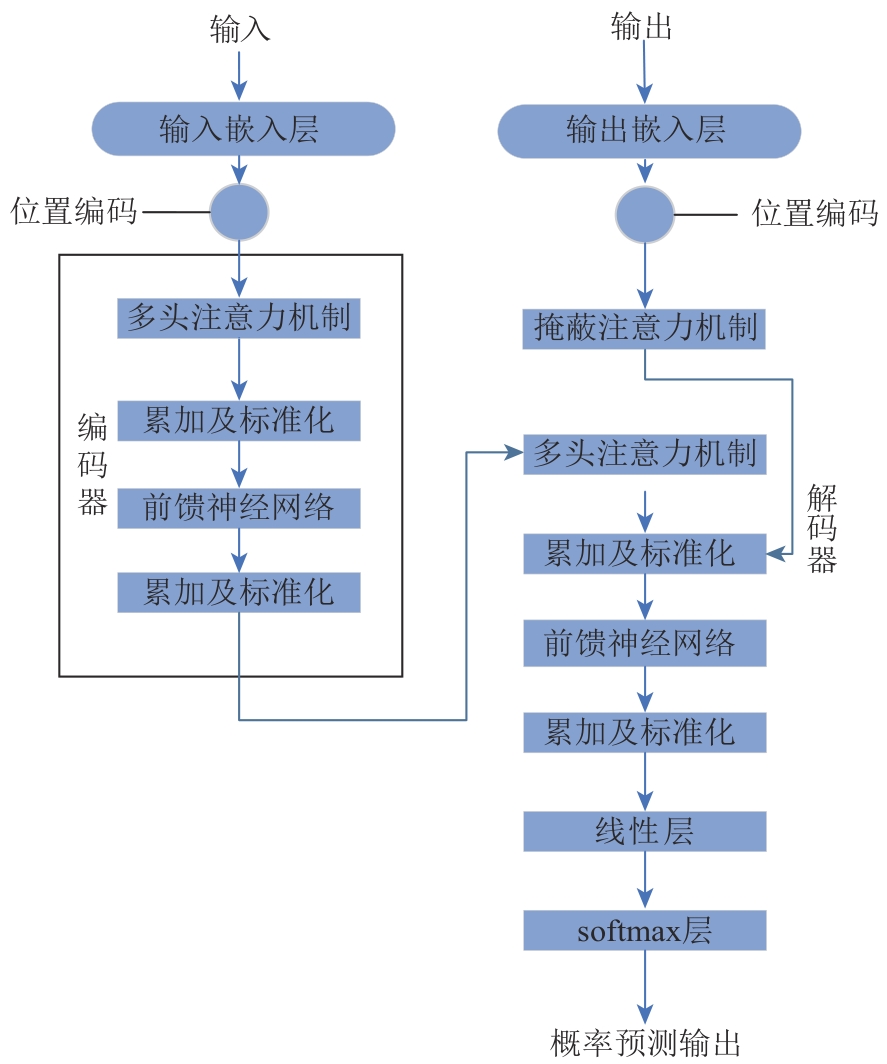
Fig. 1 Transformer structure
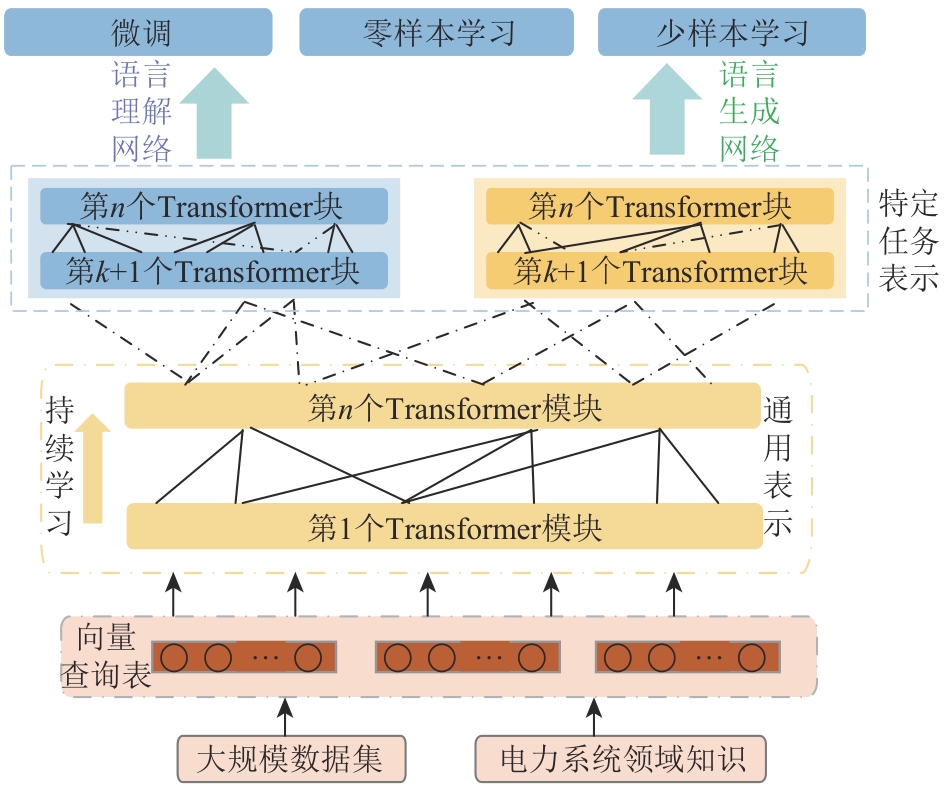
Fig. 2 Mechanism of pre-trained model
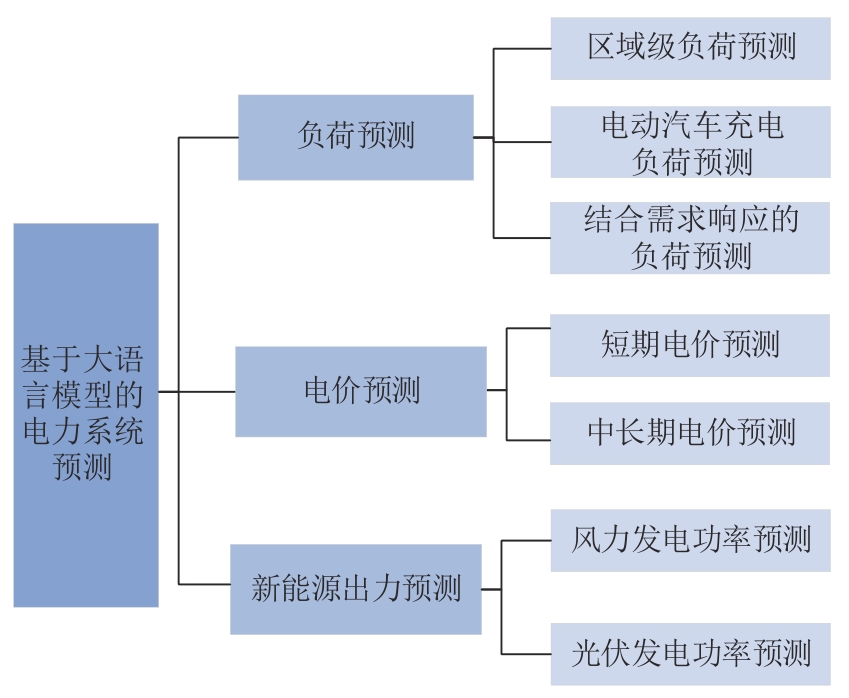
Fig. 3 Scene classifications for power system prediction based on LLM
| 1 | 王灿,张雅欣 .碳中和愿景的实现路径与政策体系[J].中国环境管理,2020,12(6):58-64. |
| WANG C, ZHANG Y X .Implementation pathway and policy system of carbon neutrality vision[J].Chinese Journal of Environmental Management,2020,12(6):58-64. | |
| 2 | 李灏恩,姜雨萌,宋天立,等 .新型电力系统背景下电力供需平衡特征和保供策略研究[J].电网与清洁能源,2023,39(12):72-78. |
| LI H E, JIANG Y M, SONG T L,et al .Research on the characteristics of power supply and demand balance and supply guarantee strategies in the context of new power systems[J].Power System and Clean Energy,2023,39(12):72-78. | |
| 3 | 汤奕,易俊,薛峰 .“双碳”目标下的新型电力系统规划与运行[J].全球能源互联网,2024,7(3):241-242. |
| TANG Y, YI J, XUE F .Planning and operation of new power system under the goal of “dual carbon”[J].Journal of Global Energy Interconnection,2024,7(3):241-242. | |
| 4 | 高骞,杨俊义,洪宇,等 .新型电力系统背景下电网发展业务数字化转型架构及路径研究[J].发电技术,2022,43(6):851-859. doi:10.12096/j.2096-4528.pgt.21124 |
| GAO Q, YANG J Y, HONG Y,et al .Research on digital transformation architecture and path of power grid development planning business under new power system blueprint[J].Power Generation Technology,2022,43(6):851-859. doi:10.12096/j.2096-4528.pgt.21124 | |
| 5 | 顾靖达,白小会,李伟,等 .新型电力系统变电站绿色低碳技术分析[J].南方能源建设,2024,11(4):111-117. |
| GU J D, BAI X H, LI W,et al .Analysis on green and low carbon technologies for new power system substations[J].Southern Energy Construction,2024,11(4):111-117. | |
| 6 | 王继业,赵俊华 .基于人工智能技术的新型电力系统优化运行与控制[J].全球能源互联网,2023,6(3):238-239. |
| WANG J Y, ZHAO J H .Optimal operation and control of new power system based on artificial intelligence technology[J].Journal of Global Energy Interconnection,2023,6(3):238-239. | |
| 7 | 陈宋宋,王阳,周颖,等 .基于客户用电数据的多时空维度负荷预测综述[J].电网与清洁能源,2023,39(12):28-40. |
| CHEN S S, WANG Y, ZHOU Y,et al .A review of multi-time-space load forecasting based on customer electricity consumption data[J].Power System and Clean Energy,2023,39(12):28-40. | |
| 8 | 赵汉超,从兰美,刘杰,等 .基于EMD-GM-Elman神经网络组合模型的新型电力系统新能源发电量及负荷需求量预测[J].电网与清洁能源,2024,40(10):132-141. |
| ZHAO H C, CONG L M, LIU J,et al .Forecasting of the new energy generation and load demand in the novel power system based on EMD-GM-Elman neural network combined model[J].Power System and Clean Energy,2024,40(10):132-141. | |
| 9 | 朱润泽,王德军 .基于LSTM神经网络的光伏系统功率预测[J].电力科技与环保,2023,39(3):201-206. |
| ZHU R Z, WANG D J .Power prediction of photovoltaic system based on LSTM neural network[J].Electric Power Technology and Environmental Protection,2023,39(3):201-206. | |
| 10 | 郭雪丽,华大鹏,包鹏宇,等 .一种基于改进VMD-PSO-CNN-LSTM的短期电价预测方法[J].电力科学与技术学报,2024,39(2):35-43. |
| GUO X L, HUA D P, BAO P Y,et al .A short-term electricity price forecasting method based on improved VMD-PSO-CNN-LSTM[J].Journal of Electric Power Science and Technology,2024,39(2):35-43. | |
| 11 | 许竞,赵铁军,高小刚,等 .高比例新能源电力系统调节资源灵活性不足风险分析[J].中国电力,2024,57(11):129-138. |
| XU J, ZHAO T J, GAO X G,et al .Risk analysis of insufficient flexibility from regulation resources in high proportion renewable energy power systems[J].Electric Power,2024,57(11):129-138. | |
| 12 | 颜炯,卢生炜,张涛,等 .高比例新能源接入下电网输配电成本多主体分摊模型[J].电力建设,2024,45(1):138-146. |
| YAN J, LU S W, ZHANG T,et al .A multi-stakeholder allocation model for transmission and distribution costs of power grid with high renewables[J].Electric Power Construction,2024,45(1):138-146. | |
| 13 | 张政伟,陈谦,牛应灏,等 .基于实时生成定值的高比例新能源电网自适应电流保护[J].电力建设,2024,45(2):137-146. |
| ZHANG Z W, CHEN Q, NIU Y H,et al .Real-time generated protection settings based adaptive current protection for transmission line considering high proportion of new energy source[J].Electric Power Construction,2024,45(2):137-146. | |
| 14 | 刘洪波,刘珅诚,盖雪扬,等 .高比例新能源接入的主动配电网规划综述[J].发电技术,2024,45(1):151-161. doi:10.12096/j.2096-4528.pgt.22106 |
| LIU H B, LIU S C, GAI X Y,et al .Overview of active distribution network planning with high proportion of new energy access[J].Power Generation Technology,2024,45(1):151-161. doi:10.12096/j.2096-4528.pgt.22106 | |
| 15 | 魏韡,范越,谢睿,等 .平抑高比例新能源发电功率波动的风-光-储容量最优配比[J].电力建设,2023,44(3):138-147. doi:10.12204/j.issn.1000-7229.2023.03.014 |
| WEI W, FAN Y, XIE R,et al .Optimal ratio of wind-solar-storage capacity for mitigating the power fluctuations in power system with high penetration of renewable energy power generation[J].Electric Power Construction,2023,44(3):138-147. doi:10.12204/j.issn.1000-7229.2023.03.014 | |
| 16 | 赵先海,刘晓峰,季振亚,等 .考虑居民用户动态行为的负荷聚合商决策分析[J].中国电力,2024,57(10):179-189. |
| ZHAO X H, LIU X F, JI Z Y,et al .Decision analysis of load aggregator considering dynamic behavior of residential users[J].Electric Power,2024,57(10):179-189. | |
| 17 | 任洪波,王楠,吴琼,等 .考虑阶梯型碳交易的多负荷聚合商协同优化调度与成本分配[J].电力建设,2024,45(2):171-182. |
| REN H B, WANG N, WU Q,et al .Collaborative optimal scheduling and cost allocation of multiload aggregator considering ladder-type carbon trading[J].Electric Power Construction,2024,45(2):171-182. | |
| 18 | 刘金朋,刘胡诗涵,张雨菲,等 .考虑居民用户可调节潜力的负荷聚合商日前投标决策优化模型研究[J].智慧电力,2024,52(2):71-78. |
| LIU J P, LIU H S H, ZHANG Y F,et al .Day-ahead bidding decision optimization model of load aggregators considering adjustable potential of residential users[J].Smart Power,2024,52(2):71-78. | |
| 19 | 艾芊,刘敦楠 .虚拟电厂关键技术与市场机制[J].全球能源互联网,2024,7(4):361-362. |
| AI Q, LIU D N .Key technologies and market mechanism of virtual power plants[J].Journal of Global Energy Interconnection,2024,7(4):361-362. | |
| 20 | 赵建立,向佳霓,汤卓凡,等 .虚拟电厂在上海的实践探索与前景分析[J].中国电力,2023,56(2):1-13. doi:10.11930/j.issn.1004-9649.202208078 |
| ZHAO J L, XIANG J N, TANG Z F,et al .Practice exploration and prospect analysis of virtual power plant in Shanghai[J].Electric Power,2023,56(2):1-13. doi:10.11930/j.issn.1004-9649.202208078 | |
| 21 | 钟永洁,纪陵,李靖霞,等 .虚拟电厂智慧运营管控平台系统框架与综合功能[J].发电技术,2023,44(5):656-666. doi:10.12096/j.2096-4528.pgt.22105 |
| ZHONG Y J, JI L, LI J X,et al .System framework and comprehensive functions of intelligent operation management and control platform for virtual power plant[J].Power Generation Technology,2023,44(5):656-666. doi:10.12096/j.2096-4528.pgt.22105 | |
| 22 | 费熹 .基于时间序列线性数学模型的电力系统短期负荷预测[J].中国高新区,2018(14):30-31. doi:10.1109/powercon.2018.8601585 |
| FEI X .Short-term load forecasting of power system based on time series linear mathematical model[J].Science & Technology Industry Parks,2018(14):30-31. doi:10.1109/powercon.2018.8601585 | |
| 23 | JENDOUBI I, BOUFFARD F .Data-driven sustainable distributed energy resources’ control based on multi-agent deep reinforcement learning[J].Sustainable Energy,Grids and Networks,2022,32:100919. doi:10.1016/j.segan.2022.100919 |
| 24 | 冯斌,胡轶婕,黄刚,等 .基于深度强化学习的新型电力系统调度优化方法综述[J].电力系统自动化,2023,47(17):187-199. |
| FENG B, HU Y J, HUANG G,et al .Review on optimization methods for new power system dispatch based on deep reinforcement learning[J].Automation of Electric Power Systems,2023,47(17):187-199. | |
| 25 | 张俊,徐箭,许沛东,等 .人工智能大模型在电力系统运行控制中的应用综述及展望[J].武汉大学学报(工学版),2023,56(11):1368-1379. |
| ZHANG J, XU J, XU P D,et al .Overview and prospect of application of artificial intelligence large model in power system operation control[J].Engineering Journal of Wuhan University,2023,56(11):1368-1379. | |
| 26 | TOUVRON H, LAVRIL T, IZACARD G,et al .LLaMA:open and efficient foundation language models[EB/OL].(2023-02-27)[2024-03-14]. . |
| 27 | CHOWDHERY A, NARANG S R, DEVLIN J,et al .PaLM:scaling language modeling with pathways[J].Journal of Machine Learning Research,2023,24:1532-4435. |
| 28 | HEGSELMANN S, BUENDIA A, LANG H,et al .Tabllm:few-shot classification of tabular data with large language models[C]//International Conference on Artificial Intelligence and Statistics.Valencia,Spain:PMLR. 2023:5549-5581. |
| 29 | 曹祎,张莉,郭静,等 .基于大语言模型的低碳电力市场发展应用前景[J].智慧电力,2024,52(2):8-16. |
| CAO Y, ZHANG L, GUO J,et al .Prospects for development of low-carbon electricity markets based on large language models[J].Smart Power,2024,52(2):8-16. | |
| 30 | DEVLIN J, CHANG M W, LEE K,et al .BERT:pre-training of deep bidirectional transformers for language understanding[EB/OL].(2019-05-24)[2024-05-23].. doi:10.18653/v1/n18-1 |
| 31 | VASWANI A, SHAZEER N, PARMAR N,et al .Attention is all you need[C]//31st Conference on Neural Information Processing Systems (NIPS 2017).California,USA:NIPS,2017:1-11. |
| 32 | JIN M, WANG S Y, MA L T,et al .Time-LLM:time series forecasting by reprogramming large language models[EB/OL].(2024-01-29)[2024-05-23].. doi:10.1007/979-8-8688-1276-7_4 |
| 33 | TAO C F, HOU L, ZHANG W,et al .Compression of generative pre-trained language models via quantization[EB/OL].(2022-01-16)[2024-05-23].. doi:10.18653/v1/2022.acl-long.331 |
| 34 | 赵俊华,文福拴,黄建伟,等 .基于大语言模型的电力系统通用人工智能展望:理论与应用[J].电力系统自动化,2024,48(6):13-28. |
| ZHAO J H, WEN F S, HUANG J W,et al .Prospect of artificial general intelligence for power systems based on large language model:theory and applications[J].Automation of Electric Power Systems,2024,48(6):13-28. | |
| 35 | CHUNG H W, HOU L, LONGPRE S,et al .Scaling instruction-finetuned language models[J].Journal of Machine Learning Research,2024,25(70):1-53. |
| 36 | 丁俐夫,陈颖,肖谭南,等 .基于大语言模型的新型电力系统生成式智能应用模式初探[J].电力系统自动化,2024,48(19):1-13. |
| DING L F, CHEN Y, XIAO T N,et al .Preliminary exploration of a new generative intelligent application model for power systems based on large language models[J].Automation of Electric Power Systems,2024,48(19):1-13. | |
| 37 | 张翼,朱永利 .结合知识蒸馏和图神经网络的局部放电增量识别方法[J].电工技术学报,2023,38(5):1390-1400. |
| ZHANG Y, ZHU Y L .Incremental partial discharge recognition method combining knowledge distillation with graph neural network[J].Transactions of China Electrotechnical Society,2023,38(5):1390-1400. | |
| 38 | 贺才郡,李开成,董宇飞,等 .基于知识蒸馏与RP-MobileNetV3的电能质量复合扰动识别[J].电力系统保护与控制,2023,51(14):75-84. |
| HE C J, LI K C, DONG Y F,et al .Power quality compound disturbance identification based on knowledge distillation and RP-MobilenetV3[J].Power System Protection and Control,2023,51(14):75-84. | |
| 39 | DU Z X, QIAN Y J, LIU X,et al .GLM:general language model pretraining with autoregressive blank infilling[EB/OL].(2022-03-17)[2024-05-23].. doi:10.18653/v1/2022.acl-long.26 |
| 40 | GRUVER N, FINZI M, QIU S,et al .Large language models are zero-shot time series forecasters[J].Advances in Neural Information Processing Systems,2023,36:19622-19635. |
| 41 | LIU X H, WANG W M .Deep time series forecasting models:a comprehensive survey[J].Mathematics,2024,12(10):1504. doi:10.3390/math12101504 |
| 42 | LIN L Q, LI Z K, LI R K,et al .Diffusion models for time-series applications:a survey[J].Frontiers of Information Technology & Electronic Engineering,2024,25(1):19-41. doi:10.1631/fitee.2300310 |
| 43 | RASUL K, ASHOK A, WILLIAMS A R,et al .Lag-llama:towards foundation models for probabilistic time series forecasting[EB/OL].(2024-02-28)[2024-03-14].. |
| 44 | GARZA A, CHALLU C, MERGENTHALER-CANSECO M .TimeGPT-1[EB/OL].(2024-05-27)[2024-06-12].. |
| 45 | 步婷,范蕊,孙可欣,等 .基于机器学习算法的区域建筑负荷预测建模研究[J].建筑科学,2022,38(4):85-96. |
| BU T, FAN R, SUN K X,et al .Research on modeling of regional cooling and heating load forecast based on machine learning algorithm[J].Building Science,2022,38(4):85-96. | |
| 46 | 尹春杰,肖发达,李鹏飞,等 .基于LSTM神经网络的区域微网短期负荷预测[J].计算机与现代化,2022(4):7-11. |
| YIN C J, XIAO F D, LI P F,et al .Short-term load forecasting of regional microgrid based on LSTM neural network[J].Computer and Modernization,2022(4):7-11. | |
| 47 | 吴潇雨,和敬涵,张沛,等 .基于灰色投影改进随机森林算法的电力系统短期负荷预测[J].电力系统自动化,2015,39(12):50-55. |
| WU X Y, HE J H, ZHANG P,et al .Power system short-term load forecasting based on improved random forest with grey relation projection[J].Automation of Electric Power Systems,2015,39(12):50-55. | |
| 48 | MATRENIN P, SAFARALIEV M, DMITRIEV S,et al .Medium-term load forecasting in isolated power systems based on ensemble machine learning models[J].Energy Reports,2022,8:612-618. doi:10.1016/j.egyr.2021.11.175 |
| 49 | LEE J,REW J .Large language models-based feature extraction for short-term load forecasting[J].Journal of Korea Society of Industrial Information Systems,2024,29(3):51-65. |
| 50 | GAO M Y, ZHOU S Y, GU W,et al .A general framework for load forecasting based on pre-trained large language model[EB/OL].(2024-09-03)[2024-09-04].. |
| 51 | XUE H, SALIM F D .Utilizing language models for energy load forecasting[C]//Proceedings of the 10th ACM International Conference on Systems for Energy-Efficient Buildings,Cities,and Transportation.Istanbul,Turkey:ACM,2023:224-227. doi:10.1145/3600100.3623730 |
| 52 | 范培潇,杨军,温裕鑫,等 .基于可进化模型预测控制的含电动汽车多微电网智能发电控制策略[J].电工技术学报,2024,39(3):699-713. |
| FAN P X, YANG J, WEN Y X,et al .A multi microgrid intelligent generation control strategy with electric vehicles based on evolutionary model predictive control[J].Transactions of China Electrotechnical Society,2024,39(3):699-713. | |
| 53 | 姚芳,汤俊豪,陈盛华,等 .基于ISSA-CNN-GRU模型的电动汽车充电负荷预测方法[J].电力系统保护与控制,2023,51(16):158-167. |
| YAO F, TANG J H, CHEN S H,et al .Charging load prediction method for electric vehicles based on an ISSA-CNN-GRU model[J].Power System Protection and Control,2023,51(16):158-167. | |
| 54 | 杨洪明,熊脶成,刘保平 .插入式混合电动汽车充放电行为的概率分析[J].电力科学与技术学报,2010,25(3):8-12. |
| YANG H M, XIONG L C, LIU B P .Probabilistic analysis of charging and discharging for plug-in hybrid electric vehicles[J].Journal of Electric Power Science and Technology,2010,25(3):8-12. | |
| 55 | 王浩林,张勇军,毛海鹏 .基于时刻充电概率的电动汽车充电负荷预测方法[J].电力自动化设备,2019,39(3):207-213. |
| WANG H L, ZHANG Y J, MAO H P .Charging load forecasting method based on instantaneous charging probability for electric vehicles[J].Electric Power Automation Equipment,2019,39(3):207-213. | |
| 56 | 李奕杰,宋恒,叶晨晖,等 .基于融合模型驱动和数据驱动的电动汽车充电负荷预测[J].湖南电力,2023,43(3):9-15. |
| LI Y J, SONG H, YE C H,et al .EV charging load forecasting based on model driven and data driven[J].Hunan Electric Power,2023,43(3):9-15. | |
| 57 | 王毅,谷亿,丁壮,等 .基于模糊熵和集成学习的电动汽车充电需求预测[J].电力系统自动化,2020,44(3):114-121. |
| WANG Y, GU Y, DING Z,et al .Charging demand forecasting of electric vehicle based on empirical mode decomposition-fuzzy entropy and ensemble learning[J].Automation of Electric Power Systems,2020,44(3):114-121. | |
| 58 | 宋向峰 .电动汽车出行行为预测及其聚合商优化调度研究[D].郑州:郑州大学,2021. |
| SONG X F .Research on electric vehicle travel behavior prediction and optimal scheduling of aggregators[D].Zhengzhou:Zhengzhou University,2021. | |
| 59 | KOOHFAR S, WOLDEMARIAM W, KUMAR A .Prediction of electric vehicles charging demand:a transformer-based deep learning approach[J].Sustainability,2023,15(3):2105. doi:10.3390/su15032105 |
| 60 | ANSALDO G .AgentSpeak:a framework for agent-based modeling with integrated large language models;case study:analyzing policy interventions in electric vehicle adoption[D].Boston,MA,USA:Northeastern University,2023. |
| 61 | FENG J K, CUI C G, ZHANG C L,et al .Large language model based agent framework for electric vehicle charging behavior simulation[EB/OL].(2024-08-03)[2024-09-04].. |
| 62 | 李鹏,何帅,韩鹏飞,等 .基于长短期记忆的实时电价条件下智能电网短期负荷预测[J].电网技术,2018,42(12):4045-4052. |
| LI P, HE S, HAN P F,et al .Short-term load forecasting of smart grid based on long-short-term memory recurrent neural networks in condition of real-time electricity price[J].Power System Technology,2018,42(12):4045-4052. | |
| 63 | 李宁,撖奥洋,张智晟 .基于Stackelberg博弈实时定价机制的电-气综合能源系统优化调度[J].电力需求侧管理,2023,25(4):80-85. |
| LI N, HAN A Y, ZHANG Z S .Optimal dispatching of integrated energy system based on Stackelberg game real-time pricing mechanism[J].Power Demand Side Management,2023,25(4):80-85. | |
| 64 | 张智晟,于道林 .考虑需求响应综合影响因素的RBF-NN短期负荷预测模型[J].中国电机工程学报,2018,38(6):1631-1638. |
| ZHANG Z S, YU D L .RBF-NN based short-term load forecasting model considering comprehensive factors affecting demand response[J].Proceedings of the CSEE,2018,38(6):1631-1638. | |
| 65 | 王毅,张宁,康重庆,等 .电力用户行为模型:基本概念与研究框架[J].电工技术学报,2019,34(10):2056-2068. |
| WANG Y, ZHANG N, KANG C Q,et al .Electrical consumer behavior model:basic concept and research framework[J].Transactions of China Electrotechnical Society,2019,34(10):2056-2068. | |
| 66 | 苏小林,刘孝杰,阎晓霞,等 .计及需求响应的主动配电网短期负荷预测[J].电力系统自动化,2018,42(10):60-66. |
| SU X L, LIU X J, YAN X X,et al .Short-term load forecasting of active distribution network based on demand response[J].Automation of Electric Power Systems,2018,42(10):60-66. | |
| 67 | 陈张宇,刘东,刘浩文,等 .基于精细化需求响应的虚拟电厂优化调度[J].电网技术,2021,45(7):2542-2550. doi:10.13335/j.1000-3673.pst.2019.2019 |
| CHEN Z Y, LIU D, LIU H W,et al .Optimal dispatching of virtual power plant based on refined demand response[J].Power System Technology,2021,45(7):2542-2550. doi:10.13335/j.1000-3673.pst.2019.2019 | |
| 68 | 周明,聂艳丽,李庚银,等 .基于小波分析的短期电价ARIMA预测方法[J].电网技术,2005,29(9):50-55. |
| ZHOU M, NIE Y L, LI G Y,et al .Wavelet analysis based ARIMA hourly electricity prices forecasting approach[J].Power System Technology,2005,29(9):50-55. | |
| 69 | 魏勤,陈仕军,黄炜斌,等 .利用随机森林回归的现货市场出清价格预测方法[J].中国电机工程学报,2021,41(4):1360-1367. |
| WEI Q, CHEN S J, HUANG W B,et al .Forecasting method of clearing price in spot market by random forest regression[J].Proceedings of the CSEE,2021,41(4):1360-1367. | |
| 70 | 李正欣,赵林度 .基于贝叶斯框架下LS-SVM的时间序列预测模型[J].系统工程理论与实践,2007,27(5):142-146. |
| LI Z X, ZHAO L D .Time series prediction based on LS-SVM within the Bayesian framework[J].Systems Engineering-Theory & Practice,2007,27(5):142-146. | |
| 71 | 许越,李强,崔晖 .基于MIC-EEMD-改进Informer的含高比例清洁能源与储能的电力市场短期电价多步预测[J].电网技术,2024,48(3):949-958. |
| XU Y, LI Q, CUI H .Short-term multi-step price prediction for the electricity market with a high proportion of clean energy and energy storage based on MIC-EEMD-improved informer[J].Power System Technology,2024,48(3):949-958. | |
| 72 | 沈秀汶,吴耀武,熊信银,等 .基于最小最大概率回归方法的中长期电价预测模型[J].中国电力,2007,40(3):1-5. |
| SHEN X W, WU Y W, XIONG X Y,et al .The mid-term price forecasting model in electricity market using MPMR[J].Electric Power,2007,40(3):1-5. | |
| 73 | 范玉宏,张维,丁珩,等 .改进灰色模型预测电力现货与中长期市场价格[J].管理观察,2018(22):45-49. |
| FAN Y H, ZHANG W, DING H,et al .Price forecasting of electric power spot,medium and longterm market based on improved grey model[J].Management Observer,2018(22):45-49. | |
| 74 | 冯长有,王锡凡,王秀丽,等 .电价分布及分类预测模型[J].电力系统自动化,2009,33(6):25-30. |
| FENG C Y, WANG X F, WANG X L,et al .Electricity price distribution and classified forecasting model[J].Automation of Electric Power Systems,2009,33(6):25-30. | |
| 75 | MIRCEA E, CHEN C L, ABDEL-ATY E .Artificial intelligence and computational intelligence:a challenge for power system engineers[J].Advanced Solutions in Power Systems:HVDC,FACTS,and Artificial Intelligence,2016:721-729. doi:10.1002/9781119175391.ch14 |
| 76 | WANG H Z, LI G Q, WANG G B,et al .Deep learning based ensemble approach for probabilistic wind power forecasting[J].Applied Energy,2017,188:56-70. doi:10.1016/j.apenergy.2016.11.111 |
| 77 | BRACALE A, CARAMIA P, CARPINELLI G,et al .Day-ahead probabilistic wind power forecasting based on ranking and combining NWPs[J].International Transactions on Electrical Energy Systems,2020,30(7):e12325. doi:10.1002/2050-7038.12325 |
| 78 | WU T J, LING Q .STELLM:spatio-temporal enhanced pre-trained large language model for wind speed forecasting[J].Applied Energy,2024,375:124034. doi:10.1016/j.apenergy.2024.124034 |
| 79 | LAI Z F, WU T J, FEI X H,et al .BERT4ST:fine-tuning pre-trained large language model for wind power forecasting[J].Energy Conversion and Management,2024,307:118331. doi:10.1016/j.enconman.2024.118331 |
| 80 | 叶林,陈政,赵永宁,等 .基于遗传算法-模糊径向基神经网络的光伏发电功率预测模型[J].电力系统自动化,2015,39(16):16-22. |
| YE L, CHEN Z, ZHAO Y N,et al .Photovoltaic power forecasting model based on genetic algorithm and fuzzy radial basis function neural network[J].Automation of Electric Power Systems,2015,39(16):16-22. | |
| 81 | CARL D .Tutorial on variational autoencoders[EB/OL].(2021-01-16)[2024-05-25].. |
| 82 | 高岩,吴汉斌,张纪欣,等 .基于组合深度学习的光伏功率日前概率预测模型[J].中国电力,2024,57(4):100-110. |
| GAO Y, WU H B, ZHANG J X,et al .Day-ahead probabilistic prediction model for photovoltaic power based on combined deep learning[J].Electric Power,2024,57(4):100-110. | |
| 83 | 侯庆春,杜尔顺,田旭,等 .数据驱动的电力系统运行方式分析[J].中国电机工程学报,2021,41(1):1-12. |
| HOU Q C, DU E S, TIAN X,et al .Data-driven power system operation mode analysis[J].Proceedings of the CSEE,2021,41(1):1-12. | |
| 84 | MORENO ESCOBAR J J, MORALES MATAMOROS O, TEJEIDA PADILLA R,et al .A comprehensive review on smart grids:challenges and opportunities[J].Sensors,2021,21(21):6978. doi:10.3390/s21216978 |
| 85 | 廖若愚,刘友波,沈晓东,等 .基于双向循环插补网络的分布式光伏集群时序数据耦合增强方法[J].电网技术,2024,48(7):2784-2794. |
| LIAO R Y, LIU Y B, SHEN X D,et al .Time series data coupling enhancement method of distributed photovoltaic cluster based on bidirectional recurrent imputation network[J].Power System Technology,2024,48(7):2784-2794. | |
| 86 | MAJUMDER S, DONG L, DOUDI F,et al .Exploring the capabilities and limitations of large language models in the electric energy sector[J].JOULE,2024,8(6):1544-1549. doi:10.1016/j.joule.2024.05.009 |
| 87 | YAO Y F, DUAN J H, XU K D,et al .A survey on large language model (LLM) security and privacy:the good,the bad,and the ugly[J].High-Confidence Computing,2024,4(2):100211. doi:10.1016/j.hcc.2024.100211 |
| 88 | LI H R, CHEN Y L, LUO J L,et al .Privacy in large language models:attacks,defenses and future directions[EB/OL].(2023-10-16)[2024-05-04].. |
| 89 | 张政,冯少飞 .大模型算力基础设施技术趋势、关键挑战与发展路径[J].信息通信技术与政策,2024(6):2-9. |
| ZHANG Z, FENG S F .Large model computing infrastructure technological trends,key challenges,and development trajectories[J].Information and Communications Technology and Policy,2024(6):2-9. | |
| 90 | LEE J, DAI Z Y, REN X Q,et al .Gecko:versatile text embeddings distilled from large language models[EB/OL].(2024-03-29)[2024-05-04].. |
| 91 | SAHA R, SAGAN N M, SRIVASTAVA V,et al .Compressing large language models using low rank and low precision decomposition[EB/OL].(2024-05-29)[2024-05-04].. |
| [1] | Jun ZHANG, Tianjiao PU, Wenzhong GAO, Youbo LIU, Wei PEI, Peidong XU, Tianlu GAO, Yuyang BAI. Key Technologies and Application Prospects of Intelligent Computing in Power Systems [J]. Power Generation Technology, 2025, 46(3): 421-437. |
| [2] | Weiquan TU, Hui LI, Zheng WAN. Research on Short-Term Forecasting of Multiple Loads in Integrated Energy Systems Based on Composite Correlation Coefficients [J]. Power Generation Technology, 2025, 46(1): 9-18. |
| [3] | Lin LIU, Dalong WANG, Xiao QI, Zhenbo ZHOU, Huanxin LIN, Chuanwei CAI. Study on Double Phase-Locked Loop on the Synthetic Inertia Control of Offshore Wind Farm Frequency Regulation [J]. Power Generation Technology, 2024, 45(2): 282-290. |
| Viewed | ||||||
|
Full text |
|
|||||
|
Abstract |
|
|||||
