

发电技术 ›› 2026, Vol. 47 ›› Issue (2): 345-358.DOI: 10.12096/j.2096-4528.pgt.260212
• 新型电力系统 • 上一篇
吴丽珍1, 张永朋1, 魏建平1,2, 陈伟1,3
收稿日期:2025-01-23
修回日期:2025-03-30
出版日期:2026-04-30
发布日期:2026-04-21
作者简介:基金资助:Lizhen WU1, Yongpeng ZHANG1, Jianping WEI1,2, Wei CHEN1,3
Received:2025-01-23
Revised:2025-03-30
Published:2026-04-30
Online:2026-04-21
Supported by:摘要:
目的 网络的开放性导致综合能源系统易受网络攻击,研究综合能源系统(integrated energy system,IES)遭受虚假数据注入攻击(false data injection attack,FDIA)后的弹性提升问题。 方法 构造系统遭受到FDIA后的弹性提升框架,建立考虑安全性及经济性的系统弹性评估方法。在分析能量流与信息流攻击机理的基础上,提出基于连续小波变换(continuous wavelet transform,CWT)和卷积神经网络(convolutional neural network,CNN)的能量流FDIA检测方法,以及基于CWT和广义回归神经网络模型(general regression neural network,GRNN)的信息流FDIA检测方法。进一步分析FDIA对系统调度造成的影响,建立优化调度模型,提升系统受到网络攻击后的弹性。 结果 含CWT+GRNN检测模型的综合能源系统弹性提升策略比不含检测模型的提升策略更具优越性,安全可靠性高出22.79%,运行经济性高出12.89%,弹性提升水平高出19.82%。含检测模型的综合能源系统弹性提升策略接近于不受网络攻击运行时的水平。 结论 基于CWT+GRNN检测模型的综合能源系统弹性提升策略在系统受FDIA后能够明显提升系统弹性,使系统性能接近于正常运行时的水平。
中图分类号:
吴丽珍, 张永朋, 魏建平, 陈伟. 抵抗虚假数据注入攻击的综合能源系统弹性提升策略[J]. 发电技术, 2026, 47(2): 345-358.
Lizhen WU, Yongpeng ZHANG, Jianping WEI, Wei CHEN. Resilience Enhancement Strategies for Integrated Energy Systems Against False Data Injection Attacks[J]. Power Generation Technology, 2026, 47(2): 345-358.
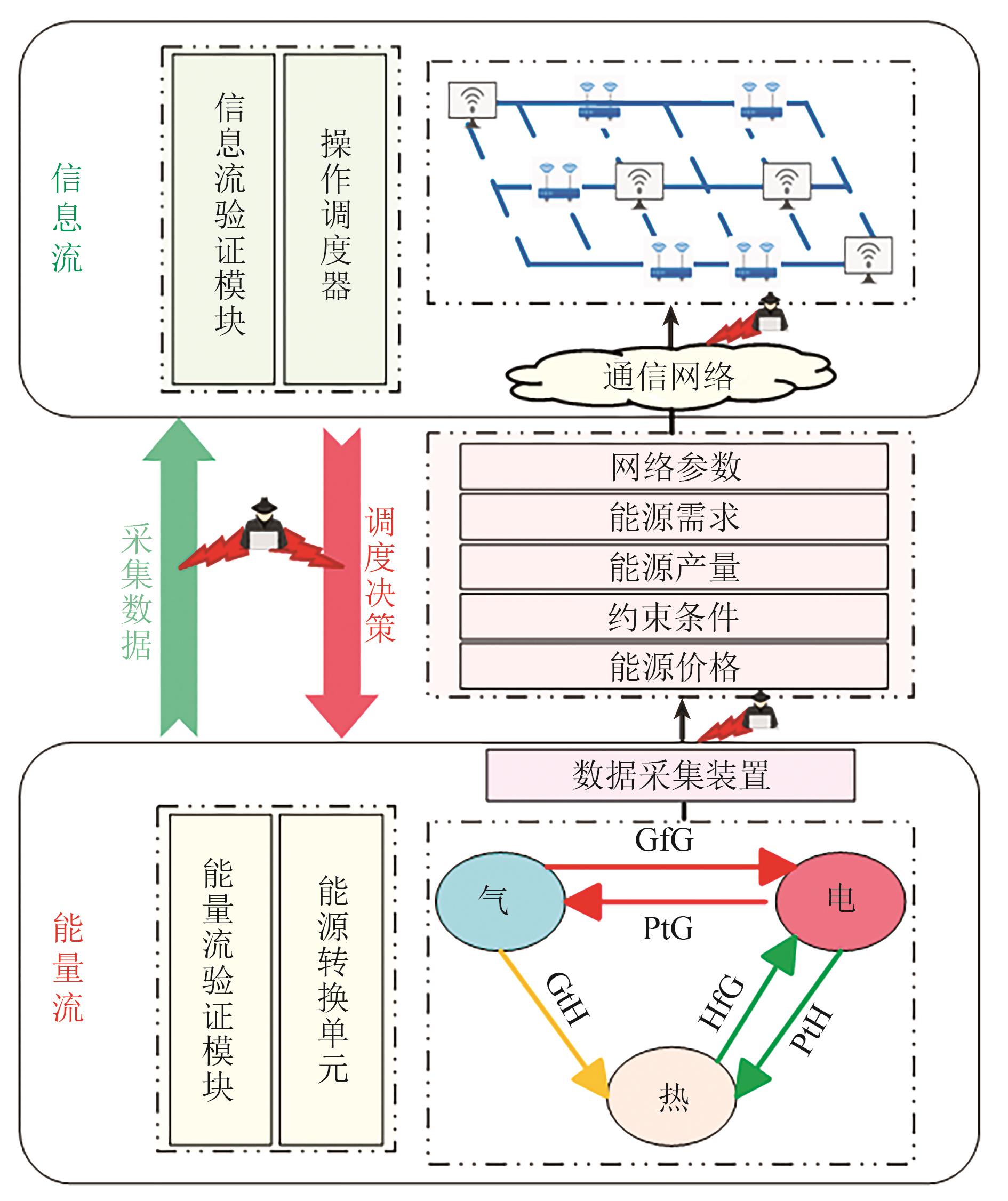
图1 系统网络攻击下的弹性调度框架
Fig. 1 Resilient scheduling framework under system cyberattacks
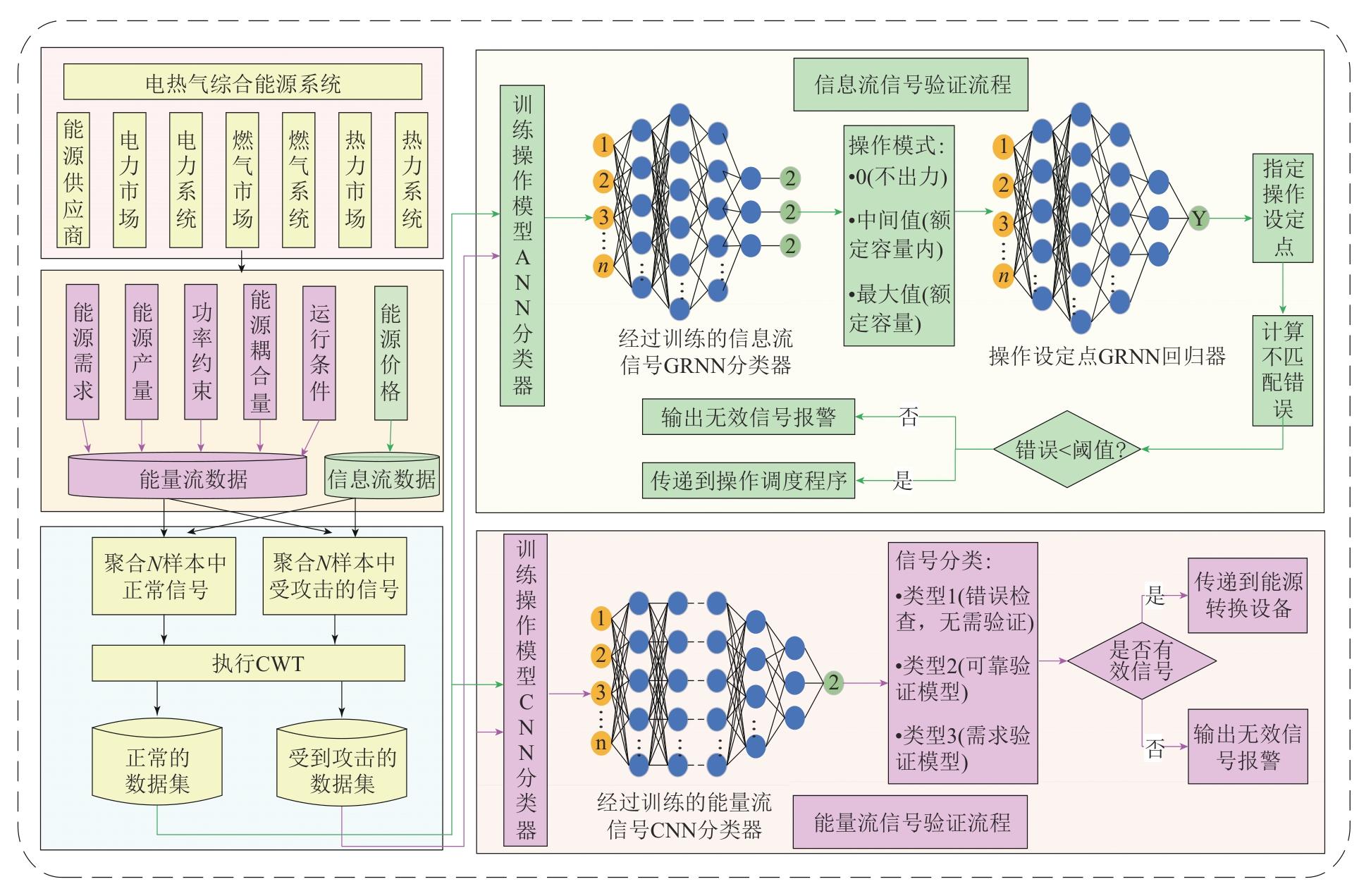
图2 针对能量流信号和信息流信号的网络攻击验证流程框架
Fig. 2 Framework for cyberattack verification process on energy flow and information flow signals
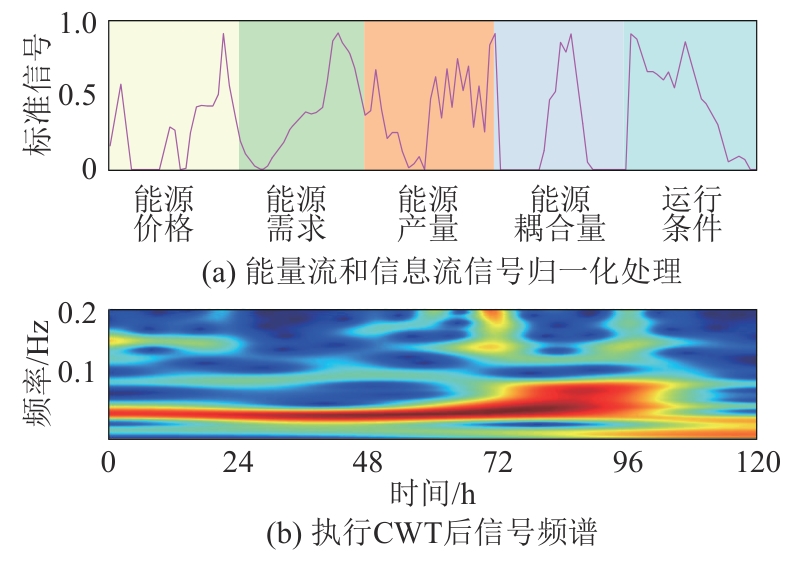
图3 主要能量流和信息流复合信号
Fig. 3 Main energy flow and information flowcomposite signals
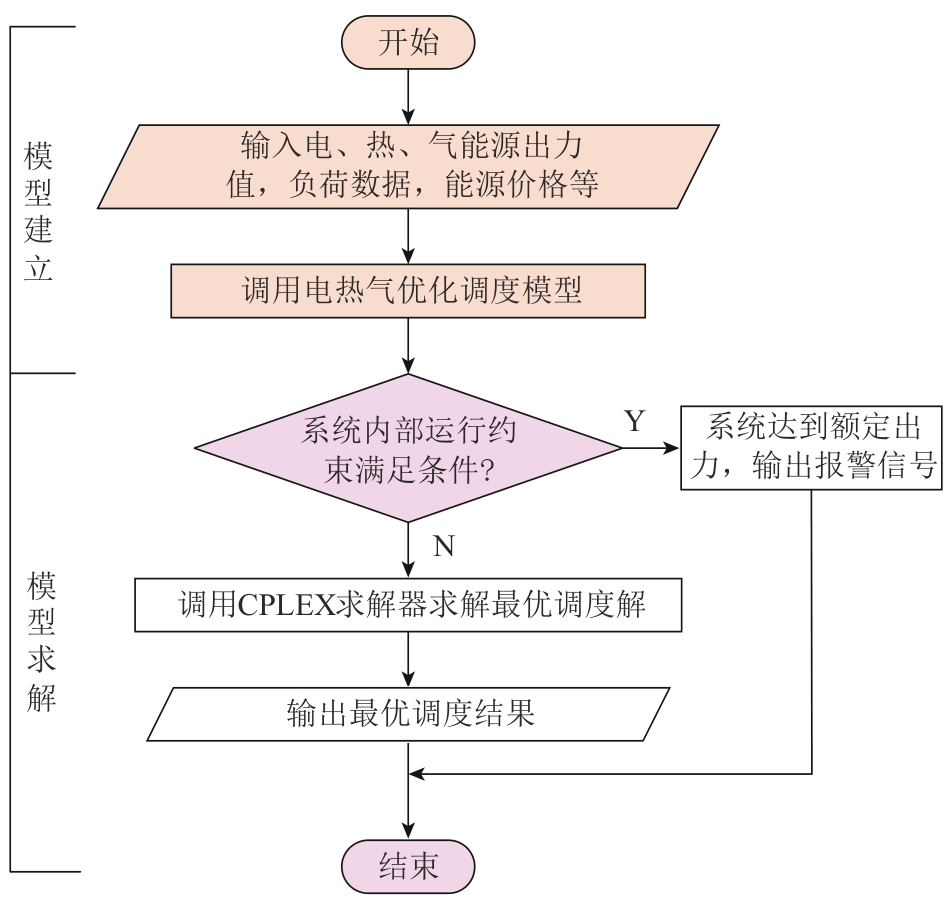
图4 优化调度模型求解流程图
Fig. 4 Solution flowchart of optimized scheduling model
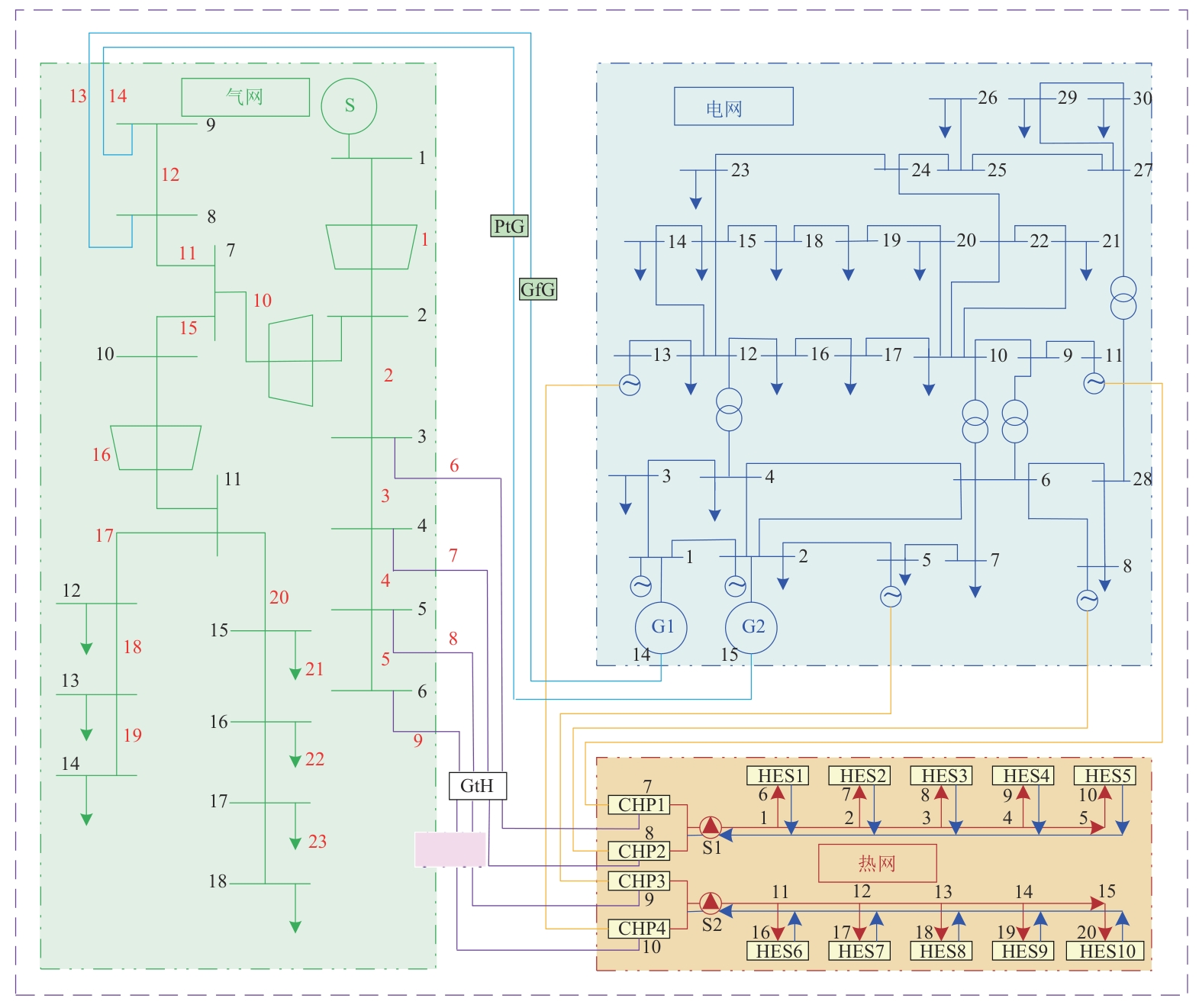
图5 电-热-气综合能源系统仿真模型
Fig. 5 Simulation model of integrated electricity-heat-gas energy system
节点 编号 | 有功 功率 | 无功 功率 | 有功 上限 | 有功 下限 | 无功 上限 | 无功 下限 |
|---|---|---|---|---|---|---|
| 1 | — | — | 1.0 | 0.5 | 1.0 | -0.20 |
| 2 | 0.8 | — | 0.8 | 0.2 | 0.6 | -0.20 |
| 5 | 0.5 | — | 0.5 | 0.15 | 0.624 5 | -0.15 |
| 8 | 0.2 | — | 0.35 | 0.1 | 0.487 3 | -0.15 |
| 11 | 0.2 | — | 0.3 | 0.1 | 0.4 | -0.10 |
| 13 | 0.2 | — | 0.4 | 0.12 | 0.447 2 | -0.15 |
表1 电力系统发电机组参数
Tab. 1 Parameters of power system generation units pu
节点 编号 | 有功 功率 | 无功 功率 | 有功 上限 | 有功 下限 | 无功 上限 | 无功 下限 |
|---|---|---|---|---|---|---|
| 1 | — | — | 1.0 | 0.5 | 1.0 | -0.20 |
| 2 | 0.8 | — | 0.8 | 0.2 | 0.6 | -0.20 |
| 5 | 0.5 | — | 0.5 | 0.15 | 0.624 5 | -0.15 |
| 8 | 0.2 | — | 0.35 | 0.1 | 0.487 3 | -0.15 |
| 11 | 0.2 | — | 0.3 | 0.1 | 0.4 | -0.10 |
| 13 | 0.2 | — | 0.4 | 0.12 | 0.447 2 | -0.15 |
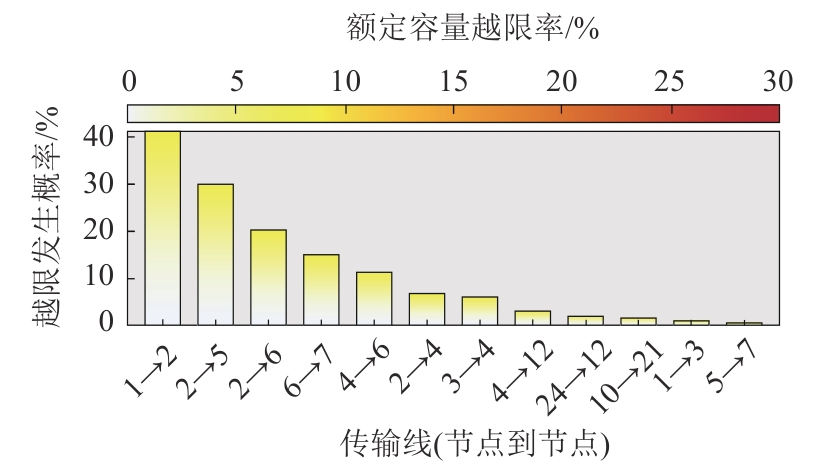
图6 攻击期间输电线路容量违规情况
Fig. 6 Transmission line capacity violations during attacks
| 检测方法 | 实际标签 | 测试 数据 | 确认受到攻击 | 确定为正常 | 检测 精度/% |
|---|---|---|---|---|---|
| 本文方法 | 受到攻击 | 1 247 | 1 178 | 69 | 94.47 |
| 正常 | 1 247 | 32 | 1 215 | 97.43 | |
| ANN | 受到攻击 | 1 247 | 1 124 | 123 | 90.14 |
| 正常 | 1 247 | 57 | 1 190 | 95.43 | |
| 2类SVM | 受到攻击 | 1 247 | 1 159 | 88 | 92.94 |
| 正常 | 1 247 | 44 | 1 203 | 96.47 | |
| 单类SVM | 受到攻击 | 1 247 | 783 | 464 | 92.79 |
| 正常 | 1 247 | 76 | 1 171 | 93.91 |
表2 本文方法与ML方法检测FDIA的准确性比较
Tab. 2 Comparison of FDIA detection accuracy between proposed method and ML method
| 检测方法 | 实际标签 | 测试 数据 | 确认受到攻击 | 确定为正常 | 检测 精度/% |
|---|---|---|---|---|---|
| 本文方法 | 受到攻击 | 1 247 | 1 178 | 69 | 94.47 |
| 正常 | 1 247 | 32 | 1 215 | 97.43 | |
| ANN | 受到攻击 | 1 247 | 1 124 | 123 | 90.14 |
| 正常 | 1 247 | 57 | 1 190 | 95.43 | |
| 2类SVM | 受到攻击 | 1 247 | 1 159 | 88 | 92.94 |
| 正常 | 1 247 | 44 | 1 203 | 96.47 | |
| 单类SVM | 受到攻击 | 1 247 | 783 | 464 | 92.79 |
| 正常 | 1 247 | 76 | 1 171 | 93.91 |
| 初始信号 | 训练数据 | 攻击检测精度/% | ||
|---|---|---|---|---|
| 1个样本 | 2个样本 | 3个样本 | ||
| 电价 | 没有噪声 | 87.47 | 97.36 | 98.56 |
| 带有噪声 | 85.00 | 94.80 | 96.10 | |
| PV发电 | 没有噪声 | 91.81 | 94.95 | 96.39 |
| 带有噪声 | 89.50 | 92.80 | 94.20 | |
表3 不同攻击样本数训练数据下FDIA检测精度
Tab. 3 FDIA detection accuracy in training data with different attack sample sizes
| 初始信号 | 训练数据 | 攻击检测精度/% | ||
|---|---|---|---|---|
| 1个样本 | 2个样本 | 3个样本 | ||
| 电价 | 没有噪声 | 87.47 | 97.36 | 98.56 |
| 带有噪声 | 85.00 | 94.80 | 96.10 | |
| PV发电 | 没有噪声 | 91.81 | 94.95 | 96.39 |
| 带有噪声 | 89.50 | 92.80 | 94.20 | |
| 机组 | 0出力 | 0~额定出力 | 额定出力 |
|---|---|---|---|
| 能源转换装置 | 65.2 | 14.6 | 20.2 |
| 能源子系统 | 44.8 | 14.0 | 41.2 |
表4 各机组平均出力的概率 (%)
Tab. 4 Probability of average output of each unit
| 机组 | 0出力 | 0~额定出力 | 额定出力 |
|---|---|---|---|
| 能源转换装置 | 65.2 | 14.6 | 20.2 |
| 能源子系统 | 44.8 | 14.0 | 41.2 |
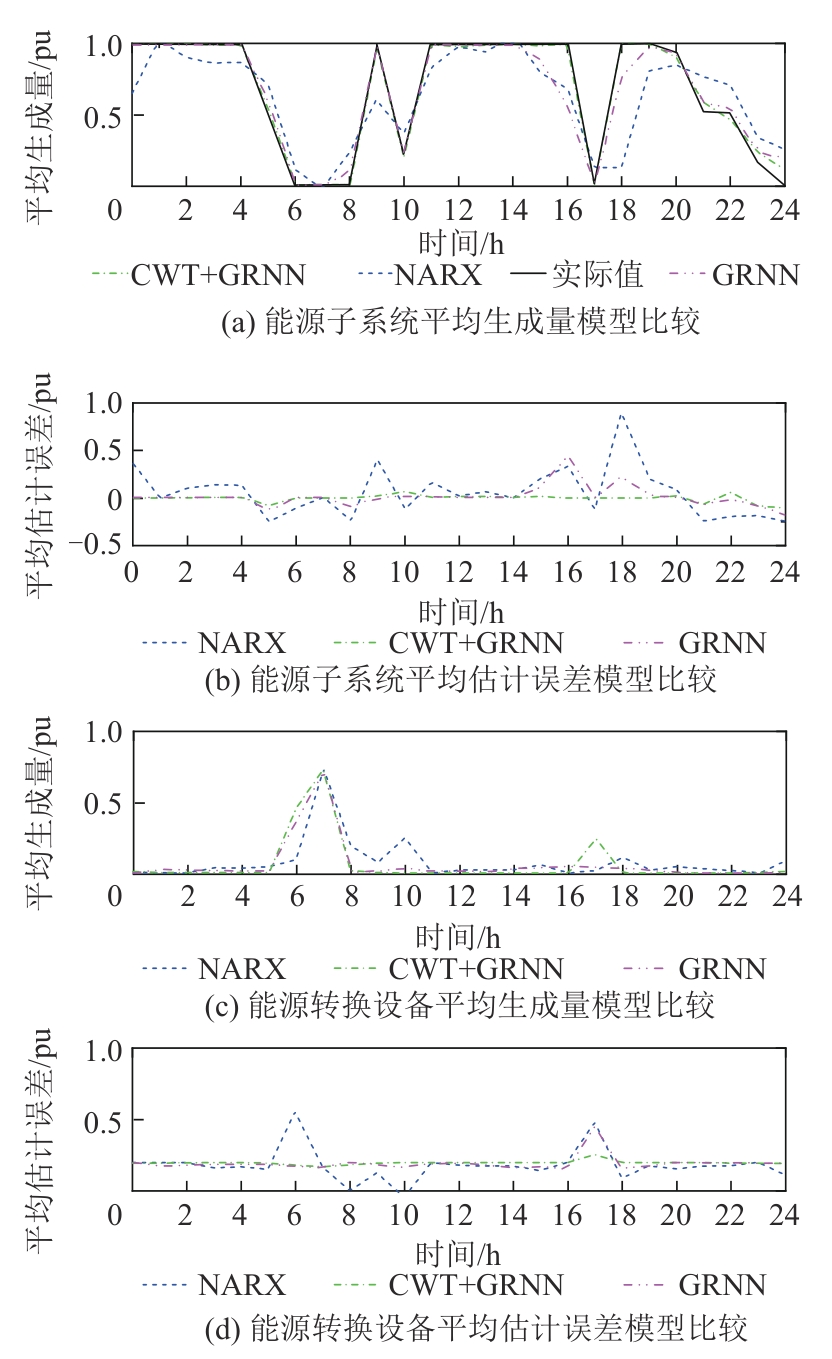
图7 CWT+GRNN与GRNN、NARX模型结果比较
Fig. 7 Comparison of results from CWT+GRNN, GRNN, and NARX models
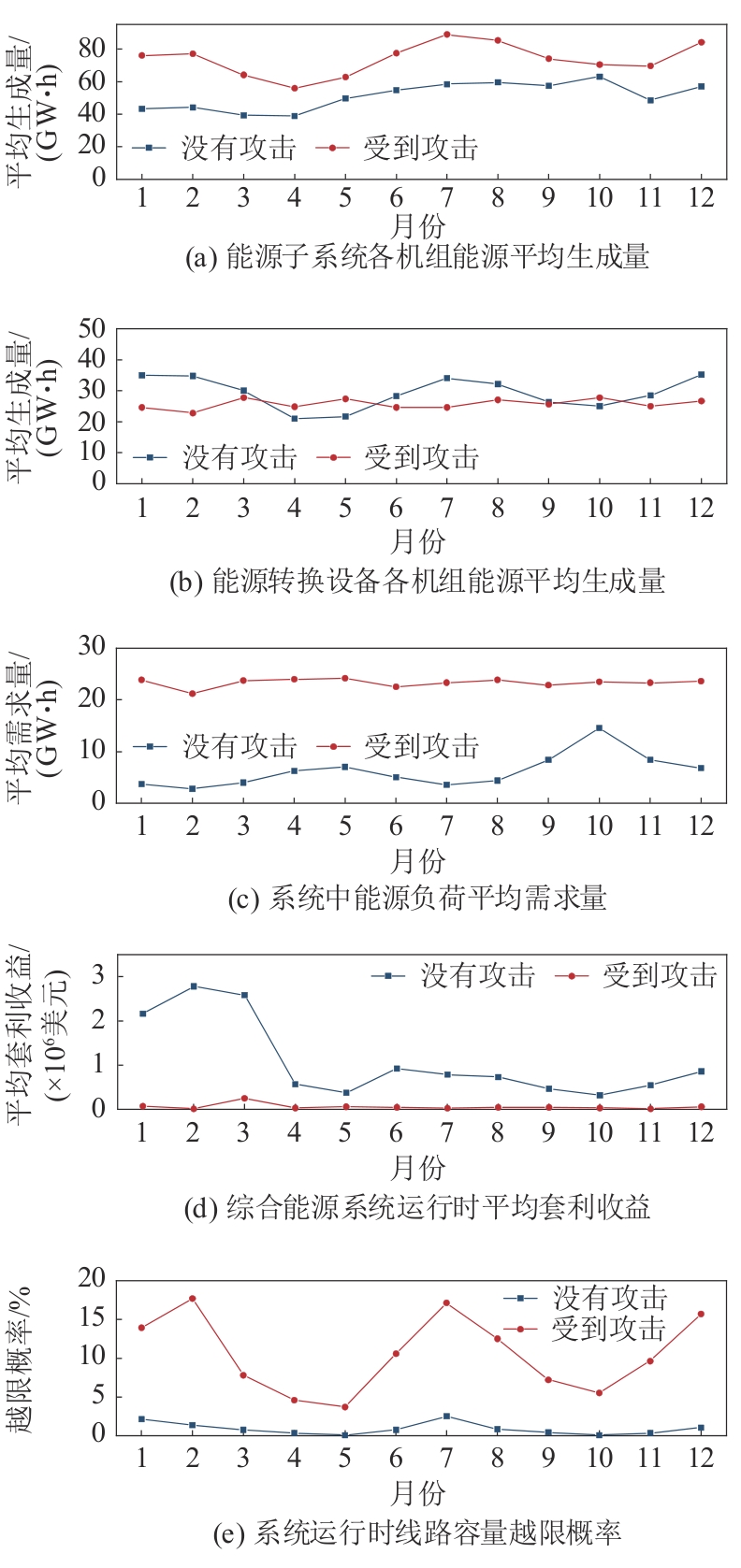
图8 综合能源系统中各设施的年运行情况
Fig. 8 Annual operation of facilities in integratedenergy system
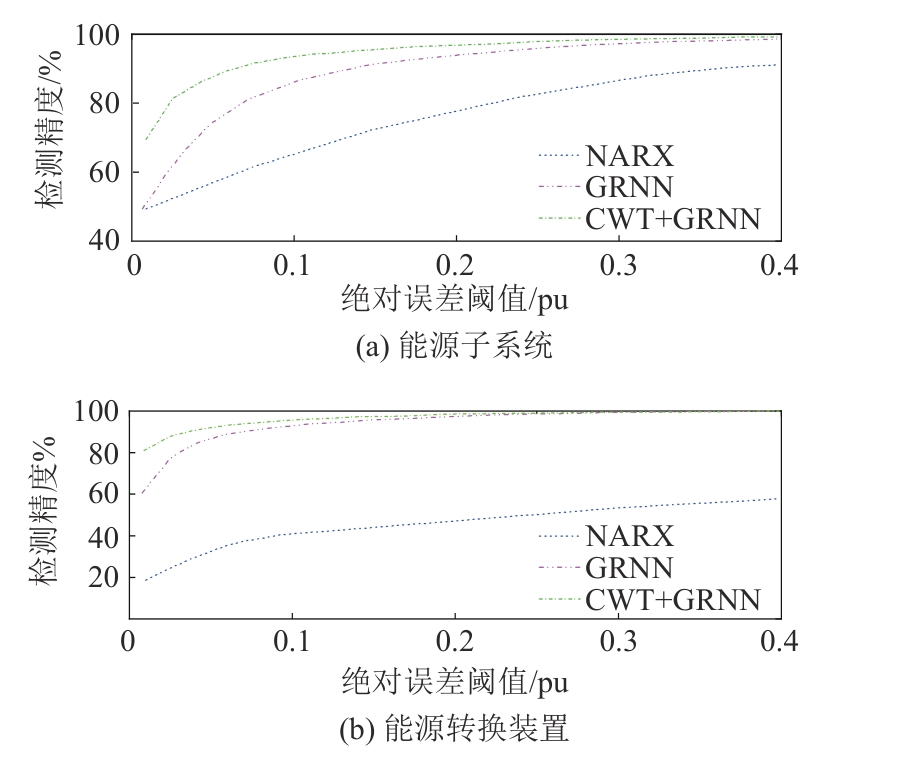
图9 不同检测模型下估计误差与检测关联性
Fig. 9 Estimation error and detection correlation of different detection models
| 系统工况 | 安全 可靠性 | 运行 经济性 | 弹性提升 效果 |
|---|---|---|---|
| 正常运行时 | 86.94 | 97.63 | 90.147 |
| 网络攻击下不含检测模型 | 63.22 | 84.35 | 69.559 |
| 网络攻击下含检测模型 | 86.01 | 97.24 | 89.379 |
表5 综合能源系统弹性提升效果评价 (%)
Tab. 5 Evaluation of resilience improvement in integrated energy system
| 系统工况 | 安全 可靠性 | 运行 经济性 | 弹性提升 效果 |
|---|---|---|---|
| 正常运行时 | 86.94 | 97.63 | 90.147 |
| 网络攻击下不含检测模型 | 63.22 | 84.35 | 69.559 |
| 网络攻击下含检测模型 | 86.01 | 97.24 | 89.379 |
| [1] | 韦晓广,高仕斌,臧天磊,等 .社会能源互联网:概念、架构和展望[J].中国电机工程学报,2018,38(17):4969-4986. doi:10.13334/j.0258-8013.pcsee.180846 |
| WEI X G, GAO S B, ZANG T L,et al .Social energy internet:concept,architecture and outlook[J].Proceedings of the CSEE,2018,38(17):4969-4986. doi:10.13334/j.0258-8013.pcsee.180846 | |
| [2] | 原凯,李敬如,宋毅,等 .区域能源互联网综合评价技术综述与展望[J].电力系统自动化,2019,43(14):41-52. doi:10.7500/AEPS20181129009 |
| YUAN K, LI J R, SONG Y,et al .Review and prospect of comprehensive evaluation technology of regional energy internet[J].Automation of Electric Power Systems,2019,43(14):41-52. doi:10.7500/AEPS20181129009 | |
| [3] | 黄华成,梁焕莲,岑东坤,等 .新型电力系统网络安全智能防护革新与应用[J].南方能源建设,2026,13(1):70-92. doi:10.16516/j.ceec.2025-121 |
| HUANG H C, LIANG H L, CEN D K,et al .Innovations and applications of novel power system cybersecurity intelligent protection[J].Southern Energy Construction,2026,13(1):70-92. doi:10.16516/j.ceec.2025-121 | |
| [4] | 沈超,李双岑,古丹妍,等 .面向新型电力系统的综合能源系统攻防博弈策略研究[J].电测与仪表,2026,63(1):56-63. |
| SHEN C, LI S C, GU D Y,et al .Research on integrated energy system attack-defense game strategy for novel power system[J].Electrical Measurement & Instrumentation,2026,63(1):56-63. | |
| [5] | 肖峻,李宗哲,宋晨辉,等 .综合能源系统能源耦合度及其对运行域的影响[J].电力系统自动化,2023,47(5):74-83. |
| XIAO J, LI Z Z, SONG C H,et al .Energy coupling degree of integrated energy system and its influence on operating region[J].Automation of Electric Power Systems,2023,47(5):74-83. | |
| [6] | 加鹤萍,丁一,宋永华,等 .信息物理深度融合背景下综合能源系统可靠性分析评述[J].电网技术,2019,43(1):1-11. doi:10.13335/j.1000-3673.pst.2018.2135 |
| JIA H P, DING Y, SONG Y H,et al .Review of reliability analysis for integrated energy systems with integration of cyber physical systems[J].Power System Technology,2019,43(1):1-11. doi:10.13335/j.1000-3673.pst.2018.2135 | |
| [7] | 黄博南,詹凤楠,张天闻,等 .一种针对电-热综合能源系统经济调度的DoS最优攻击策略[J].中国电机工程学报,2020,40(21):6839-6854. doi:10.13334/j.0258-8013.pcsee.200443 |
| HUANG B N, ZHAN F N, ZHANG T W,et al .An optimal DoS attack strategy against the economic dispatch for electric-thermal integrated energy system[J].Proceedings of the CSEE,2020,40(21):6839-6854. doi:10.13334/j.0258-8013.pcsee.200443 | |
| [8] | 阳育德,蓝水岚,覃智君,等 .电力信息物理融合系统的网络-物理协同攻击[J].电力自动化设备,2020,40(2):97-103. doi:10.16081/j.epae.202001004 |
| YANG Y D, LAN S L, QIN Z J,et al .Coordinated cyber-physical attacks of cyber-physical power system[J].Electric Power Automation Equipment,2020,40(2):97-103. doi:10.16081/j.epae.202001004 | |
| [9] | 席磊,王艺晓,熊雅慧,等 .基于改进深度极限学习机的电网虚假数据注入攻击定位检测[J].发电技术,2025,46(3):521-531. doi:10.12096/j.2096-4528.pgt.24115 |
| XI L, WANG Y X, XIONG Y H,et al .Location detection of false data injection attacks in power grid based on improved deep extreme learning machine[J].Power Generation Technology,2025,46(3):521-531. doi:10.12096/j.2096-4528.pgt.24115 | |
| [10] | 陈洪,陈惠文,冯良坤,等 .面向恶意攻击与级联失效的电力调度数据网络鲁棒性增强方法[J].广东电力,2025,38(2):28-37. |
| CHEN H, CHEN H W, FENG L K,et al .Robustness enhancement method for power dispatching data network against malicious attacks and cascading failures[J].Guangdong Electric Power,2025,38(2):28-37. | |
| [11] | 李卓,谢耀滨,吴茜琼,等 .基于深度学习的电力系统虚假数据注入攻击检测综述[J].电力系统保护与控制,2024,52(19):175-187. |
| LI Z, XIE Y B, WU Q Q,et al .Review of deep learning-based false data injection attack detection in power systems[J].Power System Protection and Control,2024,52(19):175-187. | |
| [12] | 常梦言,刘永慧 .虚假数据注入攻击下基于容积卡尔曼滤波的电力系统状态估计[J].电力科学与技术学报,2024,39(3):10-18. |
| CHANG M Y, LIU Y H .State estimation of power system based on cubature Kalman filter under false data injection attacks[J].Journal of Electric Power Science and Technology,2024,39(3):10-18. | |
| [13] | 韩一宁,张程彬,郭敏嘉,等 .基于深度强化学习面向虚假拓扑攻击和拓扑优化的电网调度方法[J].智慧电力,2024,52(3):25-31. |
| HAN Y N, ZHANG C B, GUO M J,et al .Deep reinforcement learning based dispatching method for power grid facing false topology attack and topology optimization[J].Smart Power,2024,52(3):25-31. | |
| [14] | 陶磊,罗萍萍,林济铿 .基于深度学习的直流微电网虚假数据注入攻击二阶段检测方法[J].中国电力,2024,57(9):11-19. doi:10.11930/j.issn.1004-9649.202311112 |
| TAO L, LUO P P, LIN J K .Two-stage detection method for DC microgrid false data injection attack based on deep learning[J].Electric Power,2024,57(9):11-19. doi:10.11930/j.issn.1004-9649.202311112 | |
| [15] | 申洪,周勤勇,刘耀,等 .碳中和背景下全球能源互联网构建的关键技术及展望[J].发电技术,2021,42(1):8-19. doi:10.12096/j.2096-4528.pgt.20113 |
| SHEN H, ZHOU Q Y, LIU Y,et al .Key technologies and prospects for the construction of global energy Internet under the background of carbon neutral[J].Power Generation Technology,2021,42(1):8-19. doi:10.12096/j.2096-4528.pgt.20113 | |
| [16] | 张宇航,倪明,孙永辉,等 .针对网络攻击的配电网信息物理系统风险量化评估[J].电力系统自动化,2019,43(21):12-22. doi:10.7500/AEPS20190401003 |
| ZHANG Y H, NI M, SUN Y H,et al .Quantitative risk assessment of cyber-physical system for cyber-attacks in distribution network[J].Automation of Electric Power Systems,2019,43(21):12-22. doi:10.7500/AEPS20190401003 | |
| [17] | LI X P, WANG Y K, LU Z G,et al .Graph-based detection for false data injection attacks in power grid[J].Energy,2023,263:125865. doi:10.1016/j.energy.2022.125865 |
| [18] | QU Z Y, DONG Y C, QU N,et al .False data injection attack detection in power systems based on cyber-physical attack genes[J].Frontiers in Energy Research,2021,9:644489. doi:10.3389/fenrg.2021.644489 |
| [19] | 王琦,邰伟,汤奕,等 .面向电力信息物理系统的虚假数据注入攻击研究综述[J].自动化学报,2019,45(1):72-83. doi:10.16383/j.aas.2018.c180369 |
| WANG Q, TAI W, TANG Y,et al .A review on false data injection attack toward cyber-physical power system[J].Acta Automatica Sinica,2019,45(1):72-83. doi:10.16383/j.aas.2018.c180369 | |
| [20] | TAJER A, SAURABH S, IHAG K,et al .Non-linear state recovery in power system under bad data and cyber attacks[J].Journal of Modern Power System and Clean Energy,2019,7(5):1071-1080. doi:10.1007/s40565-019-0561-2 |
| [21] | NAWAZ R, AKHTAR R, SHAHID M A,et al .Machine learning based false data injection in smart grid[J].International Journal of Electrical Power & Energy Systems,2021,130:106819. doi:10.1016/j.ijepes.2021.106819 |
| [22] | KOSUT O, JIA L Y, THOMAS R J,et al .On malicious data attacks on power system state estimation[C]//45th International Universities Power Engineering Conference UPEC2010.Cardiff,UK:IEEE,2010:1-6. doi:10.1109/ciss.2010.5464816 |
| [23] | KOSUT O, JIA L, THOMAS R J,et al .Malicious data attacks on smart grid state estimation:attack strategies and countermeasures[C]//2010 First IEEE International Conference on Smart Grid Communications.Gaithersburg,MD,USA:IEEE,2010:220-225. doi:10.1109/smartgrid.2010.5622045 |
| [24] | HUANG Y, ESMALIFALAK M, NGUYEN H,et al .Bad data injection in smart grid:attack and defense mechanisms[J].IEEE Communications Magazine,2013,51(1):27-33. doi:10.1109/mcom.2013.6400435 |
| [25] | ESMALIFALAK M, NGUYEN N T, ZHENG R,et al .Detecting stealthy false data injection using machine learning in smart grid[C]//2013 IEEEGlobal Communications Conference (GLOBECOM).Altanta,GA:IEEE,2013:808-813. doi:10.1109/glocom.2013.6831172 |
| [26] | RAWAT D B, BAJRACHARYA C .Detection of false data injection attacks in smart grid communication systems[J].IEEE Signal Processing Letters,2015,22(10):1652-1656. doi:10.1109/lsp.2015.2421935 |
| [27] | LIU L, ESMALIFALAK M, DING Q,et al .Detecting false data injection attacks on power grid by sparse optimization[J].IEEE Transactions on Smart Grid,2014,5(2):612-621. doi:10.1109/tsg.2013.2284438 |
| [28] | YANG Q, YANG J, YU W,et al .On false data-injection attacks against power system state estimation:modeling and countermeasures[J].IEEE Transactions on Parallel and Distributed Systems,2014,25(3):717-729. doi:10.1109/tpds.2013.92 |
| [29] | TAJER A, KAR S, POOR H V,et al .Distributed joint cyber attack detection and state recovery in smart grids[C]//2011IEEE International Conference on Smart Grid Communications (Smart Grid Comm).Brussels,Belgium:IEEE,2011:202-207. doi:10.1109/smartgridcomm.2011.6102319 |
| [30] | 朱杰,张葛祥 .基于历史数据库的电力系统状态估计欺诈性数据防御[J].电网技术,2016,40(6):1772-1777. doi:10.13335/j.1000-3673.pst.2016.06.024 |
| ZHU J, ZHANG G X .Defense against false data in power system state estimation based on historical database[J].Power System Technology,2016,40(6):1772-1777. doi:10.13335/j.1000-3673.pst.2016.06.024 | |
| [31] | 郑焕坤,吕婷婷,孙耀斌,等 .考虑信息设备故障的综合能源信息物理系统可靠性分析[J].高电压技术,2022,48(8):3078-3087. doi:10.13336/j.1003-6520.hve.20211785 |
| ZHENG H K, LV T T, SUN Y B,et al .Reliability analysis of integrated energy cyber physical system considering information equipment failure[J].High Voltage Engineering,2022,48(8):3078-3087. doi:10.13336/j.1003-6520.hve.20211785 | |
| [32] | 黄冬梅,何立昂,孙锦中,等 .基于边缘计算的电网假数据攻击分布式检测方法[J].电力系统保护与控制,2021,49(13):1-9. doi:10.19783/j.cnki.pspc.201130 |
| HUANG D M, HE L A, SUN J Z,et al .Distributed detection method for a false data attack in a power grid based on edge computing[J].Power System Protection and Control,2021,49(13):1-9. doi:10.19783/j.cnki.pspc.201130 | |
| [33] | 李政洁,撖奥洋,周生奇,等 .计及综合需求响应的综合能源系统优化调度[J].电力系统保护与控制,2021,49(21):36-42. doi:10.19635/j.cnki.csu-epsa.000740 |
| LI Z J, HAN A Y, ZHOU S Q,et al .Optimization of an integrated energy system considering integrated demand response[J].Power System Protection and Control,2021,49(21):36-42. doi:10.19635/j.cnki.csu-epsa.000740 | |
| [34] | 钟永洁,孙永辉,王庭华,等 .电热气互联能源系统动态环保经济协同灵活性调度[J].电网技术,2020,44(7):2457-2469. doi:10.13335/j.1000-3673.pst.2019.2463 |
| ZHONG Y J, SUN Y H, WANG T H,et al .Dynamic environmental economic and collaborative flexibility dispatch of integrated power,heat and natural gas energy system[J].Power System Technology,2020,44(7):2457-2469. doi:10.13335/j.1000-3673.pst.2019.2463 | |
| [35] | WOLF D D, SMEERS Y .The gas transmission problem solved by an extension of the simplex algorithm[J].Management Science,2000,46(11):1454-1465. doi:10.1287/mnsc.46.11.1454.12087 |
| [36] | 李元诚,曾婧 .基于改进卷积神经网络的电网假数据注入攻击检测方法[J].电力系统自动化,2019,43(20):97-104. doi:10.7500/AEPS20180919001 |
| LI Y C, ZENG J .Detection method of false data injection attack on power grid based on improved convolutional neural network[J].Automation of Electric Power Systems,2019,43(20):97-104. doi:10.7500/AEPS20180919001 | |
| [37] | JUNIOR W R L, MARTINS S A M, NEPOMUCENO E G,et al .Control of hysteretic systems through an analytical inverse compensation based on a NARX model[J].IEEE Access,2019,7:98228-98237. doi:10.1109/ACCESS.2019.2926057 |
| [38] | KHANI H, FARAG H E Z .Optimal day-ahead scheduling of power-to-gas energy storage and gas load management in wholesale electricity and gas markets[J].IEEE Transactions on Sustainable Energy,2018,9(2):940-951. doi:10.1109/tste.2017.2767064 |
| [1] | 刘可文, 侯朗博, 孙昊, 陈衡. 含高密度光伏与储能的配电网多目标优化调度策略[J]. 发电技术, 2026, 47(1): 214-224. |
| [2] | 罗斌, 白小龙, 臧天磊, 黄燕, 张琳, 李萌, 张雪霞, 蒋永龙. 风光水互补发电系统研究综述[J]. 发电技术, 2025, 46(6): 1097-1111. |
| [3] | 闫正义, 赵康, 王凯. 基于强化学习的新型电力系统优化策略应用综述[J]. 发电技术, 2025, 46(3): 508-520. |
| [4] | 侯慧, 王燕, 刘超, 张炜, 周杨珺, LI Zhengmao, 李正天, 林湘宁. 抽水蓄能灰启动下冷热电互补综合能源系统优化调度[J]. 发电技术, 2025, 46(2): 209-218. |
| [5] | 马恺, 袁至, 李骥. 考虑氢能多元化利用的综合能源系统低碳经济调度[J]. 发电技术, 2025, 46(2): 263-273. |
| [6] | 赵振宇, 李炘薪. 基于阶梯碳交易的碳捕集电厂-电转气虚拟电厂低碳经济调度[J]. 发电技术, 2023, 44(6): 769-780. |
| [7] | 许星原, 陈皓勇, 黄宇翔, 吴晓彬, 王宇绅, 廉俊豪, 张健彬. 虚拟电厂市场化交易中的挑战、策略与关键技术[J]. 发电技术, 2023, 44(6): 745-757. |
| [8] | 张宁, 朱昊, 杨凌霄, 胡存刚. 考虑可再生能源消纳的多能互补虚拟电厂优化调度策略[J]. 发电技术, 2023, 44(5): 625-633. |
| [9] | 彭道刚, 税纪钧, 王丹豪, 赵慧荣. “双碳”背景下虚拟电厂研究综述[J]. 发电技术, 2023, 44(5): 602-615. |
| [10] | 黄彦彰, 周宇昊, 郑文广, 王明晓. 产业园区新型多能联供综合能源服务研究[J]. 发电技术, 2021, 42(6): 734-740. |
| [11] | 董文博,顾秀芳,陈艳宁. 风电并网价值分析[J]. 发电技术, 2020, 41(3): 320-327. |
| [12] | 屈鲁,欧阳斌,袁志昌,张树卿,曾嵘. 综合能源系统中热力子系统的稳态特性分析[J]. 发电技术, 2020, 41(3): 237-244. |
| [13] | 蒋猛,黄宇,廖伟涵,张简炼,张又文,郭创新. 基于改进NSGA-Ⅱ算法的电-气-热综合能源系统多目标优化[J]. 发电技术, 2020, 41(2): 131-136. |
| [14] | 施云辉,郭创新,丁筱. 基于仿射可调鲁棒优化的园区综合能源系统经济调度[J]. 发电技术, 2020, 41(2): 118-125. |
| [15] | 施云辉,郭创新. 考虑运行风险的含储能综合能源系统优化调度[J]. 发电技术, 2020, 41(1): 56-63. |
| 阅读次数 | ||||||
|
全文 |
|
|||||
|
摘要 |
|
|||||
