

发电技术 ›› 2026, Vol. 47 ›› Issue (1): 133-144.DOI: 10.12096/j.2096-4528.pgt.260112
• 储能 • 上一篇
史宏思1, 孙新伟2,3, 王凯2
收稿日期:2025-05-13
修回日期:2025-07-15
出版日期:2026-02-28
发布日期:2026-02-12
通讯作者:
王凯
作者简介:基金资助:Hongsi SHI1, Xinwei SUN2,3, Kai WANG2
Received:2025-05-13
Revised:2025-07-15
Published:2026-02-28
Online:2026-02-12
Contact:
Kai WANG
Supported by:摘要:
目的 锂离子电池作为电动汽车和储能系统的关键组件,其健康状态(state of health,SOH)的准确预测对于确保系统可靠性、延长电池寿命以及优化能源管理具有重要意义。然而,电池在实际运行时因受多因素影响而导致性能衰减。为此,提出一种基于电化学阻抗谱(electrochemical impedance spectroscopy,EIS)数据的高精度SOH预测方法。 方法 采用EIS数据进行实验,并利用线性Kramers-Kronig算法对EIS数据进行预处理。采用卷积神经网络(convolutional neural network,CNN)、双向长短时记忆(bi-directional long short-term memory,BiLSTM)网络、注意力(Attention)组合模型作为预测模型,将EIS数据的阻抗实部、虚部和模值作为输入,利用CNN从中提取出重要特征,并结合BiLSTM网络模型来预测SOH。此外,通过加入Attention机制和Dropout算法来优化模型。 结果 通过不同温度下锂离子电池SOH预测及与CNN-BiLSTM、BiLSTM模型的对比表明,CNN-BiLSTM-Attention模型在25、35、45 ℃时SOH预测效果更优,精度较2个模型分别提升了46.1%和77.9%。 结论 基于EIS数据的SOH预测是可行的,CNN-BiLSTM-Attention组合模型能够实现锂离子电池SOH的精准、高效预测,具有较强的实用性。
中图分类号:
史宏思, 孙新伟, 王凯. 基于电化学阻抗谱的锂离子电池健康状态估计[J]. 发电技术, 2026, 47(1): 133-144.
Hongsi SHI, Xinwei SUN, Kai WANG. State of Health Estimation for Lithium-Ion Batteries Based on Electrochemical Impedance Spectroscopy[J]. Power Generation Technology, 2026, 47(1): 133-144.
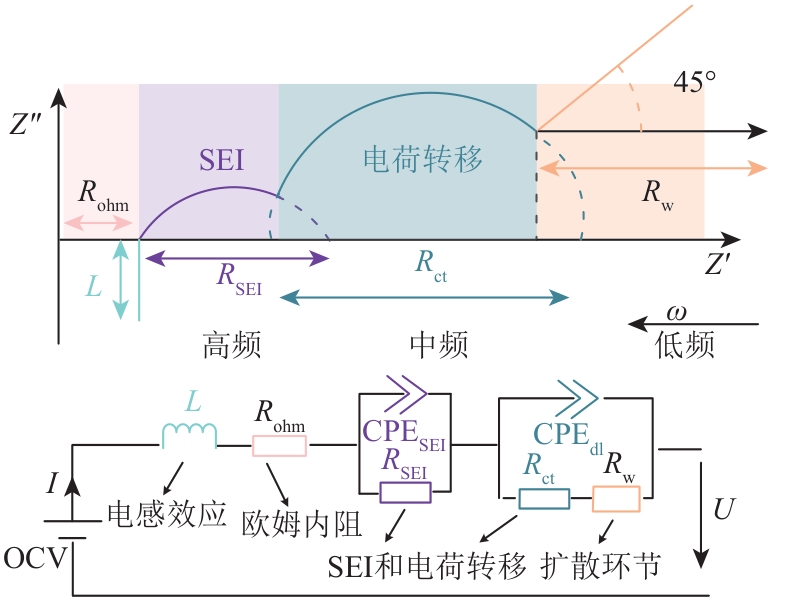
图1 理想EIS及其等效电路模型
Fig. 1 Ideal EIS and its equivalent circuit model
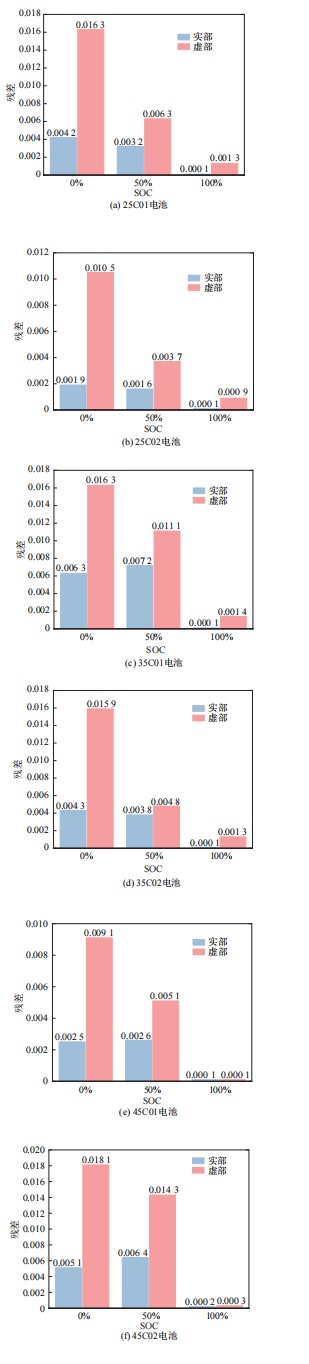
图2 不同状态下的阻抗实部和虚部残差
Fig. 2 Real and imaginary part residuals of impedance under different conditions
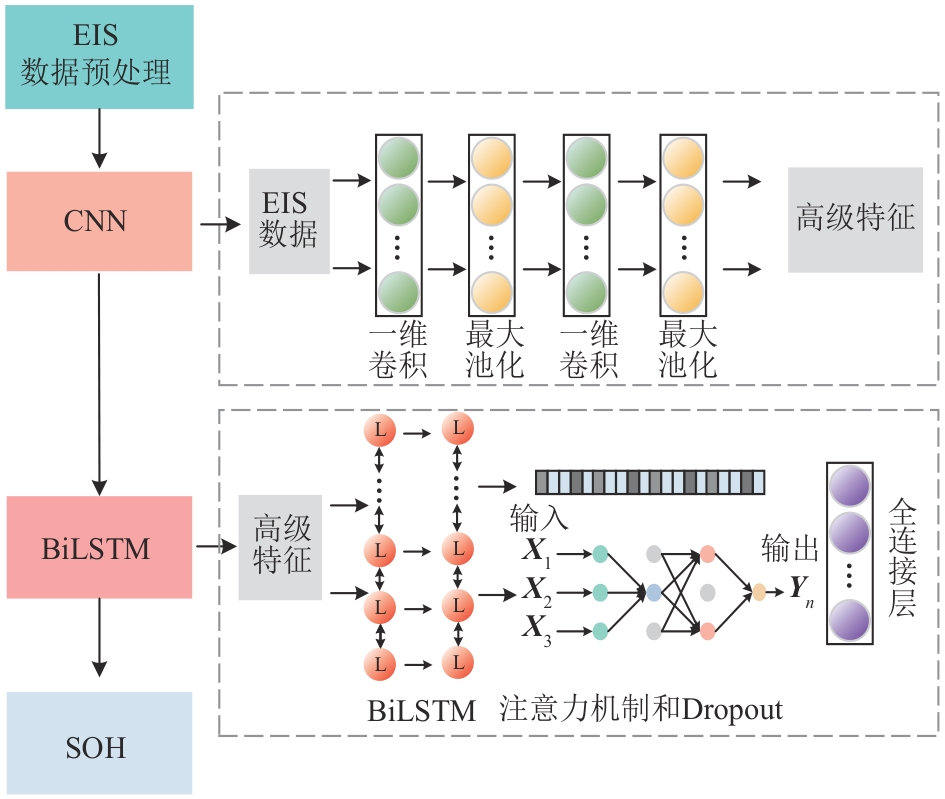
图3 基于EIS预测SOH的CNN-BiLSTM-Attention模型结构
Fig. 3 Structure of CNN-BiLSTM-Attention model for SOH prediction based on EIS
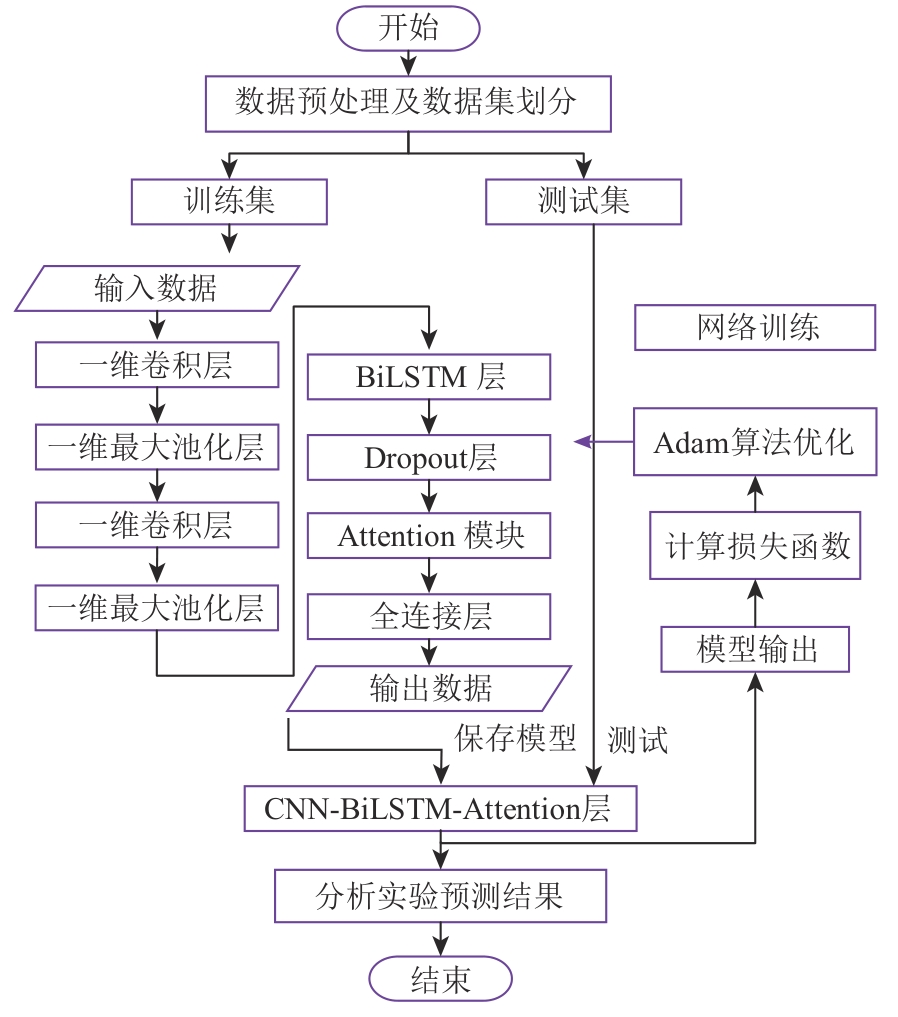
图4 预测流程图
Fig. 4 Prediction flowchart
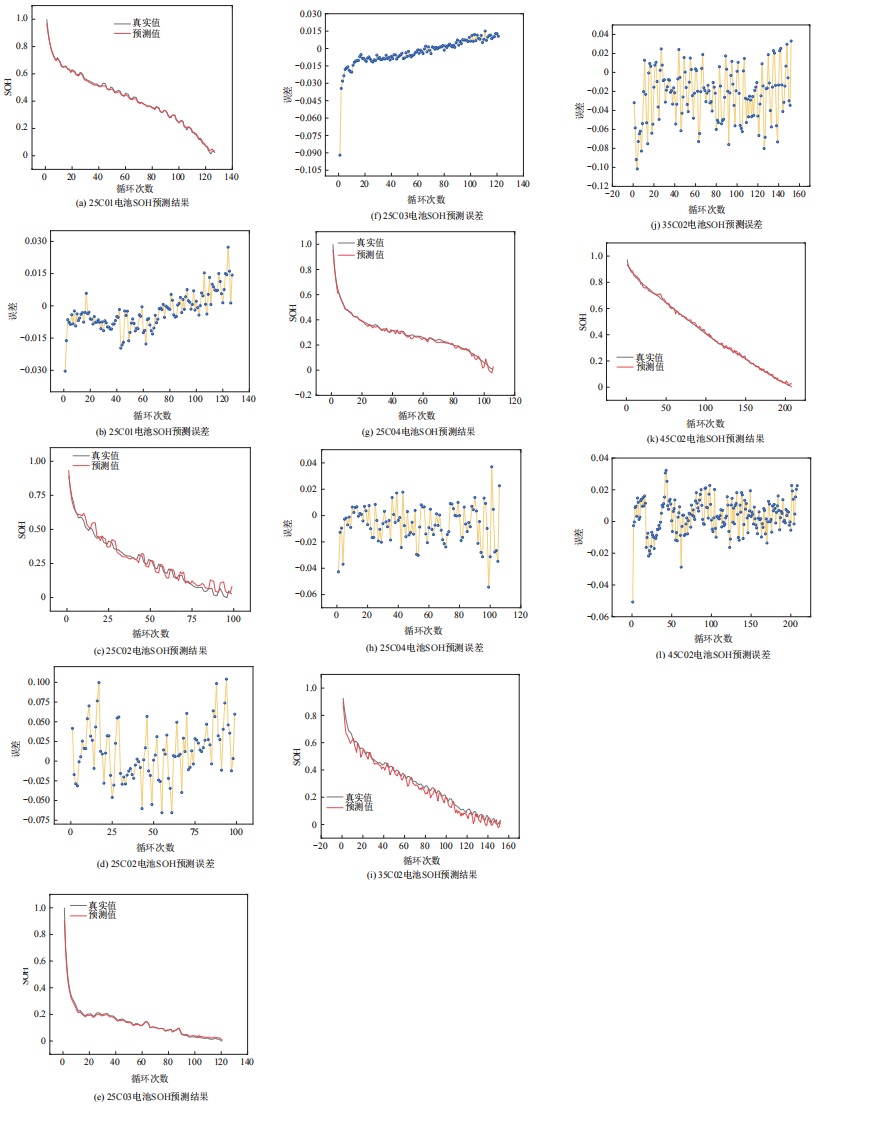
图5 CNN-BiLSTM-Attention模型SOH预测结果及误差
Fig. 5 SOH prediction results and errors of CNN-BiLSTM-Attention model
| 温度/℃ | 电池 | RMSE | MAE | R2 |
|---|---|---|---|---|
| 25 | 25C01 | 0.009 2 | 0.007 6 | 0.991 7 |
| 25C02 | 0.036 7 | 0.028 8 | 0.943 8 | |
| 25C03 | 0.011 9 | 0.018 2 | 0.981 9 | |
| 25C04 | 0.027 7 | 0.018 6 | 0.969 5 | |
| 35 | 35C02 | 0.036 8 | 0.039 7 | 0.917 6 |
| 45 | 45C02 | 0.011 1 | 0.008 6 | 0.998 1 |
表1 CNN-BiLSTM-Attention的SOH预测评价指标
Tab. 1 SOH prediction evaluation indicators of CNN-BiLSTM-Attention
| 温度/℃ | 电池 | RMSE | MAE | R2 |
|---|---|---|---|---|
| 25 | 25C01 | 0.009 2 | 0.007 6 | 0.991 7 |
| 25C02 | 0.036 7 | 0.028 8 | 0.943 8 | |
| 25C03 | 0.011 9 | 0.018 2 | 0.981 9 | |
| 25C04 | 0.027 7 | 0.018 6 | 0.969 5 | |
| 35 | 35C02 | 0.036 8 | 0.039 7 | 0.917 6 |
| 45 | 45C02 | 0.011 1 | 0.008 6 | 0.998 1 |
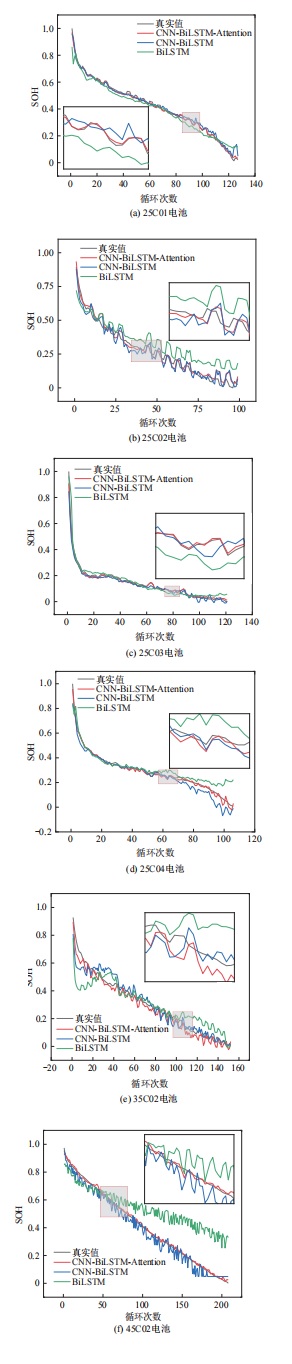
图6 不同模型SOH预测结果对比
Fig. 6 Comparison of SOH prediction results from different models
| 模型 | 电池 | RMSE | MAE | R2 |
|---|---|---|---|---|
| BiLSTM | 25C01 | 0.074 1 | 0.035 9 | 0.857 6 |
| 25C02 | 0.092 9 | 0.081 1 | 0.776 9 | |
| 25C03 | 0.080 8 | 0.026 3 | 0.735 2 | |
| 25C04 | 0.080 5 | 0.040 1 | 0.718 1 | |
| 35C02 | 0.094 2 | 0.064 4 | 0.790 4 | |
| 45C02 | 0.182 1 | 0.151 4 | 0.512 9 | |
| CNN-BiLSTM | 25C01 | 0.022 8 | 0.015 7 | 0.957 3 |
| 25C02 | 0.043 2 | 0.035 8 | 0.951 6 | |
| 25C03 | 0.021 5 | 0.015 1 | 0.967 0 | |
| 25C04 | 0.065 2 | 0.033 0 | 0.826 4 | |
| 35C02 | 0.056 0 | 0.040 9 | 0.925 7 | |
| 45C02 | 0.039 0 | 0.031 2 | 0.957 6 | |
| CNN-BiLSTM-Attention | 25C01 | 0.009 2 | 0.007 6 | 0.991 7 |
| 25C02 | 0.036 7 | 0.028 8 | 0.965 1 | |
| 25C03 | 0.011 9 | 0.008 2 | 0.989 9 | |
| 25C04 | 0.027 7 | 0.018 7 | 0.969 5 | |
| 35C02 | 0.036 8 | 0.029 7 | 0.967 8 | |
| 45C02 | 0.011 1 | 0.008 6 | 0.998 1 |
表2 各模型的SOH预测评价指标
Tab. 2 SOH prediction evaluation indicators of each model
| 模型 | 电池 | RMSE | MAE | R2 |
|---|---|---|---|---|
| BiLSTM | 25C01 | 0.074 1 | 0.035 9 | 0.857 6 |
| 25C02 | 0.092 9 | 0.081 1 | 0.776 9 | |
| 25C03 | 0.080 8 | 0.026 3 | 0.735 2 | |
| 25C04 | 0.080 5 | 0.040 1 | 0.718 1 | |
| 35C02 | 0.094 2 | 0.064 4 | 0.790 4 | |
| 45C02 | 0.182 1 | 0.151 4 | 0.512 9 | |
| CNN-BiLSTM | 25C01 | 0.022 8 | 0.015 7 | 0.957 3 |
| 25C02 | 0.043 2 | 0.035 8 | 0.951 6 | |
| 25C03 | 0.021 5 | 0.015 1 | 0.967 0 | |
| 25C04 | 0.065 2 | 0.033 0 | 0.826 4 | |
| 35C02 | 0.056 0 | 0.040 9 | 0.925 7 | |
| 45C02 | 0.039 0 | 0.031 2 | 0.957 6 | |
| CNN-BiLSTM-Attention | 25C01 | 0.009 2 | 0.007 6 | 0.991 7 |
| 25C02 | 0.036 7 | 0.028 8 | 0.965 1 | |
| 25C03 | 0.011 9 | 0.008 2 | 0.989 9 | |
| 25C04 | 0.027 7 | 0.018 7 | 0.969 5 | |
| 35C02 | 0.036 8 | 0.029 7 | 0.967 8 | |
| 45C02 | 0.011 1 | 0.008 6 | 0.998 1 |
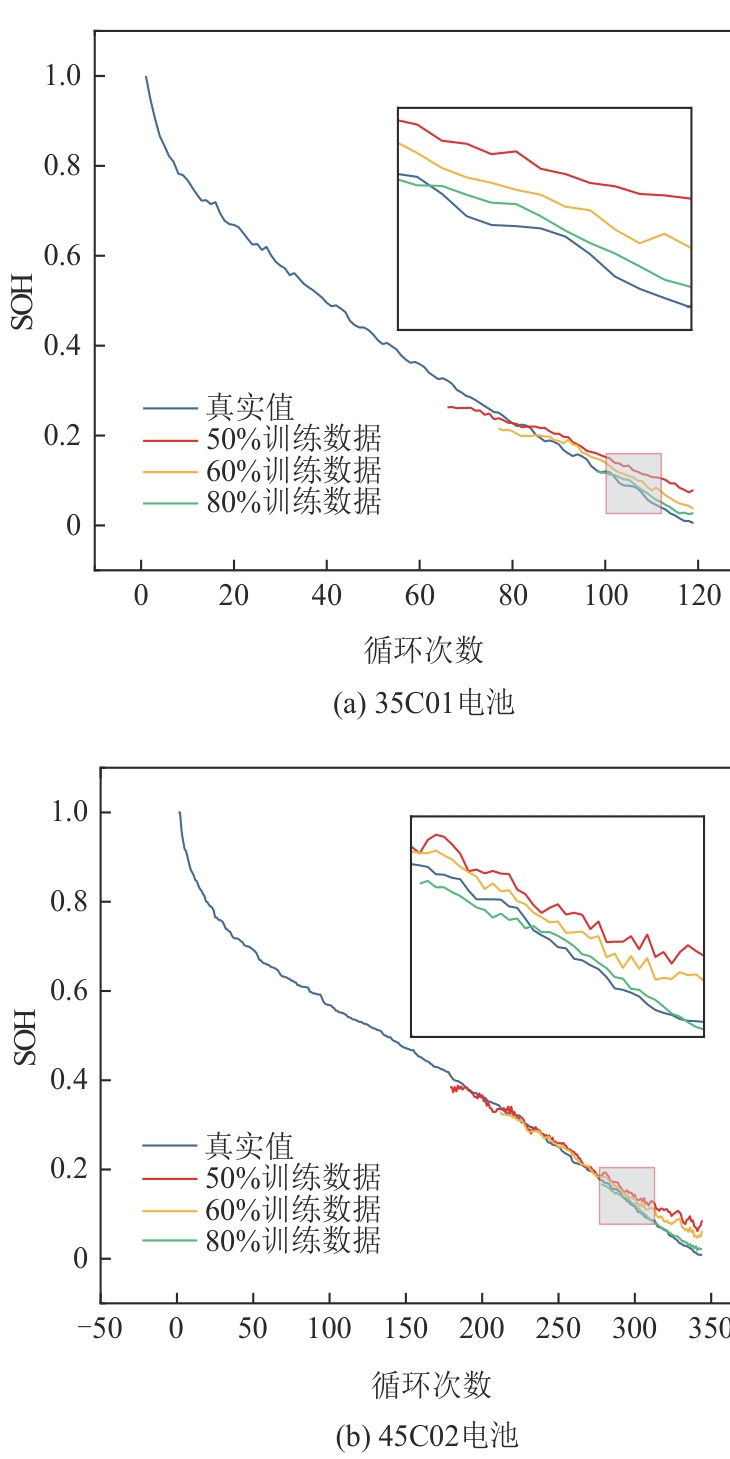
图7 2块电池SOH预测结果
Fig. 7 SOH prediction results for two batteries
| 电池 | 训练集比例/% | RMSE | MAE | R2 |
|---|---|---|---|---|
| 35C01 | 50 | 0.036 8 | 0.031 8 | 0.841 1 |
| 60 | 0.021 5 | 0.018 9 | 0.914 8 | |
| 80 | 0.007 8 | 0.006 9 | 0.960 4 | |
| 45C01 | 50 | 0.026 8 | 0.019 6 | 0.949 9 |
| 60 | 0.018 5 | 0.013 6 | 0.965 6 | |
| 80 | 0.006 6 | 0.005 4 | 0.983 4 |
表3 2块电池SOH预测评价指标
Tab. 3 SOH prediction evaluation indicators for two batteries
| 电池 | 训练集比例/% | RMSE | MAE | R2 |
|---|---|---|---|---|
| 35C01 | 50 | 0.036 8 | 0.031 8 | 0.841 1 |
| 60 | 0.021 5 | 0.018 9 | 0.914 8 | |
| 80 | 0.007 8 | 0.006 9 | 0.960 4 | |
| 45C01 | 50 | 0.026 8 | 0.019 6 | 0.949 9 |
| 60 | 0.018 5 | 0.013 6 | 0.965 6 | |
| 80 | 0.006 6 | 0.005 4 | 0.983 4 |
| [1] | 李春慧,陈翔,李向阳,等 .新型工业化城市环境能源复合承载力评价:以东莞市环境能源可持续发展为例[J].南方能源建设,2024,11(6):79-87. |
| LI C H, CHEN X, LI X Y,et al .Evaluation of environment and energy compound carrying capacity in newly industrialized cities:a case study of environmental and energy sustainable development of Dongguan[J].Southern Energy Construction,2024,11(6):79-87. | |
| [2] | HU X, FENG F, LIU K,et al .State estimation for advanced battery management:key challenges and future trends[J].Renewable and Sustainable Energy Reviews,2019,114:109334. doi:10.1016/j.rser.2019.109334 |
| [3] | 周原冰,龚乃玮,王皓界,等 .中国电动汽车发展及车网互动对新型储能配置的影响[J].中国电力,2024,57(10):1-11. |
| ZHOU Y B, GONG N W, WANG H J,et al .Study on the Influence of electric vehicle development and the vehicle-grid interaction on new energy storage configuration in China[J].Electric Power,2024,57(10):1-11. | |
| [4] | 贾俊,范炜豪,吕志鹏,等 .用于电动汽车集群并网的直流变压器启动研究[J].发电技术,2023,44(6):875-882. |
| JIA J, FAN W H, LÜ Z P,et al .Research on startup of DC transformer for electric vehicle cluster grid-connection[J].Power Generation Technology,2023,44(6):875-882. | |
| [5] | 张闯,高浪涛,刘素贞,等 .基于超声的锂离子电池微过充循环老化特性[J].电工技术学报,2024,39(24):7965-7978. |
| ZHANG C, GAO L T, LIU S Z,et al .Characterization of slight overcharge cycle aging of lithium-ion batteries based on ultrasonic[J].Transactions of China Electrotechnical Society,2024,39(24):7965-7978. | |
| [6] | ZUO H, ZHANG B, HUANG Z,et al .Effect analysis on SOC values of the power lithium manganate battery during discharging process and its intelligent estimation[J].Energy,2022,238:121854. doi:10.1016/j.energy.2021.121854 |
| [7] | 雷咸道,李杰,张二信 .基于改进TOPSIS-模糊贝叶斯网络的电池SOC和SOH联合估计方法[J].分布式能源,2024,9(5):68-75. |
| LEI X D, LI J, ZHANG E X .Joint estimation of battery SOC and SOH based on improved TOPSIS- fuzzy Bayesian network[J].Distributed Energy,2024,9(5):68-75. | |
| [8] | 赵珈卉,田立亭,程林 .锂离子电池状态估计与剩余寿命预测方法综述[J].发电技术,2023,44(1):1-17. |
| ZHAO J H, TIAN L T, CHENG L .Review on state estimation and remaining useful life prediction methods for lithium-ion battery[J].Power Generation Technology,2023,44(1):1-17. | |
| [9] | 蔡雨思,李泽文,刘萍,等 .基于间接健康特征优化与多模型融合的锂电池SOH-RUL联合预测[J].电工技术学报,2024,39(18):5883-5898. |
| CAI Y S, LI Z W, LIU P,et al .Joint prediction of lithium battery state of health and remaining useful life based on indirect health features optimization and multi-model fusion[J].Transactions of China Electrotechnical Society,2024,39(18):5883-5898. | |
| [10] | 刘旖琦,雷万钧,刘茜,等 .基于双自适应扩展粒子滤波器的锂离子电池状态联合估计[J].电工技术学报,2024,39(2):607-616. |
| LIU Y Q, LEI W J, LIU Q,et al .Joint state estimation of lithium-ion battery based on dual adaptive extended particle filter[J].Transactions of China Electrotechnical Society,2024,39(2):607-616. | |
| [11] | 吴青峰,杨艺涛,刘立群,等 .基于GA-SA-BP神经网络的锂电池健康状态估算方法[J].电力系统保护与控制,2024,52(19):74-84. |
| WU Q F, YANG Y T, LIU L Q,et al .Lithium battery state of health estimation method based on a GA-SA-BP neural network[J].Power System Protection and Control,2024,52(19):74-84. | |
| [12] | 耿萌萌,范茂松,杨凯,等 .基于EIS和神经网络的退役电池SOH快速估计[J].储能科学与技术,2022,11(2):673-678. |
| GENG M M, FAN M S, YANG K,et al .Fast estimation method for state-of-health of retired batteries based on electrochemical impedance spectroscopy and neural network[J].Energy Storage Science and Technology,2022,11(2):673-678. | |
| [13] | 陈媛,段文献,何怡刚,等 .带降噪自编码器和门控递归混合神经网络的电池健康状态估算[J].电工技术学报,2024,39(24):7933-7949. |
| CHEN Y, DUAN W X, HE Y G,et al .State of health estimation of lithium ion battery based on denoising autoencoder-gated recurrent unit[J].Transactions of China Electrotechnical Society,2024,39(24):7933-7949. | |
| [14] | 侯林涛,张彩萍,蔡雪,等 .基于阻抗谱重构技术的电池健康状态快速估计方法[J].全球能源互联网,2024,7(2):145-154. |
| HOU L T, ZHANG C P, CAI X,et al .A fast estimation method of battery state of health based on impedance spectroscopy reconstruction technique[J].Journal of Global Energy Interconnection,2024,7(2):145-154. | |
| [15] | CHANG C, WANG S, JIANG J,et al .Lithium-ion battery state of health estimation based on electrochemical impedance spectroscopy and cuckoo search algorithm optimized Elman neural network[J].Journal of Electrochemical Energy Conversion and Storage,2022,19(3):030912. doi:10.1115/1.4054128 |
| [16] | 张连德 .基于电化学阻抗谱的三元锂离子电池状态估计研究[D].长春:吉林大学,2018. |
| ZHANG L D .Study on state estimation of ternary lithium ion battery based on electrochemical impedance spectroscopy[D].Changchun:Jilin University,2018. | |
| [17] | CHEN M G, WANG Q K, SHEN J N,et al .Electrochemical impedance feature selection and gaussian process regression based on the state-of-health estimation method for lithium-ion batteries[J].Energy Storage Science and Technology,2022,11(9):2995-3002. |
| [18] | 李世忠 .基于分数阶建模与滤波的锂离子电池SOC估计方法研究[D].济南:山东大学,2021. |
| LI S Z .Research on SOC estimation methods of lithium-ion batteries based on fractional-order modeling and filtering[D].Jinan:Shandong University,2021. | |
| [19] | XIONG R, TIAN J, MU H,et al .A systematic model-based degradation behavior recognition and health monitoring method for lithium-ion batteries[J].Applied Energy,2017,207:372-383. doi:10.1016/j.apenergy.2017.05.124 |
| [20] | 闫佳乐 .基于EIS的退役锂离子电池SOH估计研究[D].合肥:合肥学院,2023. |
| YAN J L .Study on SOH estimation of retired Li-ion batteries based on EIS[D].Hefei:Hefei University,2023. | |
| [21] | ZHANG Y, TANG Q, ZHANG Y,et al .Identifying degradation patterns of lithium ion batteries from impedance spectroscopy using machine learning[J].Nature Communications,2020,11(1):1706. doi:10.1038/s41467-020-15235-7 |
| [22] | SCHÖNLEBER M, KLOTZ D, IVERS-TIFFÉE E .A method for improving the robustness of linear Kramers-Kronig validity tests[J].Electrochimica Acta,2014,131:20-27. doi:10.1016/j.electacta.2014.01.034 |
| [23] | CUI Z, WANG L, LI Q,et al .A comprehensive review on the state of charge estimation for lithium-ion battery based on neural network[J].International Journal of Energy Research,2022,46(5):5423-5440. doi:10.1002/er.7545 |
| [24] | 李俊卿,苑浩,黄涛,等 .基于PSA引导双分支神经网络特征融合的同步电机故障诊断[J].智慧电力,2024,52(12):51-58. |
| LI J Q, YUAN H, HUANG T,et al .Fault diagnosis of synchronous motor based on PSA guided double branch neural network feature fusion[J].Smart Power,2024,52(12):51-58. | |
| [25] | 明彤彤 .基于Mogrifier LSTM-CNN的锂离子电池荷电状态和健康状态联合估算[D].青岛:青岛大学,2021. |
| MING T T .Joint estimation of state of charge and health of lithium-ion batteries based on Mogrifier LSTM-CNN[D].Qingdao:Qingdao University,2021. | |
| [26] | 李虹,韩雨萌 .基于LSTM-CGAN的多微网数据驱动分布鲁棒协同优化运行策略[J].电力系统保护与控制,2024,52(18):133-148. |
| LI H, HAN Y M .Data-driven distributionally robust collaborative optimization operation strategy for a multi-microgrid based on LSTM-CGAN[J].Power System Protection and Control,2024,52(18):133-148. | |
| [27] | 李英顺,阚宏达,郭占男,等 .基于数据预处理和VMD-LSTM-GPR的锂离子电池剩余寿命预测[J].电工技术学报,2024,39(10):3244-3258. |
| LI Y S, KAN H D, GUO Z N,et al .Prediction of remaining useful life of lithium-ion battery based on data preprocessing and VMD-LSTM-GPR[J].Transactions of China Electrotechnical Society,2024,39(10):3244-3258. | |
| [28] | 李德志 .基于电化学阻抗谱的锂离子电池SOH预测研究[D].青岛:青岛大学,2023. |
| LI D Z .Study on SOH prediction of lithium ion batteries based on electrochemical impedance spectroscopy[D].Qingdao:Qingdao University,2023. | |
| [29] | 刘斌,吉春霖,曹丽君,等 .基于自适应噪声完全集合经验模态分解与BiLSTM-Transformer的锂离子电池剩余使用寿命预测[J].电力系统保护与控制,2024,52(15):167-177. |
| LIU B, JI C L, CAO L J,et al .Prediction of remaining service life of lithium-ion batteries based on complete ensemble empirical mode decomposition with adaptive noise and BiLSTM-Transformer[J].Power System Protection and Control,2024,52(15):167-177. | |
| [30] | 何健明,李梦诗,张禄亮,等 .基于Attention和残差网络的非侵入式负荷监测[J].电测与仪表,2024,61(6):173-180. |
| HE J M, LI M S, ZHANG L L,et al .Non-intrusive load monitoring algorithm based on attention and residual networks[J].Electrical Measurement & Instrumentation,2024,61(6):173-180. | |
| [31] | 崔振华 .基于优化神经网络的锂离子电池SOC估计及低温迁移问题的研究[D].青岛:青岛大学,2023. |
| CUI Z H .Research on SOC estimation and low temperature migration of lithium ion battery based on optimized neural network[D].Qingdao:Qingdao University,2023. | |
| [32] | 娄奇鹤,李荣盛,谭捷,等 .基于卷积神经网络的暂稳极限功率计算[J].中国电力,2024,57(4):211-219. |
| LOU Q H, LI R S, TAN J,et al .Calculation of transient stability limit based on convolutional neural network[J].Electric Power,2024,57(4):211-219. | |
| [33] | 付宽,王洪新,刘杰,等 .基于马尔可夫变迁场和EfficientNet的复合电能质量扰动识别[J].电网与清洁能源,2024,40(4):74-83. |
| FU K, WANG H X, LIU J,et al .Recognition of composite power quality disturbances based on MTF-EfficientNet convolutional neural network[J].Advances of Power System & Hydroelectric Engineering,2024,40(4):74-83. |
| [1] | 展宗波, 任吉平, 丁立平, 孙兆龙, 丁衡, 曹越. 高背压抽凝热电联供系统建模及快速变负荷控制策略研究[J]. 发电技术, 2025, 46(6): 1074-1084. |
| [2] | 罗斌, 白小龙, 臧天磊, 黄燕, 张琳, 李萌, 张雪霞, 蒋永龙. 风光水互补发电系统研究综述[J]. 发电技术, 2025, 46(6): 1097-1111. |
| [3] | 陈锋, 路小敏, 沈冰, 王军鹏. 基于消纳-保供博弈的分布式储能双层规划模型[J]. 发电技术, 2025, 46(6): 1133-1143. |
| [4] | 张效伟, 衣振晓, 王凯. 基于改进自适应蜜獾算法优化时间卷积网络的车载锂离子电池健康状态估计[J]. 发电技术, 2025, 46(6): 1154-1163. |
| [5] | 张静姝, 刘倩, 姚晓乐, 徐超, 巨星. 应用于锂离子电池无源热管理与安全防护的水合盐复合相变材料[J]. 发电技术, 2025, 46(6): 1164-1175. |
| [6] | 刘超, 刘亮德, 连天成, 赵伟, 杨绪飞, 刘广林. 基于吨水发电量的地热有机朗肯循环发电系统参数优化[J]. 发电技术, 2025, 46(6): 1223-1230. |
| [7] | 施凯, 龚祎帆, 徐培凤, 杜怿, 孙宇新, 任明炜. 基于功率环与电流环联合控制的虚拟同步发电机故障穿越控制策略[J]. 发电技术, 2025, 46(6): 1231-1239. |
| [8] | 李建林, 彭禹宸, 王茜, 姜晓霞, 王垒. 锂离子电池建模研究现状与展望[J]. 发电技术, 2025, 46(5): 857-871. |
| [9] | 邹博, 任建地, 许道明, 邓立生, 廖力达, 肖俊兵. 氯化物熔盐储热技术应用于新能源发电的研究进展[J]. 发电技术, 2025, 46(5): 872-884. |
| [10] | 庄坤, 汪中宏, 张一凡, 殷文倩, 雷茂云, 朱静, 李锋, 叶季蕾. 整县屋顶分布式光伏发电经济性模型及关键影响因素[J]. 发电技术, 2025, 46(5): 950-958. |
| [11] | 罗宗龙, 刘世林. 基于信息间隙决策理论鲁棒模型的户用微电网优化运行[J]. 发电技术, 2025, 46(4): 705-714. |
| [12] | 鲁亚楠, 徐涛, 刘泽楠. 制氢系统对双馈风机串补系统次同步振荡特性的影响[J]. 发电技术, 2025, 46(4): 715-726. |
| [13] | 马浩然, 袁至, 王维庆, 李骥. 考虑数据中心和储能接入的主动配电网经济调度研究[J]. 发电技术, 2025, 46(4): 748-757. |
| [14] | 王杰, 徐立军, 李笑竹, 樊小朝, 古丽扎提∙海拉提null, 王维庆. 计及灵活性不足风险的配电网智能软开关与多类型共享储能协调优化[J]. 发电技术, 2025, 46(4): 758-767. |
| [15] | 张祖菡, 刘敦楠, 凡航, 杨柳青, 段赟杰, 李赟, 马振宇. 基于大语言模型的电力系统预测技术研究综述[J]. 发电技术, 2025, 46(3): 438-453. |
| 阅读次数 | ||||||
|
全文 |
|
|||||
|
摘要 |
|
|||||
