




0 引言
随着全球经济的发展,传统煤、油、天然气等不可再生的能源储量已经不能满足人们未来对于能源的大量需求,同时化石燃料燃烧带来的碳氮硫化合物的环境和气候问题早已不可忽视。我国对于清洁环保的需求与日俱增,新能源发电机组的装机总量与发电量逐年上涨,光伏、风电等一些可再生资源具有随机性和不确定性,给电力系统的峰值负荷调节带来了巨大的挑战。一方面,新能源发电的输出随机变化,会导致峰值负荷调节能力不足,发电负荷无法被及时消纳,发电溢出和负荷脱落,经济成本高昂,甚至导致严重的系统安全问题[1-4],与电网极高的供电质量要求相悖。另一方面,如光伏发电在白天提供高输出,满足大负载需求,但在夜间无法提供输出,很多新能源发电都会产生“鸭型曲线”[5]。随着可再生能源占比的迅速增加,火电机组深度调峰改造刻不容缓[6-7]。
目前国内外学者对热电解耦的相关技术已有多项实践成果。我国为了解决新能源发电的不确定性,做了很多的努力。在我国东北电网已完成灵活性改造火电机组装机容量46 120 MW,约占火电总装机容量的45%。通过改造,增加深调能力16 570 MW,成为确保电网安全供电、促进新能源消纳的“主力军”;我国首创的“亚临界机组600℃升温改造技术”也已正式投入使用,可满足机组负荷在20%~100%灵活调节的需求,已在徐州华润电厂#3机组实施改造并通过验收[6]。
基于以上背景,本文通过对火电机组进行多种热电解耦改造方案技术路径对比,选择低压缸零出力、高背压下联合乏汽供热、压缩式热泵解耦3种方案,对火电机组进行热电解耦改造,通过软件模拟计算得出理论最优方案。通过改造,适应并协助新能源发电厂进行发电,利用能源管理的大数据宏观调控,根据新能源发电厂发电量进行实时调峰,进一步促进可再生能源并网,进而提高经济效益并促进可再生能源消纳。
1 案例机组介绍
图1
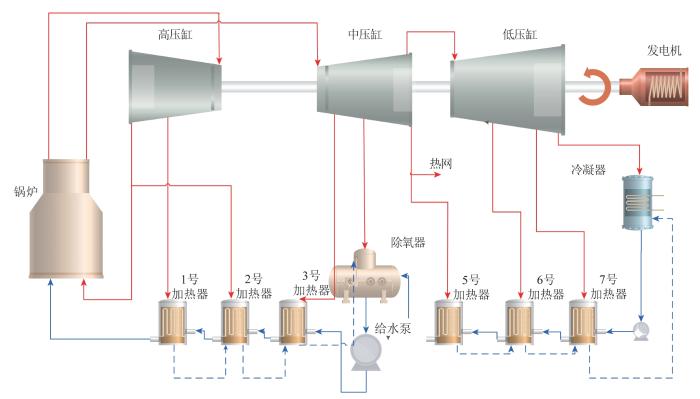
表1 案例机组THA工况下基本热力学参数
Tab. 1
| 参数 | 数值 |
|---|---|
| 主蒸汽温度/℃ | 538.00 |
| 主蒸汽压力/MPa | 16.67 |
| 主蒸汽流量/(t/h) | 937.35 |
| 再热蒸汽温度/℃ | 538.00 |
| 再热蒸汽压力/MPa | 3.32 |
| 再热蒸汽流量/(t/h) | 783.57 |
| 额定背压/kPa | 14.00 |
| 给水温度/℃ | 272.20 |
| 额定功率/MW | 300.00 |
2 案例机组不同热电解耦方案
2.1 案例机组THA工况热力分析与验证
图2
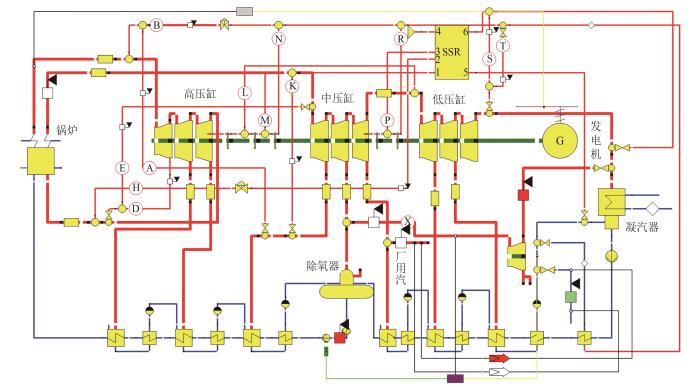
经验证,由软件建模并计算所得参数值与设计值相差不大,各项误差均在可控范围内。最终机组发电功率误差0.49%,误差较小,可根据模型数据继续进行研究,模型验证结果见表2。
表2 模型验证结果
Tab. 2
| 参数 | 设计值 | 计算值 | 相对误差/% |
|---|---|---|---|
| 主蒸汽温度/℃ | 538.00 | 538.00 | 0.00 |
| 主蒸汽压力/MPa | 16.67 | 16.67 | 0.00 |
| 主蒸汽流量/(t/h) | 937.35 | 937.35 | 0.00 |
| 再热蒸汽温度/℃ | 538.00 | 538.00 | 0.00 |
| 再热蒸汽压力/MPa | 3.32 | 3.32 | -0.06 |
| 再热蒸汽流量/(t/h) | 783.57 | 782.37 | -0.15 |
| 额定背压/kPa | 14.00 | 14.00 | 0.00 |
| 给水温度/℃ | 272.20 | 272.24 | 0.02 |
| 额定功率/MW | 300.00 | 301.50 | 0.50 |
| 热耗/[kJ/(kW·h)] | 8 182.40 | 8 065.60 | -1.43 |
2.2 机组的边界条件
1)抽汽位置选择汽轮机第5级回热抽汽。
2)低压缸总进汽流量不小于机组主汽流量的35%,即低压缸总进汽流量不小于328.00 t/h。
3)主汽在阀门全开(valves wide open,VWO)工况下所能达到的最大主汽流量为1 068.82 t/h,在分析所有工况条件下,特别是高负荷时,主汽流量不应超过1 068.82 t/h。
4)供热蒸汽冷凝放热到抽汽级压力下的饱和温度。
5)案例机组最低生产负荷≥97.00 MW。
本文后续研究内容均是在满足以上边界条件的基础上开展。
2.3 热电解耦方案
为解决供热地区电力消费与储存的问题,需要降低热电联产机组的热电耦合程度,即当热电联产机组的供热负荷保持不变时,机组发电负荷越低,允许可再生能源电力接入能源网络的空间就越大。
2.3.1 低压缸零出力(方案1)
图3
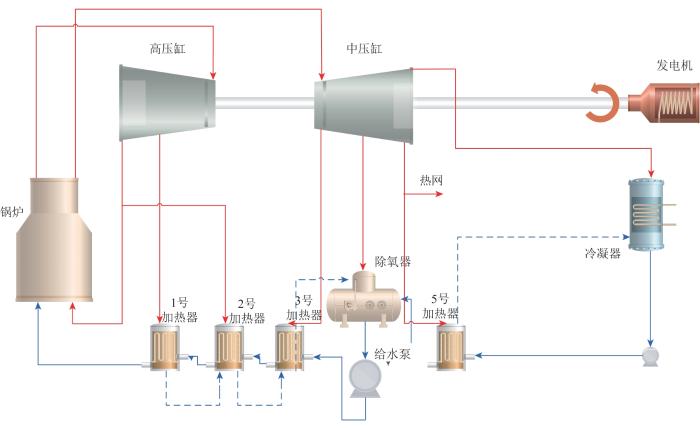
图3
低压缸零出力解耦热力系统图
Fig. 3
Decoupling thermodynamic system diagram of low pressure cylinder zero output
本方案计算限制条件如下:基础准工况为100%THA工况,低压缸只流过少部分的蒸汽用于冷却,大约为10.00 t/h[20]。
2.3.2 高背压下抽汽联合乏汽供热(方案2)
图4
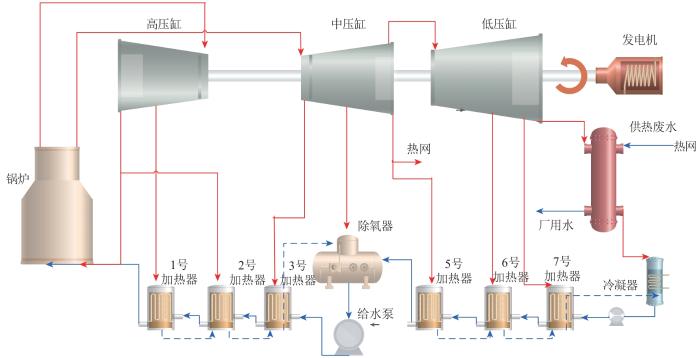
图4
高背压下联合乏汽供热解耦热力系统图
Fig. 4
Diagram of decoupled thermal system for combined steam heating at high back pressure
本方案计算限制条件如下:基础准工况为100%THA工况,高背压调整后,乏汽压力是32.00 kPa,温度70.60 ℃[24]。
2.3.3 压缩式热泵解耦(方案3)
图5
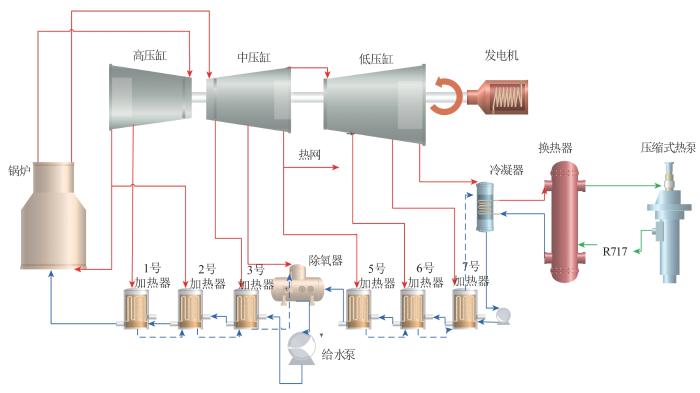
图5
压缩式热泵解耦热力系统图
Fig. 5
Compression heat pump decoupling thermodynamic system diagram
本方案中选取基准工况如下:凝汽器循环冷却水进口温度为20.00 ℃,凝汽器的循环冷却水出口温度为44.40 ℃,蒸发器和冷凝器的传热端差忽略不计[17]。
3 计算结果分析
3.1 低压缸零出力热电解耦改造分析
图6为低压缸零出力方案与案例仅从汽轮机第5级回热抽汽供热的热电特性和最低电负荷率对比。可以看出,最小发电负荷远小于原机组的发电负荷;低压缸零出力解耦的最低电负荷率远低于原机组。在供热负荷为20.00~180.00 MW时,由于最低生产负荷的限制,机组最小发电量需不小于97.00 MW;当供热负荷超过180.00 MW后,机组的最小发电量已经大于最低生产负荷97.00 MW,但又因低压缸进汽流量限制,无法继续降低至最低生产负荷97.00 MW。经改造,低压缸零出力方案与案例仅从汽轮机第5级回热抽汽作为热源相比,在原最大供热负荷304.60 MW下,改造前最低电负荷为266.99 MW,改造后最低电负荷可以达到152.73 MW,降低了114.26 MW;最低电负荷率为43.70%,降低了32.70%。另外,低压缸零出力方案所能达到的最大热负荷为435.31 MW,增加了130.71 MW。
图6
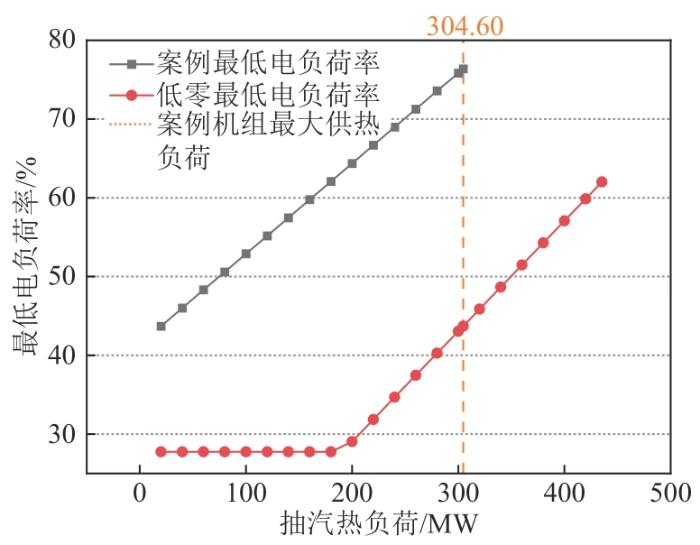
图6
低压缸零出力改造最低电负荷率与案例机组对比
Fig. 6
Comparison between the minimum electric load rate of zero output transformation of low pressure cylinder and the case unit
3.2 高背压下联合乏汽供热热电解耦改造分析
图7为高背压下联合乏汽供热方案与案例仅从汽轮机第5级回热抽汽供热的热电特性和最低电负荷率对比。可以看出,最小发电负荷远远小于原机组的发电负荷;高背压下联合乏汽供热方案解耦的最低电负荷率较原机组有所降低。经改造,高背压下联合乏汽供热方案与案例仅从汽轮机第5级回热抽汽供热作为热源相比,在原最大供热负荷304.60 MW下,改造前最低电负荷为267.00 MW,改造后最低电负荷可以达到249.90 MW,降低了17.10 MW;最低电负荷率为69.80%,降低了6.60%。另外,高背压下联合乏汽供热方案所能达到的最大热负荷为370.65 MW,增加了66.05 MW。
图7
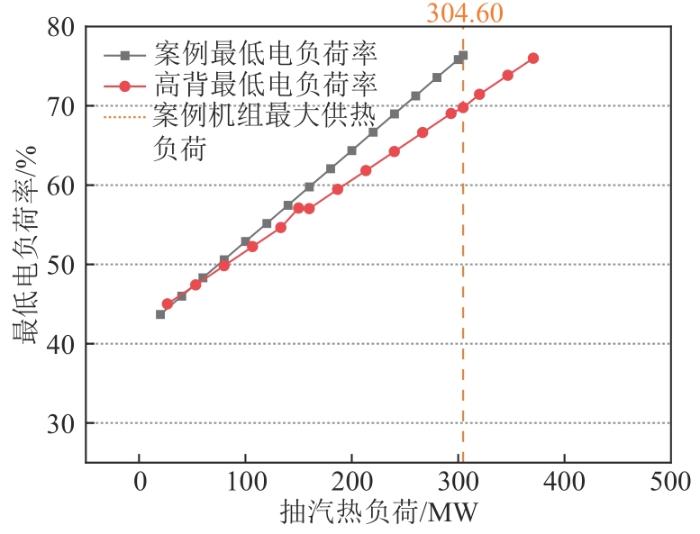
图7
高背压下联合乏汽供热改造最低电负荷率与案例机组对比
Fig. 7
Comparison between the minimum electric load rate of the combined steam heating with high back pressure transformation and the case unit
3.3 压缩式热泵解耦改造分析
图8为压缩式热泵解耦方案与案例仅从汽轮机第5级回热抽汽供热的热电特性和最低电负荷率对比。可以看出,最小发电负荷远小于原机组的发电负荷;压缩式热泵解耦方案解耦的最低电负荷率较原机组有所降低。经改造,压缩式热泵解耦方案仅从汽轮机第5级回热抽汽供热与案例相比,在原最大供热负荷304.60 MW下,改造前最低电负荷为267.00 MW,改造后最低电负荷可以达到249.96 MW,降低了17.04 MW;最低电负荷率为71.50%,降低了4.90%。压缩式热泵解耦方案所能达到的最大热负荷为342.80 MW,增加了38.00 MW。
图8
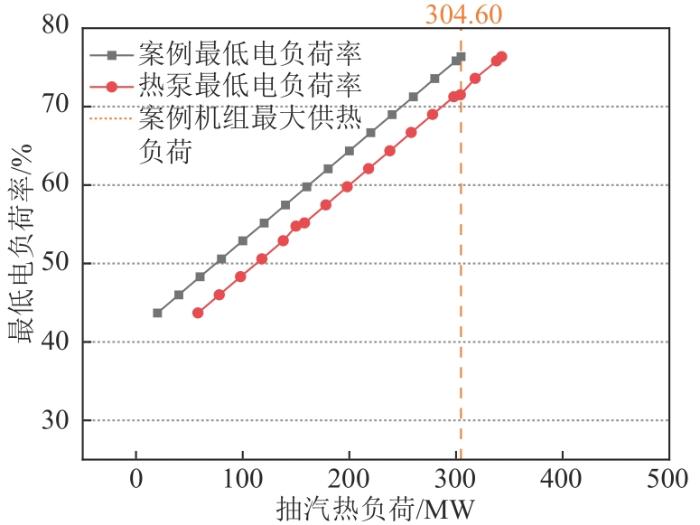
图8
压缩式热泵解耦改造最低电负荷率与案例机组对比
Fig. 8
Comparison of the minimum electric load rate of the decoupling of the compression heat pump with the case unit
3.4 3种解耦方案对比
对于火电机组改造,不同热电解耦改造方式下最大抽汽热负荷增量对比如图9所示。
图9
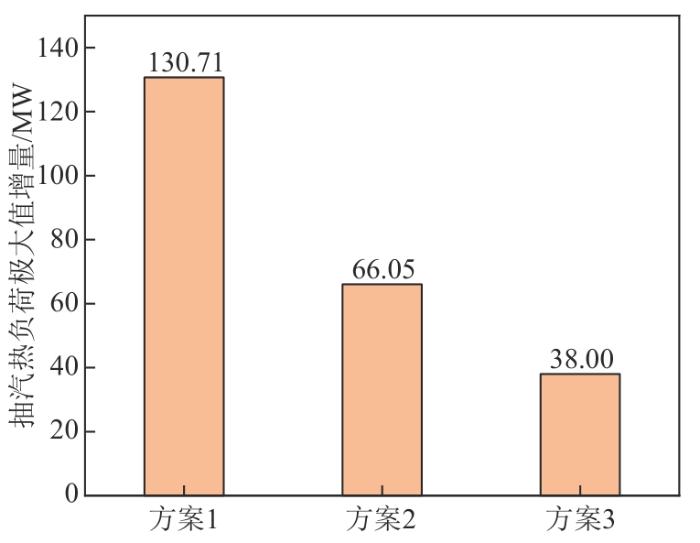
图9
不同热电解耦改造方案下最大抽汽热负荷增量对比
Fig. 9
Comparison diagram of maximum extraction heat load increment under different thermoelectric decoupling transformation modes
3种热电解耦方案改造后,在原最大供热负荷304.60 MW下,方案1、2、3最低电负荷从324.94 MW分别降低到152.73、249.90、249.96 MW;在50%热负荷下(150.00 MW),方案1、2、3最低电负荷从204.95 MW分别降低到97.00、199.63、191.44 MW;在0%热负荷下(无抽汽),方案1、2、3最低电负荷从152.76 MW分别降低到97.00、150.34、144.66 MW。不同热电解耦改造方案下最小发电量增量对比如图10所示。
图10
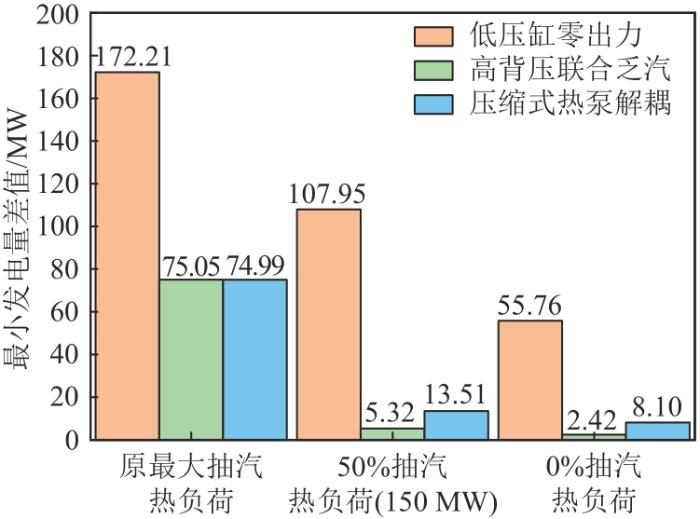
图10
不同热电解耦改造方案下最小发电量增量对比
Fig. 10
Comparison diagram of minimum generation increment under different thermoelectric decoupling transformation schemes
同理,从改造后降低的电负荷率来看,3种热电解耦方案改造后,在原最大供热负荷304.60 MW下,方案1、2、3最低电负荷率从76.40%分别降低到43.70%、69.80%、71.50%,低压缸零出力方案由于最低生产负荷限制,方案1、2、3最低电负荷率为27.70%;在50%热负荷下(150.00 MW),最低电负荷率从58.60%分别降低到27.70%、57.70%、54.80%;在0%热负荷下(无抽汽),方案1、2、3最低电负荷率分别从43.70%分别降低到27.70%、43.60%、41.10%。不同热电解耦改造方案的最低电负荷率增量对比如图11所示。
图11
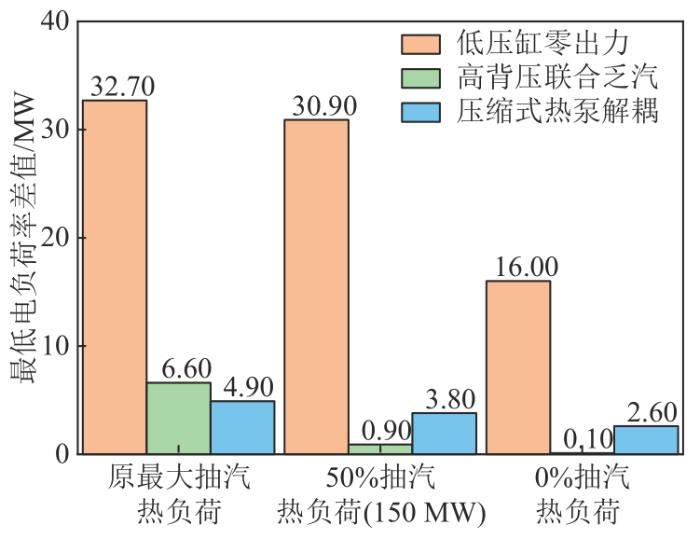
图11
不同热电解耦改造方案的最低电负荷率增量对比
Fig. 11
Comparison diagram of minimum charge rate increment for different thermoelectric decoupling schemes
4 结论
通过对某300 MW热电机组开展热电解耦改造,分析评估了不同热电解耦改造技术方案下机组调峰负荷空间。对比了不同方案下机组与原机组的最小发电量、最低电负荷率的变化,得出以下结论:
1)在同一抽汽热负荷下,低压缸零出力改造方案对比案例机组有着更大的调峰空间。在原最大抽汽热负荷下,最小发电量下降了172.21 MW,最低电负荷率下降了32.70%。
2)低压缸零出力的热电解耦改造方案可以显著提高热电机组与新能源机组的协调调峰能力,提高发电单元整体发电的稳定性。在火电机组需要进行热电解耦改造时,低压缸零出力改造为最优选择。
参考文献
A novel multi-objective robust optimization model for unit commitment considering peak load regulation ability and temporal correlation of wind powers
[J].
新能源发电并网对电网电能质量的影响研究
[J].
Impact of new energy power grid-integration on grid power quality
[J].
一种基于虚拟电厂技术的城市可再生能源消纳能力提升方法
[J].
A method for improving the accommodating capability of urban renewable energy based on virtual power plant technology
[J].
基于分布式框架的新能源场站并网性能评估
[J].
Grid-connection performance evaluation of renewable energy station under distributed framework
[J].
Optimal thermal unit commitment for solving duck curve problem by introducing CSP,PSH and demand response
[J].
Optimal scheduling for power system peak load regulation considering short-time startup and shutdown operations of thermal power unit
[J].
大规模新能源并网下火电机组深度调峰优化调度
[J].
Optimal scheduling of deep peak regulation for thermal power units in power grid with large-scale new energy
[J].
CHP and heat pumps to balance renewable power production:lessons from the district heating network in Stockholm
[J].
自备电厂在未来综合能源领域的应用展望
[J].
Application prospect of self-contained power plant in the future comprehensive energy field
[J].
600 MW热电联产机组利用热网蓄能特性的灵活性研究
[D].
Research on flexibility of 600 MW cogeneration units using thermal network energy storage characteriistics
[D].
冷热电联供系统热电解耦方案及性能分析
[D].
Thermoelectric decoupling scheme and performance analysis of combined cooling heating and power system
[D].
基于Ebsilon的火电厂热力系统建模、监测及优化研究
[D].
The research of modeling,monitoring and optimizing for thermal system of thermal power plant based on ebsilon
[D].
Thermo-economic comparison of heat-power decoupling technologies for combined heat and power plants when participating in a power-balancing service in an energy hub
[J].
350 MW超临界热电联产机组灵活性改造分析
[J].
Flexibility transformation analysis of 350 MW supercritical cogeneration unit
[J].
1 000 MW深度调峰机组热力系统优化研究
[J].
Thermodynamic system optimization research on 1 000 MW deep peak-regulating unit
[J].
200 MW热电联产机组火电灵活性供热改造分析
[J].
Analysis of thermal power flexible heating retrofit for 200 MW cogeneration units
[J].
电厂循环冷却水余热供暖方式的经济性分析
[C]//
Economic benefit analysis of several methods of utilizing circulating cooling water in heating system in power plant
[C]//
300 MW机组汽轮机低压缸零出力技术
[J].
Zero output technology of the low-pressure cylinder of 300 MW unit turbine
[J].
Performance improvement of low-pressure cylinder in high back pressure steam turbine for direct heating
[J].
低压缸零出力实现热电联产机组热电解耦与节能的理论研究
[J].
Theoretical study on heat-electricity decoupling and energy saving of low-pressure cylinder zero output renovation of heat and power cogeneration units
[J].
深度调峰工况下供热机组状态监测与控制优化
[D].
Condition monitoring and optimization of control system for heating units under deep peak load regulation
[D].
Energy-saving mechanism and parametric analysis of the high back-pressure heating process in a 300 MW coal-fired combined heat and power unit
[J].
Cascade utilization of flue gas waste heat in combined heat and power system with high back-pressure (CHP-HBP)
[J].
高背压供热机组节能分析与运行优化
[D].
Energy-saving analysis and operation optimization of the high back-pressure heating process in a combined heat and power unit
[D].
热泵回收电厂循环水余热利用问题研究
[J].
Research on waste heat recovery of circulating water in power plant by heat pump technology
[J].
利用热泵技术回收热电厂余热的可行性与经济性分析
[J].
The feasibility and economy analysis of the usage of the heat pump technique to reclaim waste heat in heat power plant
[J].
两种热泵回收循环水热量的经济性分析
[J].
Economic analysis on recycling water heat by two kinds of heat pump
[J].
Comprehensive selection and assessment methodology of compression heat pump system
[J].


