0 引言
近年来,随着中国风电装机容量逐年递增,风电消纳面临的形势也越来越严峻,弃风现象非常严重[1 ] 。特别是在我国“三北”地区,在冬季供暖期热电联产机组为满足热负荷而不得不大幅提高其最小出力,导致风电上网空间不足[2 -4 ] 。
为了解耦“以热定电”约束,国内外很多学者提出了在热电联合系统中配置蓄热装置以降低机组强迫出力,提高热电机组的调节能力,促进风电消纳[5 -7 ] 。文献[8 ]对热电厂配置蓄热、抽水蓄能、风电供热3种消纳风电的方案进行了节煤效果和国民经济性对比。文献[9 ]将储热装置安装在不同的位置,并对比分析其运行模式与风电消纳效果的差异性。上述研究在分析蓄热罐对系统的风电消纳及运行成本的影响时,都将其容量设为给定值或使其足够大,会降低整体的经济性及储热的利用率,且并未考虑蓄热罐的投资和维护成本。
近年来,关于蓄热罐配置的经济成本和效益方面也已经有相关的研究。文献[10 ]通过将储热装置与风电-热电机组联合优化,可以使系统获得的总收益大于风电场和热电机组单独运行所获得的收益,并且能够提高系统对风电的消纳能力。文献[11 ]在风电-热电-蓄热罐-碳捕集虚拟电厂运行模型中,增设蓄热罐投资和维护成本,并将其折算为日折旧与日维护成本,建立了以实现虚拟电厂总投资运行成本最低为目标的函数。文献[12 ]以综合效益最大化为目标,考虑储热系统投资成本、运维成本、风热转化收益、节省供热燃煤收益、补偿收益等因素,建立一种储热系统辅助电网调峰的优化配置模型。以上文献仅考虑了成本最低或者经济收益最大,对热电厂配置蓄热罐的年综合效益的研究鲜见报道。
本文基于以上研究,在含储热的电力系统电热综合调度模型的基础上,考虑了热电厂配置蓄热罐产生的经济效益、环境效益,以及配置蓄热罐的投资与维护成本,建立热电厂配置蓄热罐的效益成本模型,对热电厂配置蓄热罐年周期内产生的总收益进行分析,验证了在不同风电出力情况下,热电厂配置蓄热罐的必要性。
1 含储热电力系统电热综合调度模型
计算热电厂配置蓄热罐的成本和效益,必须知道各热电机组和风电机组在每个时段的出力。本文基于往年数据考虑,对供暖期每个时段按天进行日仿真调度。
1.1 目标函数
调度模型以全天风电机组弃风成本和热电机组运行成本之和最小为目标[13 ] ,可表示为
m i n [ μ × ∑ t = 1 24 ( P w p , t - P w , t ) + ∑ i = 1 N T ∑ t = 1 24 F i , t ( P i ) ] × V c o l (1)
式中:μ P w p , t P w , t t 时段的预测出力和实际出力;F i , t ( P i ) i 的煤耗量;V c o l N T 为机组数量。
调度模型以全天风电机组弃风成本和热电机组运行成本和最小为目标[13 ] 。在保障电力系统安全运行的前提下,以系统煤耗成本和弃风成本之和最小为目标函数,可以最大程度地促进风电上网,减少化石能源消耗[13 ] 。
1.2 约束条件
1.2.1 功率平衡约束
系统调度的最大作用就是在火电、风电机组之间合理地分配有功出力,使之满足用户的用电需求,功率平衡约束[14 ] 为
P L D , t = ∑ i = 1 N G P G , i , t + ∑ j = 1 N W ( P W , j , t - P W , j , t q ) + ∑ k = 1 N C P c h p , k , t (2)
式中:P L D , t t 时刻系统用电负荷的预测值;P G , i , t i 在t 时刻的出力;P W , j , t P W , j , t q j 在t 时刻的出力预测值和实际出力;P c h p , k , t k 在t 时刻的出力;N G 、N W 、N C 分别为常规纯凝机组、风电机组、抽汽式热电机组的数量。
1.2.2 热力系统约束
若将配置储热后的热电机组纳入到当前的调度体系中,就需对储热装置的特性进行研究并对其约束,如储热装置的容量的大小、储/放热功率的限值及其运行状态都将对系统的运行及分配方式产生影响[14 -15 ] 。
0 ≤ S t ≤ S m a x (3)
0 ≤ H i n t ≤ H i n m a x 0 ≤ H o u t t ≤ H o u t m a x (4)
式中H i n t H o u t t t 时刻储热装置的储热功率和放热功率,其最大值分别为H i n m a x H o u t m a x
Δ t ( H i n t - H o u t t - k l o s s S t ) = S t + 1 - S t S N = S 0 (5)
式中:k l o s s S t S 0 S N t 时刻、初始时刻、调度周期结束时的储热量。此外,储热装置运行一个周期(如1天)后,储热量需要恢复到初始量[17 ] 。
储热装置释热功率H o u t t H d t H l o a d t
H o u t t + H d t = H l o a d t (6)
1.2.3 热电联产机组约束
风电弃风的主要原因是由于热电联产机组“以热定电”的运行模式,强迫机组的最小电出力变大,致使风电的上网空间减少,热电联产的运行特性将会对风电消纳产生很大影响[16 ] 。
对于背压式热电机组,该类型的第i 台机组电出力完全由其热出力决定[13 ] ,即
P c h p , k t = H c h p , k t / k h p (7)
式中:P c h p , k t H c h p , k t k 在t 时刻的电出力、热出力;k h p
在满足运行条件下,抽汽式热电机组的热电比可以通过调节抽汽量来调整,其约束为
P c h p , k , t ≥ m a x { c b ⋅ ( H c h p , k t - K ) , P m i n , k , t - c v 2 , k ⋅ H c h p , k t } P c h p , k , t ≤ P m a x , k , t - c v 2 , k ⋅ H c h p , k t (8)
式中:P m a x , k , t P m i n , k , t t 时刻抽汽式热电机组k 在纯凝工况下对应的最大、最小发电出力;c b K c v 2 , k k 的常数参数。
在发电机组实际运行中,如果风电出力大时,为保证风电有足够的上网空间,抽汽式热电机组一般都运行在最小凝气工况,此时抽汽式热电机组也不具有调节能力,相当于运行在背压机组工况。
0 ≤ H c h p , k , t ≤ H c h p m a x (9)
式中H c h p m a x [17 ] 。
- D C H P , k m a x ⋅ Δ t ≤ P c h p , k , t + 1 - P c h p , k , t ≤ U C H P , k m a x ⋅ Δ t (10)
式中U C H P , k m a x D C H P , k m a x k 每min向上、向下爬坡速率极限。
热电机组的热出力H c h p t H i n t H d t
H c h p t = H i n t + H d t (11)
1.2.4 常规机组约束
常规机组指的是不参与供热的纯凝机组,这部分机组主要承担调峰任务,作为系统备用。
P G , i m i n ≤ P G , i , t ≤ P G , i m a x - D G , i m a x ⋅ Δ t ≤ P G , i , t + 1 - P G , i , t ≤ U R , i m a x ⋅ Δ t (12)
式中:P G , i m i n P G , i m a x i 的最小出力、最大出力;D G , i m a x U R , i m a x i 的向下、向上爬坡速率极限。
U S R = ∑ i = 1 N G m i n ( P G , i m a x - P G , i , t , D G , i m a x ) ≥ P s r U D R = ∑ i = 1 N G m i n ( P G , i , t - P G , i m i n , U R , i m a x ) ≥ P s r (13)
式中P s r
2 方案效益模型
热电厂配置蓄热罐消纳弃风带来2方面的效益:1)风电代替火电的经济效益,因风电机组运行过程中无能量消耗,风电代替火电有很好的节煤效果;2)风电代替火电的环境效益,风电在发电过程中不产生SO2 、CO2 、烟尘等[17 -19 ] 污染。
2.1 经济效益
C Z = Δ C w + Δ C r (14)
式中:Δ C w Δ C r
Δ C w = [ ∑ t = 1 T P w t ( G h s u b ) - ∑ t = 1 T P w t ( 0 ) ] ⋅ μ ⋅ η (15)
式中:P w t G hsub )、P w t G hsub 、0时风电机组电出力,MW;η 为考虑蓄热罐蓄热损失及水泵耗电后的综合利用效率。
Δ C r = [ ∑ i = 1 N T ∑ t = 1 T F i , t ( G h s u b ) - ∑ i = 1 N T ∑ t = 1 T F i , t ( 0 ) ] ⋅ V c o a l (16)
式中:F i , t ( G h s u b ) G h s u b i 在第t 时段的煤耗量;F i , t ( 0 ) i 在t 时刻的煤耗量;V c o a l
2.2 环境效益
本文考虑CO2 、SO2 、烟尘等煤炭燃烧的主要污染物,对热电厂配置蓄热罐消纳弃风带来的环境效益进行分析。热电厂年排污成本变化C p 为
C p = ( G S O 2 δ S O 2 + G C O 2 δ C O 2 + G y δ y ) ⋅ Δ C Z ⋅ p H B (17)
式中:G S O 2 G C O 2 G y 2 、CO2 、烟尘的排放率,分别取2.7、1 878.9、1.2 kg/t;δ S O 2 δ C O 2 δ y 2 、CO2 、烟尘的当量值,kg;p H B
2.3 收益现值
根据热电厂配置蓄热罐消纳弃风方案的经济及环境效益分析,可得在年周期内对应的收益为
C N = C Z + C p (18)
3 方案成本模型
热电厂配置蓄热罐消纳弃风方案的成本主要包括建设投资成本、固定维护成本。其中建设投资成本以蓄热罐的建设成本为主,固定维护成本以蓄热罐等设备的维护成本为主,一般用蓄热罐建设成本的一定百分比乘以蓄热罐使用年限来计算。
等年值初始投资费用是规划初期购买、安装蓄热罐的一次性投资折算到生命周期内每年的等值费用,与蓄热罐的容量与寿命有关[20 ] ,计算公式为
C d = V x ⋅ P r i ⋅ r ( 1 + r ) n ( 1 + r ) n - 1 (19)
式中:Vx 表示蓄热罐的体积;P ri 表示蓄热罐单位体积的造价;n 表示蓄热罐的寿命;r 表示资本的年利率。
设每年的维护成本为其建设成本的某个百分比ξ
C s = C d ⋅ ξ (20)
根据上述热电厂配置蓄热罐消纳弃风方案的收益现值以及成本现值模型,可确定系统配置所述容量蓄热罐时的总收益为
C = C N - C d - C s (21)
4 模型求解
本文采用使用MATLAB工具箱YALMIP建模工具在MATLAB仿真软件中建立含储热电力系统电热综合调度模型,它能够让用户直接通过YALMIP的语法去调用各类解析器。本文采用GUROBI求解器求解混合整数线性规划[21 ] 。
5 算例分析
5.1 系统参数
为验证本文模型的有效性和计算火电灵活改造项目的成本效益,本文以中国“北方”实际电网的简化结构为参考,构建算例仿真模型[22 ] 。系统参数如表1 所示。
算例中,热电厂、蓄热罐和热电机组参数如表2—4所示,表4 中a , b , c 为机组煤耗参数。典型日的电负荷和风电场发电功率预测值如表5 所示。机组承担的热负荷根据某省实际机组所承担的热负荷计算,假设该日内热负荷基本不发生变化,热负荷为1 770 MW。其中,系统与其他电网无电功率交换。
5.2 调度结果分析
1)热电厂未配置储热装置,采用传统的热电联产机组对热负荷进行供热,采用以热定电的方式运行。
2)热电厂配置储热装置,系统通过对热电联产机组及储热装置灵活调节进行供热。
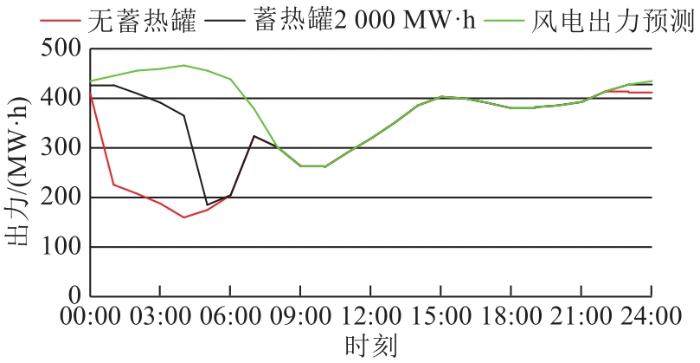
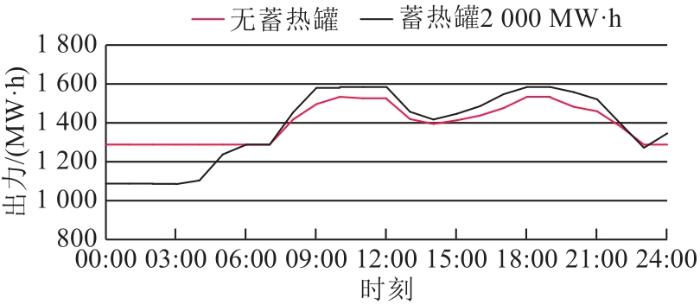
某典型日热电、风电机组出力情况分别如图1 、2 所示。图1 是风电场的出力情况,可以清晰地看出在热电厂不配置蓄热罐时,风电场的弃风状况严重。全天发生弃风的时段为0:00—09:00,共有9 h之多,尤其在05:00时,风电出力仅有174.7 MW·h。而对比加装储热后的风电出力情况,可以看出通过蓄热罐的作用的确可以减少风电场弃风电量,全天的风电消纳量比无蓄热罐装置多870.3 MW·h,表现出巨大的风电消纳效益。
图1
图1
不同场景下风电机组电出力
Fig. 1
Power output of wind turbinds under different scenarios
图2
图2
不同场景下热电机组电出力
Fig. 2
Electric output of thermoelectric units under different scenarios
同时,对比图2 中00:00—09:00热电机组的出力情况,可知热电机组为给风电机组提供上网空间而降低了出力。而这时不满足供热负荷的部分由蓄热罐的储热量来提供,达到了热电解耦的效果,提高了热电机组的灵活性。
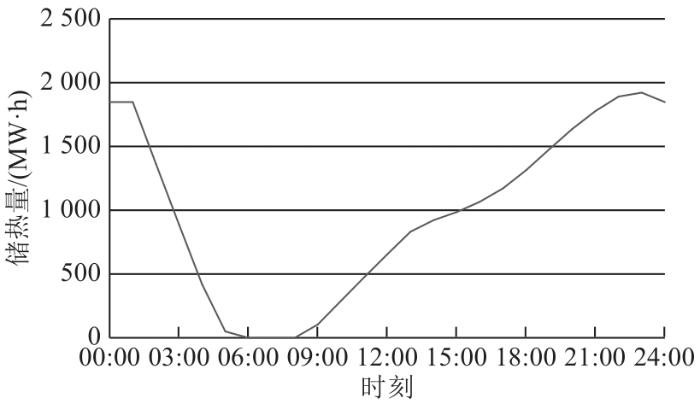
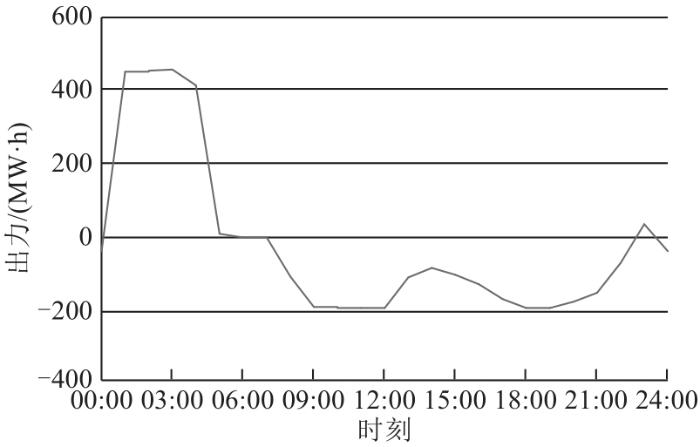
当蓄热罐容量为2 000 MW·h时,热电厂所配置的储热装置在一日内储热量的变化曲线及热出力变化曲线分别如图3 、4 所示。可以看出,在非弃风时段储热装置不停地在储热,并在23:00达到最大值(2 000 MW·h)。而在00:00—06:00的弃风严重的时段,蓄热罐不断放热,对供热机组降低的热出力进行补偿。
图3
图3
2 000 MW⋅h蓄热罐容量变化
Fig. 3
Change of 2 000 MW⋅h heat storage tank capacity
图4
图4
2 000 MW⋅h蓄热罐热出力变化
Fig. 4
Thermal output change of 2 000 MW⋅h heat storage tank
本算例中,热电厂配置储热装置后,一日内系统可实现节煤量约114 t,增加风电消纳量870 MW·h,表现出巨大的节煤和风电消纳效益。
5.3 成本效益结果分析
在分析成本效益结果时,本算例采用蓄热罐容量分别为1 500、3 000、4 500、6 000 MW·h,本方案的年弃风消纳量和年成本效益变化如表6 所示。
从表6 可以看出,随着储热系统配置容量的增加,减少的弃风量随之增加,经济效益也逐渐增加;但是在蓄热罐容量达到4 500 MW·h时,风电消纳量达到了一个峰值(227 019 MW·h),此时经济效益开始下降。可以看出,过多的配置储热容量降低了整体的经济性及储热的利用率。
5.4 蓄热罐配置必要性分析
通过改变风电的渗透率,计算蓄热罐在不同的风电装机结构下产生的正向经济效益,分析热电厂配置蓄热罐的必要性,如表7 、8 所示。
从表7 中可以看出,当风电装机容量占总装机容量比较小时,电力系统中产生的弃风较少,因此消纳的弃风量也比较少,在蓄热罐容量达到3 000 MW·h时,就稳定在653 MW·h不再增加。蓄热罐容量配置仅仅在40 MW·h时就可以产生正的总收益,当蓄热罐容量逐渐增大时,其配置成本远远大于其经济效益,不适合配置蓄热罐。
从表8 可以看出,当风电渗透率较大,蓄热罐容量大于1 500 MW·h时,弃风消纳量就稳定在133 013 MW·h不再增加,此时在典型日内热电机组和凝气机组共出力42 543 MW·h,由于蓄热罐在非弃风时段储热的特性,导致系统对风电的接纳量达到了饱和,蓄热罐容量增大已经对风电消纳量的增加不起作用;相应地,产生的经济效益也不再增加,导致该方案的总收益快速下降。这是因为风电装机规模越大,同样情况下风电功率越大,则在电负荷一定的情况下弃风功率越大,弃风持续时间也越长,能够用于储热的非弃风时段也就越短,蓄热罐所能存储的热量就越少,消纳弃风的效果越差[23 -26 ] 。
6 结论
考虑了热电厂配置储热产生的经济效益、环境效益,以及配置蓄热罐的投资与维护成本,建立了热电厂配置蓄热罐的效益成本模型,通过算例仿真,得出如下结论:
1)过多配置储热容量将会降低整体的经济性及储热的利用率。在风电装机容量为900 MW·h时,逐步增加蓄热罐的容量到4 500 MW·h,弃风消纳量开始稳定在227 019 MW·h保持不变,但是总收益达到了5 780万元以后却开始不断下降。说明盲目配置过多储热并不能提高整体的收益,因此存在最优储热系统配置容量,使整体效益最佳。
2)不同的风电装机容量下,配置蓄热罐所产生的效益是不同的,根据建立的效益成本模型,可以证实在给定的电力系统条件下热电厂配置蓄热罐的必要性。
3)蓄热罐必要性分析不仅适用于蓄热罐,亦适用于其他蓄热装置,只需将其函数和参数进行替换即可。
参考文献
View Option
[3]
WANG H L LIU Y XU L X et al Research on hierarchical coordinated optimization model of multi-microgrid system considering wind power consumption
[J].Electric Power Construction ,2020 ,41 (8 ):87 -98 . doi:10.12204/j.issn.1000-7229.2020.08.011
[4]
[本文引用: 1]
SHUAI W L ZHU X W LI X M et al “Source-network-load-storage” coordinated optimization operation for an integrated energy system considering wind power consumption
[J].Power System Protection and Control ,2021 ,49 (19 ):18 -26 . doi:10.19783/j.cnki.pspc.210037
[本文引用: 1]
[6]
HUANG X XU Z SUN Y et al Heat and power load dispatching considering energy storage of district heating system and electric boilers
[J].Journal of Modern Power Systems and Clean Energy ,2018 ,6 :992 -1003 . doi:10.1007/s40565-017-0352-6
[7]
[本文引用: 1]
LV Q CHEN T Y WANG H X et al Analysis on peak-load regulation ability of cogeneration unit with heat accumulator
[J].Automation of Electric Power Systems ,2014 ,38 (11 ):34 -41 . doi:10.7500/AEPS20130724002
[本文引用: 1]
[8]
[本文引用: 1]
LV Q WANG H X CHEN T Y et al Operation strategies of heat accumulator in combined heat and power plant with uncertain wind power
[J].Automation of Electric Power Systems ,2015 ,39 (14 ):23 -29 . doi:10.7500/AEPS20140829001
[本文引用: 1]
[9]
[本文引用: 1]
YU Y J CHEN H K JIANG X et al Operation strategy for heat storage tank to improve wind power accommodation
[J].Automation of Electric Power Systems ,2017 ,41 (7 ):37 -43 . doi:10.7500/AEPS20160510006
[本文引用: 1]
[11]
[本文引用: 1]
GU Z P KANG C Q CHEN X Y et al Operation optimization of integrated power and heat energy systems and the benefit on wind power accommodation considering heating network constraints
[J].Proceedings of the CSEE ,2015 ,35 (14 ):3596 -3604 . doi:10.13334/j.0258-8013.pcsee.2015.14.014
[本文引用: 1]
[12]
[本文引用: 1]
LV Q LI L ZHU Q S et al Comparison of coal-saving effect and national economic indices of three feasible curtailed wind power accommodating strategies
[J].Automation of Electric Power Systems ,2015 ,39 (7 ):75 -83 . doi:10.7500/AEPS20140125001
[本文引用: 1]
[13]
陈磊 ,徐飞 ,王晓 ,等 储热提升风电消纳能力的实施方式及效果分析
[J].中国电机工程学报 ,2015 ,35 (17 ):4283 -4290 .
[本文引用: 4]
CHE L XU F WANG X et al Implementation and effect of thermal storage in improving wind power accommodation
[J].Proceedings of the CSEE ,2015 ,35 (17 ):4283 -4290 .
[本文引用: 4]
[14]
于婧 ,孙宏斌 ,沈欣炜 考虑储热装置的风电-热电机组联合优化运行策略
[J].电力自动化设备 ,2017 ,37 (6 ):139 -145 .
[本文引用: 2]
YU J SUN H B SHEN X W Optimal operating strategy of integrated power system with wind farm, CHP unit and heat storage device
[J].Electric Power Automation Equipment ,2017 ,37 (6 ):139 -145 .
[本文引用: 2]
[15]
周任军 ,武浩然 ,冯剑 ,等 考虑虚拟电厂经济运行的蓄热罐定容配置
[J].中国电力 ,2019 ,52 (11 ):167 -174 .
[本文引用: 1]
ZHOU R J WU H R FENG J et al Determining heat storage tank capacities in consideration of the economic operation of virtual power plant
[J].Electric Power ,2019 ,52 (11 ):167 -174 .
[本文引用: 1]
[17]
田雪枫 基于博弈论的热电厂内蓄热设备容量规划方法
[D].北京 :华北电力大学 ,2018 .
[本文引用: 3]
TIAN X F Capacity planning method of heat storage equipment in thermal power plant based on game theory
[D].Beijing :North China Electric Power University ,2018 .
[本文引用: 3]
[18]
LADIGE D THOMAS B WIDMANN C Intelligent management of the heat storage tank for production of electricity on demand using CHP units
[J].Energy Procedia ,2015 ,73 :239 -243 . doi:10.1016/j.egypro.2015.07.678
[19]
SARTOR K DEWALLEF P Integration of heat storage system into district heating networks fed by a biomass CHP plant
[J].Journal of Energy Storage ,2018 ,15 :350 -358 . doi:10.1016/j.est.2017.12.010
[本文引用: 1]
[20]
[本文引用: 1]
CAO Y LI P YUAN Y et al Analysis on accommodating capability of renewable energy and assessment on low-carbon benefits based on time sequence simulation
[J].Automation of Electric Power Systems ,2014 ,38 (17 ):60 -66 . doi:10.7500/AEPS20140329002
[本文引用: 1]
[21]
李纯 面向弃风消纳的热电厂最优蓄热容量确定研究
[D].大连 :大连理工大学 ,2016 .
[本文引用: 1]
LI C Study on Determination of Optimal Regenerative Capacity of Thermal Power Plant for Discarding Wind
[D].Dalian :Dalian University of Technology ,2016 .
[本文引用: 1]
[22]
PHILIPP V KOCH B GEORGE G et al Heuristic approach for the economic optimisation of combined heat and power (CHP) plants:operating strategy, heat storage and power
[J].Energy ,2017 ,121 :66 -77 . doi:10.1016/j.energy.2016.12.133
[本文引用: 1]
[24]
ZHU Q W Optimal allocation of electrothermal energy storage capacity of multi-energy complementary building energy system
[D].Jinan :Sandong University ,2018 . doi:10.1016/j.egypro.2019.01.183
[25]
DONG W B GU X F CHEN Y N Value analysis of wind power integration
[J].Power Generation Technology ,2020 ,41 (3 ):320 -327 . doi:10.12096/j.2096-4528.pgt.19117
[26]
陈天佑 基于储热的热电厂消纳风电方案研究
[D].大连 :大连理工大学 ,2014 .
[本文引用: 1]
CHEN T Y Study on wind power accommodation scheme of thermal power plant based on heat storage
[D].Dalian :Dalian University of Technology ,2014 .
[本文引用: 1]
包含大容量储热的电-热联合系统
1
2014
... 近年来,随着中国风电装机容量逐年递增,风电消纳面临的形势也越来越严峻,弃风现象非常严重[1 ] .特别是在我国“三北”地区,在冬季供暖期热电联产机组为满足热负荷而不得不大幅提高其最小出力,导致风电上网空间不足[2 -4 ] . ...
包含大容量储热的电-热联合系统
1
2014
... 近年来,随着中国风电装机容量逐年递增,风电消纳面临的形势也越来越严峻,弃风现象非常严重[1 ] .特别是在我国“三北”地区,在冬季供暖期热电联产机组为满足热负荷而不得不大幅提高其最小出力,导致风电上网空间不足[2 -4 ] . ...
考虑风电消纳的源-荷协同优化调度策略
1
2020
... 近年来,随着中国风电装机容量逐年递增,风电消纳面临的形势也越来越严峻,弃风现象非常严重[1 ] .特别是在我国“三北”地区,在冬季供暖期热电联产机组为满足热负荷而不得不大幅提高其最小出力,导致风电上网空间不足[2 -4 ] . ...
考虑风电消纳的源-荷协同优化调度策略
1
2020
... 近年来,随着中国风电装机容量逐年递增,风电消纳面临的形势也越来越严峻,弃风现象非常严重[1 ] .特别是在我国“三北”地区,在冬季供暖期热电联产机组为满足热负荷而不得不大幅提高其最小出力,导致风电上网空间不足[2 -4 ] . ...
考虑风电消纳的区域多微网分层协调优化模型
0
2020
考虑风电消纳的区域多微网分层协调优化模型
0
2020
考虑风电消纳的综合能源系统“源-网-荷-储”协同优化运行
1
2021
... 近年来,随着中国风电装机容量逐年递增,风电消纳面临的形势也越来越严峻,弃风现象非常严重[1 ] .特别是在我国“三北”地区,在冬季供暖期热电联产机组为满足热负荷而不得不大幅提高其最小出力,导致风电上网空间不足[2 -4 ] . ...
考虑风电消纳的综合能源系统“源-网-荷-储”协同优化运行
1
2021
... 近年来,随着中国风电装机容量逐年递增,风电消纳面临的形势也越来越严峻,弃风现象非常严重[1 ] .特别是在我国“三北”地区,在冬季供暖期热电联产机组为满足热负荷而不得不大幅提高其最小出力,导致风电上网空间不足[2 -4 ] . ...
考虑消纳风电的区域综合能源系统电转气与储能设备优化配置
1
2021
... 为了解耦“以热定电”约束,国内外很多学者提出了在热电联合系统中配置蓄热装置以降低机组强迫出力,提高热电机组的调节能力,促进风电消纳[5 -7 ] .文献[8 ]对热电厂配置蓄热、抽水蓄能、风电供热3种消纳风电的方案进行了节煤效果和国民经济性对比.文献[9 ]将储热装置安装在不同的位置,并对比分析其运行模式与风电消纳效果的差异性.上述研究在分析蓄热罐对系统的风电消纳及运行成本的影响时,都将其容量设为给定值或使其足够大,会降低整体的经济性及储热的利用率,且并未考虑蓄热罐的投资和维护成本. ...
考虑消纳风电的区域综合能源系统电转气与储能设备优化配置
1
2021
... 为了解耦“以热定电”约束,国内外很多学者提出了在热电联合系统中配置蓄热装置以降低机组强迫出力,提高热电机组的调节能力,促进风电消纳[5 -7 ] .文献[8 ]对热电厂配置蓄热、抽水蓄能、风电供热3种消纳风电的方案进行了节煤效果和国民经济性对比.文献[9 ]将储热装置安装在不同的位置,并对比分析其运行模式与风电消纳效果的差异性.上述研究在分析蓄热罐对系统的风电消纳及运行成本的影响时,都将其容量设为给定值或使其足够大,会降低整体的经济性及储热的利用率,且并未考虑蓄热罐的投资和维护成本. ...
Heat and power load dispatching considering energy storage of district heating system and electric boilers
0
2018
配置储热后热电机组调峰能力分析
1
2014
... 为了解耦“以热定电”约束,国内外很多学者提出了在热电联合系统中配置蓄热装置以降低机组强迫出力,提高热电机组的调节能力,促进风电消纳[5 -7 ] .文献[8 ]对热电厂配置蓄热、抽水蓄能、风电供热3种消纳风电的方案进行了节煤效果和国民经济性对比.文献[9 ]将储热装置安装在不同的位置,并对比分析其运行模式与风电消纳效果的差异性.上述研究在分析蓄热罐对系统的风电消纳及运行成本的影响时,都将其容量设为给定值或使其足够大,会降低整体的经济性及储热的利用率,且并未考虑蓄热罐的投资和维护成本. ...
配置储热后热电机组调峰能力分析
1
2014
... 为了解耦“以热定电”约束,国内外很多学者提出了在热电联合系统中配置蓄热装置以降低机组强迫出力,提高热电机组的调节能力,促进风电消纳[5 -7 ] .文献[8 ]对热电厂配置蓄热、抽水蓄能、风电供热3种消纳风电的方案进行了节煤效果和国民经济性对比.文献[9 ]将储热装置安装在不同的位置,并对比分析其运行模式与风电消纳效果的差异性.上述研究在分析蓄热罐对系统的风电消纳及运行成本的影响时,都将其容量设为给定值或使其足够大,会降低整体的经济性及储热的利用率,且并未考虑蓄热罐的投资和维护成本. ...
考虑风电不确定性的热电厂蓄热罐运行策略
1
2015
... 为了解耦“以热定电”约束,国内外很多学者提出了在热电联合系统中配置蓄热装置以降低机组强迫出力,提高热电机组的调节能力,促进风电消纳[5 -7 ] .文献[8 ]对热电厂配置蓄热、抽水蓄能、风电供热3种消纳风电的方案进行了节煤效果和国民经济性对比.文献[9 ]将储热装置安装在不同的位置,并对比分析其运行模式与风电消纳效果的差异性.上述研究在分析蓄热罐对系统的风电消纳及运行成本的影响时,都将其容量设为给定值或使其足够大,会降低整体的经济性及储热的利用率,且并未考虑蓄热罐的投资和维护成本. ...
考虑风电不确定性的热电厂蓄热罐运行策略
1
2015
... 为了解耦“以热定电”约束,国内外很多学者提出了在热电联合系统中配置蓄热装置以降低机组强迫出力,提高热电机组的调节能力,促进风电消纳[5 -7 ] .文献[8 ]对热电厂配置蓄热、抽水蓄能、风电供热3种消纳风电的方案进行了节煤效果和国民经济性对比.文献[9 ]将储热装置安装在不同的位置,并对比分析其运行模式与风电消纳效果的差异性.上述研究在分析蓄热罐对系统的风电消纳及运行成本的影响时,都将其容量设为给定值或使其足够大,会降低整体的经济性及储热的利用率,且并未考虑蓄热罐的投资和维护成本. ...
促进风电消纳的蓄热罐运行策略
1
2017
... 为了解耦“以热定电”约束,国内外很多学者提出了在热电联合系统中配置蓄热装置以降低机组强迫出力,提高热电机组的调节能力,促进风电消纳[5 -7 ] .文献[8 ]对热电厂配置蓄热、抽水蓄能、风电供热3种消纳风电的方案进行了节煤效果和国民经济性对比.文献[9 ]将储热装置安装在不同的位置,并对比分析其运行模式与风电消纳效果的差异性.上述研究在分析蓄热罐对系统的风电消纳及运行成本的影响时,都将其容量设为给定值或使其足够大,会降低整体的经济性及储热的利用率,且并未考虑蓄热罐的投资和维护成本. ...
促进风电消纳的蓄热罐运行策略
1
2017
... 为了解耦“以热定电”约束,国内外很多学者提出了在热电联合系统中配置蓄热装置以降低机组强迫出力,提高热电机组的调节能力,促进风电消纳[5 -7 ] .文献[8 ]对热电厂配置蓄热、抽水蓄能、风电供热3种消纳风电的方案进行了节煤效果和国民经济性对比.文献[9 ]将储热装置安装在不同的位置,并对比分析其运行模式与风电消纳效果的差异性.上述研究在分析蓄热罐对系统的风电消纳及运行成本的影响时,都将其容量设为给定值或使其足够大,会降低整体的经济性及储热的利用率,且并未考虑蓄热罐的投资和维护成本. ...
风电场与含储热的热电联产联合运行的优化调度
1
2017
... 近年来,关于蓄热罐配置的经济成本和效益方面也已经有相关的研究.文献[10 ]通过将储热装置与风电-热电机组联合优化,可以使系统获得的总收益大于风电场和热电机组单独运行所获得的收益,并且能够提高系统对风电的消纳能力.文献[11 ]在风电-热电-蓄热罐-碳捕集虚拟电厂运行模型中,增设蓄热罐投资和维护成本,并将其折算为日折旧与日维护成本,建立了以实现虚拟电厂总投资运行成本最低为目标的函数.文献[12 ]以综合效益最大化为目标,考虑储热系统投资成本、运维成本、风热转化收益、节省供热燃煤收益、补偿收益等因素,建立一种储热系统辅助电网调峰的优化配置模型.以上文献仅考虑了成本最低或者经济收益最大,对热电厂配置蓄热罐的年综合效益的研究鲜见报道. ...
风电场与含储热的热电联产联合运行的优化调度
1
2017
... 近年来,关于蓄热罐配置的经济成本和效益方面也已经有相关的研究.文献[10 ]通过将储热装置与风电-热电机组联合优化,可以使系统获得的总收益大于风电场和热电机组单独运行所获得的收益,并且能够提高系统对风电的消纳能力.文献[11 ]在风电-热电-蓄热罐-碳捕集虚拟电厂运行模型中,增设蓄热罐投资和维护成本,并将其折算为日折旧与日维护成本,建立了以实现虚拟电厂总投资运行成本最低为目标的函数.文献[12 ]以综合效益最大化为目标,考虑储热系统投资成本、运维成本、风热转化收益、节省供热燃煤收益、补偿收益等因素,建立一种储热系统辅助电网调峰的优化配置模型.以上文献仅考虑了成本最低或者经济收益最大,对热电厂配置蓄热罐的年综合效益的研究鲜见报道. ...
考虑热网约束的电热能源集成系统运行优化及其风电消纳效益分析
1
2015
... 近年来,关于蓄热罐配置的经济成本和效益方面也已经有相关的研究.文献[10 ]通过将储热装置与风电-热电机组联合优化,可以使系统获得的总收益大于风电场和热电机组单独运行所获得的收益,并且能够提高系统对风电的消纳能力.文献[11 ]在风电-热电-蓄热罐-碳捕集虚拟电厂运行模型中,增设蓄热罐投资和维护成本,并将其折算为日折旧与日维护成本,建立了以实现虚拟电厂总投资运行成本最低为目标的函数.文献[12 ]以综合效益最大化为目标,考虑储热系统投资成本、运维成本、风热转化收益、节省供热燃煤收益、补偿收益等因素,建立一种储热系统辅助电网调峰的优化配置模型.以上文献仅考虑了成本最低或者经济收益最大,对热电厂配置蓄热罐的年综合效益的研究鲜见报道. ...
考虑热网约束的电热能源集成系统运行优化及其风电消纳效益分析
1
2015
... 近年来,关于蓄热罐配置的经济成本和效益方面也已经有相关的研究.文献[10 ]通过将储热装置与风电-热电机组联合优化,可以使系统获得的总收益大于风电场和热电机组单独运行所获得的收益,并且能够提高系统对风电的消纳能力.文献[11 ]在风电-热电-蓄热罐-碳捕集虚拟电厂运行模型中,增设蓄热罐投资和维护成本,并将其折算为日折旧与日维护成本,建立了以实现虚拟电厂总投资运行成本最低为目标的函数.文献[12 ]以综合效益最大化为目标,考虑储热系统投资成本、运维成本、风热转化收益、节省供热燃煤收益、补偿收益等因素,建立一种储热系统辅助电网调峰的优化配置模型.以上文献仅考虑了成本最低或者经济收益最大,对热电厂配置蓄热罐的年综合效益的研究鲜见报道. ...
三种弃风消纳方案的节煤效果与国民经济性比较
1
2015
... 近年来,关于蓄热罐配置的经济成本和效益方面也已经有相关的研究.文献[10 ]通过将储热装置与风电-热电机组联合优化,可以使系统获得的总收益大于风电场和热电机组单独运行所获得的收益,并且能够提高系统对风电的消纳能力.文献[11 ]在风电-热电-蓄热罐-碳捕集虚拟电厂运行模型中,增设蓄热罐投资和维护成本,并将其折算为日折旧与日维护成本,建立了以实现虚拟电厂总投资运行成本最低为目标的函数.文献[12 ]以综合效益最大化为目标,考虑储热系统投资成本、运维成本、风热转化收益、节省供热燃煤收益、补偿收益等因素,建立一种储热系统辅助电网调峰的优化配置模型.以上文献仅考虑了成本最低或者经济收益最大,对热电厂配置蓄热罐的年综合效益的研究鲜见报道. ...
三种弃风消纳方案的节煤效果与国民经济性比较
1
2015
... 近年来,关于蓄热罐配置的经济成本和效益方面也已经有相关的研究.文献[10 ]通过将储热装置与风电-热电机组联合优化,可以使系统获得的总收益大于风电场和热电机组单独运行所获得的收益,并且能够提高系统对风电的消纳能力.文献[11 ]在风电-热电-蓄热罐-碳捕集虚拟电厂运行模型中,增设蓄热罐投资和维护成本,并将其折算为日折旧与日维护成本,建立了以实现虚拟电厂总投资运行成本最低为目标的函数.文献[12 ]以综合效益最大化为目标,考虑储热系统投资成本、运维成本、风热转化收益、节省供热燃煤收益、补偿收益等因素,建立一种储热系统辅助电网调峰的优化配置模型.以上文献仅考虑了成本最低或者经济收益最大,对热电厂配置蓄热罐的年综合效益的研究鲜见报道. ...
储热提升风电消纳能力的实施方式及效果分析
4
2015
... 调度模型以全天风电机组弃风成本和热电机组运行成本之和最小为目标[13 ] ,可表示为 ...
... 调度模型以全天风电机组弃风成本和热电机组运行成本和最小为目标[13 ] .在保障电力系统安全运行的前提下,以系统煤耗成本和弃风成本之和最小为目标函数,可以最大程度地促进风电上网,减少化石能源消耗[13 ] . ...
... [13 ]. ...
... 对于背压式热电机组,该类型的第i 台机组电出力完全由其热出力决定[13 ] ,即 ...
储热提升风电消纳能力的实施方式及效果分析
4
2015
... 调度模型以全天风电机组弃风成本和热电机组运行成本之和最小为目标[13 ] ,可表示为 ...
... 调度模型以全天风电机组弃风成本和热电机组运行成本和最小为目标[13 ] .在保障电力系统安全运行的前提下,以系统煤耗成本和弃风成本之和最小为目标函数,可以最大程度地促进风电上网,减少化石能源消耗[13 ] . ...
... [13 ]. ...
... 对于背压式热电机组,该类型的第i 台机组电出力完全由其热出力决定[13 ] ,即 ...
考虑储热装置的风电-热电机组联合优化运行策略
2
2017
... 系统调度的最大作用就是在火电、风电机组之间合理地分配有功出力,使之满足用户的用电需求,功率平衡约束[14 ] 为 ...
... 若将配置储热后的热电机组纳入到当前的调度体系中,就需对储热装置的特性进行研究并对其约束,如储热装置的容量的大小、储/放热功率的限值及其运行状态都将对系统的运行及分配方式产生影响[14 -15 ] . ...
考虑储热装置的风电-热电机组联合优化运行策略
2
2017
... 系统调度的最大作用就是在火电、风电机组之间合理地分配有功出力,使之满足用户的用电需求,功率平衡约束[14 ] 为 ...
... 若将配置储热后的热电机组纳入到当前的调度体系中,就需对储热装置的特性进行研究并对其约束,如储热装置的容量的大小、储/放热功率的限值及其运行状态都将对系统的运行及分配方式产生影响[14 -15 ] . ...
考虑虚拟电厂经济运行的蓄热罐定容配置
1
2019
... 若将配置储热后的热电机组纳入到当前的调度体系中,就需对储热装置的特性进行研究并对其约束,如储热装置的容量的大小、储/放热功率的限值及其运行状态都将对系统的运行及分配方式产生影响[14 -15 ] . ...
考虑虚拟电厂经济运行的蓄热罐定容配置
1
2019
... 若将配置储热后的热电机组纳入到当前的调度体系中,就需对储热装置的特性进行研究并对其约束,如储热装置的容量的大小、储/放热功率的限值及其运行状态都将对系统的运行及分配方式产生影响[14 -15 ] . ...
提高风电接纳的储热系统容量优化配置
2
2019
... 储热装置中的热量S t [16 ] 大小需满足 ...
... 风电弃风的主要原因是由于热电联产机组“以热定电”的运行模式,强迫机组的最小电出力变大,致使风电的上网空间减少,热电联产的运行特性将会对风电消纳产生很大影响[16 ] . ...
提高风电接纳的储热系统容量优化配置
2
2019
... 储热装置中的热量S t [16 ] 大小需满足 ...
... 风电弃风的主要原因是由于热电联产机组“以热定电”的运行模式,强迫机组的最小电出力变大,致使风电的上网空间减少,热电联产的运行特性将会对风电消纳产生很大影响[16 ] . ...
基于博弈论的热电厂内蓄热设备容量规划方法
3
2018
... 式中:k l o s s S t S 0 S N t 时刻、初始时刻、调度周期结束时的储热量.此外,储热装置运行一个周期(如1天)后,储热量需要恢复到初始量[17 ] . ...
... 式中H c h p m a x [17 ] . ...
... 热电厂配置蓄热罐消纳弃风带来2方面的效益:1)风电代替火电的经济效益,因风电机组运行过程中无能量消耗,风电代替火电有很好的节煤效果;2)风电代替火电的环境效益,风电在发电过程中不产生SO2 、CO2 、烟尘等[17 -19 ] 污染. ...
基于博弈论的热电厂内蓄热设备容量规划方法
3
2018
... 式中:k l o s s S t S 0 S N t 时刻、初始时刻、调度周期结束时的储热量.此外,储热装置运行一个周期(如1天)后,储热量需要恢复到初始量[17 ] . ...
... 式中H c h p m a x [17 ] . ...
... 热电厂配置蓄热罐消纳弃风带来2方面的效益:1)风电代替火电的经济效益,因风电机组运行过程中无能量消耗,风电代替火电有很好的节煤效果;2)风电代替火电的环境效益,风电在发电过程中不产生SO2 、CO2 、烟尘等[17 -19 ] 污染. ...
Intelligent management of the heat storage tank for production of electricity on demand using CHP units
0
2015
Integration of heat storage system into district heating networks fed by a biomass CHP plant
1
2018
... 热电厂配置蓄热罐消纳弃风带来2方面的效益:1)风电代替火电的经济效益,因风电机组运行过程中无能量消耗,风电代替火电有很好的节煤效果;2)风电代替火电的环境效益,风电在发电过程中不产生SO2 、CO2 、烟尘等[17 -19 ] 污染. ...
基于时序仿真的新能源消纳能力分析及其低碳效益评估
1
2014
... 等年值初始投资费用是规划初期购买、安装蓄热罐的一次性投资折算到生命周期内每年的等值费用,与蓄热罐的容量与寿命有关[20 ] ,计算公式为 ...
基于时序仿真的新能源消纳能力分析及其低碳效益评估
1
2014
... 等年值初始投资费用是规划初期购买、安装蓄热罐的一次性投资折算到生命周期内每年的等值费用,与蓄热罐的容量与寿命有关[20 ] ,计算公式为 ...
面向弃风消纳的热电厂最优蓄热容量确定研究
1
2016
... 本文采用使用MATLAB工具箱YALMIP建模工具在MATLAB仿真软件中建立含储热电力系统电热综合调度模型,它能够让用户直接通过YALMIP的语法去调用各类解析器.本文采用GUROBI求解器求解混合整数线性规划[21 ] . ...
面向弃风消纳的热电厂最优蓄热容量确定研究
1
2016
... 本文采用使用MATLAB工具箱YALMIP建模工具在MATLAB仿真软件中建立含储热电力系统电热综合调度模型,它能够让用户直接通过YALMIP的语法去调用各类解析器.本文采用GUROBI求解器求解混合整数线性规划[21 ] . ...
Heuristic approach for the economic optimisation of combined heat and power (CHP) plants:operating strategy, heat storage and power
1
2017
... 为验证本文模型的有效性和计算火电灵活改造项目的成本效益,本文以中国“北方”实际电网的简化结构为参考,构建算例仿真模型[22 ] .系统参数如表1 所示. ...
配置蓄热装置的供热机组灵活性分析
1
2019
... 从表8 可以看出,当风电渗透率较大,蓄热罐容量大于1 500 MW·h时,弃风消纳量就稳定在133 013 MW·h不再增加,此时在典型日内热电机组和凝气机组共出力42 543 MW·h,由于蓄热罐在非弃风时段储热的特性,导致系统对风电的接纳量达到了饱和,蓄热罐容量增大已经对风电消纳量的增加不起作用;相应地,产生的经济效益也不再增加,导致该方案的总收益快速下降.这是因为风电装机规模越大,同样情况下风电功率越大,则在电负荷一定的情况下弃风功率越大,弃风持续时间也越长,能够用于储热的非弃风时段也就越短,蓄热罐所能存储的热量就越少,消纳弃风的效果越差[23 -26 ] . ...
配置蓄热装置的供热机组灵活性分析
1
2019
... 从表8 可以看出,当风电渗透率较大,蓄热罐容量大于1 500 MW·h时,弃风消纳量就稳定在133 013 MW·h不再增加,此时在典型日内热电机组和凝气机组共出力42 543 MW·h,由于蓄热罐在非弃风时段储热的特性,导致系统对风电的接纳量达到了饱和,蓄热罐容量增大已经对风电消纳量的增加不起作用;相应地,产生的经济效益也不再增加,导致该方案的总收益快速下降.这是因为风电装机规模越大,同样情况下风电功率越大,则在电负荷一定的情况下弃风功率越大,弃风持续时间也越长,能够用于储热的非弃风时段也就越短,蓄热罐所能存储的热量就越少,消纳弃风的效果越差[23 -26 ] . ...
多能互补建筑能源系统电热储能容量优化配置
0
2018
多能互补建筑能源系统电热储能容量优化配置
0
2018
基于储热的热电厂消纳风电方案研究
1
2014
... 从表8 可以看出,当风电渗透率较大,蓄热罐容量大于1 500 MW·h时,弃风消纳量就稳定在133 013 MW·h不再增加,此时在典型日内热电机组和凝气机组共出力42 543 MW·h,由于蓄热罐在非弃风时段储热的特性,导致系统对风电的接纳量达到了饱和,蓄热罐容量增大已经对风电消纳量的增加不起作用;相应地,产生的经济效益也不再增加,导致该方案的总收益快速下降.这是因为风电装机规模越大,同样情况下风电功率越大,则在电负荷一定的情况下弃风功率越大,弃风持续时间也越长,能够用于储热的非弃风时段也就越短,蓄热罐所能存储的热量就越少,消纳弃风的效果越差[23 -26 ] . ...
基于储热的热电厂消纳风电方案研究
1
2014
... 从表8 可以看出,当风电渗透率较大,蓄热罐容量大于1 500 MW·h时,弃风消纳量就稳定在133 013 MW·h不再增加,此时在典型日内热电机组和凝气机组共出力42 543 MW·h,由于蓄热罐在非弃风时段储热的特性,导致系统对风电的接纳量达到了饱和,蓄热罐容量增大已经对风电消纳量的增加不起作用;相应地,产生的经济效益也不再增加,导致该方案的总收益快速下降.这是因为风电装机规模越大,同样情况下风电功率越大,则在电负荷一定的情况下弃风功率越大,弃风持续时间也越长,能够用于储热的非弃风时段也就越短,蓄热罐所能存储的热量就越少,消纳弃风的效果越差[23 -26 ] . ...