




0 引言
基于此,本文利用EIS数据,采用卷积神经网络(convolutional neural network,CNN)自动提取阻抗数据的特征,然后将提取的特征输入到双向长短时记忆(bi-directional long short-term memory,BiLSTM)网络中,并采用注意力(Attention)机制优化BiLSTM网络。通过对不同温度下锂离子电池的SOH进行预测,并与其他模型的结果进行对比分析,验证EIS数据在SOH估计中的有效性,以及CNN-BiLSTM-Attention组合模型在SOH估计中的实用性。
1 EIS原理及其数据预处理
1.1 EIS原理简介
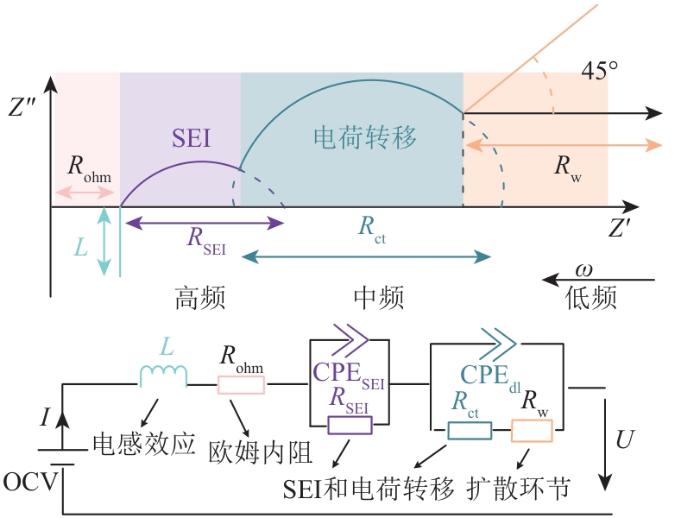
在给定特定频率的正弦电流I的作用下,电池两端会产生相应的电压降V。电池阻抗值可表示为
式中:
图1
1.2 EIS数据预处理
本文采用目前国内外阻抗研究领域最大的数据集[21],阻抗数据满足Kramers-Kronig (K-K)关系。通过积分计算得到的阻抗实部
式中:
通过式(
针对这一问题,Schönleber等[22]提出线性K-K(Lin-KK)方法,其不直接运用式(
拟合等效电路的阻抗表达式如下:
式中:
最小时间常数
式中
时间常数
为合理地判断被测量的EIS数据与ECM之间的相关性,采用拟合残差作为判断依据,其实部、虚部分别表示如下:
式中:
Lin-KK测试中RC元件数量选择至关重要。为了更准确地量化在ECM中RC元件的适宜数量,引入度量值
式中:
在本文中,设计参数c的取值对实验结果具有显著影响,特别是在c=0.85时,获得了较为理想的实验效果。为深入探究不同条件下锂离子电池的阻抗特性,利用Lin-KK方法对在多种温度和SOC条件下的6块锂离子电池进行了直至其寿命终止的循环阻抗测试,计算出每块电池所有循环次数的阻抗实部和虚部残差,然后取平均值。
图2为不同状态下的阻抗实、虚部残差,可以看出,6块电池全部循环次数的平均残差都是在100%SOC时最小,明显低于其他2个状态,说明100%SOC的阻抗数据更接近真实值,所以选择100%SOC的阻抗数据作为SOH预测的数据基础。
图2
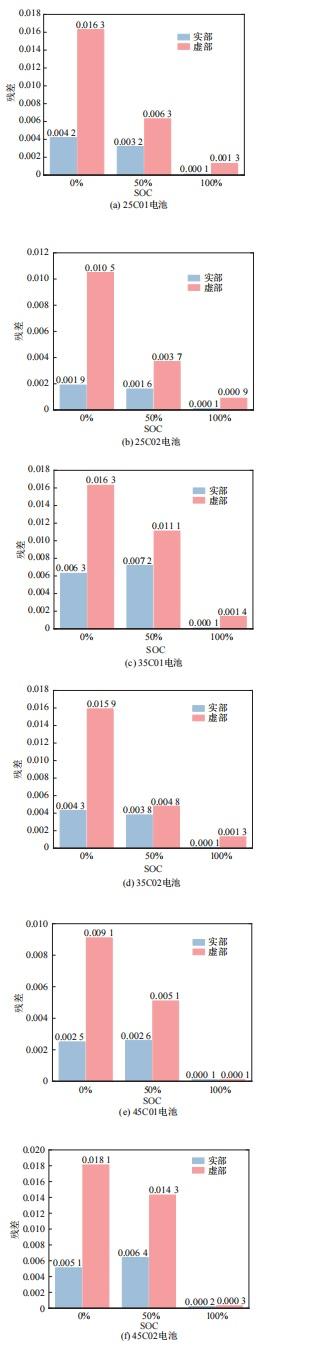
图2
不同状态下的阻抗实部和虚部残差
Fig. 2
Real and imaginary part residuals of impedance under different conditions
2 模型结构
2.1 神经网络
2.1.1 CNN
2.1.2 长短时记忆神经网络
2.1.3 BiLSTM神经网络
BiLSTM输出过程如下:
式中: xi (i=1, 2,…, t)表示输入数据; Ai 和 Bi 分别表示向前和向后迭代的LSTM隐藏状态; Yi 表示输出数据;
2.2 深度学习机制
2.2.1 Attention机制
Attention机制中信息权重选择依赖于注意力值[30]。其计算包含2个主要步骤:1)针对所有输入分配注意力;2)计算输入信息加权平均,实现信息精准处理。
注意力状态转换过程如下:
式中:
2.2.2 Dropout
模型训练中,Dropout 随机失活神经元可能丢失关键信息,削弱网络预估能力[33]。为此,本文提出融合Dropout与注意力权重机制的新策略:根据神经元权重调整失活概率,降低高注意力权重神经元的失活概率,以最大化保留对预测结果至关重要的神经元。
2.3 CNN-BiLSTM-Attention预测模型结构
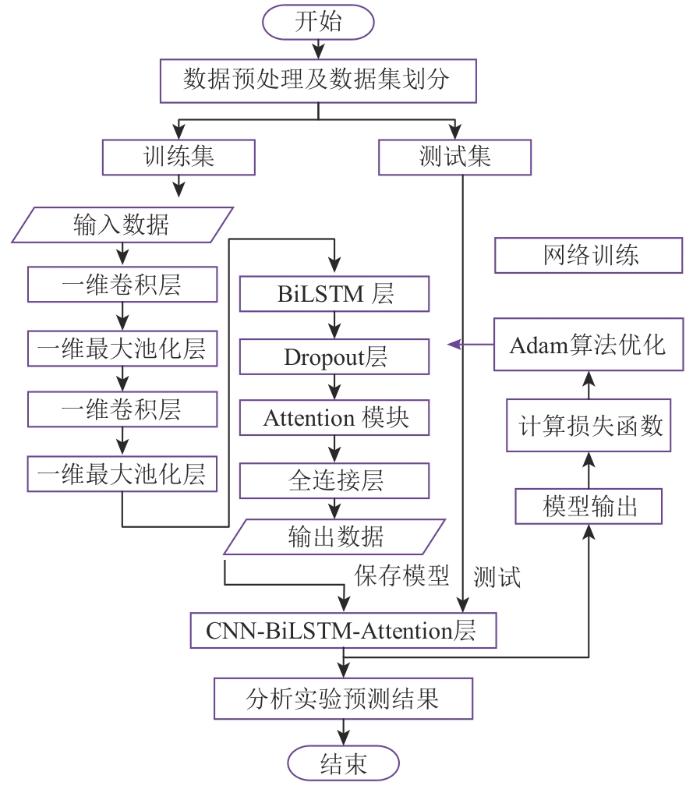
基于EIS预测SOH的CNN-BiLSTM-Attention模型结构如图3所示。一维CNN参数设置如下:2个卷积层,2个池化层,32个卷积滤波器,卷积核大小为3,最大池化层大小为2,激活函数为Relu。BiLSTM参数设置如下:1层BiLSTM,128个神经元,激活函数为Selu。
图3
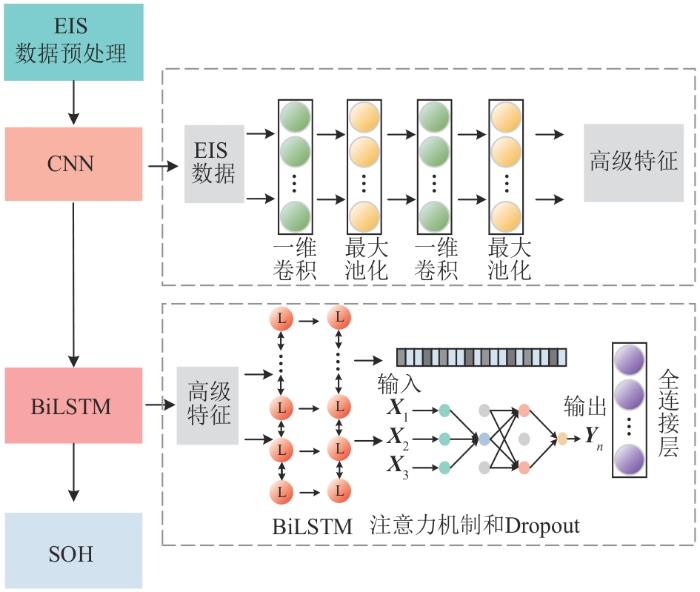
图3
基于EIS预测SOH的CNN-BiLSTM-Attention模型结构
Fig. 3
Structure of CNN-BiLSTM-Attention model for SOH prediction based on EIS
预测模型由一维CNN、BiLSTM神经网络和注意力机制3部分构成。首先,输入层预处理阻抗数据;其次,CNN自动提取EIS的有效非线性局部特征;再次,利用BiLSTM学习CNN提取的高级特征与SOH之间的非线性映射关系;最后,BiLSTM自动学习并关注对SOH估计最有影响的特征,从而提高模型对EIS数据的利用效率和SOH预测性能。由于训练数据数量较少,容易出现过拟合,因此通过增加Dropout层来防止过拟合。
3 实验设计
为验证EIS估计SOH的有效性与CNN-BiLSTM-Attention模型的预测能力,首先将数据集划分为以下工况:1)25 ℃工况下,25C05、25C06、25C07和25C08电池作为训练集,25C01、25C02、25C03和25C04电池作为测试集;2)35 ℃工况下,35C01电池作为训练集,35C02电池作为测试集;3)45 ℃工况下,45C01电池作为训练集,45C02电池作为测试集。然后,对模型进行训练,并保存训练好的模型,用于预测SOH。最后,采用35C01和45C01电池,通过划分不同比例的训练集和测试集来验证泛化能力。预测流程如图4所示,训练模型的参数设置如下:损失函数为Mse,优化器为Adam,批处理大小为32,学习率为0.01,迭代次数为500。
图4
4 SOH预测结果与分析
4.1 CNN-BiLSTM-Attention模型的预测结果
图5
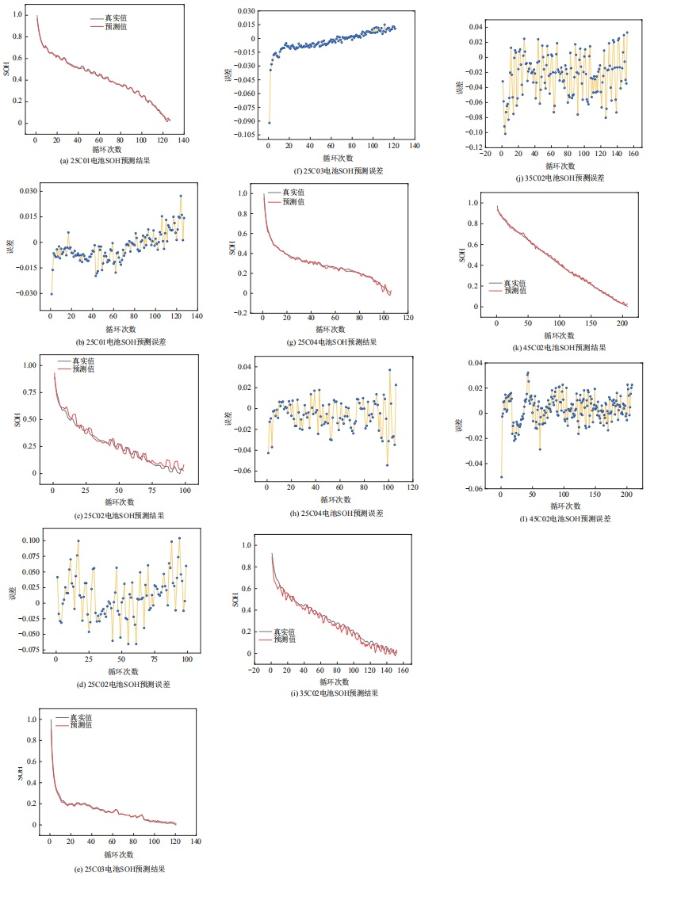
图5
CNN-BiLSTM-Attention模型SOH预测结果及误差
Fig. 5
SOH prediction results and errors of CNN-BiLSTM-Attention model
表1 CNN-BiLSTM-Attention的SOH预测评价指标
Tab. 1
| 温度/℃ | 电池 | RMSE | MAE | R2 |
|---|---|---|---|---|
| 25 | 25C01 | 0.009 2 | 0.007 6 | 0.991 7 |
| 25C02 | 0.036 7 | 0.028 8 | 0.943 8 | |
| 25C03 | 0.011 9 | 0.018 2 | 0.981 9 | |
| 25C04 | 0.027 7 | 0.018 6 | 0.969 5 | |
| 35 | 35C02 | 0.036 8 | 0.039 7 | 0.917 6 |
| 45 | 45C02 | 0.011 1 | 0.008 6 | 0.998 1 |
从图5可以看出,CNN-BiLSTM-Attention模型在3个不同温度条件下的SOH预测结果均表现出色;预测误差紧密围绕零点波动,一致性好,且曲线波动幅度较小,显示出高稳定性。此外,考虑到电池在充放电及静置过程中受容量再生现象的影响,网络模型在特征提取时可能受到噪声干扰,这对SOH的预测精度造成影响。但该模型在此方面具有有效的追踪能力,能成功应对噪声对预测精度的影响。
从表1可以看出,各温度下预测结果的RMSE、MAE均小于0.04,R2值均保持在0.9以上,说明模型精度高、性能优。因此,利用电化学阻抗数据预测SOH有效可行,且CNN-BiLSTM-Attention模型在时序预测中优势显著。
4.2 模型对比分析
为了更深入地验证CNN-BiLSTM-Attention模型在锂电池SOH预测方面的性能,本文设计了相应的对比实验。在实验中,所有模型采用相同的训练和测试数据集,并将CNN-BiLSTM-Attention模型与CNN-BiLSTM、BiLSTM模型的预测结果进行对比,如图6所示。可以看出,3个模型中,BiLSTM模型的预测效果最差。CNN-BiLSTM模型与BiLSTM相比具有更好的拟合性,这是由于CNN能够更好地提取数据的重要特征。而CNN-BiLSTM-Attention模型引入了Attention机制,自动为BiLSTM隐藏层状态分配相应权重,以区分不同时间EIS序列的重要性,使预测值与真实值最接近。
图6
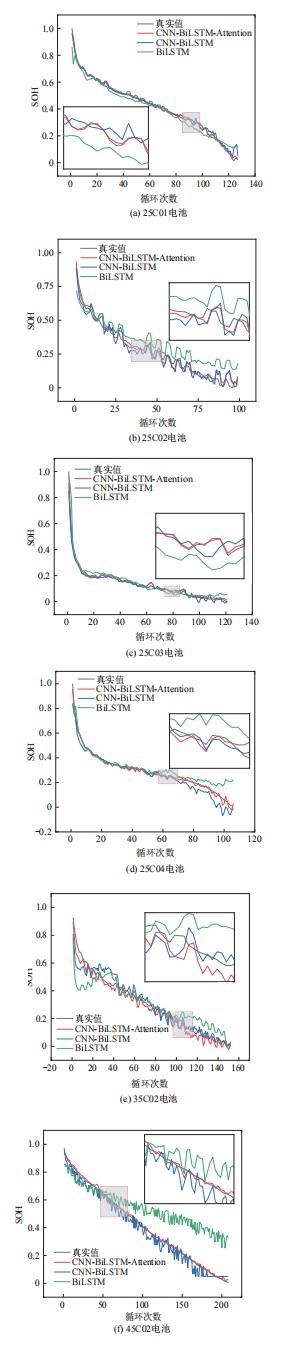
图6
不同模型SOH预测结果对比
Fig. 6
Comparison of SOH prediction results from different models
表2为各模型的SOH预测评价指标,通过对比可以看出,CNN-BiLSTM-Attention模型的RMSE、MAE均最小,R2值最大,表明该模型对SOH预测效果最好。
表2 各模型的SOH预测评价指标
Tab. 2
| 模型 | 电池 | RMSE | MAE | R2 |
|---|---|---|---|---|
| BiLSTM | 25C01 | 0.074 1 | 0.035 9 | 0.857 6 |
| 25C02 | 0.092 9 | 0.081 1 | 0.776 9 | |
| 25C03 | 0.080 8 | 0.026 3 | 0.735 2 | |
| 25C04 | 0.080 5 | 0.040 1 | 0.718 1 | |
| 35C02 | 0.094 2 | 0.064 4 | 0.790 4 | |
| 45C02 | 0.182 1 | 0.151 4 | 0.512 9 | |
| CNN-BiLSTM | 25C01 | 0.022 8 | 0.015 7 | 0.957 3 |
| 25C02 | 0.043 2 | 0.035 8 | 0.951 6 | |
| 25C03 | 0.021 5 | 0.015 1 | 0.967 0 | |
| 25C04 | 0.065 2 | 0.033 0 | 0.826 4 | |
| 35C02 | 0.056 0 | 0.040 9 | 0.925 7 | |
| 45C02 | 0.039 0 | 0.031 2 | 0.957 6 | |
| CNN-BiLSTM-Attention | 25C01 | 0.009 2 | 0.007 6 | 0.991 7 |
| 25C02 | 0.036 7 | 0.028 8 | 0.965 1 | |
| 25C03 | 0.011 9 | 0.008 2 | 0.989 9 | |
| 25C04 | 0.027 7 | 0.018 7 | 0.969 5 | |
| 35C02 | 0.036 8 | 0.029 7 | 0.967 8 | |
| 45C02 | 0.011 1 | 0.008 6 | 0.998 1 |
4.3 泛化性能验证
图7
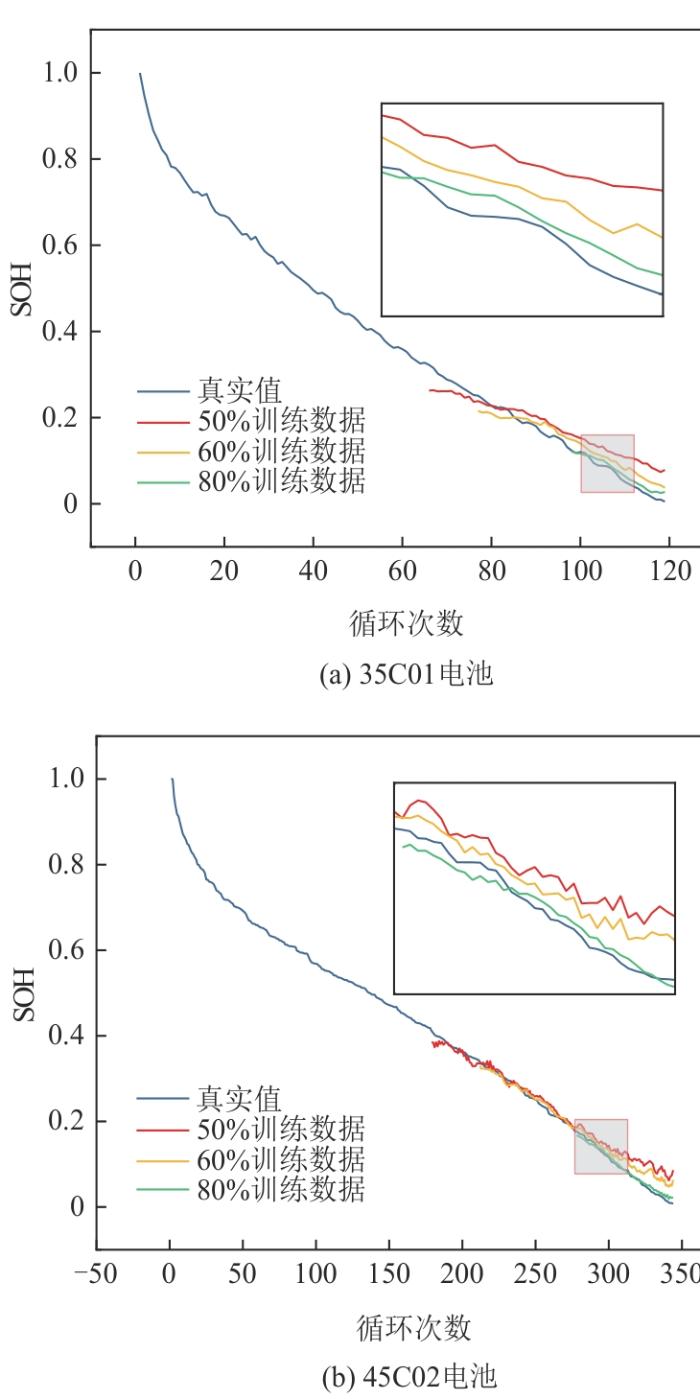
表3 2块电池SOH预测评价指标
Tab. 3
| 电池 | 训练集比例/% | RMSE | MAE | R2 |
|---|---|---|---|---|
| 35C01 | 50 | 0.036 8 | 0.031 8 | 0.841 1 |
| 60 | 0.021 5 | 0.018 9 | 0.914 8 | |
| 80 | 0.007 8 | 0.006 9 | 0.960 4 | |
| 45C01 | 50 | 0.026 8 | 0.019 6 | 0.949 9 |
| 60 | 0.018 5 | 0.013 6 | 0.965 6 | |
| 80 | 0.006 6 | 0.005 4 | 0.983 4 |
5 结论
基于锂离子电池EIS数据,采用组合模型CNN-BiLSTM-Attention进行SOH预测,得到如下结论:
1)基于EIS数据的锂离子电池SOH预测是有效可行的,采用线性K-K方法对阻抗数据进行预处理,可以保证EIS数据的有效性。
2)CNN能够自动处理阻抗数据并提取特征,可以有效解决人工提取特征时对于重要特征的疏漏问题。Attention机制能够对BiLSTM预测模型进行优化,提高预测精度。
3)CNN-BiLSTM-Attention模型能够精准、高效预测锂离子电池SOH,预测精度比CNN-BiLSTM和BiLSTM模型分别提高了46.1%和77.9%,具有较强的实用性。
参考文献
新型工业化城市环境能源复合承载力评价:以东莞市环境能源可持续发展为例
[J].
Evaluation of environment and energy compound carrying capacity in newly industrialized cities:a case study of environmental and energy sustainable development of Dongguan
[J].
State estimation for advanced battery management:key challenges and future trends
[J].
中国电动汽车发展及车网互动对新型储能配置的影响
[J].
Study on the Influence of electric vehicle development and the vehicle-grid interaction on new energy storage configuration in China
[J].
用于电动汽车集群并网的直流变压器启动研究
[J].
Research on startup of DC transformer for electric vehicle cluster grid-connection
[J].
基于超声的锂离子电池微过充循环老化特性
[J].
Characterization of slight overcharge cycle aging of lithium-ion batteries based on ultrasonic
[J].
Effect analysis on SOC values of the power lithium manganate battery during discharging process and its intelligent estimation
[J].
基于改进TOPSIS-模糊贝叶斯网络的电池SOC和SOH联合估计方法
[J].
Joint estimation of battery SOC and SOH based on improved TOPSIS- fuzzy Bayesian network
[J].
锂离子电池状态估计与剩余寿命预测方法综述
[J].
Review on state estimation and remaining useful life prediction methods for lithium-ion battery
[J].
基于间接健康特征优化与多模型融合的锂电池SOH-RUL联合预测
[J].
Joint prediction of lithium battery state of health and remaining useful life based on indirect health features optimization and multi-model fusion
[J].
基于双自适应扩展粒子滤波器的锂离子电池状态联合估计
[J].
Joint state estimation of lithium-ion battery based on dual adaptive extended particle filter
[J].
基于GA-SA-BP神经网络的锂电池健康状态估算方法
[J].
Lithium battery state of health estimation method based on a GA-SA-BP neural network
[J].
基于EIS和神经网络的退役电池SOH快速估计
[J].
Fast estimation method for state-of-health of retired batteries based on electrochemical impedance spectroscopy and neural network
[J].
带降噪自编码器和门控递归混合神经网络的电池健康状态估算
[J].
State of health estimation of lithium ion battery based on denoising autoencoder-gated recurrent unit
[J].
基于阻抗谱重构技术的电池健康状态快速估计方法
[J].
A fast estimation method of battery state of health based on impedance spectroscopy reconstruction technique
[J].
Lithium-ion battery state of health estimation based on electrochemical impedance spectroscopy and cuckoo search algorithm optimized Elman neural network
[J].
基于电化学阻抗谱的三元锂离子电池状态估计研究
[D].
Study on state estimation of ternary lithium ion battery based on electrochemical impedance spectroscopy
[D].
Electrochemical impedance feature selection and gaussian process regression based on the state-of-health estimation method for lithium-ion batteries
[J].
基于分数阶建模与滤波的锂离子电池SOC估计方法研究
[D].
Research on SOC estimation methods of lithium-ion batteries based on fractional-order modeling and filtering
[D].
A systematic model-based degradation behavior recognition and health monitoring method for lithium-ion batteries
[J].
基于EIS的退役锂离子电池SOH估计研究
[D].
Study on SOH estimation of retired Li-ion batteries based on EIS
[D].
Identifying degradation patterns of lithium ion batteries from impedance spectroscopy using machine learning
[J].
A method for improving the robustness of linear Kramers-Kronig validity tests
[J].
A comprehensive review on the state of charge estimation for lithium-ion battery based on neural network
[J].
基于PSA引导双分支神经网络特征融合的同步电机故障诊断
[J].
Fault diagnosis of synchronous motor based on PSA guided double branch neural network feature fusion
[J].
基于Mogrifier LSTM-CNN的锂离子电池荷电状态和健康状态联合估算
[D].
Joint estimation of state of charge and health of lithium-ion batteries based on Mogrifier LSTM-CNN
[D].
基于LSTM-CGAN的多微网数据驱动分布鲁棒协同优化运行策略
[J].
Data-driven distributionally robust collaborative optimization operation strategy for a multi-microgrid based on LSTM-CGAN
[J].
基于数据预处理和VMD-LSTM-GPR的锂离子电池剩余寿命预测
[J].
Prediction of remaining useful life of lithium-ion battery based on data preprocessing and VMD-LSTM-GPR
[J].
基于电化学阻抗谱的锂离子电池SOH预测研究
[D].
Study on SOH prediction of lithium ion batteries based on electrochemical impedance spectroscopy
[D].
基于自适应噪声完全集合经验模态分解与BiLSTM-Transformer的锂离子电池剩余使用寿命预测
[J].
Prediction of remaining service life of lithium-ion batteries based on complete ensemble empirical mode decomposition with adaptive noise and BiLSTM-Transformer
[J].
基于Attention和残差网络的非侵入式负荷监测
[J].
Non-intrusive load monitoring algorithm based on attention and residual networks
[J].
基于优化神经网络的锂离子电池SOC估计及低温迁移问题的研究
[D].
Research on SOC estimation and low temperature migration of lithium ion battery based on optimized neural network
[D].
基于卷积神经网络的暂稳极限功率计算
[J].
Calculation of transient stability limit based on convolutional neural network
[J].
基于马尔可夫变迁场和EfficientNet的复合电能质量扰动识别
[J].
Recognition of composite power quality disturbances based on MTF-EfficientNet convolutional neural network
[J].


