


0 引言
目前,国内外一般采用添加亲水材料的熔融共混改性[10-11]、熔融接枝亲水材料改性[12]、溶液接枝亲水材料改性[13]等亲水改性方法;就液固界面改性而言,有效提高聚丙烯亲水性的方法主要有界面表面粗糙法、等离子处理法[14]、火焰处理法[15]、物理法[16]、表面接枝聚合[17-18]等改性方法。聚丙烯填料的改性关键在于选择合适的改性剂与改性剂添加量。Farrukh等[19]采用质量分数为16%的热塑性聚酯与聚丙烯进行共混,制得的聚丙烯膜与水的接触角从85.5°降低到55.0°;方勇[20]采用聚丙烯接枝马来酸酐(polypropylene grafted maleic anhydride,PP-g-MAH)作为改性剂,添加质量分数为40%的马来酸酐,得到的单板液体成膜率从10%有效提高到90%;Saffar等[21]采用共混改性法将聚丙烯与质量分数为2%的丙烯酸接枝聚丙烯进行共混制膜,并将其浸渍于纳米TiO2悬浮液中,改性后的聚丙烯膜与水的接触角从90°有效降低到40°。总的来说,共混改性工艺简单、效果明显,但缺少其与二氧化碳捕集相结合的应用研究与验证。
本文对聚丙烯填料在二氧化碳捕集领域的应用进行了进一步探索。首先选用聚丙烯材料和质量分数为30%的PP-g-MAH颗粒料,采用熔融共混方法将其制成410Y和350Y规整填料,然后在搭建的规整填料流体力学和传质性能测试平台上对二氧化碳捕集应用场景的聚丙烯填料流体力学及传质性能进行测试,并与不锈钢填料进行对比。
1 熔融共混聚丙烯填料制备
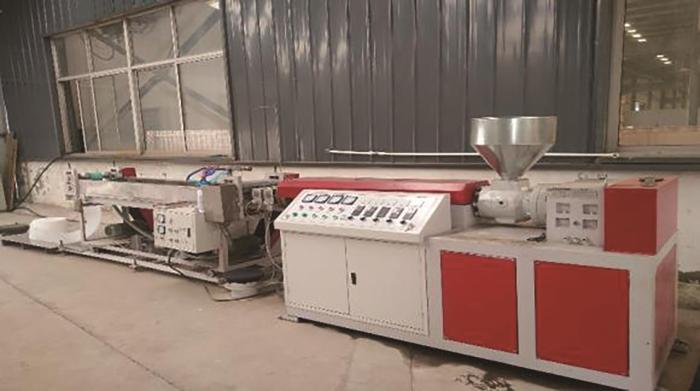
聚丙烯材料和质量分数为30%的PP-g-MAH颗粒料混合后,采用熔融共混方法制成宽度为200 mm的平板,降温后通过波纹规整填料模具压制波纹结构,最后按照填料块尺寸切割组装。聚丙烯填料生产装置如图1所示。
图1
聚丙烯材料孔板波纹填料实验的几何参数见表1,聚丙烯规整填料410Y和350Y的比表面积分别为410、350 m2/m3。对于相同公称比表面积的规整填料,聚丙烯填料的几何结构参数不完全与不锈钢填料一致。
表1 聚丙烯规整填料410Y和350Y参数
Tab. 1
| 填料型号 | 比表面积/(m2/m3) | 波纹波距/mm | 波纹波峰/mm | 波纹边长/mm | 板片厚度/mm |
|---|---|---|---|---|---|
| 410Y PP | 410 | 8.00 | 6.25 | 10.1 | 0.8 |
| 350Y PP | 350 | 7.66 | 8.59 | 11.5 | 1.0 |
2 流体力学及传质性能测试平台
搭建填料流体力学性能和传质性能测试平台,对未亲水改性聚丙烯填料410Y和熔融共混亲水改性聚丙烯填料350Y性能进行测试。测试平台由离心风机(用于输送空气,流量为120~1 000 m3/h,对应空塔气速为0.5~4 m/s)、亚克力塔体、聚丙烯规整填料、循环泵(用于输送溶液,流量为0~6 m3/h)、流量计(涡街流量计连接在风机后,用于测量塔内气体流量,设备型号为川仪VFD10133213A002VH1211110-OUY,量程为120~1 000 m3/h,精度为0.01 m3/h;电磁流量计连接在溶液循环泵后、塔顶前,用于测量送入塔内的液体流量,设备型号为川仪MFH40018110A005EH1401111,量程为0~5 m3/h,精度为0.1 m3/h)、传感器(压力传感器测量塔顶、塔底取样口的压力差,型号为川仪PDS,量程为0~3 kPa,精度为0.075%;温度传感器测量塔顶、塔底取样口的气体温度,量程为0~100 ℃,测量精度为1%)、溶液储罐和控制阀门组成,如图2所示。测试塔体直径为300 mm,填料填充高度为2 000 mm。在空气/水体系中,对聚丙烯规整填料410Y和350Y的流体力学性能进行测试,测试内容包括干压降、湿压降和填料持液量。填料段压降与气体速度有关,用F因子表示,对于不锈钢填料,一般取值为0.8~3.1 Pa0.5,循环液体流量为0~70 m3/(m2⋅h)。
图2
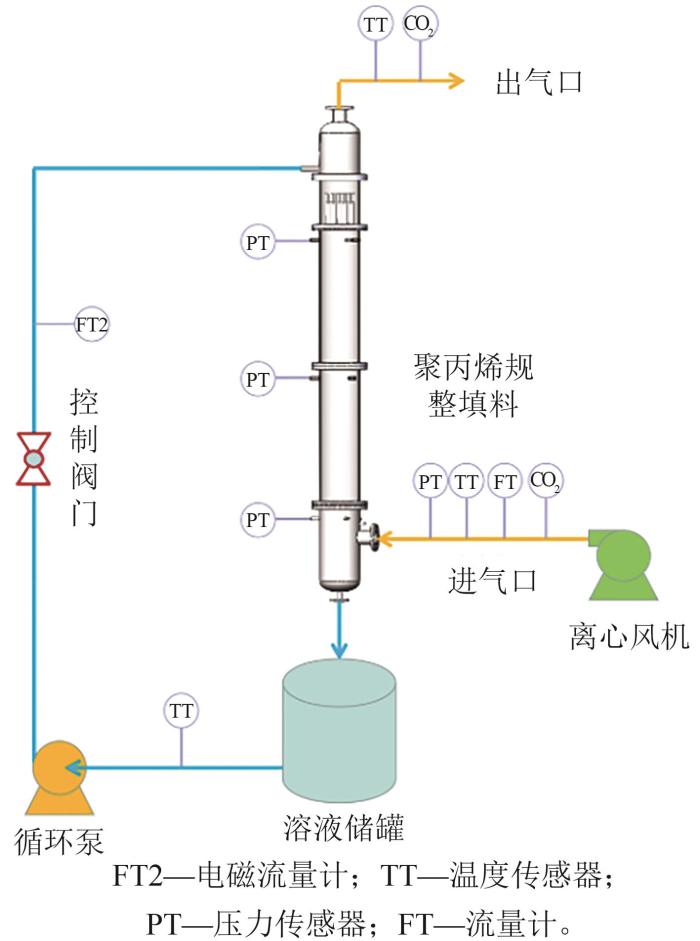
图2
填料流体力学及传质性能测试平台
Fig. 2
Filler fluid mechanics and mass transfer performance testing platform
有效比表面积的测量采用化学方法(0.1 mol/L NaOH吸收空气中的CO2),因为该方法可以很好地反映传质填料的有效比表面积。在测试中吸收塔的空塔气速保持在1.0 m/s左右,在液相负荷为14.0 m3/(m2⋅h)和28.0 m3/(m2⋅h)条件下分别测试规整填料的有效比表面积,并采用LI-840A红外气体分析仪(量程为0~20 000 mg/L,精度为±1.5%)测量进口和出口的CO2浓度。因气相传质阻力较小,可以忽略不计,则有效比表面积计算式[22]如下:
式中:ae为填料有效比表面积,m2/m3;uG为表面气速,m/s;
3 实验结果与讨论
3.1 聚丙烯填料流体力学性能
CO2吸收塔内总压降决定了烟气鼓风机的功率,总压降由气体分布器、填料段、液体分布器和除雾器的压降组成,其中填料段压降的推荐值不应超过200 Pa/m[24]。F因子的表达式如下:
式中:
图3
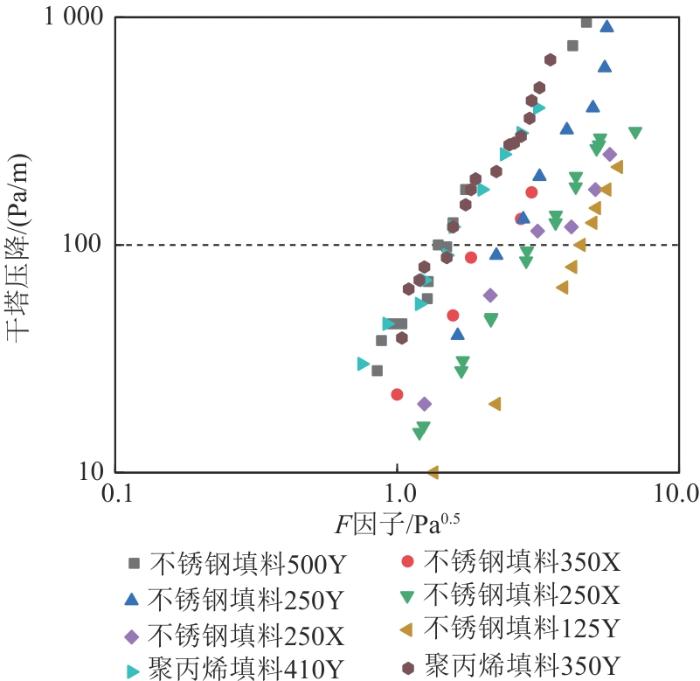
图3
聚丙烯填料与不锈钢填料的干塔压降对比
Fig. 3
Comparison of dry tower pressure drop between polypropylene fillers and stainless steel fillers
图4显示了不同溶液负荷条件下的湿塔压降。吸收塔液相负荷Ql为10~30 m3/(m2⋅h),本文选取14、28 m3/(m2⋅h)进行试验。在试验过程中,聚丙烯规整填料没有明显的液泛现象,当液相负荷为14、28 m3/(m2⋅h)时,亲水改性聚丙烯填料350Y液泛气速分别为2.5、2.9 m/s。由于聚丙烯填料的湿塔压降高于相同比面积的不锈钢规整填料,因此,350Y塑料填料的湿压降设定为200 Pa/m。在不同液相负荷条件下,在测试平台测得亲水改性聚丙烯填料350Y空塔气速分别为1.49 m/s和1.33 m/s,对应于液泛气速的50%~55%。对于不锈钢规整填料,最佳空塔气速约为液泛气速的50%~80%。
图4
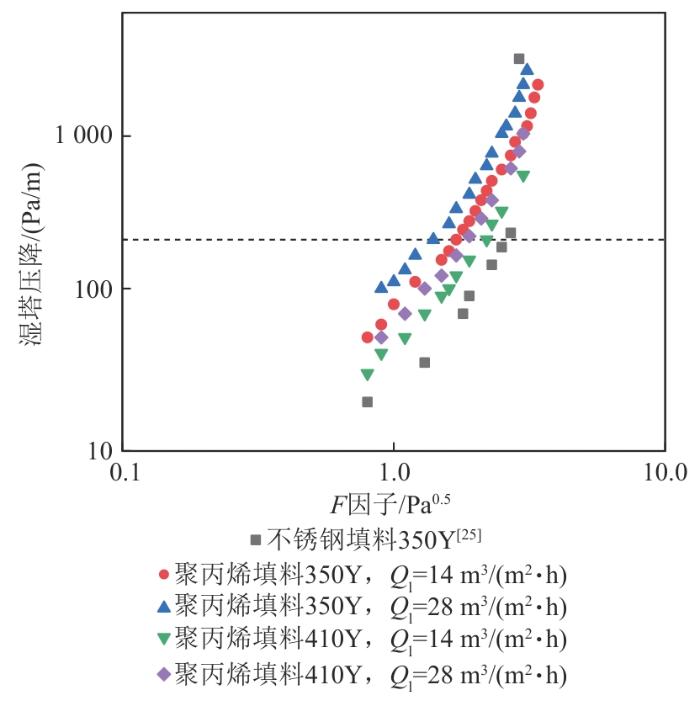
图4
聚丙烯填料与不锈钢填料的湿塔压降对比
Fig. 4
Comparison of wet tower pressure drop between polypropylene fillers and stainless steel fillers
当吸收塔未达到液泛点时,亲水改性聚丙烯填料350Y持液率略有变化,如图5所示。填料塔含液量是在特定的操作条件下,在填料表面和波纹板片中空隙区域的单位体积内所持液体的体积。试验过程中壁流严重,因此,在相同液相负荷条件下,聚丙烯填料410Y的持液率低于聚丙烯填料350Y,也正因为这个原因,聚丙烯填料410Y的持液率随气速变化不大。
图5
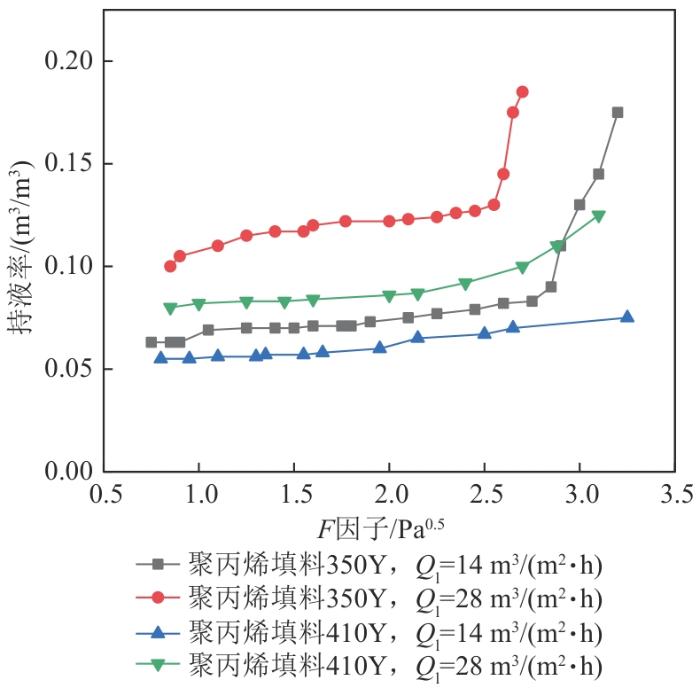
图5
试验用聚丙烯填料的持液率
Fig. 5
Liquid holding capacity of experimental polypropylene fillers
3.2 聚丙烯填料传质性能
式中:ae_stainless、ae_plastic分别为不锈钢填料、聚丙烯填料有效比表面积;
图6为不同液相负荷下未亲水改性聚丙烯填料410Y、亲水改性聚丙烯填料350Y和不锈钢规整填料(350X、500Y、A3-500、B1-500)[25]比表面积利用率的对比。聚丙烯规整填料比表面积利用率随液相负荷增大而升高。对于未亲水改性聚丙烯规整填料410Y,其比表面积利用率远低于不锈钢规整填料500Y。当液相负荷为14 m3/(m2⋅h)时,聚丙烯填料410Y比表面积利用率为不锈钢规整填料500Y的50%左右。但是综合来看,聚丙烯填料与不锈钢填料有效比表面积的差值随着液相负荷的增大而减小。对于亲水改性聚丙烯填料350Y,当液相负荷小于30 m3/(m2⋅h)时,其比表面积利用率接近不锈钢填料500Y。当液体负荷达到40 m3/(m2⋅h)时,聚丙烯填料350Y出现轻微液泛,导致其比表面积利用率远大于不锈钢填料500Y。
图6
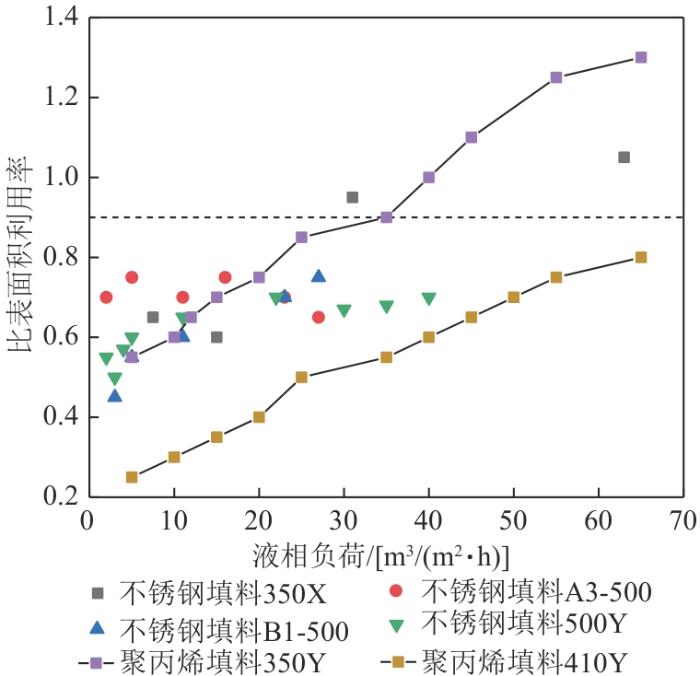
图6
聚丙烯填料与不锈钢填料比表面积利用率对比
Fig. 6
Comparison of specific surface area utilization between polypropylene fillers and stainless steel fillers
聚丙烯规整填料的有效比表面积修正系数拟合曲线如图7所示。在CO2-胺反应的吸收塔内的液相负荷条件下(即Q/LP=2.5×10-6 m2/s),由于未改性聚丙烯填料润湿性能较差,在相同公称比表面积规格条件下,聚丙烯填料410Y的有效比表面积远低于不锈钢填料410Y(约为不锈钢填料410Y的50%),亲水改性聚丙烯填料350Y的有效比表面积接近不锈钢填料350Y(约为不锈钢填料350Y的90%)。从CO2与有机胺反应的总传质系数来看,亲水改性聚丙烯填料350Y可以替代不锈钢规整填料350Y。
图7
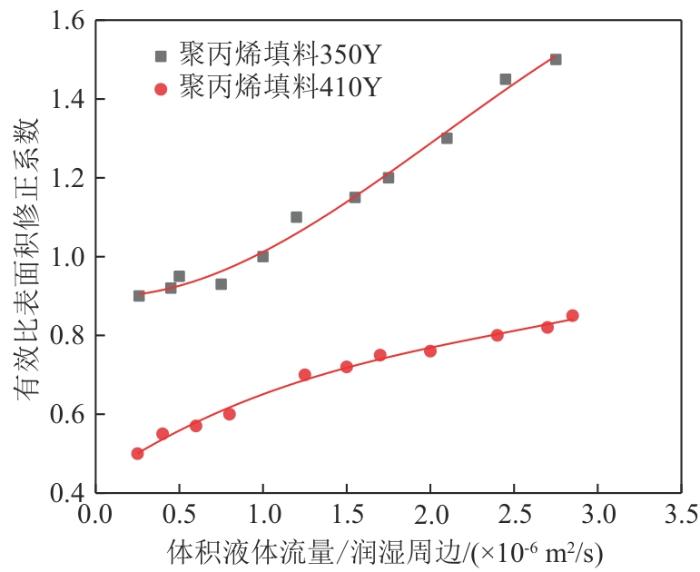
图7
聚丙烯规整填料的有效比表面积修正系数
Fig. 7
Effective specific surface area correction factor of polypropylene regular fillers
式中a、b、c、d均为拟合后的系数。当填料为聚丙烯410Y时,a=0.592,b=38 139.2,c=-1.763×10⁹,d=4.072×10³;当填料为聚丙烯350Y时,a=1.254,b=-2 000 167,c=3.583×10⁹,d=-6.277×10¹³。
3.3 耐溶剂性能测试
为测试聚丙烯材料的耐溶剂性能,取若干样品分别放入质量分数为30%的乙醇胺(MEA)、质量分数为30%的MEA+2-氨基-2-甲基-1-丙醇(AMP)吸收剂的溶液中,常温处置,每隔1个月取出进行质量测定,作为材料腐蚀情况的考察,结果如图8所示。可以看出,样品质量基本无明显变化,经过6个月的浸泡后,材料质量略微有所上升,上升幅度不超过3%,且材料表面基本无肉眼可见的变化。由此可以基本推断,聚丙烯材料耐腐蚀性能较佳,6个月的浸泡仅有轻微的溶胀发生,无明显腐蚀。
图8
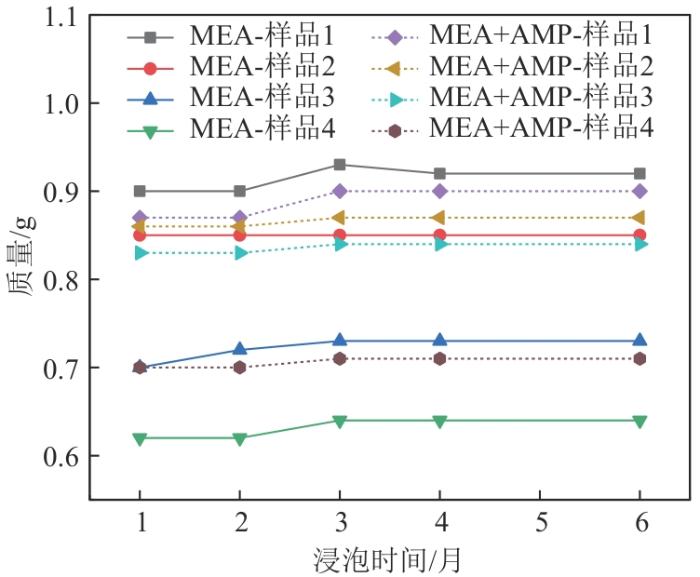
图8
吸收剂浸泡下聚丙烯平板质量变化
Fig. 8
Mass change of polypropylene flat plate soaked in absorbent
4 结论
提出添加聚丙烯接枝马来酸酐以提高聚丙烯材料亲水性能并以此制备规整填料,该填料在流体力学和传质性能方面与传统不锈钢填料接近,实际应用中可以替代不锈钢填料,达到降低成本的效果。主要结论如下:
1)该聚丙烯填料410Y和350Y的干塔压降与不锈钢填料接近,湿塔压降高于相同公称比表面积的不锈钢规整填料。
2)在CO2-胺反应的吸收塔内的液相负荷条件下,该聚丙烯填料350Y有效比表面积约为不锈钢填料的90%左右。
3)在吸收剂6个月的浸泡下,该聚丙烯材料质量无明显变化,具有较好的耐腐蚀性能。
4)经过流体力学和传质性能测试可以看出,该聚丙烯填料与不锈钢填料性能接近,可在实际应用中替代不锈钢规整填料。
参考文献
二氧化碳捕集技术及适用场景分析
[J].
Research on carbon dioxide capture technology and suitable scenarios
[J].
乙二烯三胺与三乙醇胺混合胺溶液CO2吸收剂研究
[J].
Study on CO2 absorbent of DETA and TEA mixed amine solution
[J].
基于电渗析技术的CO2吸收剂再生过程研究
[J].
Study on reclamation process of CO2 absorbent based on electrodialysis technology
[J].
Amine-based solvent for CO2 absorption and its impact on carbon steel corrosion:a perspective review
[J].
Prediction of effective area and liquid hold-up in structured packings by CFD
[J].
燃气电厂化学吸收二氧化碳捕获系统运行参数与能耗分析
[J].
Analysis of operating parameters and energy consumption of chemical absorption carbon dioxide capture system in natural gas power plants
[J].
融合极限场景辨别算法的含碳捕集综合能源系统鲁棒调度模型研究
[J].
Robust scheduling model of integrated energy system with carbon capture integrating extreme scenario discrimination algorithm
[J],
考虑碳捕集和电转气的热电联合虚拟电厂调度优化模型
[J].
Dispatching optimiz ation model of combined heat and power virtual power plant considering carbon capture and power-to-gas
[J].
基于碳捕集与液态CO2储能的综合能源系统优化调度
[J].
Optimal scheduling of integrated energy systems based on carbon capture and liquid CO2 energy storage
[J].
Fouling and rejection characteristic of humic substances in polysulfone ultrafiltration membrane
[J].
Development of polypropylene microporous hydrophilic membranes by blending with PP-g-MA and PP-g-AA
[J].
Preparation of hydrophilic HDPE porous membranes via thermally induced phase separation by blending of amphiphilic PE-b-PEG copolymer
[J].
Improving performance and antifouling capability of PES UF membranes via blending with highly hydrophilic hydrous manganese dioxide nanoparticles
[J].
Influence of additives on polysulfone-based ultrafiltration membrane performance during peat water filtration
[J].
Morphology structure study of polypropylene hollow fiber membrane made by the blend-spinning and cold-stretching method
[J].
Surface segregation of segmented amphiphilic copolymer of poly(dimethylsiloxane) and poly (ethylene glycol) on poly(vinylidene fluoride) blend membrane for oil-water emulsion separation
[J].
Conductive thin film nanocomposite forward osmosis membrane (TFN-FO) blended with carbon nanoparticles for membrane fouling control
[J].
Preparation and characterization of PVDF-P(PEGMA-r-MMA) ultrafiltration blend membranes via simplified blend method
[J].
Fabrication and characterization of microfiltration blended membranes
[J].
聚丙烯基复合材料填料的开发
[D].
Development of polypropylene-based composite filler
[D].
Hydrophilic modification of polypropylene microporous membranes by grafting TiO2 nanoparticles with acrylic acid groups on the surface
[J].
Influence of surface tension on effective packing area
[J].
用于烟气CO2化学吸收塔的高效聚丙烯规整填料研究
[D].
Study on efficient polypropylene structured packing for flue gas CO2 chemical absorption tower
[D].
Amine modeling for CO2 capture:internals selection
[J].
Pressure drop,capacity and mass transfer area requirements for post-combustion carbon capture by solvents
[J].
Dimen sionless models for predicting the effective area,liquid-film,and gas-film mass-transfer coefficients of packing
[J].
A dimensionless model for predicting the mass-transfer area of structured packing
[J].


