

发电技术 ›› 2026, Vol. 47 ›› Issue (2): 325-335.DOI: 10.12096/j.2096-4528.pgt.260210
• 新型电力系统 • 上一篇
孙立明1, 杨博2
收稿日期:2025-10-01
修回日期:2025-12-30
出版日期:2026-04-30
发布日期:2026-04-21
作者简介:基金资助:Liming SUN1, Bo YANG2
Received:2025-10-01
Revised:2025-12-30
Published:2026-04-30
Online:2026-04-21
Supported by:摘要:
目的 为解决电动汽车快速增长导致的充电需求与供给之间不匹配,以及电动汽车充电站(electric vehicle charging station,EVCS)规划不合理导致的用户不满意度高、对电网冲击大等问题,提出一种基于电动汽车充电需求时空分布预测的多目标EVCS最优规划方法。 方法 首先,通过OpenStreetMap开源网站获取路网数据,采用QGIS软件将其可视化,建立路网拓扑结构模型,以此为基础建立包含道路等级、车流量、速度等参数的动态路网模型;其次,利用兴趣点数据对路网节点进行功能区划分,并以影响充电需求预测的相关因素分析、能耗模型建立和充电需求判断3个步骤为基础,实现对充电需求时空分布预测;再次,以EVCS综合成本、用户不满意度和电网电压波动最小化为目标函数,建立多目标EVCS规划模型;最后,将该模型应用于实际区域,并采用具有档案进化路径的快速收敛多目标均衡优化器(fast convergence multi‑objective equilibrium optimizer with archive evolution path,FC-MOEO/AEP)进行优化求解。 结果 所提EVCS最优规划模型在实际区域具有一定的可行性,且充电需求预测模型能够准确地预测实际区域的充电需求分布,在一定程度上为EVCS的合理规划提供了必要的数据支撑。 结论 所提规划方法为EVCS的布局和电动汽车参与电网调度提供了参考,实现了投资者、电动汽车用户和电网的三方共赢。
中图分类号:
孙立明, 杨博. 基于充电需求时空分布预测的电动汽车充电站最优规划[J]. 发电技术, 2026, 47(2): 325-335.
Liming SUN, Bo YANG. Optimal Planning of Electric Vehicle Charging Station Based on Spatio-Temporal Distribution Prediction of Charging Demand[J]. Power Generation Technology, 2026, 47(2): 325-335.
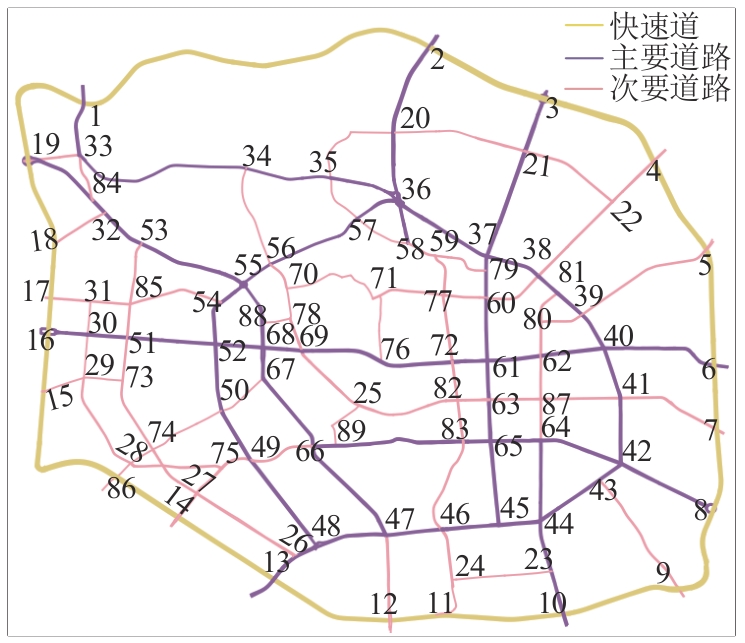
图1 路网拓扑结构
Fig. 1 Road network topology
| 道路类型 | 设计时速/ (km/h) | 设计通行能力/(台/h) | |||
|---|---|---|---|---|---|
| 快速道 | 80 | 1 750 | 1.0 | 1.88 | 4.90 |
| 主要道路 | 60 | 1 400 | 1.1 | 1.89 | 4.85 |
| 次要道路 | 40 | 1 300 | 1.4 | 1.88 | 6.97 |
表1 不同道路等级的相关参数
Tab. 1 Relevant parameters of different road classes
| 道路类型 | 设计时速/ (km/h) | 设计通行能力/(台/h) | |||
|---|---|---|---|---|---|
| 快速道 | 80 | 1 750 | 1.0 | 1.88 | 4.90 |
| 主要道路 | 60 | 1 400 | 1.1 | 1.89 | 4.85 |
| 次要道路 | 40 | 1 300 | 1.4 | 1.88 | 6.97 |
| 功能区类别 | 路网节点 |
|---|---|
| 居民区 | 2, 3, 5, 8, 15, 17, 19, 21, 22, 33, 34, 35, 43, 47, 74, 84 |
| 工作区 | 25, 44, 45, 48, 49, 50, 51, 52, 63, 65, 67, 68, 75, 80, 81 |
| 商业区 | 4, 9, 10, 14, 23, 27, 32, 38, 41, 42, 46, 53, 61, 66, 82, 83, 89 |
| 公共服务区 | 1, 6, 7, 11, 12, 13, 16, 18, 20, 24, 26, 29, 30, 31, 39, 40, 54, 55, 62, 64, 73, 85, 88 |
| 绿地公园区 | 28, 36, 37, 56, 57, 58, 59, 60, 69, 70, 71, 76, 77, 78, 79, 86 |
表2 路网节点功能分区
Tab. 2 Functional zoning of road network nodes
| 功能区类别 | 路网节点 |
|---|---|
| 居民区 | 2, 3, 5, 8, 15, 17, 19, 21, 22, 33, 34, 35, 43, 47, 74, 84 |
| 工作区 | 25, 44, 45, 48, 49, 50, 51, 52, 63, 65, 67, 68, 75, 80, 81 |
| 商业区 | 4, 9, 10, 14, 23, 27, 32, 38, 41, 42, 46, 53, 61, 66, 82, 83, 89 |
| 公共服务区 | 1, 6, 7, 11, 12, 13, 16, 18, 20, 24, 26, 29, 30, 31, 39, 40, 54, 55, 62, 64, 73, 85, 88 |
| 绿地公园区 | 28, 36, 37, 56, 57, 58, 59, 60, 69, 70, 71, 76, 77, 78, 79, 86 |
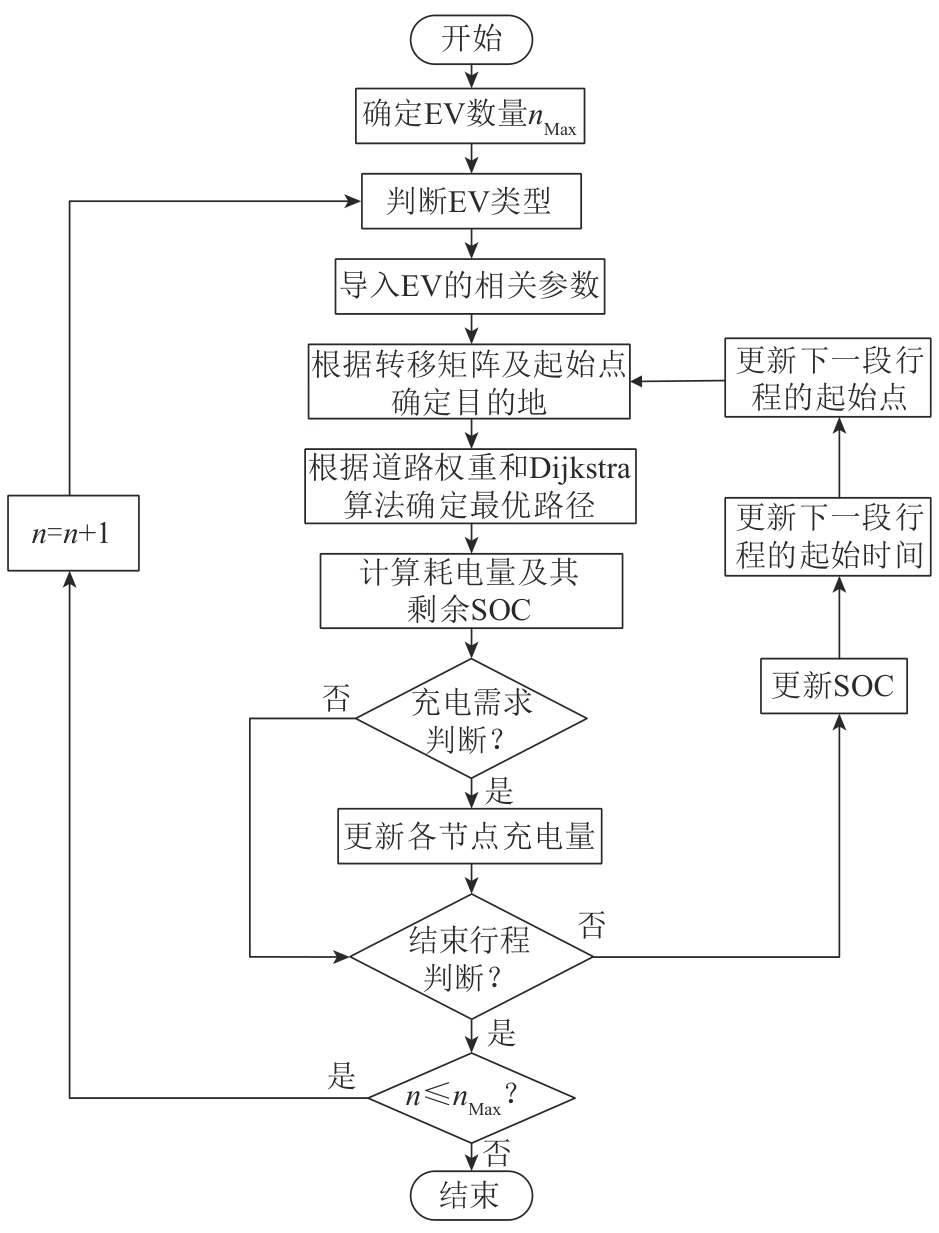
图2 充电需求时空分布预测流程图
Fig. 2 Flow chart for spatio-temporal distribution prediction of charging demand
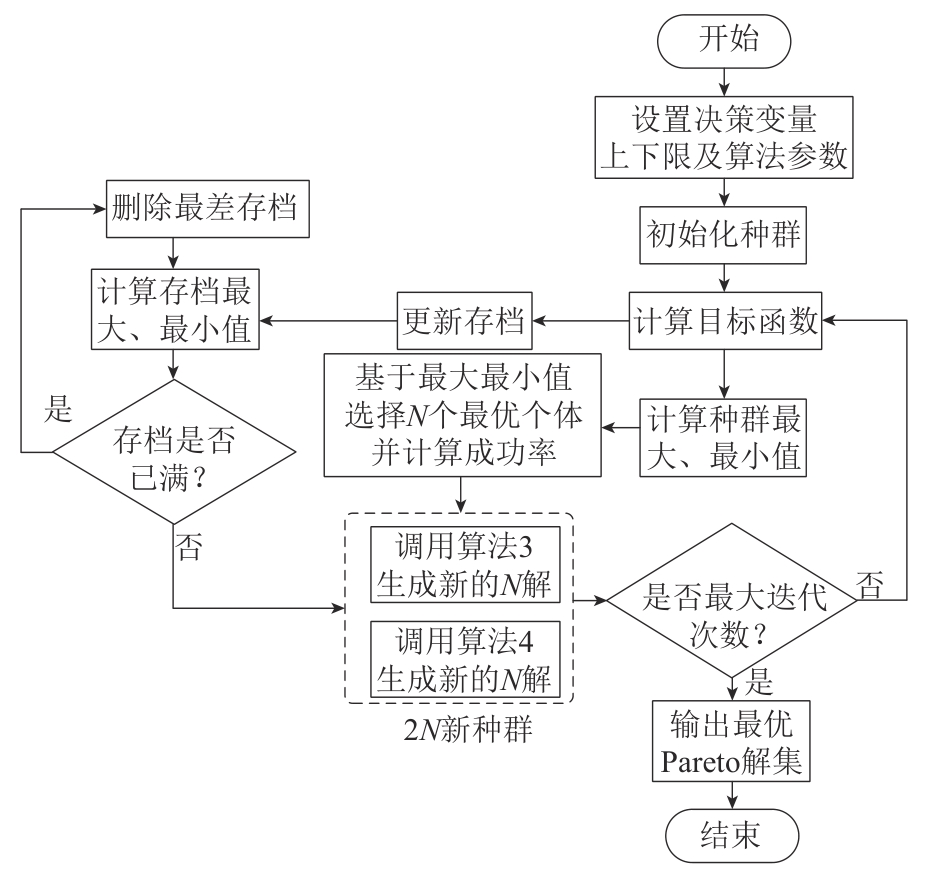
图3 基于FC-MOEO/AEP模型求解流程图
Fig. 3 Solution flow chart based on FC-MOEO/AEP model
| EV类型 | 型号 | 电池容量/(kW⋅h) | 质量/kg | 占比/% |
|---|---|---|---|---|
| 私家车 | 特斯拉Model S (长续航版) | 100 | 1 840 | 60 |
| 出租车 | 比亚迪 E5 | 60 | 1 900 | 30 |
| 公交车 | 比亚迪 K7 | 222 | 8 800 | 10 |
表3 EV参数及其占比
Tab. 3 EV parameters and their proportions
| EV类型 | 型号 | 电池容量/(kW⋅h) | 质量/kg | 占比/% |
|---|---|---|---|---|
| 私家车 | 特斯拉Model S (长续航版) | 100 | 1 840 | 60 |
| 出租车 | 比亚迪 E5 | 60 | 1 900 | 30 |
| 公交车 | 比亚迪 K7 | 222 | 8 800 | 10 |
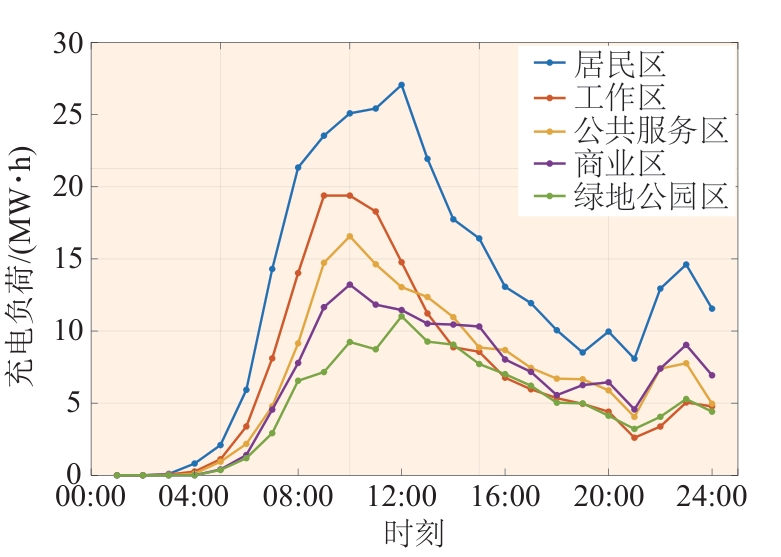
图4 各区域充电需求分布图
Fig. 4 Distribution map of charging demand in each region
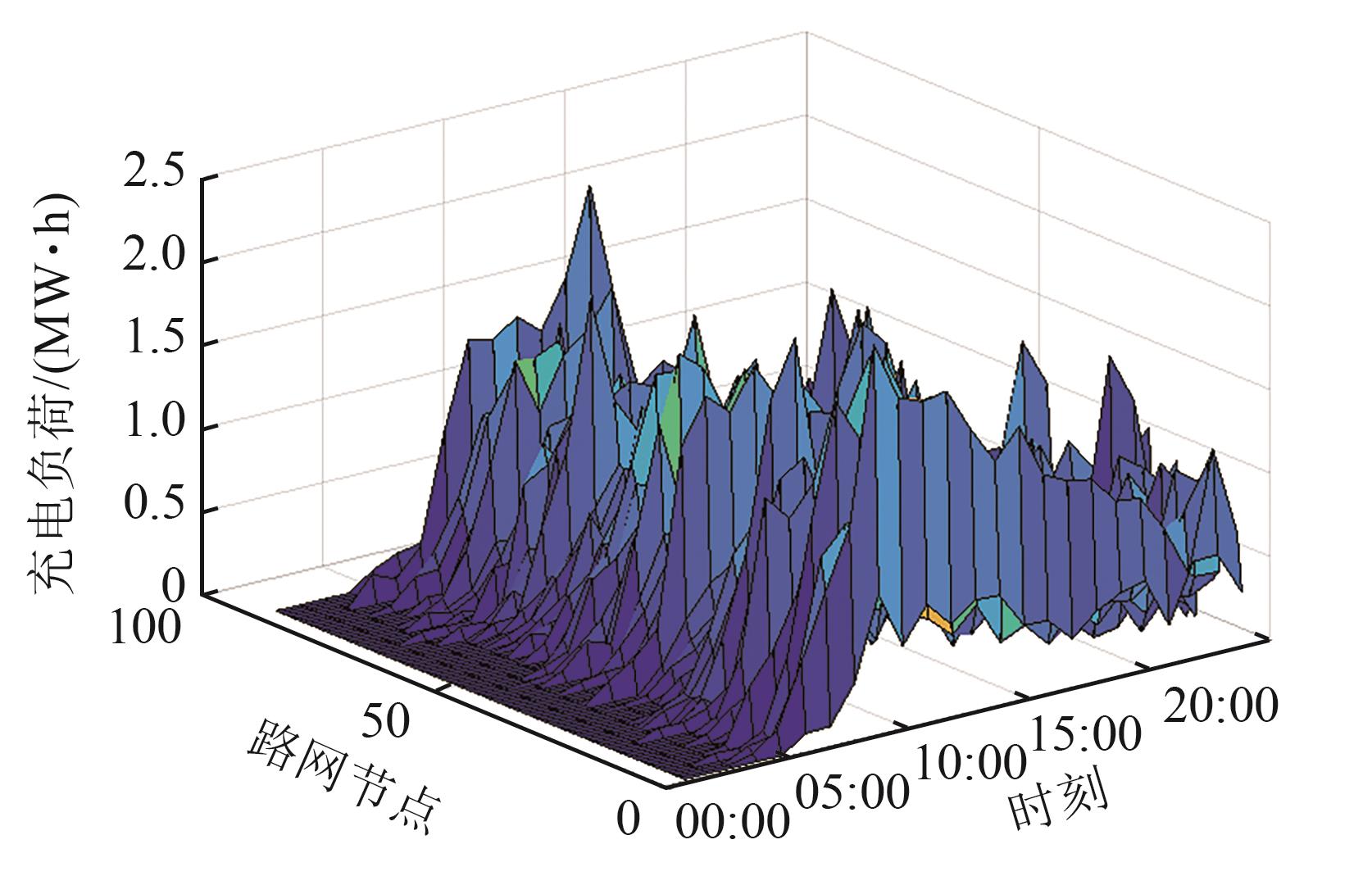
图5 各路网节点充电需求分布
Fig. 5 Distribution of charging demand of each network node
| 目标函数 | 综合成本/万元 | 用户不满意度 | 电压波动/pu |
|---|---|---|---|
| FC-MOEO/AEP | 1 684.1 | 0.054 2 | 0.001 25 |
| MOLA | 1 749.0 | 0.055 6 | 0.002 48 |
| MOPSO | 1 735.7 | 0.063 3 | 0.001 77 |
| MOTEO | 1 704.5 | 0.040 7 | 0.001 74 |
表4 各算法优化结果对比
Tab. 4 Optimization result comparison of each algorithm
| 目标函数 | 综合成本/万元 | 用户不满意度 | 电压波动/pu |
|---|---|---|---|
| FC-MOEO/AEP | 1 684.1 | 0.054 2 | 0.001 25 |
| MOLA | 1 749.0 | 0.055 6 | 0.002 48 |
| MOPSO | 1 735.7 | 0.063 3 | 0.001 77 |
| MOTEO | 1 704.5 | 0.040 7 | 0.001 74 |
| EVCS编号 | 慢充桩数量/个 | 快充桩数量/个 | 路网节点 | 电网节点 |
|---|---|---|---|---|
| #1 | 10 | 5 | 41 | 59 |
| #2 | 35 | 5 | 16 | 25 |
| #3 | 17 | 11 | 78 | 103 |
| #4 | 53 | 38 | 2 | 2/4 |
| #5 | 30 | 15 | 70 | 94 |
| #6 | 11 | 5 | 3 | 6 |
| #7 | 52 | 73 | 45 | 65/66 |
| #8 | 32 | 5 | 31 | 46 |
| #9 | 23 | 29 | 86 | 113 |
| #10 | 35 | 8 | 50 | 73 |
| #11 | 33 | 30 | 58 | 81 |
| #12 | 10 | 19 | 22 | 37 |
表5 FC-MOEO/AEP配置方案
Tab. 5 FC-MOEO/AEP configuration scheme
| EVCS编号 | 慢充桩数量/个 | 快充桩数量/个 | 路网节点 | 电网节点 |
|---|---|---|---|---|
| #1 | 10 | 5 | 41 | 59 |
| #2 | 35 | 5 | 16 | 25 |
| #3 | 17 | 11 | 78 | 103 |
| #4 | 53 | 38 | 2 | 2/4 |
| #5 | 30 | 15 | 70 | 94 |
| #6 | 11 | 5 | 3 | 6 |
| #7 | 52 | 73 | 45 | 65/66 |
| #8 | 32 | 5 | 31 | 46 |
| #9 | 23 | 29 | 86 | 113 |
| #10 | 35 | 8 | 50 | 73 |
| #11 | 33 | 30 | 58 | 81 |
| #12 | 10 | 19 | 22 | 37 |
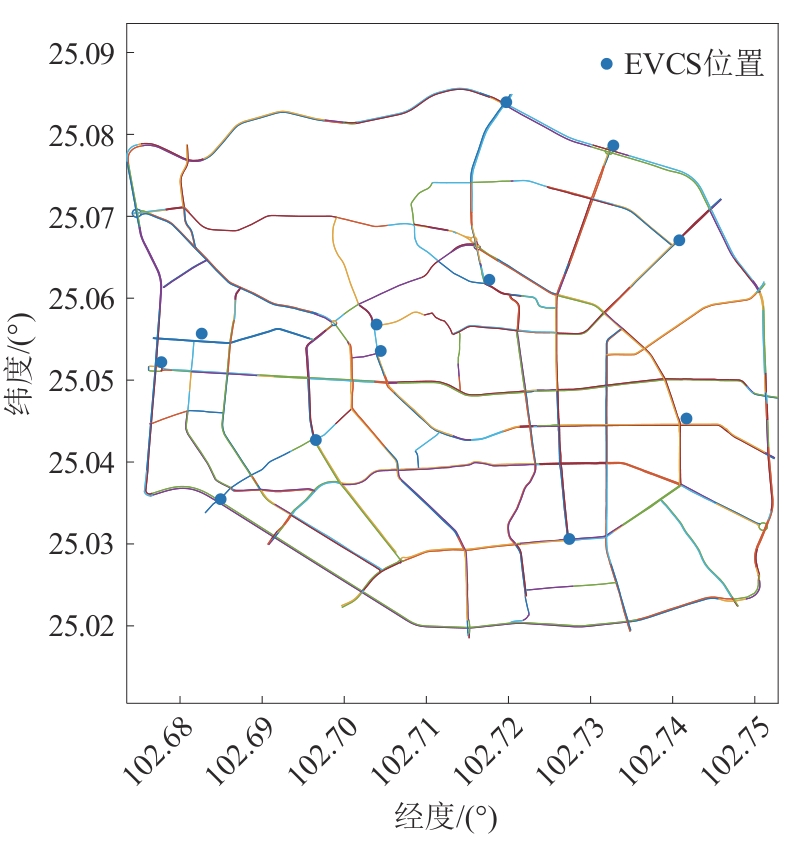
图6 EVCS最优规划位置分布图
Fig. 6 EVCS optimal planning location distribution map
| [1] | 张琳娟,李文峰,许长清,等 .计及充电排队与实时SOC的电动汽车充电负荷时空分布预测[J].电力建设,2025,46(8):54-66. |
| ZHANG L J, LI W F, XU C Q,et al .Spatial-temporal distribution prediction of electric vehicle charging load considering charging behavior and real-time SOC[J].Electric Power Construction,2025,46(8):54-66. | |
| [2] | 张宇,何奇,王海亮,等 .基于改进出行链的电动汽车充电负荷预测及其对配电网的影响[J].电网与清洁能源,2025,41(3):67-77. |
| ZHANG Y, HE Q, WANG H L,et al .The spatial-temporal prediction of electric vehicle charging load based on optimized trip chain and its impacts on distribution networks[J].Power System and Clean Energy,2025,41(3):67-77. | |
| [3] | 杨晓辉,王晓鹏,邓叶恒 .含电动汽车的主动配电网多目标分层优化调度[J].电力工程技术,2024,43(4):156-165. doi:10.12158/j.2096-3203.2024.04.016 |
| YANG X H, WANG X P, DENG Y H .Multi-objective hierarchical optimization dispatch of active distribution network with electric vehicles[J].Electric Power Engineering Technology,2024,43(4):156-165. doi:10.12158/j.2096-3203.2024.04.016 | |
| [4] | KUNJ T,PAL K .Optimal location planning of EV charging station in existing distribution network with stability condition[C]//2020 7th International Conference on Signal Processing and Integrated Networks (SPIN).Noida,India:IEEE,2020:1060-1065. doi:10.1109/spin48934.2020.9071396 |
| [5] | YANG B, LI J L, SHU H C,et al .Recent advances of optimal sizing and location of charging stations: a critical overview[J].International Journal of Energy Research,2022,46(13):17899-17925. doi:10.1002/er.8476 |
| [6] | 程杉,王豪杰,徐其平,等 .含超大功率充电的多类型充电设施两阶段选址定容方法[J].电力系统保护与控制,2024,52(23):33-44. |
| CHENG S, WANG H J, XU Q P,et al .Two-stage siting and capacity determination method for multi-type charging facilities with ultra-high-power charging[J].Power System Protection and Control,2024,52(23):33-44. | |
| [7] | 郑佳俊,段小宇,胡泽春,等 .组件式移动充电设施布局优化方法与投放策略[J].中国电力,2025,58(4):107-118. doi:10.11930/j.issn.1004-9649.202501026 |
| ZHENG J J, DUAN X Y, HU Z C,et al .Modular mobile charging facility layout optimization method and deployment strategy[J].Electric Power,2025,58(4):107-118. doi:10.11930/j.issn.1004-9649.202501026 | |
| [8] | 韩一鸣,贺彬,杨博,等 .考虑行驶特性的电动汽车充电站联合电储能系统最优规划[J].上海交通大学学报,2025,59(11):1720-1731. doi:10.16183/j.cnki.jsjtu.2023.629 |
| HAN Y M, HE B, YANG B,et al .Optimal planning of electric vehicle charging stations combined with battery energy storage systems considering driving characteristics[J].Journal of Shanghai Jiaotong University,2025,59(11):1720-1731. doi:10.16183/j.cnki.jsjtu.2023.629 | |
| [9] | 孙志颖,李青,张凯 .考虑活动-出行需求特性的大规模电动汽车入网影响力分析[J].南方电网技术,2024,18(12):138-147. doi:10.13648/j.cnki.issn1674-0629.2024.12.015 |
| SUN Z Y, LI Q, ZHANG K .Influences analysis of large-scale electric vehicles interconnected with power system regarding activity-travel demand characteristics[J].Southern Power System Technology,2024,18(12):138-147. doi:10.13648/j.cnki.issn1674-0629.2024.12.015 | |
| [10] | 陈文颖,刘蓓迪 .基于粒子群算法的电动汽车有序充放电优化[J].山东电力技术,2023,50(1):52-58. doi:10.3969/j.issn.1007-9904.2023.01.009 |
| CHEN W Y, LIU B D .Sequential charging and discharging optimization of electric vehicles based on particle swarm optimization[J].Shandong Electric Power,2023,50(1):52-58. doi:10.3969/j.issn.1007-9904.2023.01.009 | |
| [11] | 丁乐言,柯松,张帆,等 .考虑出行需求和引导策略的电动汽车充电负荷预测[J].电力建设,2024,45(6):10-26. doi:10.12204/j.issn.1000-7229.2024.06.002 |
| DING L Y, KE S, ZHANG F,et al .Forecasting of electric-vehicle charging load considering travel demand and guidance strategy[J].Electric Power Construction,2024,45(6):10-26. doi:10.12204/j.issn.1000-7229.2024.06.002 | |
| [12] | WU C, JIANG S, GAO S,et al .Charging demand forecasting of electric vehicles considering uncertainties in a microgrid[J].Energy,2022,247:123475. doi:10.1016/j.energy.2022.123475 |
| [13] | LUO L, GU W, ZHOU S,et al .Optimal planning of electric vehicle charging stations comprising multi-types of charging facilities[J].Applied Energy,2018,226:1087-1099. doi:10.1016/j.apenergy.2018.06.014 |
| [14] | 罗平,杨泽喆,张嘉昊,等 .考虑多场景充电需求预测的电动汽车充电站规划[J].高电压技术,2025,51(1):368-378. |
| LUO P, YANG Z Z, ZHANG J H,et al .Electric vehicle charging station planning considering multi-scene charging demand forecasting[J].High Voltage Engineering,2025,51(1):368-378. | |
| [15] | XU D, PEI W, ZHANG Q .Optimal planning of electric vehicle charging stations considering user satisfaction and charging convenience[J].Energies,2022,15(14):5027. doi:10.3390/en15145027 |
| [16] | ASNA M, SHAREEF H, ACHIKKULATH P,et al .Analysis of an optimal planning model for electric vehicle fast-charging stations in Alain City,United Arab Emirates[J].IEEE Access,1020:73678-73694. |
| [17] | 陈卓旭,宛玉健,胡泽春,等 .考虑随机用户均衡的区县级电动汽车快充站规划[J].电力系统自动化,2024,48(15):25-34. doi:10.7500/AEPS20230731007 |
| CHEN Z X, WAN Y J, HU Z C,et al .District and county level electric vehicle fast charging station planning considering stochastic user equilibrium[J].Automation of Electric Power Systems,2024,48(15):25-34. doi:10.7500/AEPS20230731007 | |
| [18] | 吴豫,董智,赵阳,等 .基于LSTM算法的配电网分布式电源和电动汽车充电站联合优化规划[J].供用电,2023,40(6):64-74. |
| WU Y, DONG Z, ZHAO Y,et al .Joint optimization planning of distribution network DG and EV charging station based on LSTM algorithm[J].Distribution & Utilization,2023,40(6):64-74. | |
| [19] | ZHU J, LI Y, YANG J,et al .Planning of electric vehicle charging station based on queuing theory[J].The Journal of Engineering,2017(13):1867-1871. doi:10.1049/joe.2017.0655 |
| [20] | 江昌旭,卢玥君,袁羽娟,等 .考虑里程焦虑的高速公路充电站及配电网扩展规划[J].电网技术,2025,49(9):3881-3890. |
| JIANG C X, LU Y J, YUAN Y J,et al .Highway charging station and distribution network expansion planning considering range anxiety[J].Power System Technology,2025,49(9):3881-3890. | |
| [21] | HAKLAY M, WEBER P .OpenStreetMap:user-generated street maps[J].IEEE Pervasive Computing,2008,7(4):12-18. doi:10.1109/mprv.2008.80 |
| [22] | 张美霞,高凌霄,杨秀 .基于模糊Borda法的电动汽车负荷对配电网影响综合评估研究[J].电力科学与技术学报,2024,39(3):67-77. |
| ZHANG M X, GAO L X, YANG X .A comprehensive assessment of the electric vehicle load impact on distribution network based on fuzzy Borda method[J].Journal of Electric Power Science and Technology,2024,39(3):67-77. | |
| [23] | 袁洪涛,徐潇源,严正,等 .电动汽车集中充换电设施规划和优化运行研究综述[J].电力系统保护与控制,2024,52(19):157-174. |
| YUAN H T, XU X Y, YAN Z,et al .Review of centralized EV charging and battery swapping facility planning and optimal scheduling[J].Power System Protection and Control,2024,52(19):157-174. | |
| [24] | 张美霞,徐立成,杨秀 .基于城市网格属性划分的电动汽车充电需求预测[J].电测与仪表,2025,62(3):10-19. |
| ZHANG M X, XU L C, YANG X .EV charging demand prediction based on city grid attribute division[J].Electrical Measurement & Instrumentation,2025,62(3):10-19. | |
| [25] | 胡俊杰,潘羿,徐成明,等 .基于动态交通推演的电动汽车充电快速引导策略[J].电工技术学报,2025,40(9):2880-2896. |
| HU J J, PAN Y, XU C M,et al .Fast guidance strategy for electric vehicle charging based on dynamic traffic inference[J].Transactions of China Electrotechnical Society,2025,40(9):2880-2896. | |
| [26] | 张美霞,王晓晴,杨秀,等 .考虑路网和用户满意度的集群电动汽车主从博弈优化调度策略[J].电力系统保护与控制,2024,52(3):1-11. |
| ZHANG M X, WANG X Q, YANG X,et al .Stackelberg game optimization scheduling strategy for aggregated electric vehicles considering customer satisfaction and the road network[J].Power System Protection and Control,2024,52(3):1-11. | |
| [27] | 张美霞,徐立成,杨秀,等 .基于电动汽车充电需求时空分布特性的充电站规划研究[J].电网技术,2023,47(1):256-265. |
| ZHANG M X, XU L C, YANG X,et al .Planning of charging stations based on spatial and temporal distribution characteristics of electric vehicle charging demand[J].Power System Technology,2023,47(1):256-265. | |
| [28] | U.S.Department of Transportation .2009 national household travel survey[EB/OL].[2024-08-30].. doi:10.1123/jpah.2014-0052 |
| [29] | 董晓红,孔华志,丁飞,等 .考虑电池老化的电动汽车中长期充电负荷预测方法[J].电力系统自动化,2024,48(13):159-173. |
| DONG X H, KONG H Z, DING F,et al .Medium- and long-term charging load forecasting method for electric vehicles considering battery aging[J].Automation of Electric Power Systems,2024,48(13):159-173. | |
| [30] | 张夏韦,梁军,王要强,等 .电动汽车充电负荷时空分布预测研究综述[J].电力建设,2023,44(12):161-173. doi:10.12204/j.issn.1000-7229.2023.12.014 |
| ZHANG X W, LIANG J, WANG Y Q,et al .Overview of research on spatiotemporal distribution prediction of electric vehicle charging[J].Electric Power Construction,2023,44(12):161-173. doi:10.12204/j.issn.1000-7229.2023.12.014 | |
| [31] | ZHANG J, YAN J, LIU Y,et al .Daily electric vehicle charging load profiles considering demographics of vehicle users[J].Applied Energy,2020,274:115063. doi:10.1016/j.apenergy.2020.115063 |
| [32] | 喻磊,王锐,程杉,等 .基于多主体主从博弈的电动汽车充电站双层定价策略[J].电力科学与技术学报,2025,40(3):243-254. |
| YU L, WANG R, CHENG S,et al .Two-level pricing strategy for electric vehicle charging stations based on multi-agent Stackelberg game[J].Journal of Electric Power Science and Technology,2025,40(3):243-254. | |
| [33] | FIORI C,AHN K, RAKHA H A .Power-based electric vehicle energy consumption model:model development and validation[J].Applied Energy,2016,168:257-268. doi:10.1016/j.apenergy.2016.01.097 |
| [34] | 刘宗,何俊,黄文涛,等 .基于态势感知的高渗透率电动汽车接入电网后电压调整策略[J].中国电力,2023,56(2):32-44. doi:10.11930/j.issn.1004-9649.202204108 |
| LIU Z, HE J, HUANG W T,et al .Voltage adjustment strategy for high-penetration electric vehicles connected to power grid based on situation awareness[J].Electric Power,2023,56(2):32-44. doi:10.11930/j.issn.1004-9649.202204108 | |
| [35] | 毕军,杜宇佳,王永兴,等 .基于用户综合满意度的电动汽车充电诱导优化模型[J].清华大学学报(自然科学版),2023,63(11):1750-1759. doi:10.16511/j.cnki.qhdxxb.2023.26.038 |
| BI J, DU Y J, WANG Y X,et al .Optimization model of electric vehicle charging induction based on comprehensive satisfaction of users[J].Journal of Tsinghua University (Science and Technology),2023,63(11):1750-1759. doi:10.16511/j.cnki.qhdxxb.2023.26.038 | |
| [36] | 肖白,赵雪纯,董光德 .电能质量综合评估方法综述与展望[J].发电技术,2024,45(4):716-733. doi:10.12096/j.2096-4528.pgt.23083 |
| XIAO B, ZHAO X C, DONG G D .Summary and prospect of comprehensive evaluation methods of power quality[J].Power Generation Technology,2024,45(4):716-733. doi:10.12096/j.2096-4528.pgt.23083 | |
| [37] | ILCHI GHAZAAN M, GHADERI P, REZAEIZADEH A .A fast convergence EO-based multi-objective optimization algorithm using archive evolution path and its application to engineering design problems[J].The Journal of Supercomputing,2023,79(16):18849-18885. doi:10.1007/s11227-023-05362-5 |
| [1] | 熊永康, 杜昀, 曾振锋, 舒展, 辛建波, 宋冠宏. 台风灾害下分布式资源协同配置的配电网弹性提升策略[J]. 发电技术, 2026, 47(1): 204-213. |
| [2] | 史宏思, 孙新伟, 王凯. 基于电化学阻抗谱的锂离子电池健康状态估计[J]. 发电技术, 2026, 47(1): 133-144. |
| [3] | 张效伟, 衣振晓, 王凯. 基于改进自适应蜜獾算法优化时间卷积网络的车载锂离子电池健康状态估计[J]. 发电技术, 2025, 46(6): 1154-1163. |
| [4] | 李建林, 彭禹宸, 王茜, 姜晓霞, 王垒. 锂离子电池建模研究现状与展望[J]. 发电技术, 2025, 46(5): 857-871. |
| [5] | 罗宗龙, 刘世林. 基于信息间隙决策理论鲁棒模型的户用微电网优化运行[J]. 发电技术, 2025, 46(4): 705-714. |
| [6] | 贾俊, 范炜豪, 吕志鹏, 姚建光, 周珊, 王健, 张锦涛. 用于电动汽车集群并网的直流变压器启动研究[J]. 发电技术, 2023, 44(6): 875-882. |
| [7] | 吴小汉, 张谦, 粟尧嘉, 黄耀宇, 吴佳琦. 基于区块链的私有充电桩共享平台交易策略[J]. 发电技术, 2022, 43(3): 439-451. |
| [8] | 陈小波, 杨秀媛. 泛在电力物联网中考虑风电消纳的电动汽车充放电控制策略研究[J]. 发电技术, 2021, 42(5): 561-567. |
| [9] | 宣文博, 李慧, 刘忠义, 孙业广, 侯恺. 一种基于虚拟电厂技术的城市可再生能源消纳能力提升方法[J]. 发电技术, 2021, 42(3): 289-297. |
| [10] | 贺瑜环, 杨秀媛, 陈麒宇, 卜思齐, 徐智蔷, 肖天颖. 电动汽车智能充放电控制与应用综述[J]. 发电技术, 2021, 42(2): 180-192. |
| [11] | 蒋燕萍,陈佩军,陈海燕. 电动汽车集约型换电设施的设计研究[J]. 发电技术, 2019, 40(6): 535-539. |
| [12] | 陈麒宇. 泛在电力物联网实施策略研究[J]. 发电技术, 2019, 40(2): 99-106. |
| [13] | 陈宇,彭潇,丁婧,王亚洲,邵敬平. 电动汽车参与风电场输出功率波动平抑方法研究[J]. 发电技术, 2019, 40(1): 91-98. |
| [14] | 张祖平,陈麒宇,杨秀媛,贺瑜环. 大容量直流充电桩集群的调峰研究[J]. 发电技术, 2019, 40(1): 11-16. |
| [15] | 王军亮,李永,李建设,陈麒宇. 电动汽车充电对电网安全风险影响及管控措施研究[J]. 发电技术, 2018, 39(5): 405-411. |
| 阅读次数 | ||||||
|
全文 |
|
|||||
|
摘要 |
|
|||||
